The Paradox of Abolishing Feudalism: Aspirational vs. Practical Realities
This article explores the inherent tension between the idealistic goals of revolutions to end feudalism and the practical challenges of replacing the administrative and economic structures that feudal privileges once provided. It examines the fiscal, legal, and land tenure vacuums created by the sudden abolition of the
When a political revolution declares the end of an old era, it often creates a vacuum between what is promised and what can be executed. This tension is most visible in the transition from feudalism to modern governance. On paper, the abolition of feudal privileges represents a triumph of liberty and equality; in practice, however, the sudden removal of these structures often leaves a void in the very mechanisms used to collect taxes, maintain order, and manage land. This article explores the contradiction between the aspirational goal of ending feudalism and the practical failure to provide functional transition mechanisms for the privileges and taxes that once sustained the state.
The Aspirational Goal: Liberty and the End of Privilege
The core driver of many historical revolutions is the desire to dismantle the "Old Regime"—a system where rights and obligations were not universal, but were instead tied to specific social ranks or estates. In a feudal system, the law is not a single, unified code applied to all citizens; rather, it is a patchwork of customs, exemptions, and specific rights held by the nobility and the clergy.
The aspirational side of this transition is rooted in the concept of legal equality. By declaring feudalism dead, a society aims to:
Universalize Taxation: Moving from "privilege-based" tax exemptions to a system where all citizens contribute based on wealth or income.
Standardize Law: Replacing local seigneurial courts with a centralized national judiciary.
Redefine Property: Moving from land held through complex feudal duties to land held through clear, individual ownership.
Exam Tip: When analyzing revolutionary periods, distinguish between de jure changes (what the law says) and de facto changes (what actually happens on the ground). The "Aspirational vs. Practical" conflict is essentially the gap between these two states.
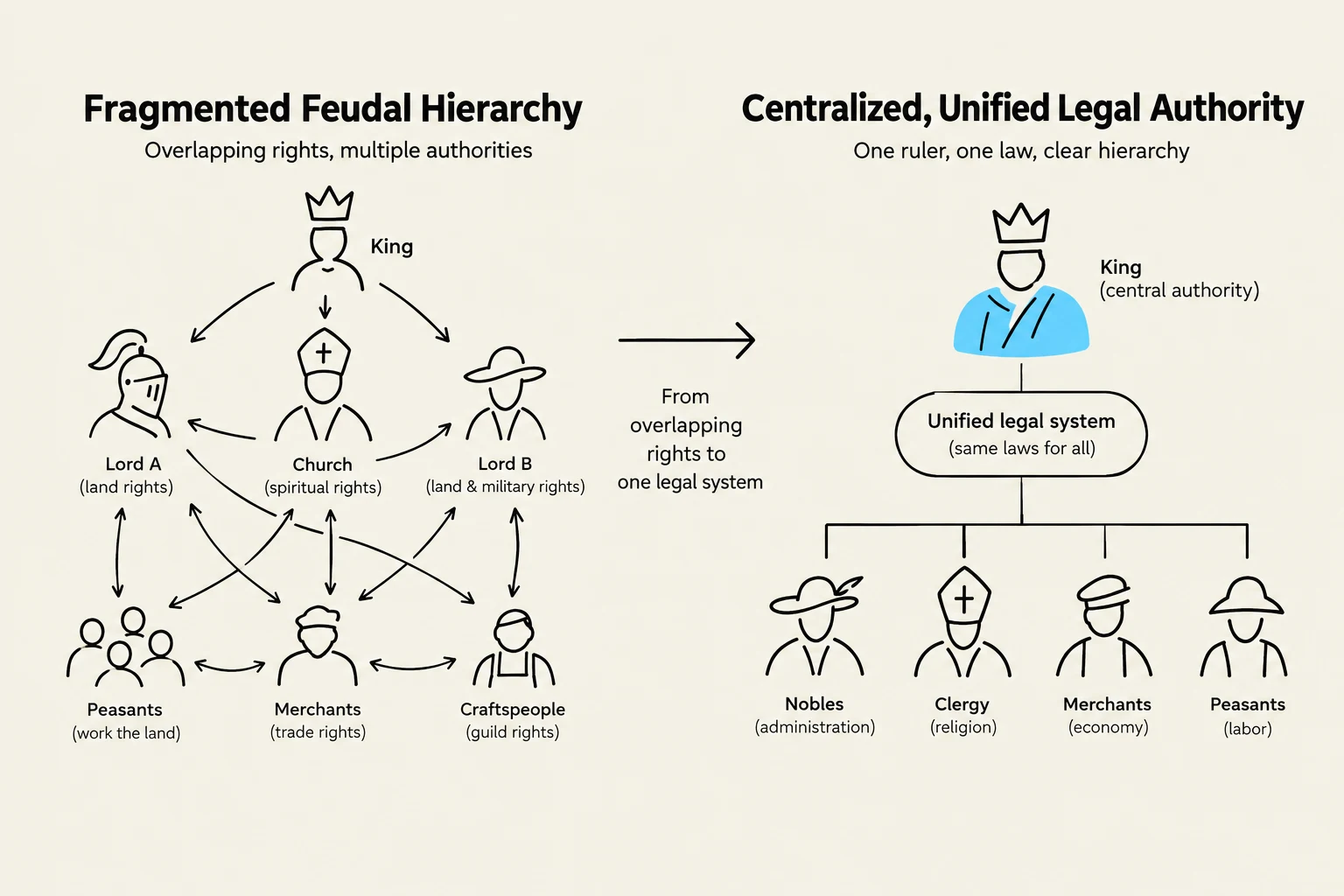
This diagram illustrates the transition from a fragmented feudal hierarchy with overlapping authorities to a centralized legal system with a single ruler and uniform laws.
The Practical Reality: The Infrastructure of Privilege
The fundamental problem arises when revolutionaries realize that "privilege" is not just a social unfairness, but also a functional administrative tool. In many pre-modern states, the nobility and the church were not just beneficiaries of the system; they were the administrators of it. They collected the taxes, managed the local roads, and provided the local security that the central state was too weak to provide itself.
When the "privileges" are abolished, the "mechanisms" often vanish with them. This creates a mathematical and administrative crisis for the new government. Consider the following simplified model of state revenue:
Rtotal=Rcentral+Rlocal_feudal
If a revolution eliminates Rlocal_feudal (the taxes collected by lords) without immediately establishing a robust Rcentral (a direct state tax collection system), the total revenue available to the state collapses, even if the new system is theoretically "fairer".
This diagram illustrates the economic consequences of abolishing local feudal tax collection mechanisms, leading to a collapse in state revenue and inability to fund services.
The Failure of Transition Mechanisms
The contradiction between aspiration and reality is most acute in three specific areas:
1. The Fiscal Vacuum
In many historical contexts, the state's ability to function depended on the very inequalities it sought to destroy. If the state abolishes the right of the nobility to collect certain dues, but the state itself does not have the bureaucracy to collect those same funds directly, the state becomes bankrupt. The "liberty" granted to the peasantry can inadvertently lead to the "instability" of the state.
2. The Legal Vacuum
Feudalism provided a localized, albeit unequal, method of dispute resolution. When these seigneurial courts were abolished, the central state often lacked the judges, the clerks, and the physical presence to replace them immediately. This led to a period of "legal lawlessness" where neither the old rights nor the new rights were effectively enforced.
3. The Land Tenure Vacuum
The transition from feudal tenure (where land is held in exchange for service) to private property (where land is held by title) is rarely seamless. Without a clear mechanism to register new titles and compensate those losing old rights, land ownership often becomes a source of violent conflict rather than economic stability.
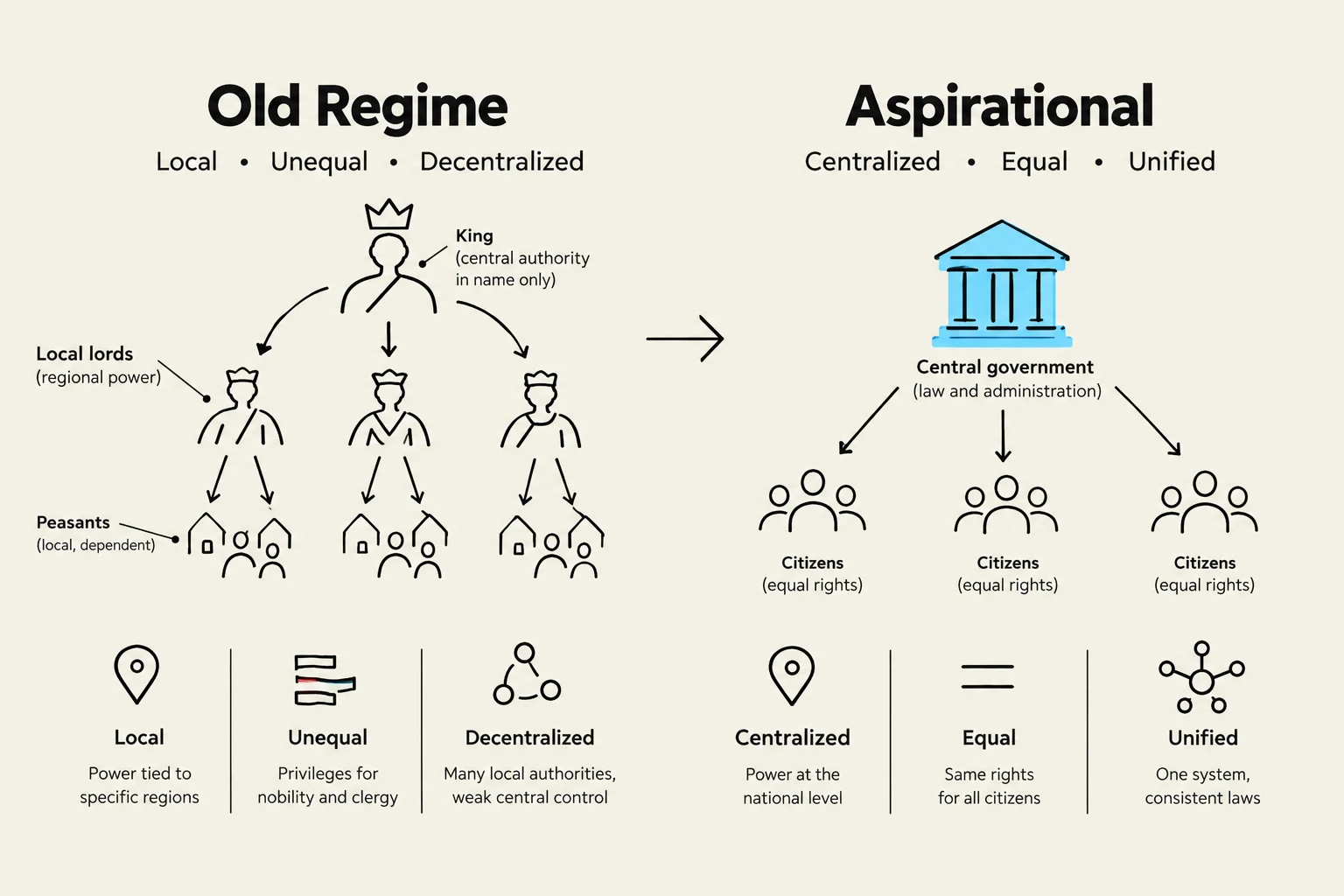
This diagram contrasts the 'Old Regime' characterized by local, unequal, and decentralized power structures with an 'Aspirational' system that is centralized, equal, and unified, featuring a central government and citizens with equal rights.
Conclusion: Lessons for Political Transition
The study of the end of feudalism teaches us that political change cannot be achieved through declaration alone. To move from an aspirational state to a practical reality, a revolution must do more than just "stop" an old system; it must "start" a new one with equal or greater administrative efficiency.
The paradox of liberty is that the very structures that limit freedom (like feudal privileges) often provide the stability required for a state to exist. A successful transition requires a "bridge" of mechanisms—tax collectors, local magistrates, and land registries—that can carry the weight of the state from the old world to the new. Without this bridge, the aspiration of equality often collapses into the reality of chaos.
Keep reading for free.
Create an account to finish this reading and make it part of your study routine.