The Nutrition Care Process: A Framework for Dietetic Practice
An in-depth explanation of the Nutrition Care Process (NCP), a systematic, evidence-based approach used by dietetics professionals to provide individualized patient care. It covers the four key steps: assessment, diagnosis (including PES statements), intervention, and monitoring/evaluation.
In the field of clinical nutrition, providing high-quality care requires more than just knowing which foods are healthy. It requires a systematic, evidence-based approach to problem-solving that ensures every patient receives individualized and effective treatment. This approach is known as the Nutrition Care Process (NCP). By using a standardized framework, dietetics professionals can move away from "guesswork" and toward a consistent method that improves the quality of care and facilitates clear communication within healthcare teams.
The Structure of the NCP Model
The NCP is not just a checklist; it is a comprehensive model designed to guide critical thinking. At its core, the model focuses on the relationship between the client and the dietetics professional, ensuring that care is always patient-centered.
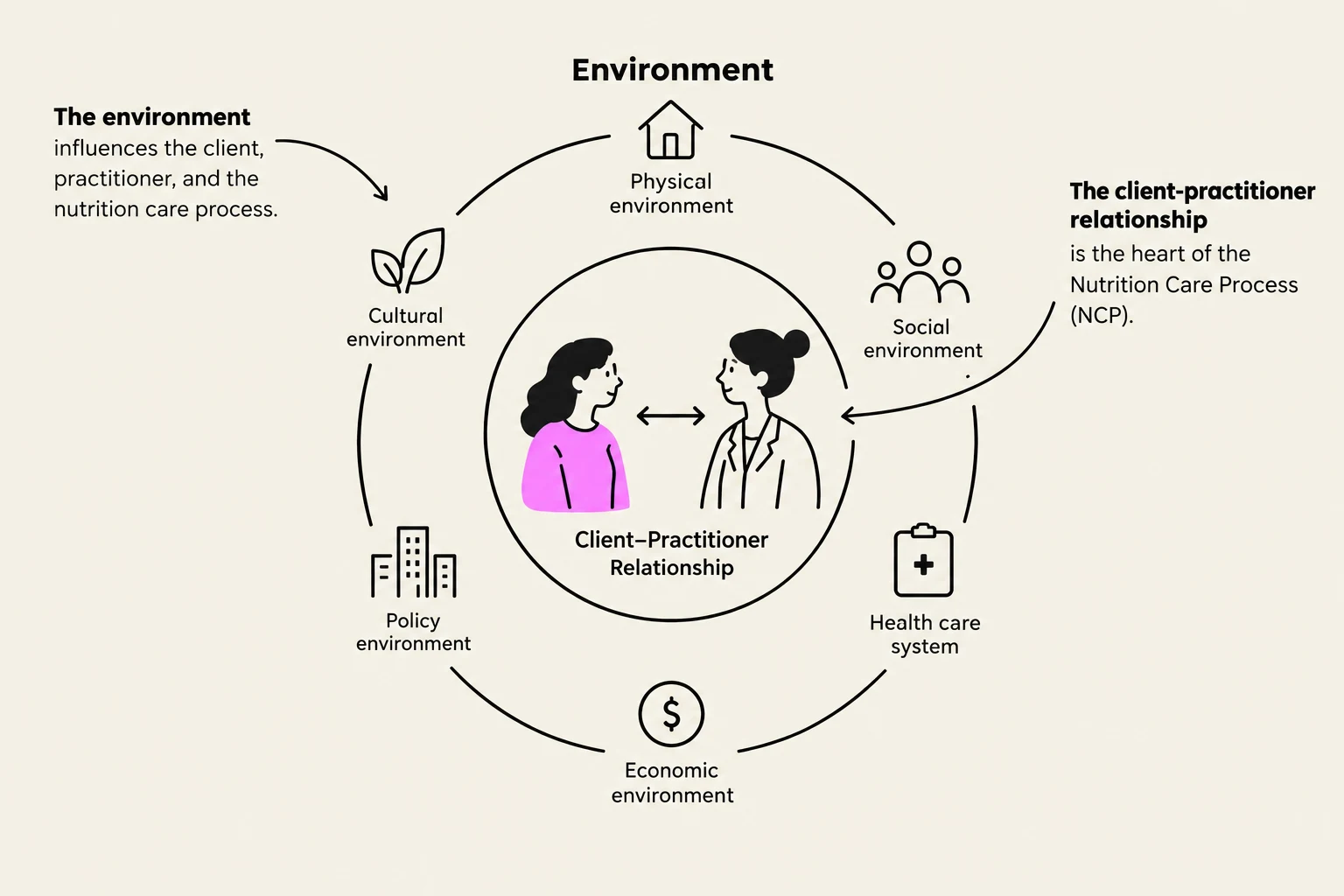
The model is visualized as a series of concentric rings. The central core represents the individualized interaction with the client, while the outer rings account for environmental factors that might impact a person's ability to follow nutritional advice. Furthermore, the model is supported by professional strengths and essential administrative systems, such as screening processes and outcomes management systems.
This diagram illustrates the various environmental factors that influence the client-practitioner relationship within the Nutrition Care Process (NCP), including cultural, physical, social, policy, and economic environments, as well as the broader health care system.
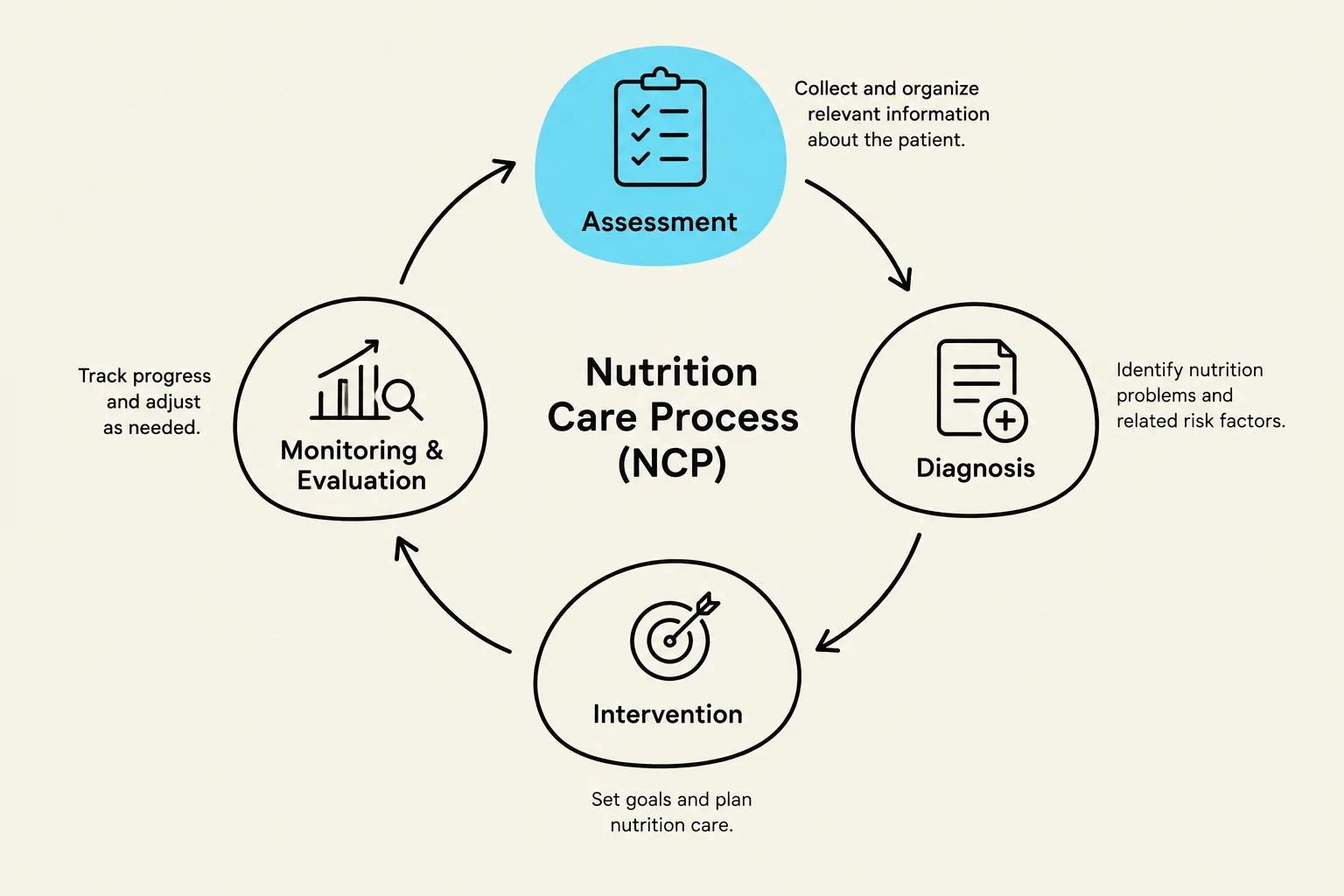
Exam Tip: Remember that the NCP is a process, not a single event. It is a continuous cycle of assessment, diagnosis, intervention, and evaluation designed to address nutrition-related problems.
Step 1: Nutrition Assessment
The first step in the process is the Nutrition Assessment. During this phase, the practitioner gathers and verifies data to identify potential nutrition-related problems. Rather than looking at data in isolation, the practitioner must use critical thinking to distinguish relevant information from irrelevant data and organize it into a meaningful framework.
Assessment data is typically organized into five distinct categories:
Food/Nutrition-Related History: Information regarding dietary intake, eating patterns, and food access.
Anthropometric Measurements: Physical measurements of the body, such as height, weight, and BMI.
Biochemical Data: Laboratory results, medical tests, and other clinical procedures.
Nutrition-Focused Physical Findings: Observations of the body that indicate nutritional status (e.g., muscle wasting or skin integrity).
Client History: Medical history, social history, and other relevant background information.
Once the data is collected, the practitioner evaluates it against scientifically valid, comparative standards to formulate a nutrition prescription—the specific plan of care required to address the patient's needs.
Step 2: Nutrition Diagnosis and the PES Statement
A common misconception is that a "nutrition diagnosis" is the same as a medical diagnosis. This is incorrect. While a medical diagnosis identifies a disease (e.g., Diabetes), a nutrition diagnosis identifies a specific nutritional problem that a dietetics professional can treat through nutrition-related activities.
Nutrition diagnoses are categorized into four domains:
Intake: Problems related to the ingestion of food, nutrients, or bioactive substances.
Clinical: Nutritional problems related to medical or physical conditions.
Behavioral–Environmental: Problems related to knowledge, attitudes, or access to food.
Nutrition Situation: Problems related to the broader context of nutrition care.
To document this diagnosis clearly, practitioners use the PES Statement format. This format ensures that the problem is linked directly to its cause and its measurable evidence.
The PES Formula
The statement must follow this specific structure:
Problem (P) related to Etiology (E) as evidenced by Signs and Symptoms (S)
Problem (P): The diagnostic label describing the nutritional alteration.
Etiology (E): The root cause or contributing factor that the practitioner intends to address.
Signs and Symptoms (S): The measurable, defining characteristics that prove the problem exists.
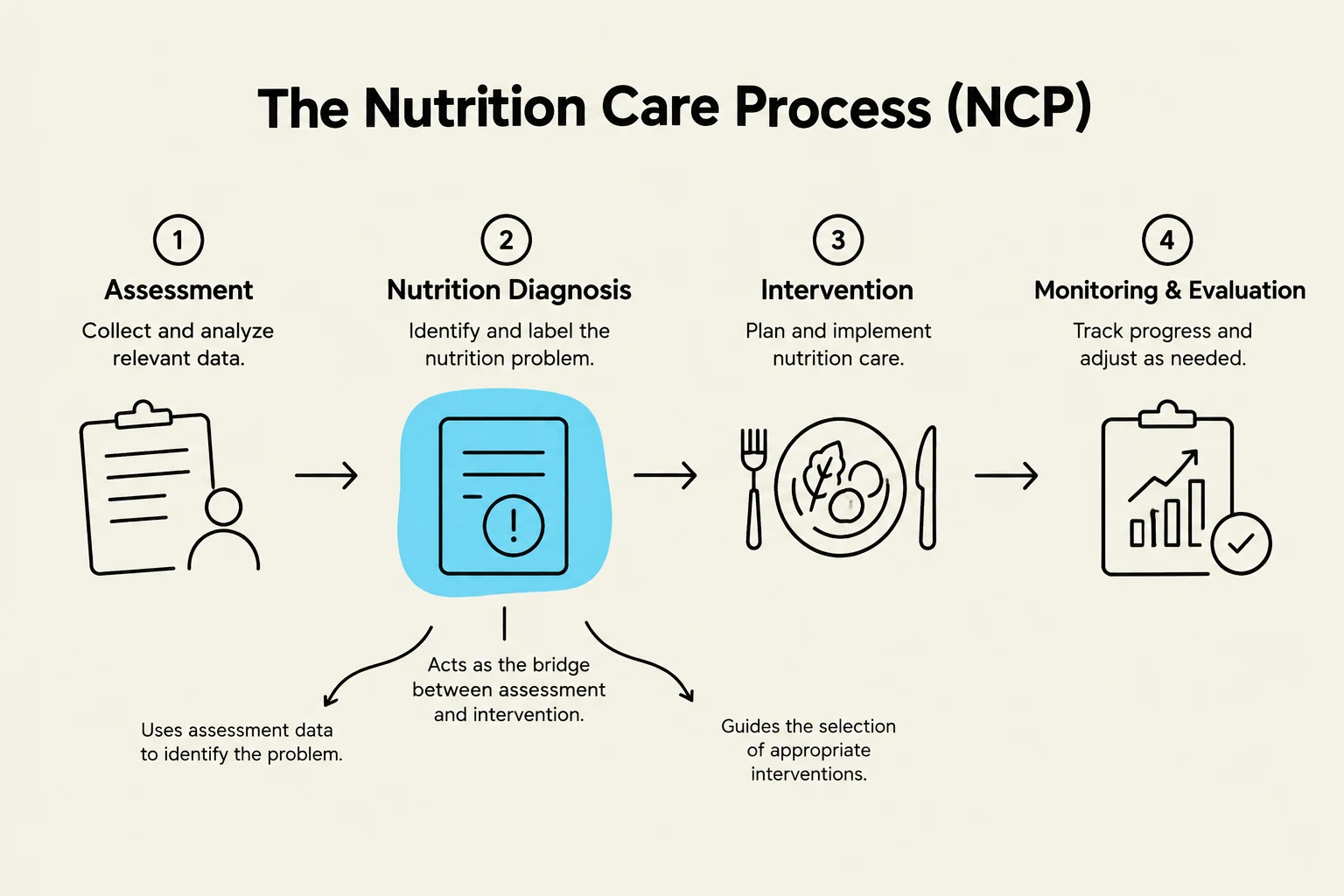
The Nutrition Care Process (NCP) outlines four key steps: Assessment, Nutrition Diagnosis, Intervention, and Monitoring & Evaluation.
Worked Example: Creating a PES Statement
Imagine a patient who has lost significant weight because they are unable to swallow properly due to a recent stroke.
Assessment Data: Patient reports difficulty swallowing (dysphagia), weight loss of 5% in one month, and a clinical observation of coughing during meals.
Identify the Problem (P): Inadequate oral intake.
Identify the Etiology (E): Impaired swallowing ability (dysphagia) secondary to stroke.
Identify Signs/Symptoms (S): 5% unintentional weight loss in one month and coughing during meals.
The resulting PES Statement:
Inadequate oral intake (P) related to impaired swallowing ability (E) as evidenced by 5% unintentional weight loss in one month and coughing during meals (S).
Step 3: Nutrition Intervention
Once the diagnosis is established, the practitioner moves to the Nutrition Intervention. This step involves prioritizing the diagnoses and developing a plan to address them. The practitioner writes a nutrition prescription and sets specific, measurable goals.
Interventions are not "one size fits all." They must be matched to the client's specific needs, values, and lifestyle. Interventions may include:
Dietary changes: Modifying food texture (e.g., pureed diets for dysphagia) or nutrient composition (e.g., low-sodium diets).
Behavioral strategies: Counseling to improve eating habits or knowledge.
Nutrition support: Implementing enteral (tube feeding) or parenteral (IV feeding) nutrition when oral intake is insufficient.
Step 4: Nutrition Monitoring and Evaluation
The final step is Nutrition Monitoring and Evaluation. This is where the practitioner measures the patient's progress against the goals set during the intervention phase.
The practitioner monitors several types of outcomes:
Nutrition outcomes: Changes in nutrient intake or weight.
Clinical/health status outcomes: Improvements in laboratory values or physical symptoms.
Client-centered outcomes: The patient's own perception of their progress or ability to manage their condition.
By using outcomes management systems, practitioners can determine if the intervention was successful or if the nutrition care plan needs to be adjusted. This continuous loop of monitoring ensures that care remains effective and safe.
The Nutrition Care Process (NCP) is a systematic approach to providing high-quality nutrition care. It involves assessment, diagnosis, intervention, and monitoring and evaluation.
Summary Table: The Four Steps of NCP
Step
Primary Action
Goal
Assessment
Collect and analyze data
Identify nutrition-related problems
Diagnosis
Formulate a PES statement
Define the specific nutritional problem
Intervention
Implement a nutrition prescription
Address the etiology and problem
Monitoring & Evaluation
Measure outcomes
Determine if goals were met
Keep reading for free.
Create an account to finish this reading and make it part of your study routine.