The Nursing Process and Critical Thinking in Healthcare
An overview of the nursing process, a systematic framework for patient care, and its integration with critical thinking, clinical reasoning, and judgment to ensure effective and ethical nursing practice.
In the complex environment of modern healthcare, nurses must do more than simply follow orders; they must act as highly skilled thinkers who can navigate uncertainty and prioritize patient safety. The foundation of this professional capability is the integration of the Nursing Process with advanced cognitive skills. This systematic framework allows nurses to identify patient needs, implement evidence-based care, and evaluate the effectiveness of their actions.
The Nursing Process: A Systematic Framework
The nursing process is a continuous, five-step cycle that serves as the primary guideline for nursing practice. It is mandated by the ANA Scope and Standards of Practice, the Code of Ethics, and various Nurse Practice Acts.
The five essential stages are:
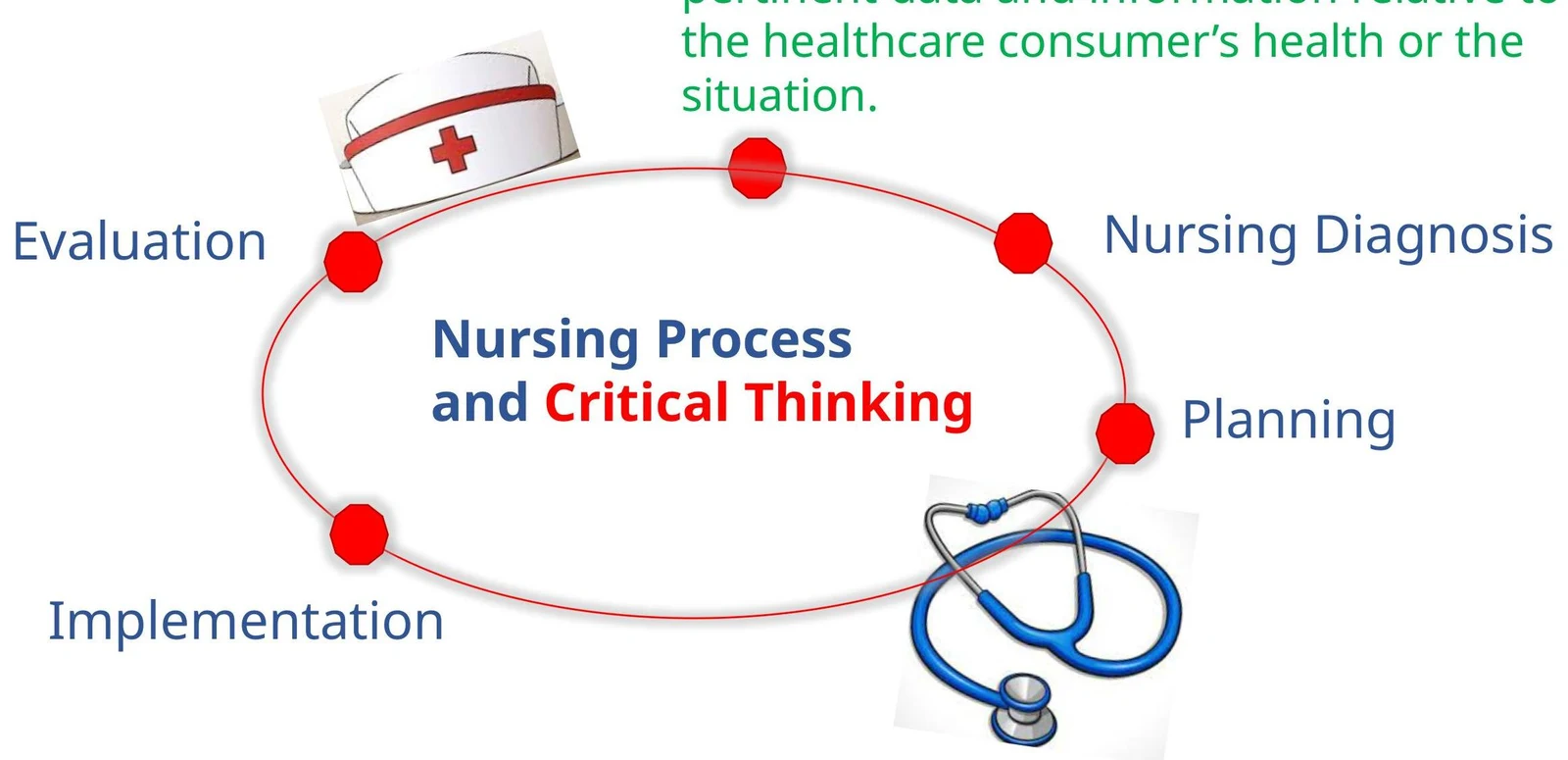
Assessment: The systematic collection, analysis, validation, and communication of patient data.
Nursing Diagnosis: Analyzing assessment data to identify human responses to health conditions.
Planning: Developing individualized goals and outcomes.
Implementation: The "doing" phase where nursing actions are carried out.
Evaluation: Determining the patient's progress and the effectiveness of the care plan.
The nursing process and critical thinking cycle includes evaluation, implementation, planning, and nursing diagnosis.
Cognitive Foundations: Thinking, Reasoning, and Judgment
While the nursing process provides the structure, cognitive processes provide the engine. To move from raw data to informed action, a nurse must master several interconnected skills.
Critical Thinking and Problem-Solving
Critical Thinking is a disciplined, purposeful, and systematic approach to thinking. It involves being open to alternatives, reflecting on one's own assumptions, and seeking truth through evidence-based practice. It is characterized by specific Critical Thinking Skills, such as:
Objectively gathering information and recognizing gaps in knowledge.
Separating relevant from irrelevant data.
Making inferences and visualizing potential outcomes.
Problem-Solving is a subset of this thinking, specifically focused on identifying a specific problem and applying theoretical knowledge to find a reasonable solution within a patient context.
Clinical Reasoning and Decision-Making
Clinical Decision-Making is the goal-directed effort to choose the best action among various alternatives to achieve a desired outcome.
Clinical Reasoning is the "glue" that links thoughts together logically. It is a reflective and creative process used to create meaning regarding patient care.
Clinical Judgment: The Ultimate Goal
Clinical Judgment is the interpretive thinking that allows a nurse to adjust interventions based on how a patient responds to previous care. It is the culmination of the entire process.
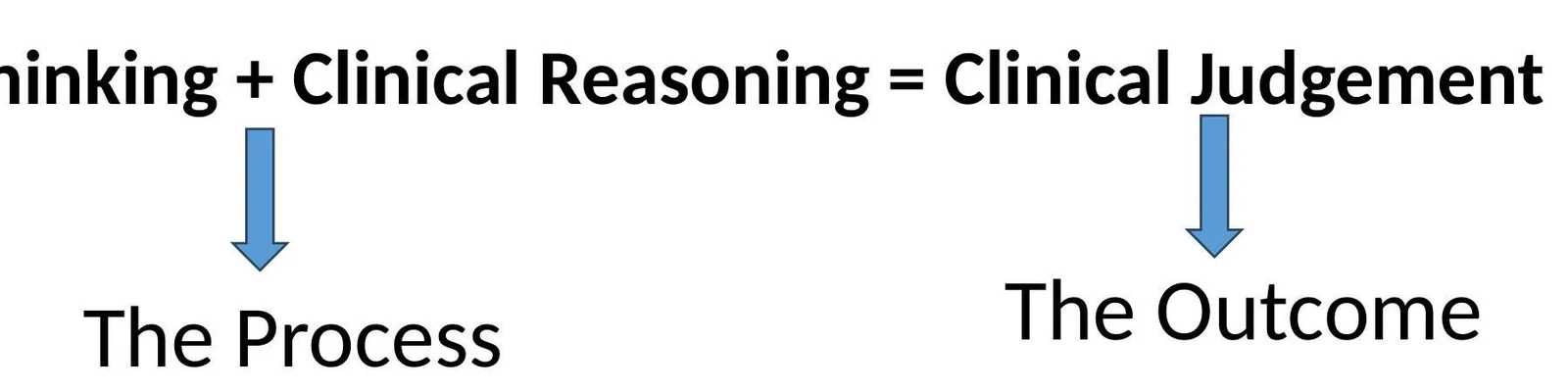
The relationship between these concepts can be summarized by the following essential equation:
Critical Thinking+Clinical Reasoning=Clinical JudgmentA diagram illustrating that thinking plus clinical reasoning equals clinical judgment, which is described as the process and the outcome.
Deep Dive: Assessment and Diagnosis
Mastering Assessment
Assessment is the first phase of the process. Nurses must distinguish between two types of data:
Subjective Data (Symptoms): Information shared by the patient regarding feelings, beliefs, or concerns (e.g., "My throat hurts").
Objective Data (Signs): Verifiable data obtained through the senses or instrumentation (e.g., a blood pressure reading or visible swelling).
Data can come from Primary Sources (the patient) or Secondary Sources (family, medical records, or the healthcare team).
The Art of Nursing Diagnosis
Unlike a medical diagnosis, which identifies a disease, a Nursing Diagnosis identifies the human response to that disease. For example, while a doctor diagnoses "Diabetes," a nurse might diagnose "Ineffective Health Maintenance".
When writing a diagnostic statement, nurses use the PES Format:
P (Problem): The NANDA diagnosis.
E (Etiology): The cause or "related to" (R/T) factor.
S (Signs/Symptoms): The evidence or "manifested by" (M/B) factor.
Exam Tip: Prioritization
When deciding which diagnosis to address first, use Maslow’s Hierarchy of Human Needs. Physiological instability (Airway, Breathing, Circulation) is always the highest priority, followed by safety, and then psychosocial needs.
Implementation, Collaboration, and Evaluation
Implementation and the Healthcare Team
Implementation involves direct care (e.g., administering medication) and indirect care (e.g., documentation and delegation). Because modern care is complex, nurses must engage in Collaboration—working effectively within interprofessional teams to achieve quality care.
While a physician may lead the medical plan for a patient, the Registered Nurse (RN) is the leader for the patient's total care needs and coordinates the rest of the team, including LPNs, UAPs, and therapists.
Evaluation: Closing the Loop
Evaluation is not just the end of the process; it is a continuous activity used to determine if goals were met. Nurses evaluate outcomes as:
Met: The patient achieved the specific, measurable goal.
Not Met: The patient did not achieve the goal, requiring the nurse to reassess and revise the plan.
Clinical Reflection
If a goal is "Not Met," the nurse must use clinical reasoning to hypothesize why. Was the intervention incorrect? Was the data inaccurate? This reflection is what drives professional growth and improved patient outcomes.
Ethical Responsibility
Finally, the nurse's ability to navigate this process is not just a skill, but an ethical mandate. According to the Code of Ethics (Provision 4), the nurse holds the authority, accountability, and responsibility to make decisions and take actions that ensure optimal patient care.
Keep reading for free.
Create an account to finish this reading and make it part of your study routine.