The Nursing Process: ADPIE Framework for Patient Care
An in-depth explanation of the Nursing Process, a systematic approach used by nurses to provide patient-centered care. It covers the five essential steps: Assessment, Diagnosis, Planning, Implementation, and Evaluation (ADPIE), detailing data collection, nursing diagnosis formulation, goal setting, intervention strateg
In the complex world of healthcare, nurses do not simply react to symptoms; they engage in a sophisticated, intellectual process of reasoning known as the Nursing Process. This systematic approach allows nurses to identify, diagnose, and treat both actual and potential health issues from a holistic perspective. Unlike a medical diagnosis, which focuses on a disease, the nursing process is unique to the profession, focusing on the patient's response to health challenges.
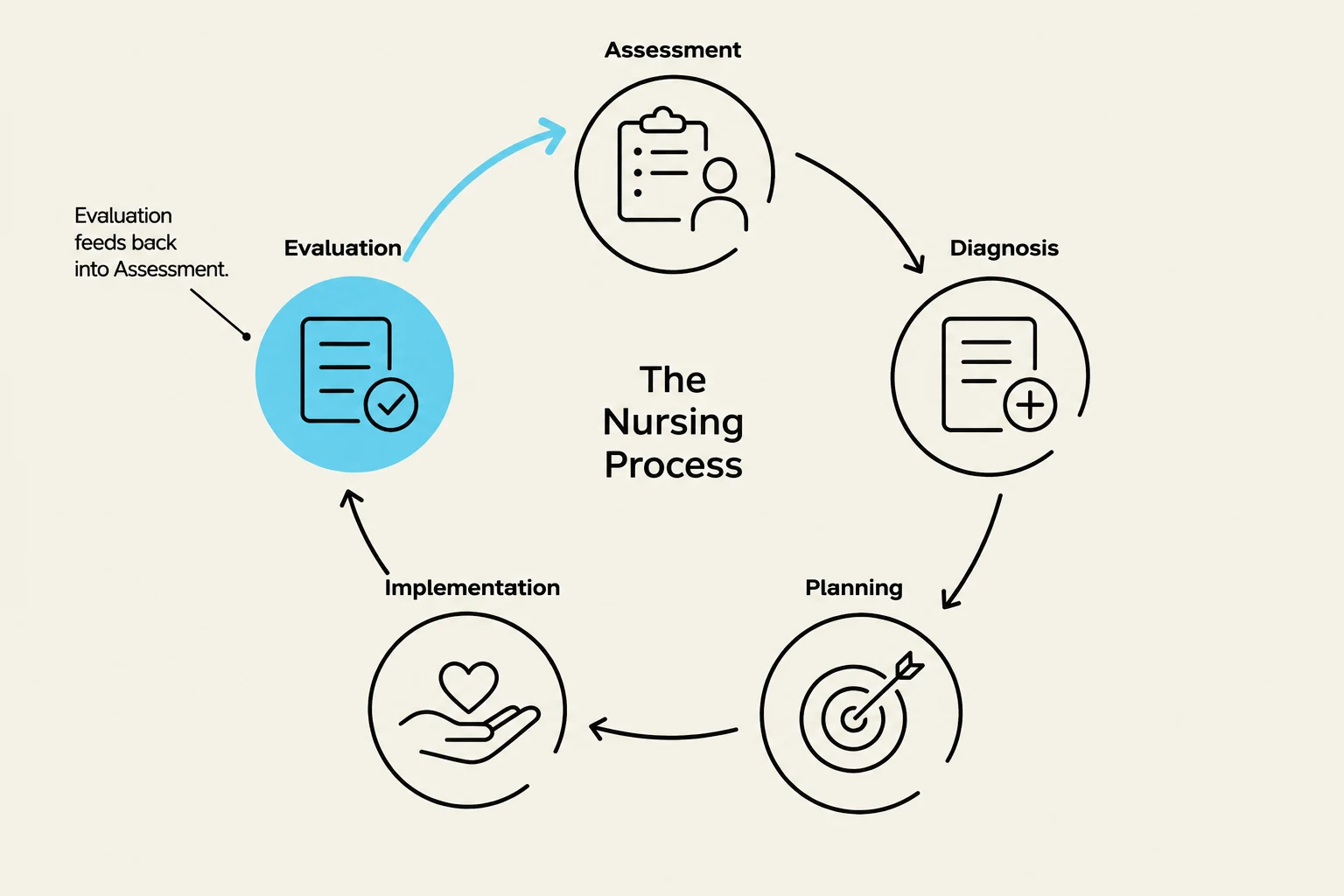
To make this process easy to remember, students use the acronym ADPIE, which represents the five essential steps: Assessment, Diagnosis, Planning, Implementation, and Evaluation.
1. Assessment: The Foundation of Data Collection
The first step in the nursing process is Assessment, which involves systematic Data Collection to establish a database of the client's perceived needs, health problems, and responses. This data is the raw material used to fuel every subsequent step of the process.
Data is categorized into two distinct types:
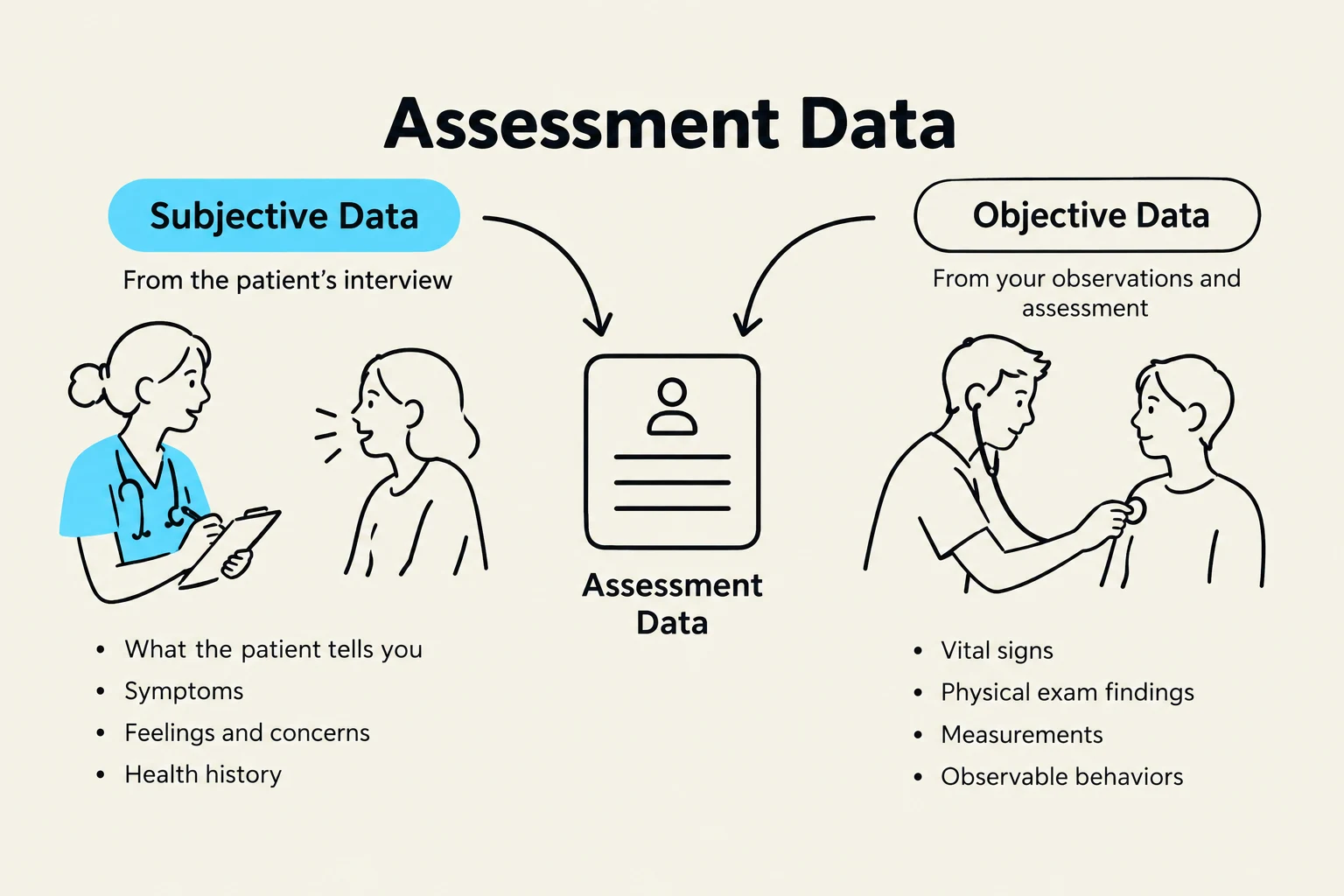
Subjective Data: This is information provided by the patient or their family/caregivers through an interview or conversation. It includes the patient's "story," such as complaints of pain, feelings, or spiritual/cultural beliefs. Because this is what the patient says, it should be documented in quotation marks (e.g., "My chest hurts so bad!").
Objective Data: This is information that the nurse observes or measures directly. It includes vital signs (heart rate, blood pressure, etc.), physical examination findings (inspection, palpation, auscultation), and laboratory or diagnostic results.
Exam Tip: If a question asks for "subjective" data, look for words like "states," "reports," or "claims." If it asks for "objective" data, look for measurable facts like "BP 120/80" or "skin is diaphoretic".
This diagram illustrates the two main types of assessment data: subjective data, gathered from patient interviews, and objective data, obtained from observations and physical examinations.
Accurate Data Documentation is a legal and professional responsibility. Nurses must use approved terminology and ensure that everything heard, seen, felt, or smelled is recorded precisely.
2. Nursing Diagnosis: Data Analysis and Clinical Judgement
Once data is collected, the nurse must perform Data Analysis. This requires Critical Thinking—the ability to recognize patterns or trends in the data, compare them to normal standards, and make reasoned decisions. Through this analysis, the nurse moves from raw data to Clinical Judgement, forming a Nursing Diagnosis.
A nursing diagnosis is not a medical diagnosis; rather, it is a judgment about the client's response to health problems. Nurses use standardized terminology from NANDA-I (NANDA International) to ensure a common language across the profession.
Types of Nursing Diagnoses
There are three primary types of nursing diagnoses you will encounter:
Problem-Focused (Actual) Diagnosis: A problem currently present in the patient (e.g., Acute Pain).
Risk Diagnosis: A potential problem the patient is susceptible to (e.g., Risk for Infection).
Health Promotion (Wellness) Diagnosis: A desire to improve current health (e.g., Readiness for enhanced self-care).
The PES Format
To write a complete three-part nursing diagnosis, many nurses use the PES system:
P (Problem): The NANDA label.
E (Etiology): The "related to" (r/t) factor—what is contributing to the problem.
S (Symptom): The "as evidenced by" (AEB) factor—the signs and symptoms found during assessment.
Example:Acute pain (P) related to chest pressure (E) as evidenced by patient stating "it's a 10/10" and wincing (S).
3. Planning: Setting SMART Goals
After identifying the diagnosis, the nurse moves to Planning. This stage involves setting client-centered goals and deciding on interventions to achieve those goals.
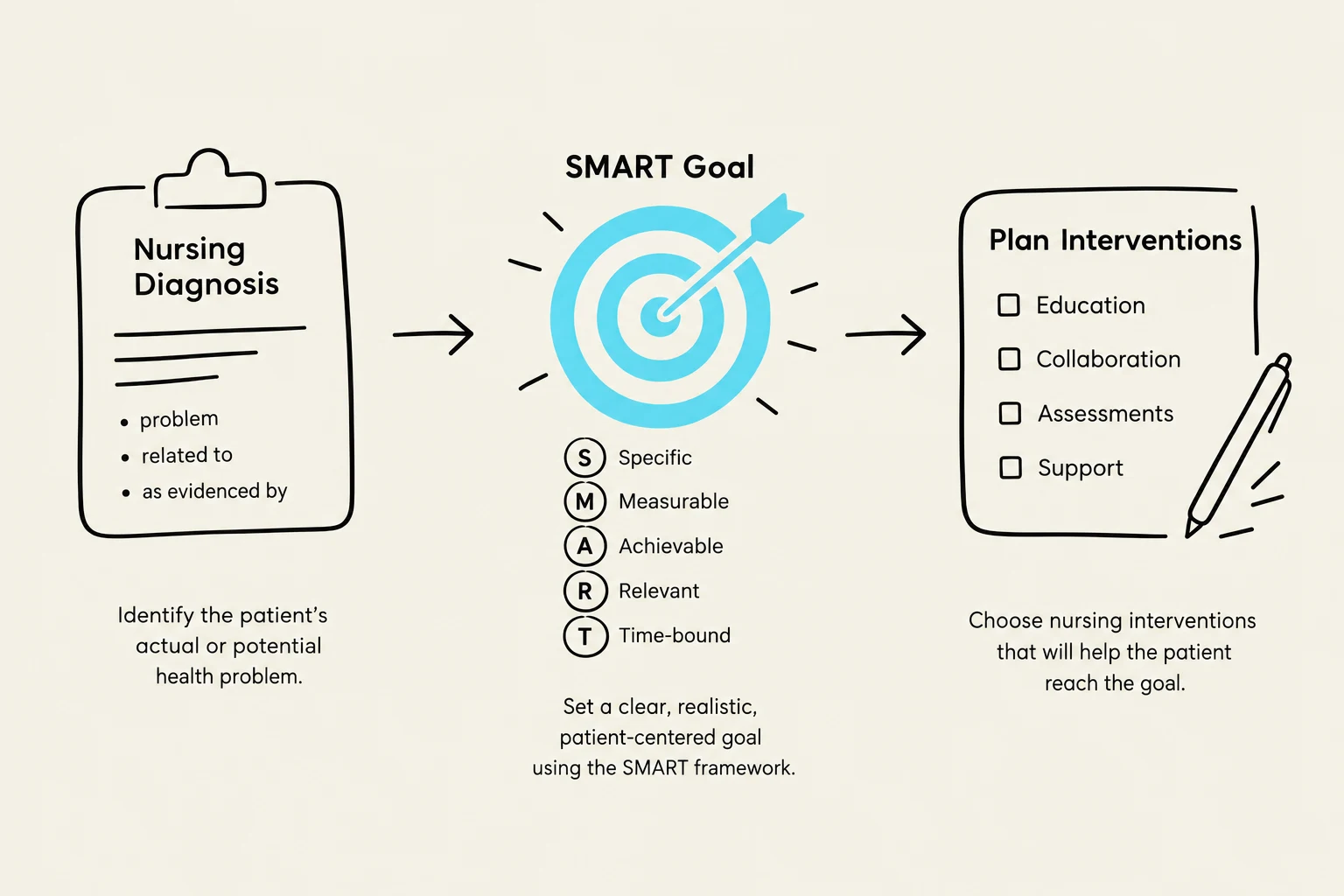
Effective planning requires the creation of SMART Goals:
Specific: Clearly defined so others understand.
Measurable: Can be quantified or observed to evaluate achievement.
Attainable/Realistic: Possible given the patient's condition and mutually agreed upon with the client.
Timed: Includes a specific timeframe (e.g., "within 30 minutes" or "by discharge").
This diagram illustrates the SMART goal framework in nursing, outlining the steps from nursing diagnosis to planning interventions.
4. Implementation: Taking Action
Implementation is the "doing" phase where the nurse carries out the planned interventions to reach the SMART goals. Interventions can be categorized into three types:
Independent: Actions the nurse can perform without an order (e.g., teaching, repositioning, or performing a pain assessment).
Dependent: Actions that require a physician's order (e.g., administering medication or wound dressings).
Collaborative: Actions performed in conjunction with other health professionals (e.g., working with a physiotherapist for mobility).
For example, if the diagnosis is Acute Pain, implementation might include non-pharmacological methods like relaxation techniques or distraction, alongside pharmacological methods like administering prescribed analgesics.
5. Evaluation: Closing the Loop
The final step is Evaluation, which is an ongoing and continuous process. Evaluation is not just the end of the process; it is a way to determine if the care plan is working or if it needs to be revised.
During evaluation, the nurse asks:
Were the goals met, partially met, or not met?
Were the interventions appropriate?
Does the assessment data suggest a need for a new diagnosis or a revised plan?
If a goal is "partially met" (e.g., pain decreased from 10/10 to 5/10), the nurse must continue the assessment and potentially adjust the interventions.
A diagram illustrating the five steps of the nursing process: Assessment, Diagnosis, Planning, Implementation, and Evaluation, with feedback loops indicated.
By following the ADPIE framework, nurses ensure that patient care is organized, evidence-based, and, most importantly, tailored to the unique needs of every individual.
Keep reading for free.
Create an account to finish this reading and make it part of your study routine.