Explores the profound impact of nuclear weapons on global politics, the development of deterrence strategies like MAD, and the origins, dynamics, and eventual end of the Cold War.
The period between 1945 and 1989 represents one of the most transformative eras in human history. It was defined by a fundamental shift in the nature of power: the transition from conventional warfare to the era of nuclear weapons. This "Nuclear Revolution" did not merely change how wars were fought; it fundamentally altered the political landscape, creating a bipolar world where the threat of total annihilation became the primary mechanism for maintaining a fragile peace.
The Nuclear Revolution: From Manhattan to the Hydrogen Bomb
The dawn of the nuclear age began with the Manhattan Project, a massive scientific and military undertaking by the United States. The practical application of this research culminated in August 1945 with the atomic bombings of Hiroshima and Nagasaki. These events demonstrated a level of destructive power previously unimaginable, fundamentally altering the calculus of global conflict.
The technological leap was not a single event but a rapid escalation. While the initial atomic bombs were devastating, the subsequent development of the hydrogen bomb represented a massive increase in destructive capacity. This escalation changed the stakes from "winning" a war to surviving one.
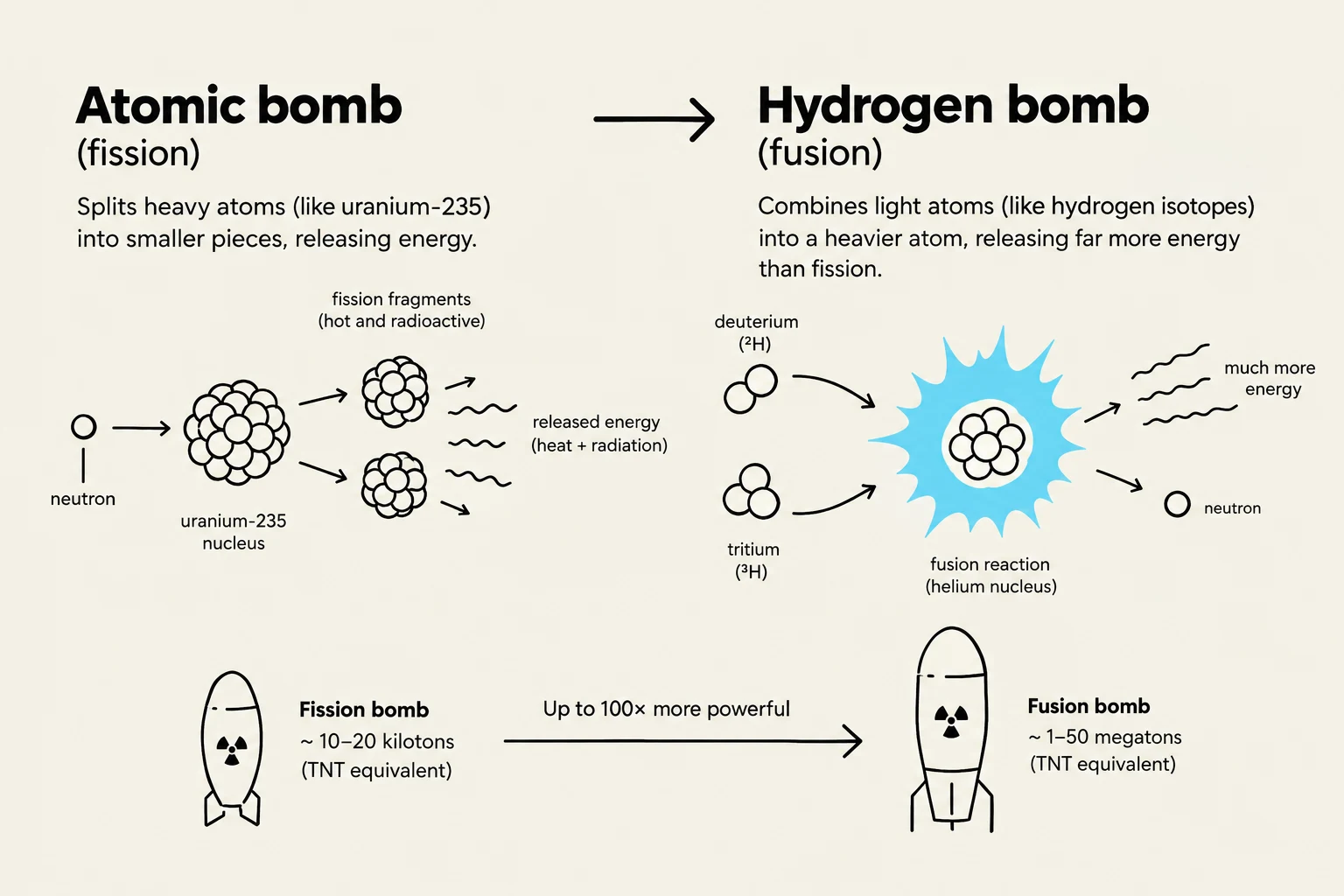
Study Tip: When distinguishing between weapon types, remember that the atomic bomb relies on fission, whereas the hydrogen bomb utilizes fusion, resulting in significantly higher yields.
This diagram illustrates the fundamental processes of atomic (fission) and hydrogen (fusion) bombs, detailing their respective mechanisms and energy outputs.
The geopolitical landscape shifted permanently in 1949 when the Soviet Union successfully conducted its own nuclear detonation. This ended the American monopoly and ushered in an era of "nuclear states." Today, this group includes declared powers like the US, Russia, China, Britain, France, India, and Pakistan, as well as undeclared powers such as Israel and North Korea.
Military and Political Consequences: The Logic of Deterrence
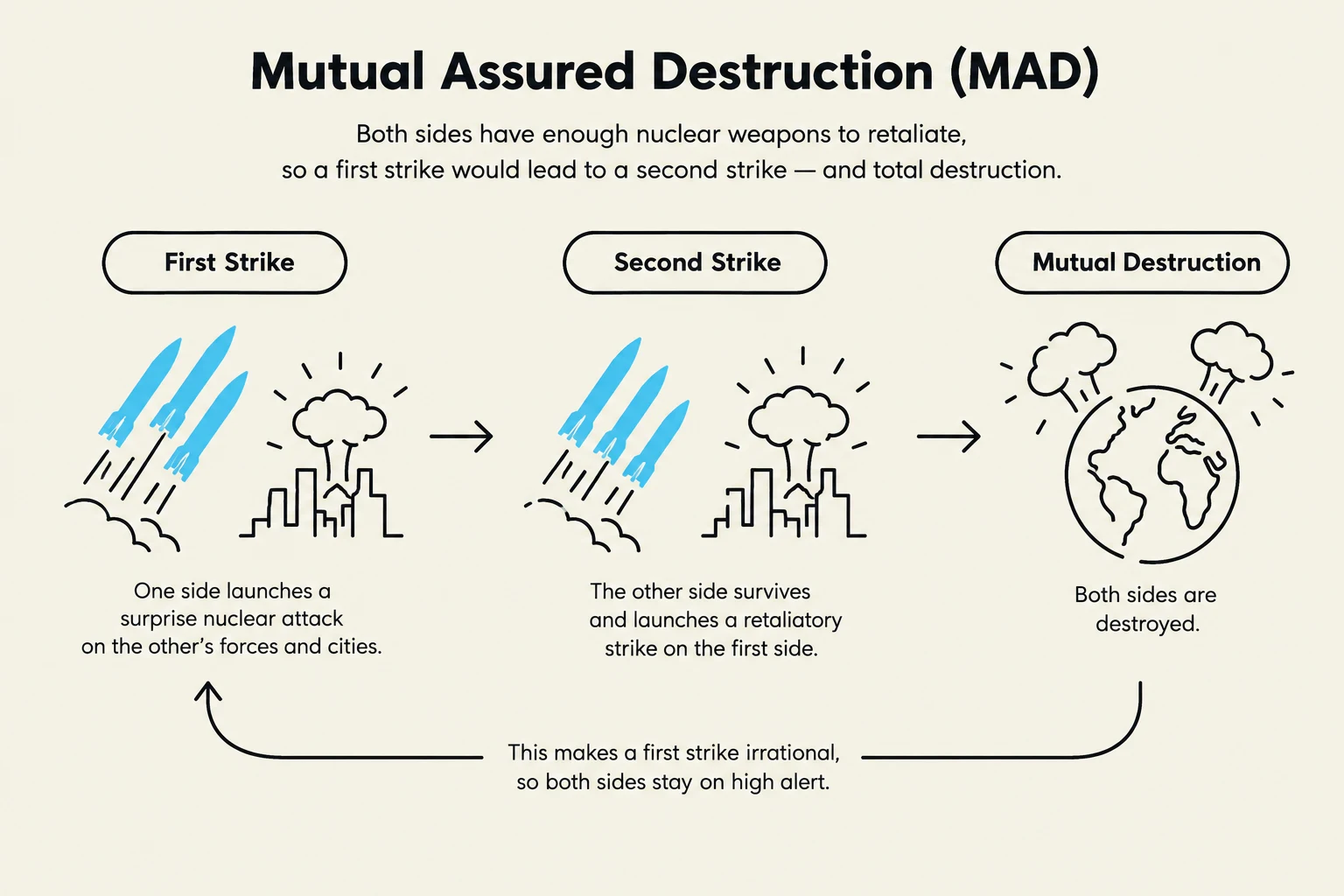
The existence of nuclear weapons introduced new military concepts that redefined national security. Central to this is the distinction between first-strike capability (the ability to attack and destroy an opponent's arsenal before they can respond) and second-strike capability (the ability to absorb a nuclear attack and still retain enough weapons to retaliate devastatingly).
When both sides possess a guaranteed second-strike capability, the result is Mutual Assured Destruction (MAD). Under MAD, an all-out nuclear war becomes irrational because no side can "win"; the result would be total destruction, potentially even leading to a "nuclear winter" where the environmental consequences render the planet uninhabitable.
Because of this, the "Nuclear Revolution" forced a shift in how states interact:
Deterrence: Instead of using weapons for defense, they are used to prevent an opponent from acting.
Limited War: Since total war is too risky, conflicts are often confined to smaller, conventional scales.
The Nuclear Taboo: A psychological and political norm has emerged against the actual use of nuclear weapons in conflict.
The diagram illustrates the concept of Mutual Assured Destruction (MAD), where a nuclear first strike by one side would result in a retaliatory second strike, leading to the destruction of both parties. This scenario makes a first strike irrational and necessitates a state of high alert.
The Cold War: Origins and Containment
As the nuclear age began, the world entered the Cold War (1945–1989). This was a period of intense tension between the United States and the Soviet Union, characterized by bipolarity—a system where two superpowers dominate global politics.
The origins of this conflict can be analyzed through different lenses. At the individual level, some point to the personality of Joseph Stalin, a paranoid dictator. At the state level, the conflict is seen as an inevitable clash between capitalism and communism. At the systemic level, the security dilemma plays a crucial role: as one state increases its security (e.g., through arms races), it inadvertently makes the other state feel less secure, leading to a cycle of escalation.
To counter Soviet influence, the United States adopted a policy of containment. This strategy was shaped by several key milestones:
The Long Telegram: George Kennan's analysis of Soviet intentions.
The Iron Curtain Speech: Winston Churchill's warning about the division of Europe.
The Truman Doctrine & Marshall Plan: US commitments to provide political and economic aid to prevent the spread of communism.
NATO: The formation of a military alliance to protect Western Europe.
Crises, Conflict, and the End of the Era
The Cold War was not a continuous state of war, but it was punctuated by high-tension "shocks" and proxy wars.
Proxy Wars: Conflicts like the Korean War and the Vietnam War saw the superpowers competing for influence without engaging in direct nuclear combat.
Crises: The Berlin Crisis and the Cuban Missile Crisis represented moments where the world came closest to nuclear war. The Cuban Missile Crisis, in particular, served as a terrifying lesson in the limits of "brinksmanship".
Late Cold War: Tensions resurfaced during the Soviet invasion of Afghanistan in 1979 and the subsequent era of increased military spending in the 1980s.
A timeline illustrating the four main phases of the Cold War: Origins (1945-53), High Tension (1954-63), Détente (1964-79), and The End (1980-91), with key events listed for each period.
The Cold War eventually ended not through a nuclear exchange, but through the internal decline of the Soviet Union. A combination of imperial overstretch, technological gaps, and the reform efforts of Mikhail Gorbachev led to the eventual collapse of the Soviet system. While the nuclear revolution created the tools for total destruction, it was the political and economic dynamics of the bipolar struggle that ultimately dictated the course of the late 20th century.
Exam Summary Table: Why the Cold War stayed "Cold"
Factor
Description
Bipolarity
Two clear poles reduced the number of unpredictable actors.
Nuclear Weapons
Made direct conflict between superpowers suicidal.
Reconnaissance
Improved intelligence made "surprise" attacks harder.
Rules of the Game
Established norms and "red lines" between the US and USSR.
Keep reading for free.
Create an account to finish this reading and make it part of your study routine.