The Nature of Geology: Understanding Earth's Systems and Processes
An introduction to Earth's main components and systems, geologic processes, and how geology influences the distribution of resources and human life. Covers lithosphere, hydrosphere, atmosphere, biosphere, isostasy, rock cycle, and geological hazards.
Geology is far more than just the study of rocks; it is the comprehensive study of Earth's processes, composition, and history. By examining how the planet's internal and external forces interact, geologists can reconstruct ancient environments—such as identifying prehistoric life through fossils or understanding past climate change through evidence of glacial retreat. Understanding geology is essential for human survival, as it dictates the distribution of natural resources and determines where it is safe or productive to build our civilizations.
Earth's Main Components and Systems
To understand the planet, we must view it as a collection of interacting "spheres". These systems include the lithosphere (the solid Earth), the hydrosphere (all water in its various forms), the atmosphere (the gaseous envelope surrounding the planet), and the biosphere (all living organisms).
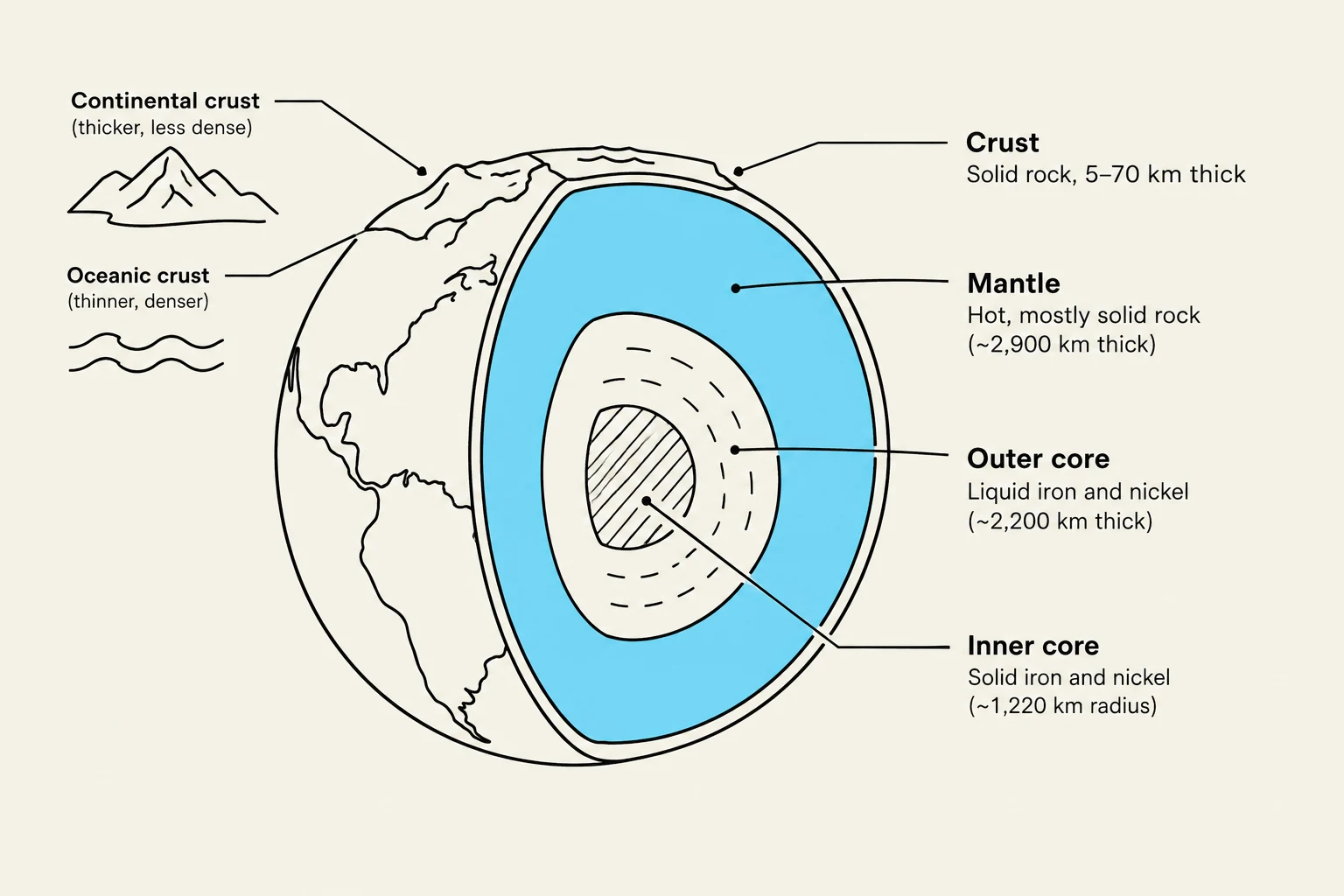
The lithosphere is not uniform; it is divided into layers based on chemical composition and mechanical behavior. The outermost layer is the crust, which comes in two distinct types: continental crust, which is thick, less dense, and granite-like, and oceanic crust, which is thinner, denser, and basalt-like. Beneath the crust lies the mantle, the thickest layer of the Earth, composed largely of minerals like olivine. At the very center lies the core, a metallic iron-nickel center consisting of a molten outer core and a solid inner core.
Mechanically, the lithosphere (comprising the crust and the uppermost, strong part of the mantle) sits atop the asthenosphere, a hotter, weaker, and more ductile layer that allows the plates above to move.
Diagram illustrating the layers of the Earth, including the continental and oceanic crust, mantle, outer core, and inner core, with descriptions of their composition and thickness.
Study Tip: When distinguishing between the lithosphere and the asthenosphere, remember that the distinction is mechanical (strength/rigidity) rather than just chemical. The lithosphere is the "strong" outer shell, while the asthenosphere is the "weak," flowing layer beneath it.
Isostasy and Elevation
Why are some parts of the Earth higher than others? This is explained by isostasy, a principle analogous to buoyancy. Just as a thick piece of wood floats higher in water than a thin piece, the thickness and density of the crust determine its elevation above the mantle. Generally, the thicker continental crust sits at higher elevations, while the thinner, denser oceanic crust sits well below sea level.
Geologic Processes: Drivers of Change
Geologic change is driven by two sets of forces: internal and external.
Internal Drivers:
Radioactive decay: This process occurs deep within the Earth, producing the heat that drives mantle movement.
Internal forces: These include the movement of materials and tectonic forces that shape the crust.
External Drivers:
Gravity: This causes water, ice, and rocks to move downhill.
Solar energy: Drives the weather and the hydrologic cycle.
Atmospheric pressure, wind, and ocean currents: These work together to redistribute heat and move sediments across the surface.
The hydrologic cycle is a vital part of these external processes. Water moves constantly between the surface and the atmosphere through evaporation, transpiration by plants, and precipitation (rain, snow, or hail). This movement of water is the most important sculpting agent on Earth, as flowing water carries sediment and carves landscapes.
Landscapes and Human Impact
The physical features of a landscape directly influence human activity, often presenting a balance between opportunity and hazard.
Hazards and Safety
Geologic features can dictate where it is dangerous to live:
Faults: These are fractures in the crust that may indicate potential for earthquakes.
Volcanic eruptions: While volcanoes can be destructive through ash and lava, they also provide essential nutrients to the soil.
Slopes: Areas with very steep slopes are prone to landslides, making them unstable for construction.
Resource Distribution
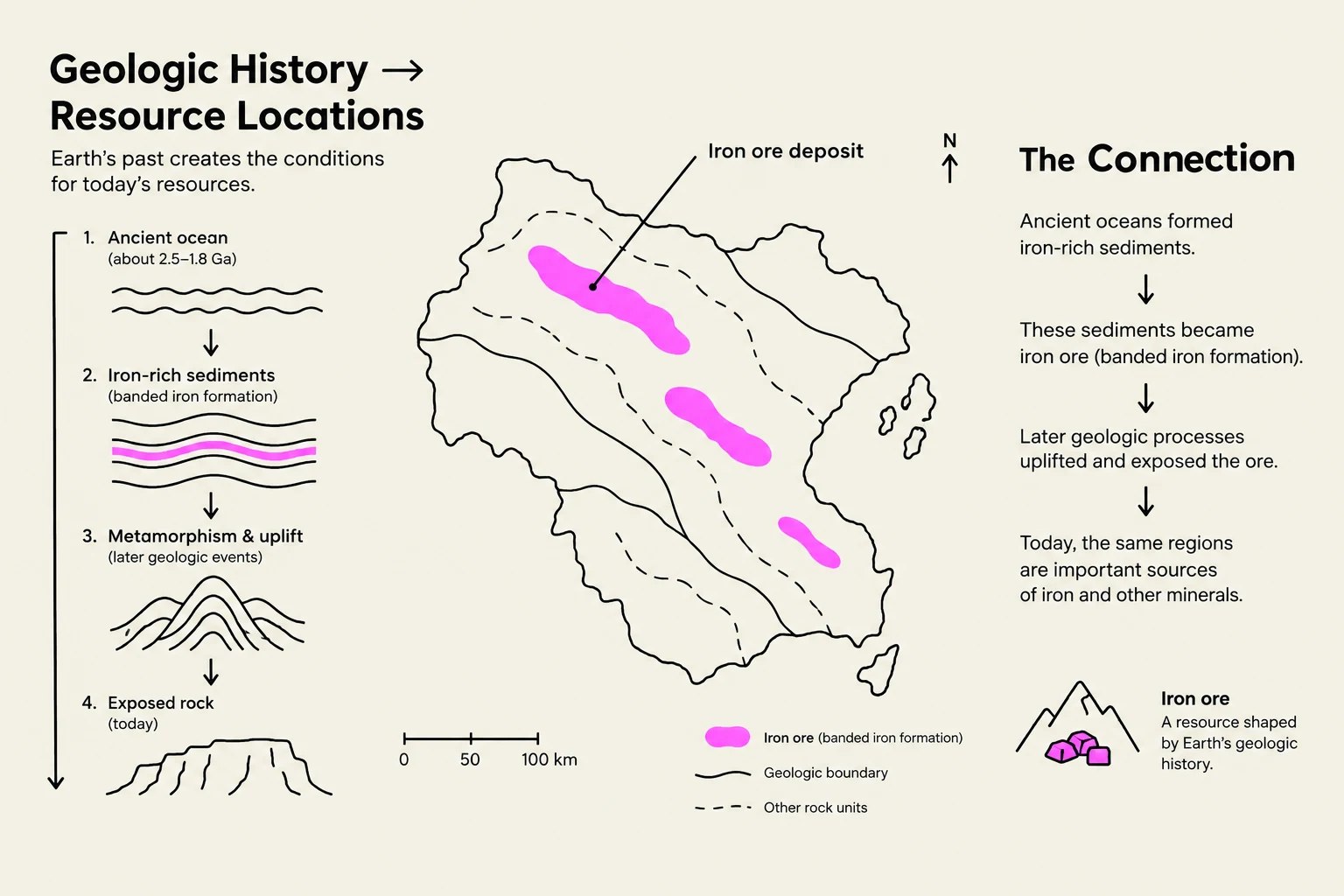
The location of economic resources is not random; it is strictly controlled by geologic history. For example, iron deposits are often found in very old rocks (such as the Canadian Shield) that record changes in Earth's early atmosphere. In contrast, copper mines are often much younger and are linked to more recent mountain-building events, such as those found along the western coast of North America.
This diagram illustrates the geological processes that lead to the formation and location of iron ore deposits, from ancient oceans to exposed rock formations.
The Rock Cycle and Surface Transformation
The Earth's surface is constantly being recycled through the rock cycle. This involves several key processes:
Weathering and Erosion: Weathering mechanically breaks or chemically alters rock, while erosion strips away these pieces and transports them via wind, water, or gravity.
Deposition and Lithification: When sediment comes to rest, it is deposited. Over time, these layers can be buried and compacted (lithification) to form sedimentary rocks.
Metamorphism: Buried rocks can be subjected to intense heat and pressure, transforming them into metamorphic rocks.
Melting and Igneous Formation: If rocks are pushed deep enough, they melt. This molten rock can then cool and solidify—either deep underground or as lava on the surface—to form igneous rocks.
The rock cycle illustrates the transformations between igneous, sedimentary, and metamorphic rocks, driven by processes like melting, cooling, weathering, erosion, deposition, compaction, cementation, and heat and pressure.
Exam Tip: If asked to identify the difference between weathering and erosion, remember: weathering is the breaking of the rock, while erosion is the movement of that broken material.
By studying these cycles and the forces that drive them, geologists can not only understand the world as it is today but also predict how landscapes will transform in the future.
Keep reading for free.
Create an account to finish this reading and make it part of your study routine.