An explanation of the Mutual Aid Model in social work, contrasting it with traditional casework in groups. It details the core philosophy, essential conditions, and the practitioner's role in fostering collective strength and member-to-member support within a group setting.
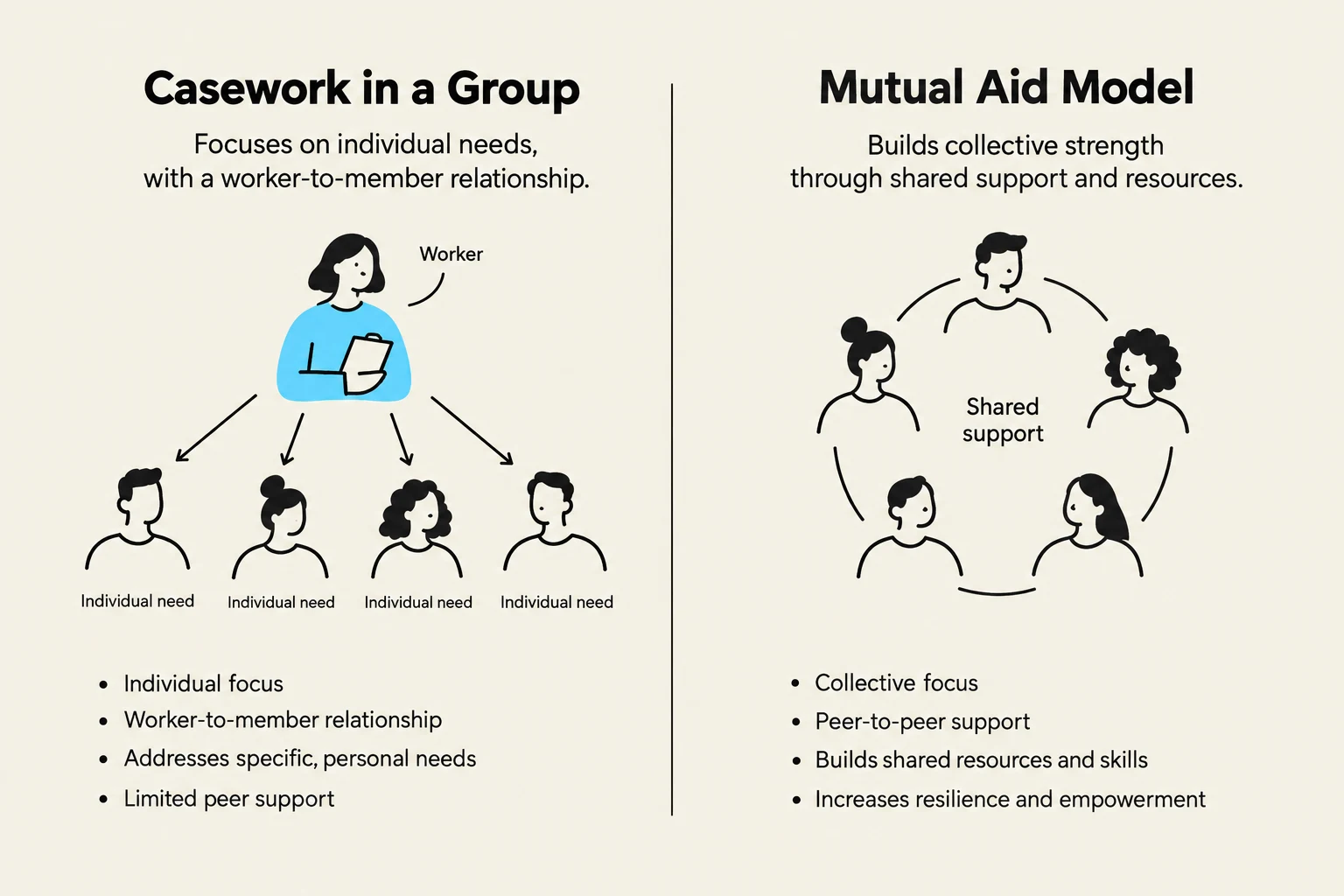
In traditional social work, a group is often viewed as a collection of individuals, each with their own private problems, gathered in one room. In this setting, the practitioner often acts as the primary expert, moving from person to person to provide individual therapy—a practice known as casework in a group or aggregational therapy of individuals.
The Mutual Aid Model challenges this approach. Instead of treating the group as a mere backdrop for individual treatment, this model views the group itself as a "second client". The core philosophy is simple: mutual aid is people helping one another as they think things through. By shifting the focus from the worker-to-member relationship to the member-to-member relationship, the practitioner catalyzes the collective power of the group to solve problems and foster growth.
Defining Mutual Aid: Process and Result
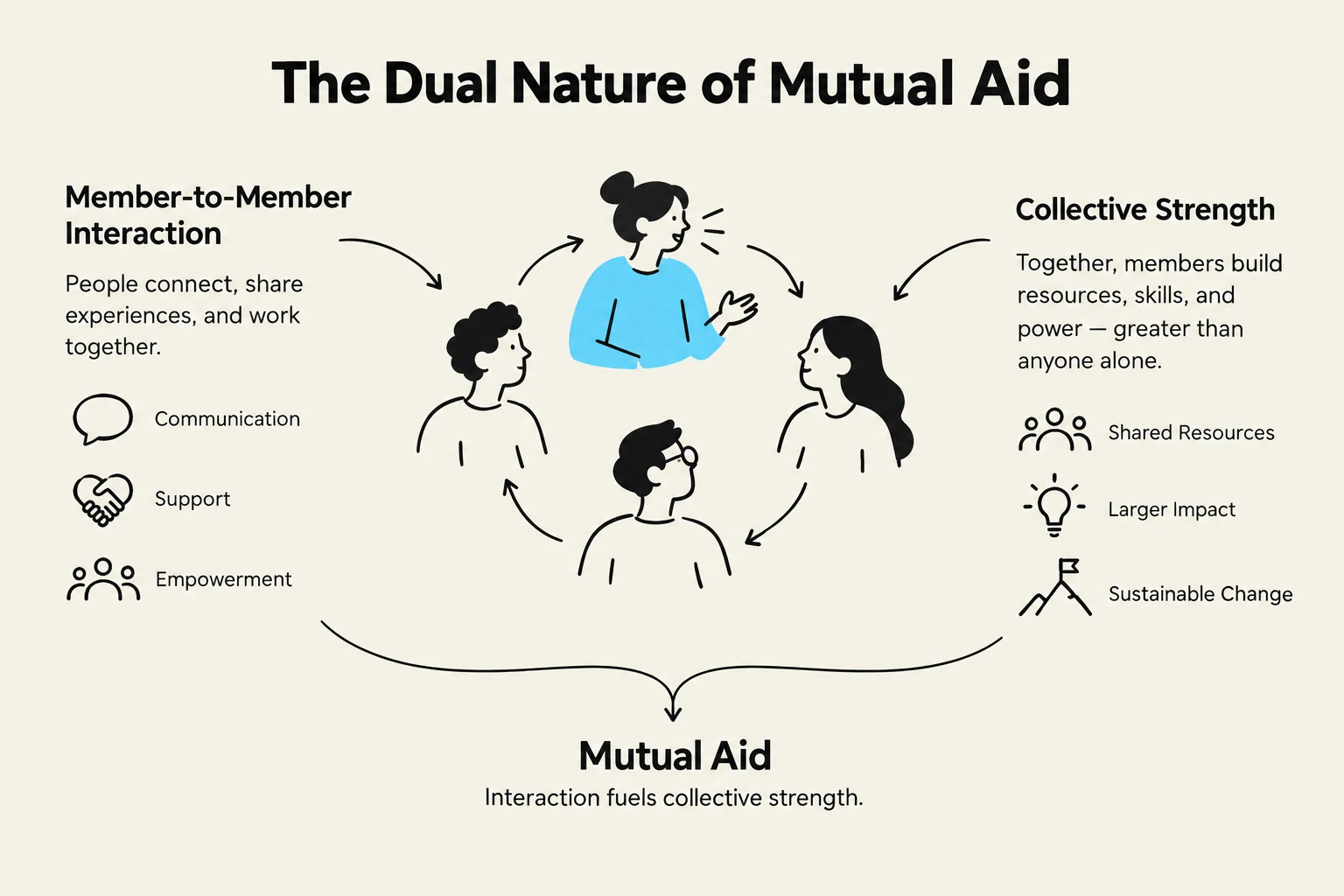
Mutual aid is not just a single action; it is both a process and a result. As a process, it involves the spontaneous exchange of support, information, and empathy among members. As a result, it is the sense of belonging, the resolution of shared concerns, or the collective advancement of a cause that members experience after participating.
It is important to distinguish mutual aid from mere "advice-giving." While a member might offer a suggestion, true mutual aid is found in the "exchange of strengths". This can manifest in intense ways, such as vigorous debate and conflict resolution, or in subtle, quiet ways, such as a "glance of understanding" or a supportive pat on the back.
This diagram illustrates the dual nature of mutual aid, highlighting member-to-member interaction and collective strength. It shows how communication, support, and empowerment among individuals lead to shared resources, larger impact, and sustainable change.
The Essential Conditions for Mutual Aid
For a group to move beyond a simple collection of people and become a functioning mutual-aid system, several specific conditions must coexist.
1. Group Purpose and "Groupness"
A group must have a group purpose—a common cause or mission that binds individual goals to a collective objective. Without a clear purpose, the group remains a collection of individuals pursuing private agendas, leading back to the "casework in a group" trap. When a purpose is successfully established, it fosters groupness, a sense of community or "we-ness" where members recognize each other as potential sources of help.
2. Democratic-Humanistic Culture
Mutual aid requires a democratic-humanistic culture. This is an environment where every member has a right to be heard and where everyone’s feelings and needs are considered during decision-making processes. It is a delicate balance: members must feel safe enough to express honest, even difficult, opinions without fear of harsh judgment, yet they must also feel an obligation to respect the perspectives of others.
3. Capacity to Communicate
Because mutual aid relies on member-to-member contact, members must possess the capacity to communicate and interact. This includes both verbal and nonverbal interaction. While practitioners should not exclude those with limited skills, the model thrives in "free-floating" communication patterns—where members speak spontaneously when they have something to contribute—rather than rigid "round-robin" or "maypole" patterns where the worker controls the flow.
Student Tip: If you observe a group where members only speak when the worker calls on them, or if they only address the worker and never each other, mutual aid is being stifled. This is often called the "maypole pattern".
The Role of the Practitioner: From Leader to Worker
One of the most significant shifts in this model is the change in the practitioner's identity. In the mutual-aid model, the professional is a worker, not a "leader".
Sharing Authority
To facilitate mutual aid, the practitioner must practice sharing authority. This means relinquishing the role of the sole expert and empowering members to participate in the group's decision-making and governance. By decentralizing power, the worker encourages member autonomy and allows the group to utilize its own internal leadership and expertise.
Group-Specific Skills and Dynamics
Working with groups requires group-specific skills that differ significantly from individual casework skills. Instead of focusing solely on the individual's needs, the worker must attend to small-group dynamics and the group process.
This image contrasts a "Casework in a Group" model, which focuses on individual needs with a worker-to-member relationship, with a "Mutual Aid Model" that builds collective strength through shared support and resources.
The worker's primary task is to recognize opportunities for interaction and use their skills to catalyze the group's potential. This involves:
Monitoring the quality of the group process.
Helping the group navigate conflict productively.
Encouraging the exchange of strengths among members.
Versatility of the Model
The beauty of the mutual-aid model lies in its versatility. It is not limited to therapeutic settings; it can be applied to organizational committees, social-action coalitions, or even large-scale community meetings. While the intensity of mutual aid may vary—ranging from a quiet "glance of understanding" to intense, transformative debate—the fundamental principles remain the same.
Ultimately, the goal is to move away from the "worker-as-expert" paradigm and toward a system where the group's collective resources are harnessed to achieve its unique potential.
This diagram illustrates three key components of effective group dynamics: Group Purpose, Shared Authority, and Spontaneous Communication. It shows how these elements contribute to building trust and alignment, ultimately strengthening the group.
Keep reading for free.
Create an account to finish this reading and make it part of your study routine.