Everything in the living world, from the smallest bacterium to the largest mammal, is built from matter. This matter is organized into a hierarchy of complexity, starting with fundamental atoms and building up to the massive organic macromolecules that drive life's processes. To understand how a cell functions, we must first understand the chemistry that governs its structure and energy.
Atomic Structure and the Building Blocks of Matter
The structure of an atom including nucleus and electron shells.
At the heart of all matter is the atom. An atom consists of a central nucleus containing protons (which carry a positive charge) and neutrons (which are neutral). Surrounding this nucleus are electrons, which carry a negative charge and occupy specific energy levels or "shells".
The number of protons in an atom determines its identity and is known as the atomic number. While the number of protons remains constant for a specific element, the number of neutrons can vary. These variations are called isotopes. For example, carbon has three naturally occurring isotopes: 612C, 613C, and 614C.
The periodic table organizes these elements by increasing atomic number. Elements are arranged in vertical columns called "groups" and horizontal rows called "periods". Some groups, such as Group VIII (the noble gases like Helium and Krypton), are particularly stable and rarely react with other atoms.
Chemical Bonds: How Atoms Connect
Comparison of ionic, covalent, and hydrogen bonding.
Atoms rarely exist in isolation; they bond together to form molecules (two or more atoms bonded together) or compounds (two or more different elements bonded together). Chemical stability is usually achieved when atoms satisfy the "octet rule," seeking to fill their outer valence shell with eight electrons.
There are three primary types of bonds that facilitate these connections:
Ionic Bonds: These occur when atoms transfer electrons, resulting in ions with opposite charges that are attracted to one another.
Covalent Bonds: These involve the sharing of electron pairs between atoms.
Nonpolar covalent bonds involve equal sharing of electrons.
Polar covalent bonds involve unequal sharing, where one atom exerts a stronger pull on the electrons, creating slight positive and negative charges.
Hydrogen Bonds: These are much weaker than ionic or covalent bonds. They form when a slightly positive hydrogen atom in one molecule is attracted to a slightly negative atom (like oxygen or nitrogen) in another molecule or a different part of the same molecule.
Study Tip: Remember that the strength of a bond is crucial for biological function. While covalent bonds hold the "backbone" of molecules together, the weak nature of hydrogen bonds allows for the flexible, dynamic interactions necessary for DNA replication and protein folding.
The Unique Chemistry of Water
Water (H2O) is an inorganic molecule because it does not contain carbon and hydrogen linked together. However, its polarity and ability to form hydrogen bonds make it the most critical substance for life.
Water exhibits several life-sustaining properties:
High Heat Capacity: Water can absorb significant amounts of heat with minimal temperature change, helping organisms maintain stable internal temperatures.
High Heat of Vaporization: It requires a large amount of energy to turn liquid water into gas. This is why sweating is an effective cooling mechanism.
Universal Solvent: Due to its polarity, water can dissolve many substances (solutes), facilitating chemical reactions inside and outside cells.
Cohesion and Adhesion: Cohesion is the tendency of water molecules to stick to each other, while adhesion is the ability to cling to other polar surfaces.
Density: Unlike most substances, frozen water is less dense than liquid water, allowing ice to float and providing insulation for aquatic life.
pH and Buffers
The concentration of hydrogen ions (H+) in a solution determines its pH. The scale ranges from 0 to 14:
0–6: Acidic (high H+ concentration).
7: Neutral (pure water).
8–14: Basic or alkaline (high OH− concentration).
Because biological systems are highly sensitive to pH changes—for instance, human blood must stay near 7.4 to avoid life-threatening acidosis or alkalosis—cells utilize buffers to maintain a stable pH range.
Organic Macromolecules
Organic molecules are defined by the presence of carbon and hydrogen. Many organic molecules are polymers, which are long chains built from repeating subunits called monomers.
The assembly and disassembly of these molecules involve two key chemical reactions:
Dehydration Reaction: A reaction that removes a water molecule to form a covalent bond between monomers.
Hydrolysis Reaction: A reaction that breaks a covalent bond by adding a water molecule.
Organic molecules are categorized into four major classes:
1. Carbohydrates
Carbohydrates serve as energy sources and structural components.
Monosaccharides: Single sugar molecules (e.g., glucose) that provide immediate energy.
Disaccharides: Two monosaccharides joined together (e.g., sucrose or lactose) that provide energy after digestion.
Polysaccharides: Long chains of sugars. These can be for energy storage (like starch in plants or glycogen in animals) or for structural support (like cellulose in plants or chitin).
2. Lipids
Lipids are generally insoluble in water (hydrophobic).
Triglycerides: Composed of one glycerol and three fatty acids; used for long-term energy storage and insulation.
Phospholipids: Consist of two fatty acids and a polar phosphate group; they are the primary component of cell membranes, forming a bilayer.
Steroids: Characterized by a four-ring carbon backbone; they function as important hormones like testosterone and estrogen.
3. Proteins
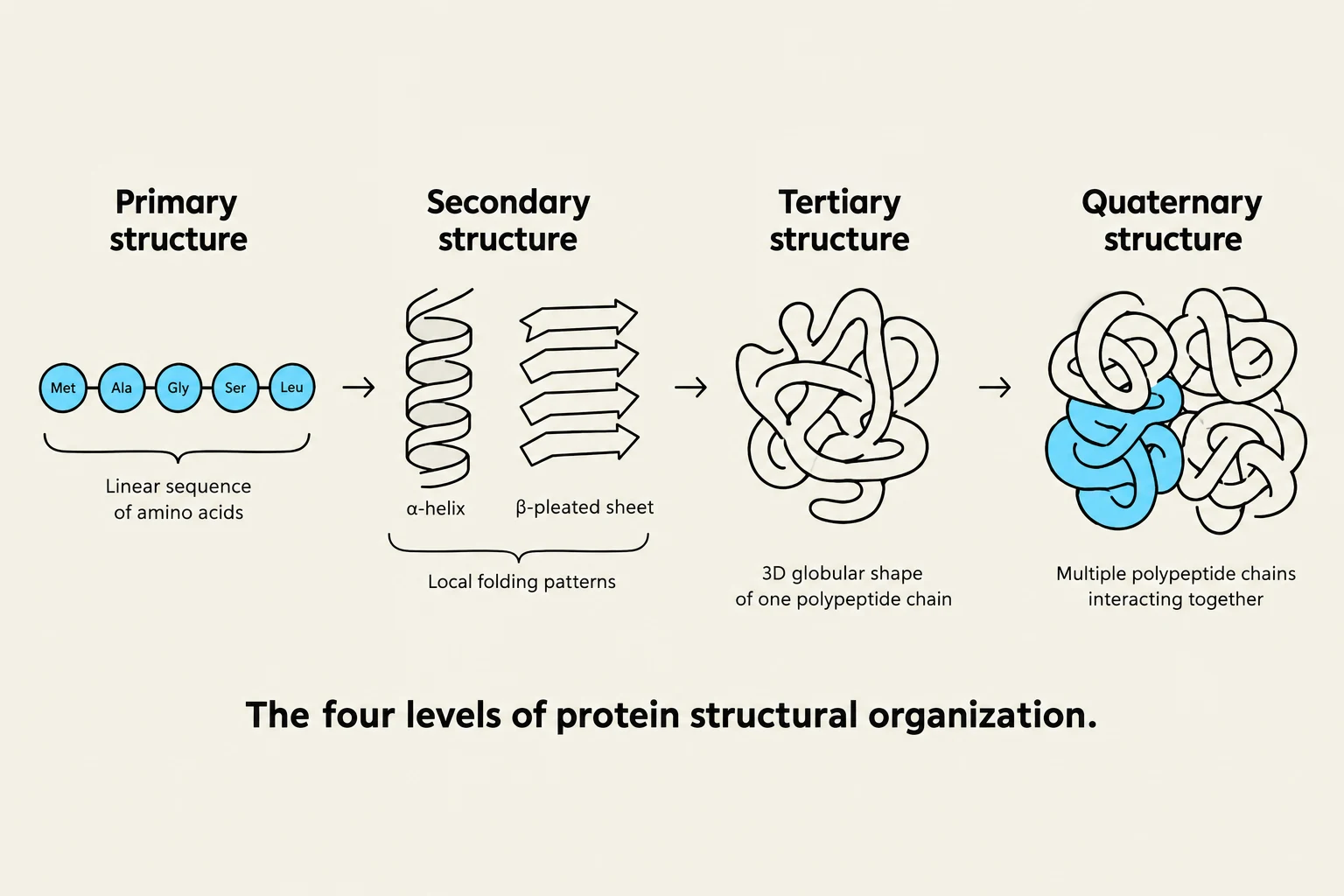
Proteins are the "workhorses" of the cell, facilitating metabolism, transport, defense, and motion. They are polymers made of amino acids joined by peptide bonds. The function of a protein is entirely dependent on its shape, which is organized into four levels:
Primary Structure: The linear sequence of amino acids.
Secondary Structure: The coiling (alpha helix) or folding (beta pleated sheet) of the chain, held by hydrogen bonds.
Tertiary Structure: The complex 3D shape of a single polypeptide.
Quaternary Structure: The structure formed when two or more polypeptide chains join together.
Warning: If a protein loses its shape due to environmental changes, it is said to be denatured, and it can no longer function.
4. Nucleic Acids
Nucleic acids are the information molecules of the cell, composed of monomers called nucleotides. Each nucleotide contains a sugar, a nitrogenous base, and a phosphate group.
DNA (Deoxyribonucleic acid): A double-stranded helix that stores the genetic information required for an organism's development and reproduction.
RNA (Ribonucleic acid): Usually single-stranded, RNA assists in the process of protein synthesis by translating the information in DNA.
The four levels of protein structural organization: primary (linear sequence of amino acids), secondary (local folding patterns like alpha-helix and beta-pleated sheet), tertiary (3D globular shape of one polypeptide chain), and quaternary (multiple polypeptide chains interacting together).
Cellular Energy: ATP
While glucose is a primary fuel source, the cell uses a specific molecule to power its immediate chemical work: ATP (Adenosine Triphosphate). ATP is a nucleotide with three phosphate groups. When the cell needs energy, it performs a hydrolysis reaction to break off the third phosphate, converting ATP into ADP (Adenosine Diphosphate) and an inorganic phosphate. This release of energy acts as the "energy currency" that powers everything from muscle contraction to active transport.
Keep reading for free.
Create an account to finish this reading and make it part of your study routine.