


In the study of genetics, a mutation is defined as a heritable change in the genome. While these changes can lead to a variety of outcomes—some beneficial, some detrimental, and most having no effect at all—they serve as a fundamental driver of evolution. Understanding how these changes occur at the molecular level requires a look at the mechanics of DNA replication, the impact of environmental agents, and the ways in which cells attempt to correct or bypass genetic errors.
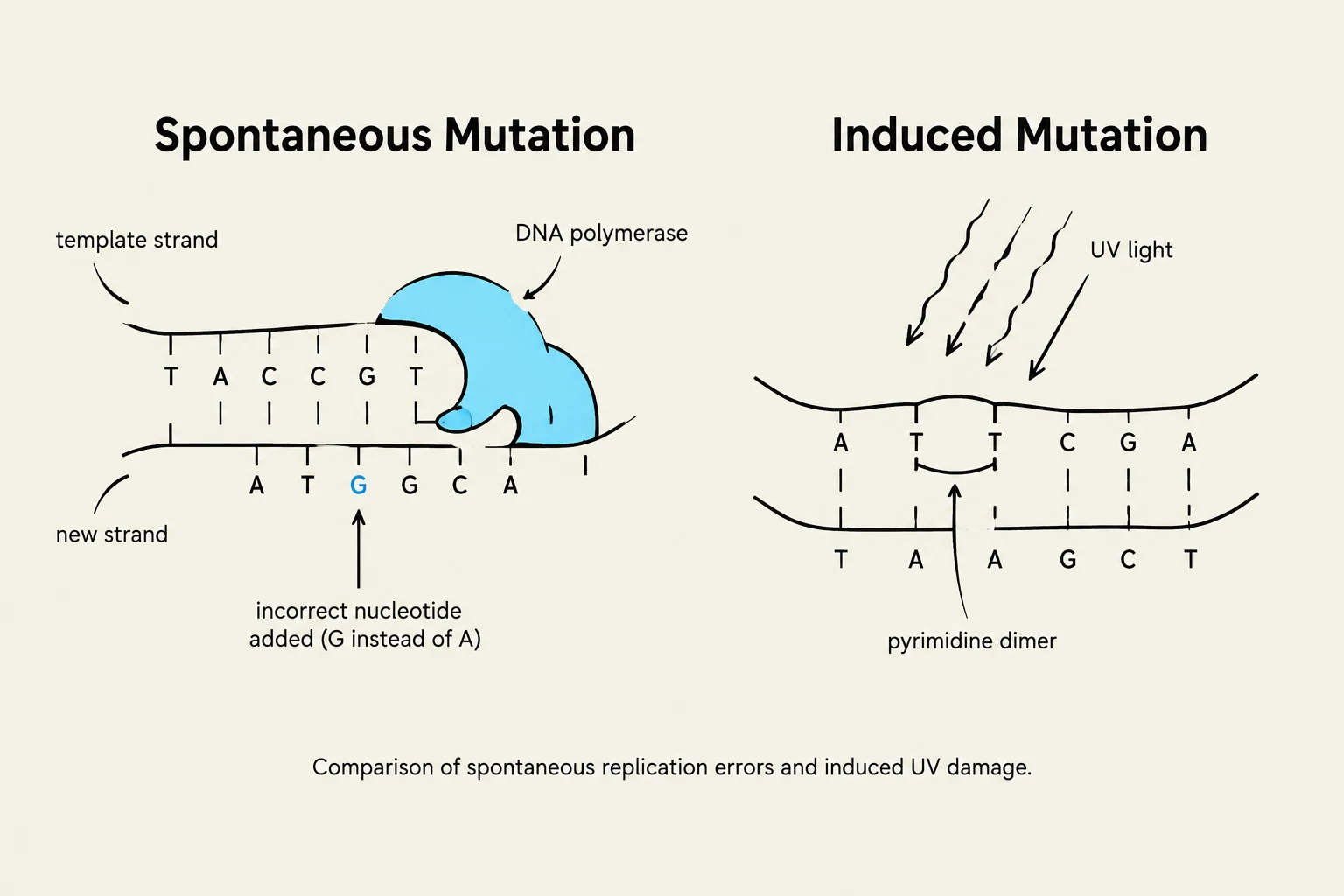
Origins of Mutation: Spontaneous vs. Induced
Mutations can be categorized based on their origin into two primary types: spontaneous and induced.
Spontaneous Mutations
Spontaneous mutations occur without any external intervention. Most of these arise from occasional errors made by DNA polymerase during the process of DNA replication. Because prokaryotes undergo exponential growth, these errors can accumulate quickly within a population.
Induced Mutations
Induced mutations are caused by environmental factors or are deliberately introduced by researchers. These can include:
- Chemical agents: Such as alkylating agents that modify DNA or base analogs that mimic natural nucleotides but cause faulty base pairing.
- Radiation: Including nonionizing radiation like Ultraviolet (UV) light, which forms pyrimidine dimers, and ionizing radiation like X-rays, which can cause double- or single-stranded breaks in the DNA backbone.
Point Mutations and Base-Pair Substitutions
A point mutation is a change that affects only a single base pair. The most common form is a base-pair substitution, where one nucleotide is replaced by another. The phenotypic impact of a substitution depends heavily on the degeneracy of the genetic code—the fact that multiple codons can encode the same amino acid.
Keep reading for free.
Create an account to finish this reading and make it part of your study routine.
Continue reading freeAlready have an account? Log in
Updated