The Materiality of the Digital World: Infrastructure, Environment, and Labor
Explores the physical infrastructure, environmental impact, and human labor behind the digital world, challenging the perception of the internet as a borderless cloud. Discusses data centers, fiber-optic cables, energy and water consumption, supply chains, content moderation, uneven access, and e-waste.
When we interact with Artificial Intelligence (AI) or browse social media, the experience feels weightless, instantaneous, and borderless. We tend to perceive the digital world as a "cloud"—an ethereal, universal space accessible from any corner of the globe. However, this perception is a geographic illusion. The digital world is fundamentally materialized; it is anchored in specific physical locations and relies on a massive, global web of hardware and infrastructure. To understand the digital age, we must look beneath the code to the concrete, copper, silicon, and lithium that make it possible.
Material Infrastructure: The Physicality of the Internet
The "borderless" digital world is actually built upon highly visible and vulnerable physical networks. Two primary components form this foundation: fibre-optic cables and data centres.
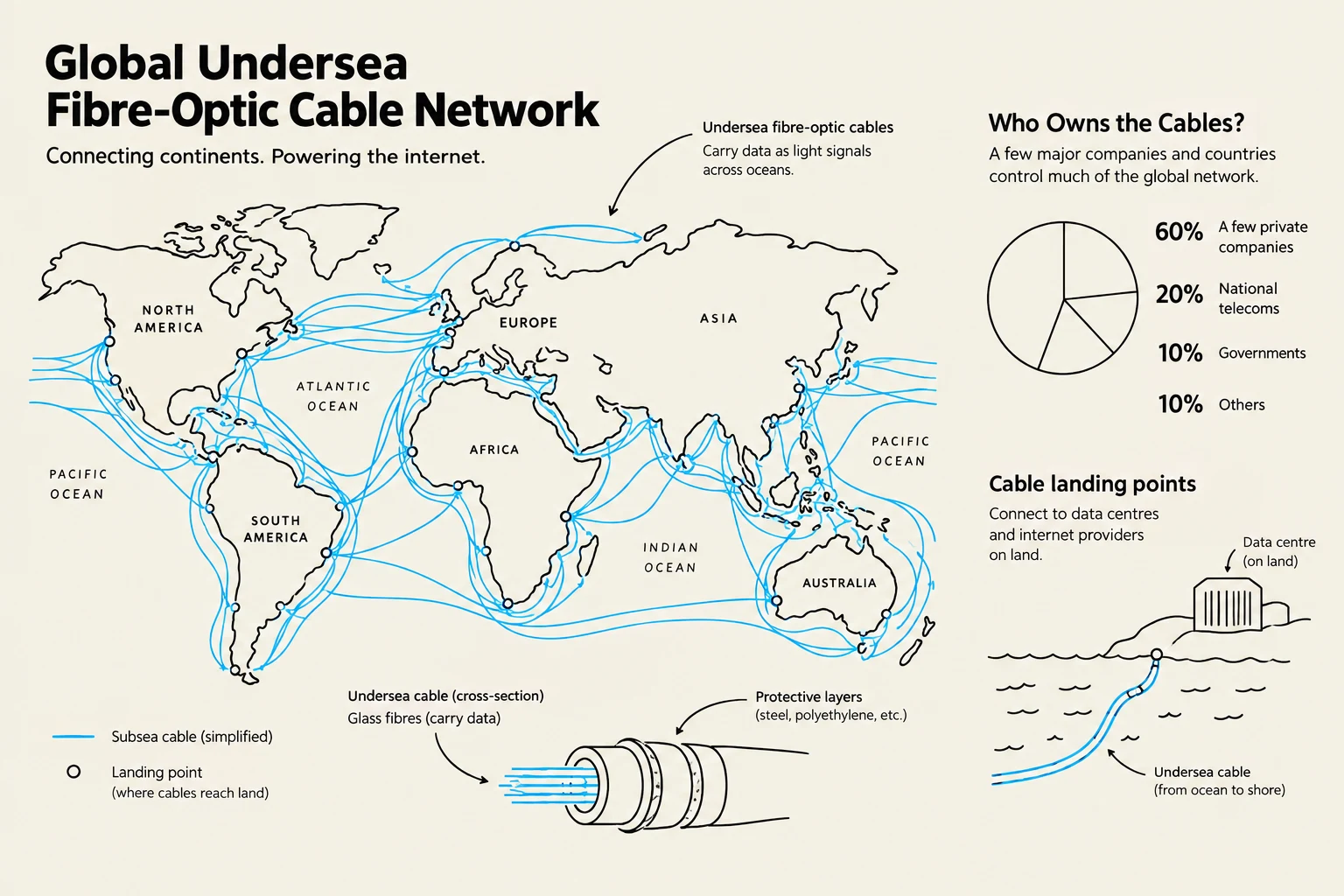
Seabed fibre-optic cables serve as the physical connective tissue of the global internet, running across ocean floors to link continents. While these cables facilitate global communication, they are not public utilities; they are privately owned by consortia of telecommunications companies and, increasingly, by "Big Tech" giants such as Meta, Alphabet, Microsoft, and Amazon. This concentration of ownership means that a handful of corporations hold significant control over the physical pathways of global information.
This diagram illustrates the global undersea fibre-optic cable network, showing how continents are connected to power the internet. It also details cable ownership distribution and landing points.
Data Centres and the AI Surge
If cables are the veins of the digital world, data centres are its heart. These massive facilities house the servers that process, store, and distribute the world's data. The rapid rise of Artificial Intelligence has become a primary driver for the expansion of these facilities.
In 2025, AI accounted for 20% of all data centre workloads, a figure that is projected to double to 40% by 2030. This growth is not distributed evenly across the globe. There is a heavy geographic concentration of data centres in the United States, with China and Western Europe trailing significantly behind.
Exam Tip: When discussing the geography of the digital world, avoid the "cloud" metaphor. Instead, emphasize materiality—the fact that digital processes require physical land, minerals, and energy in specific, often concentrated, locations.
The Environmental Footprint of AI
The environmental cost of maintaining this digital infrastructure is immense and multifaceted, involving energy, water, and land usage.
Energy and Water Consumption
Data centres require massive amounts of electricity to power servers and to train complex AI models. However, the carbon footprint of a data centre is not uniform; it depends heavily on the local energy mix (e.g., whether a country relies on coal or renewables).
Furthermore, high-density server facilities require significant amounts of water for cooling. In arid regions or areas facing groundwater depletion, the large-scale withdrawal of water for data centres can place severe stress on local aquifers and surface water systems.
Land and Upstream Impacts
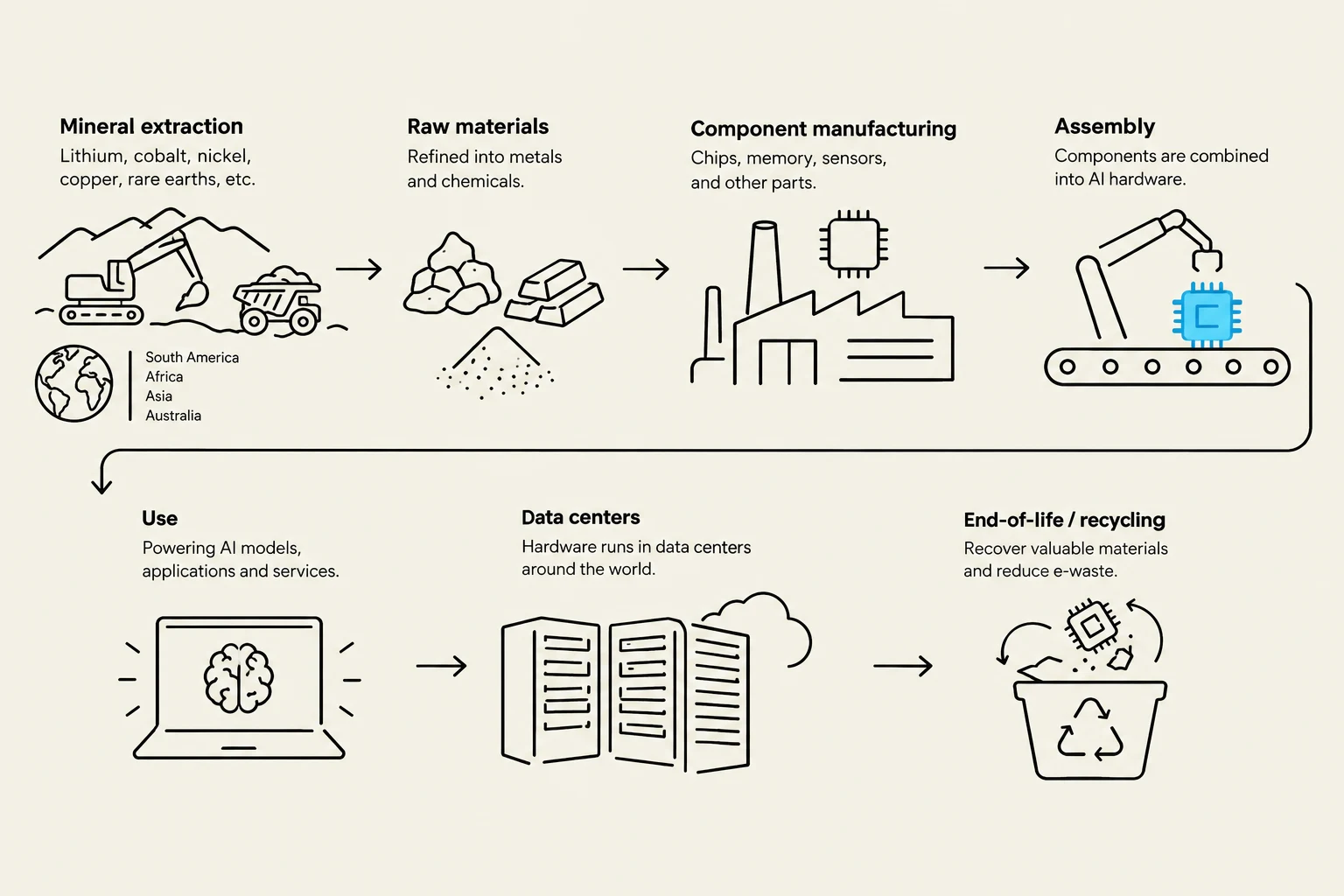
The "footprint" of AI also includes the land required for the facilities themselves and the land needed to generate renewable energy to power them. We must also consider the upstream impacts: the global supply chain required to build hardware. For example, companies like NVIDIA rely on minerals like tungsten from Brazil, gold from Colombia, and tantalum from Kazakhstan to manufacture the GPUs that power AI.
This diagram illustrates the lifecycle of AI hardware, from mineral extraction and raw material processing to component manufacturing, assembly, use in data centers, and finally, end-of-life recycling.
Spatial Divisions of Labour
A common misconception is that AI is fully automated. In reality, the digital world relies on a vast, often invisible, "disguised labour" of human workers. This creates a sharp spatial division of labour where the benefits of technology are concentrated in some regions, while the intensive, often traumatic work is outsourced to others.
This labour includes:
Data Annotators: Workers who label data to make it legible for algorithms.
Content Moderators: Workers who manually review social media posts to remove toxic, violent, or graphic content.
A poignant example is found in content moderation hubs in Kenya and Uganda. Workers there often face intense psychological pressure, tasked with reviewing thousands of disturbing images—including violence and sexual abuse—to meet strict performance targets. This highlights how pre-existing global income inequalities are used to carry out essential but high-stress digital functions as cheaply as possible.
Uneven Access and Territorial Regulation
The digital world is not equally accessible to everyone. While the global average for internet users was 71% in 2024, this figure masks extreme disparities; for instance, Sub-Saharan Africa had an internet usage rate of only 33.6%. Access is uneven due to variations in cable/cellular coverage, speed, and socio-economic status.
Despite the "borderless" feel of the internet, national governments still exert control through territorial regulation:
China's "Great Firewall": Blocks access to many Google platforms.
Canada's Online News Act: Requires platforms to pay for news content.
EU Net Neutrality: Ensures ISPs treat all online traffic equally.
The Downstream Problem: E-Waste
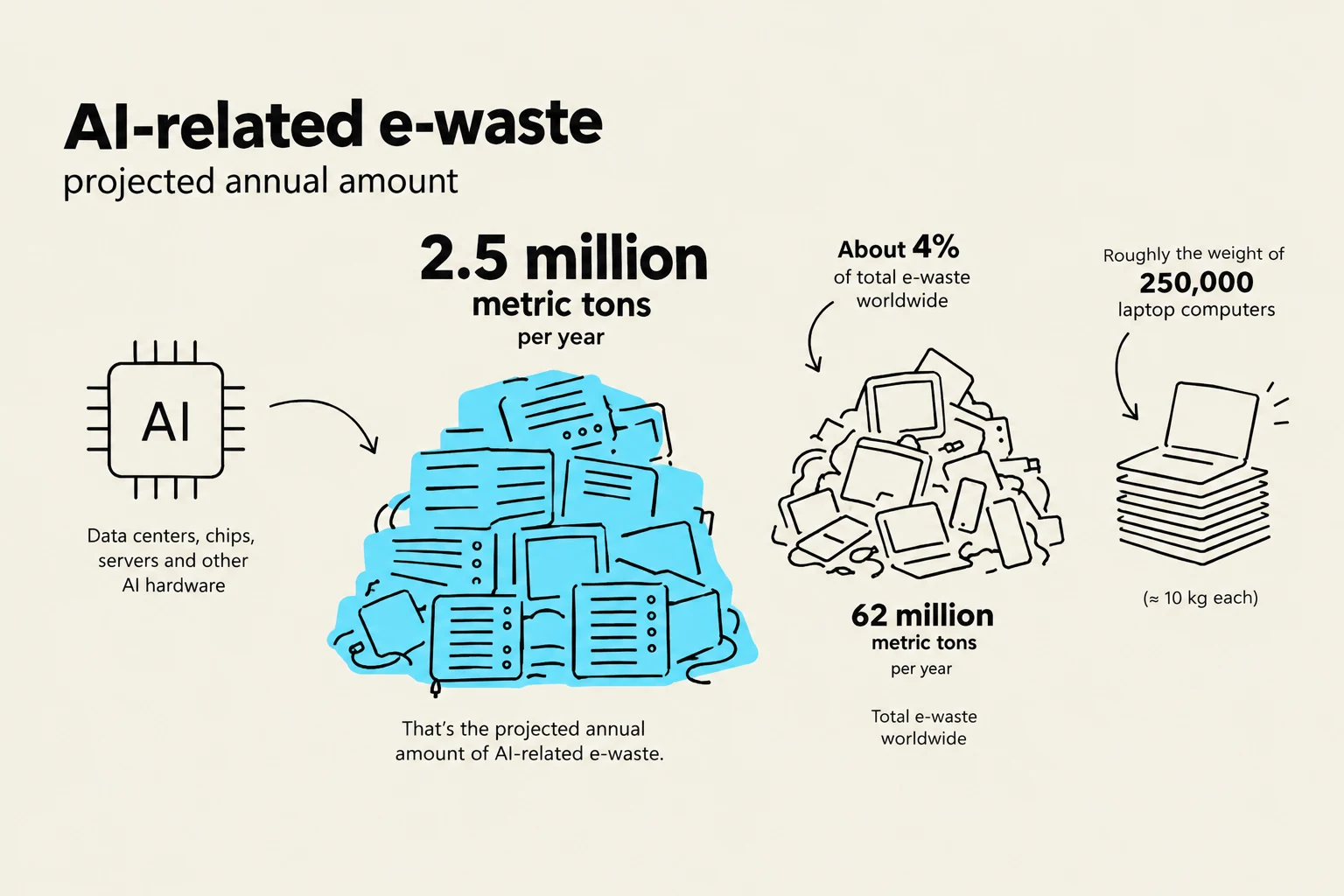
Finally, we must consider the "end-of-life" for digital hardware. As technology becomes obsolete, it enters the e-waste stream. It is projected that AI infrastructure could generate up to 2.5 million metric tons of e-waste annually by 2030. Without effective recycling, heavy metals like lead, cadmium, and mercury can contaminate soil and water, often in developing nations where illegal e-waste dumping occurs.
AI-related e-waste is projected to be 2.5 million metric tons per year, which is about 4% of total e-waste worldwide. This is equivalent to the weight of 250,000 laptop computers.
Summary for Students: To master this topic, remember that the digital world is a material system. It is characterized by:
Concentration: Of infrastructure (data centres), ownership (Big Tech), and investment (US/China).
Unevenness: In access (global north vs. south), labour (moderators in Kenya), and environmental harm (e-waste and resource extraction).
Materiality: It requires land, water, minerals, and energy to exist.
Keep reading for free.
Create an account to finish this reading and make it part of your study routine.