When we interact with Artificial Intelligence, we often perceive it as an ethereal, "cloud-based" entity existing in a weightless digital realm. However, this perception is a misconception. The digital world is fundamentally material; it depends on massive physical infrastructures, specific geographic locations, and a complex web of social and labor relations. To understand the true cost of AI, we must look beyond the screen and examine the physical reality of its production, operation, and eventual disposal.
Digital Materiality and the Scale of Infrastructure
The concept of digital materiality reminds us that every algorithm requires hardware, and every piece of hardware requires energy, land, and water. This infrastructure is not distributed evenly. Instead, it is concentrated in data centers—massive, "supersized" warehouses that house the computing power necessary for AI.
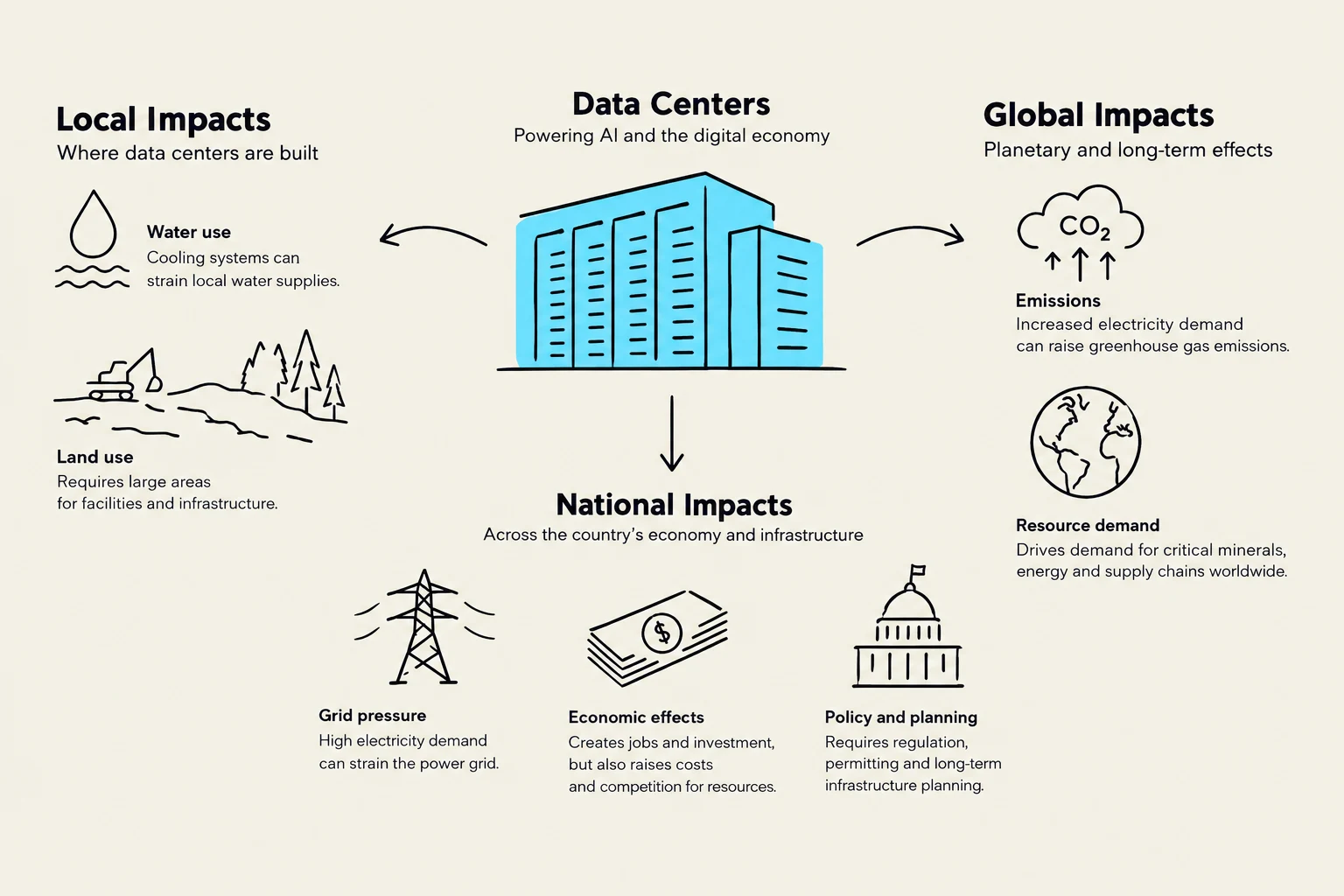
The impact of these data centers varies significantly depending on the scale at which they are assessed:
Local Scale: Communities often face direct consequences such as the consumption of water from local aquifers, the loss of prime agricultural land, increased noise pollution, and impacts on indigenous land rights.
Regional/National Scale: Governments must balance the potential for economic growth and "digital sovereignty" against the strain on the electricity grid and the loss of food-producing land.
Global Scale: The massive energy requirements of AI contribute to global fossil fuel consumption and climate change, affecting those who may not even have the internet access required to benefit from the technology.
This diagram illustrates the local, national, and global impacts of data centers, covering aspects like water use, land use, grid pressure, economic effects, policy, emissions, and resource demand.
Study Tip: When analyzing technological impacts, always ask: "At which scale is this problem being discussed?" A solution that works at a national level (like tax incentives) might create a crisis at a local level (like water shortages).
The Spatial Division of Labor
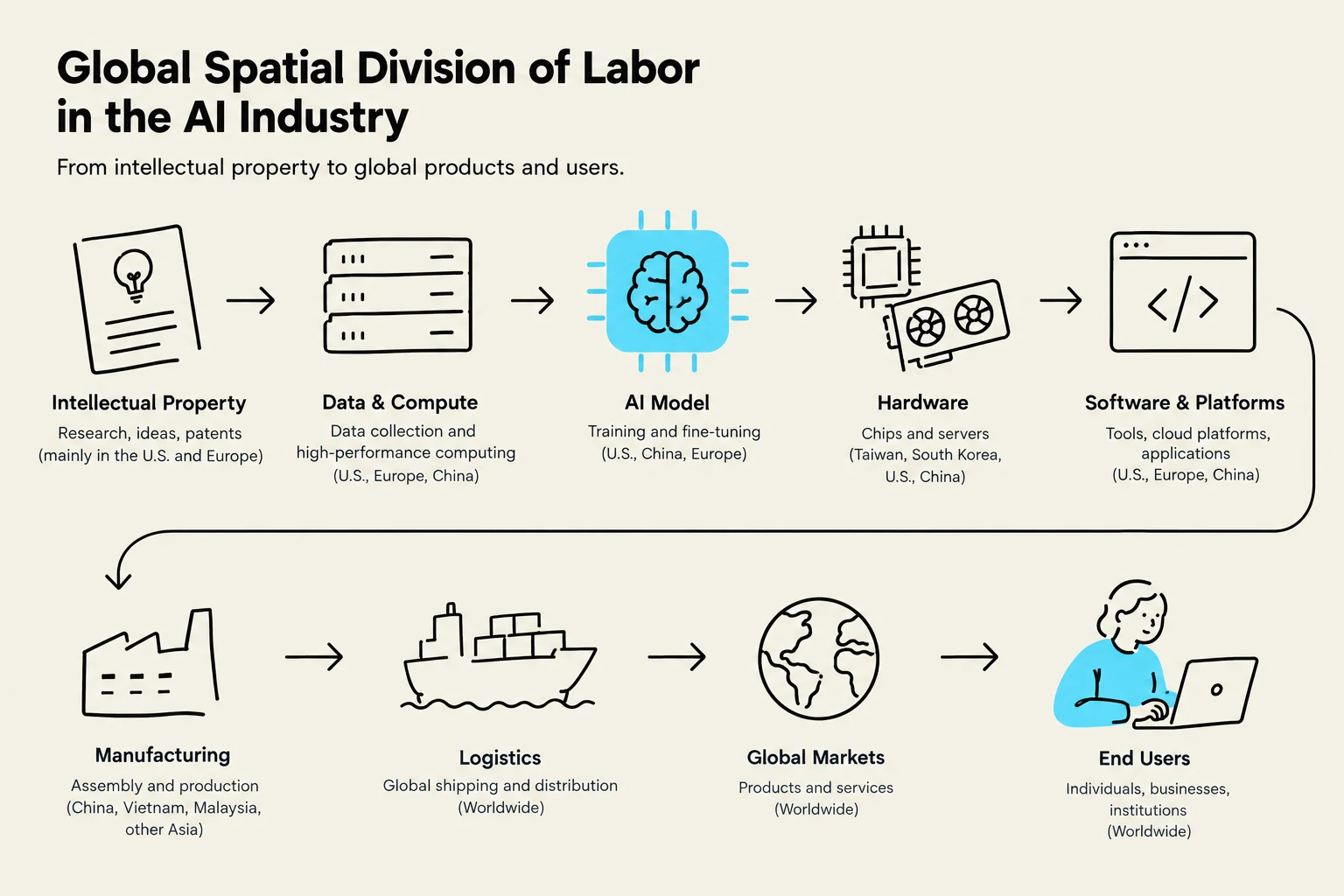
The creation and maintenance of the digital economy are not performed by a monolithic group of workers in a single location. Instead, there is a distinct spatial division of labor. This division often mirrors existing global income inequalities, ensuring that high-value tasks are concentrated in wealthy nations while low-paid, high-intensity work is outsourced.
We can observe this division through the lifecycle of an AI model:
Intellectual Property & Design: High-level design and ownership reside in tech hubs like California (e.g., Nvidia).
Advanced Manufacturing: The cutting-edge fabrication of complex chips occurs in specialized locations like Taiwan (e.g., TSMC).
Data Labeling & Content Moderation: The "hidden" work of adjusting algorithms, tweaking models, and checking content for safety is often performed by low-paid workers in regions such as Kenya or Uganda.
This diagram illustrates the global spatial division of labor within the AI industry, showing the flow from intellectual property and data processing to AI model development, hardware manufacturing, software creation, logistics, global markets, and finally, end-users.
Environmental Injustice and E-Waste Displacement
The environmental footprint of AI extends to the very beginning and the very end of the hardware lifecycle. This creates a pattern of environmental injustice, where the benefits of technology are concentrated in high-income nations, while the "spoiled environments" caused by extraction and disposal are exported to the Global South.
Upstream: Mineral Extraction
To build the GPUs and chips that drive AI, massive amounts of critical minerals—such as tin, tantalum, tungsten, and gold—must be mined. These extraction processes often occur in countries like Kazakhstan, Brazil, or Colombia, frequently resulting in the contamination of soil and water and heavy usage of local resources.
Downstream: E-Waste Generation
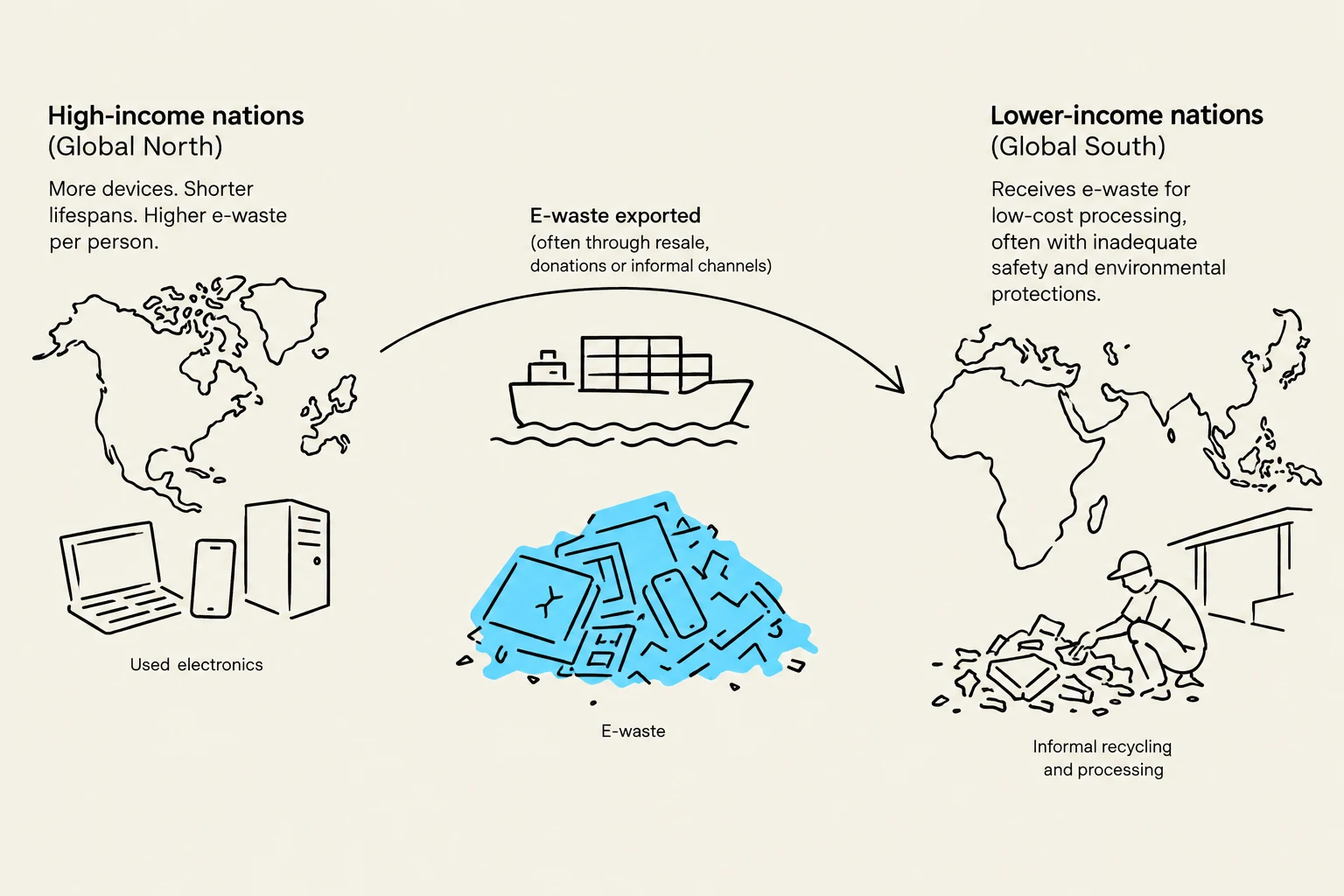
As AI hardware becomes obsolete at an accelerating rate, it enters the e-waste stream. It is estimated that AI infrastructure could generate up to 2.5 million metric tonnes of e-waste annually by 2030.
A significant portion of this waste is generated in high-income nations (such as the US, Canada, Norway, and Japan) but is subsequently shipped to regions in Western Africa, Mexico, Brazil, India, and Southeast Asia for disposal. Without effective recycling, heavy metals like lead, cadmium, and mercury from these discarded devices can leach into the environment, devastating local ecosystems.
This diagram illustrates the global flow of electronic waste from high-income nations to lower-income nations for informal recycling and processing.
The Need for Lifecycle Governance
Because the impacts of AI are so geographically and socially dispersed, addressing them requires lifecycle governance. We cannot simply regulate the software; we must implement holistic management that spans the entire supply chain.
Effective governance must include:
Responsible Extraction: Regulating the mining of critical minerals to minimize environmental and social harm.
Sustainable Manufacturing: Reducing the water and energy intensity of chip fabrication.
Circular Economy Practices: Implementing robust recycling and "effective cycling" to prevent heavy metal contamination during e-waste disposal.
Labor Protections: Ensuring that the workers in the "hidden" parts of the digital economy are treated with dignity and paid fairly.
Ultimately, assessing the true cost of AI requires us to look at multiple scales simultaneously—from the local farmer losing land to a data center, to the global worker labeling data, to the international movement of toxic waste.
Keep reading for free.
Create an account to finish this reading and make it part of your study routine.