The Lymphatic System: A Bridge Between Circulation and Immunity
Explores the lymphatic system's crucial role in fluid balance and immune surveillance, integrating it with the circulatory system. Covers fluid dynamics, pathogen filtration, and mathematical modeling of fluid flux.
In the study of human anatomy, we often categorize organs into distinct systems: the circulatory system moves blood, and the immune system defends against pathogens. However, biological reality is rarely so compartmentalized. To maintain homeostasis, the body requires a mechanism that can simultaneously manage fluid balance and facilitate immune surveillance. This is the role of the lymphatic system. Rather than acting as an isolated network, the lymphatic system serves as a critical bridge, integrating the fluid dynamics of the circulatory system with the defensive capabilities of the immune system.
The Fluid Connection: Bridging Circulatory Dynamics
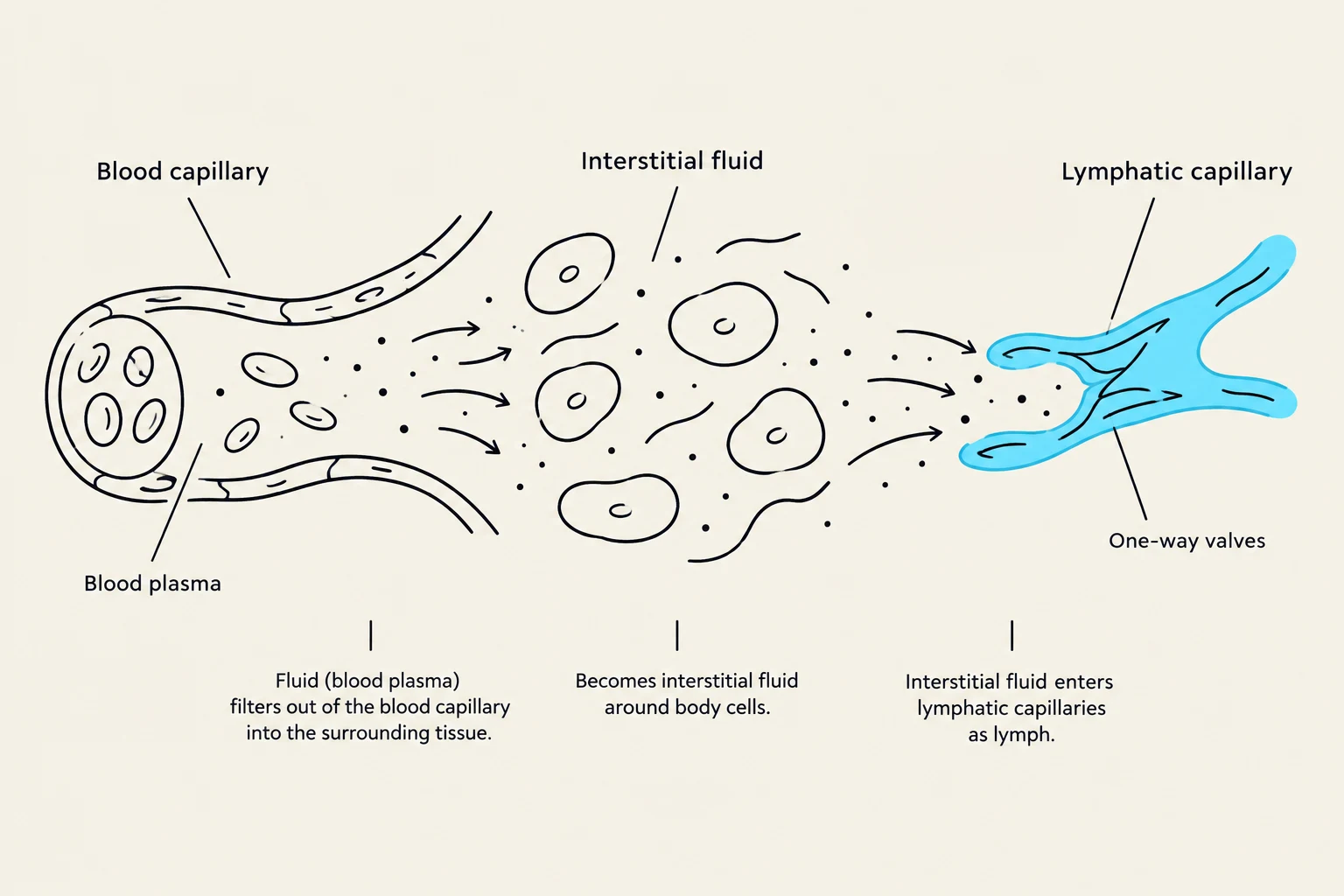
The relationship between the circulatory and lymphatic systems begins at the microscopic level within the capillary beds. As blood circulates through the body, high hydrostatic pressure forces plasma out of the arterial end of capillaries and into the interstitial spaces surrounding cells. While much of this fluid is reabsorbed at the venous end of the capillary, a significant portion remains in the tissue spaces.
If this excess fluid—now termed interstitial fluid—were not removed, the body would suffer from massive edema (swelling) and a catastrophic drop in blood volume. The lymphatic system solves this problem through a network of highly permeable lymphatic capillaries. These vessels act as "drains," picking up the excess fluid and returning it to the venous circulation, thereby maintaining the delicate balance of blood volume and interstitial pressure.
Diagram illustrating the process of fluid exchange between blood capillaries, interstitial fluid, and lymphatic capillaries, showing how plasma filters out of blood capillaries to become interstitial fluid and is then collected by lymphatic capillaries as lymph.
Exam Tip: When asked about the primary function of the lymphatic system in relation to the circulatory system, remember the term "fluid homeostasis." It is not just about moving fluid; it is about preventing the loss of blood volume to the tissues.
The Immune Connection: Surveillance and Response
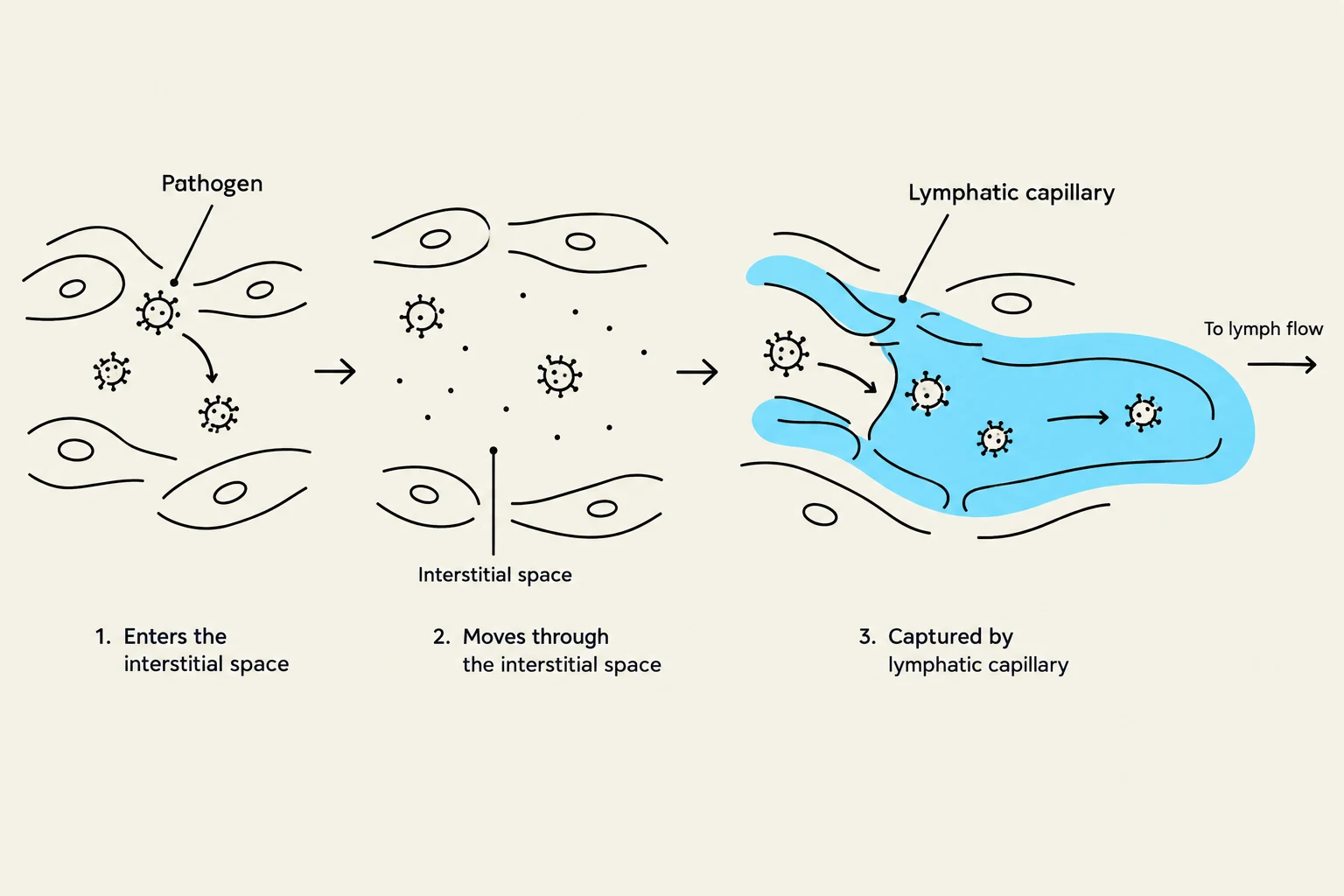
While the circulatory system provides the "highway" for transport, the lymphatic system provides the "security checkpoints." As lymphatic capillaries collect interstitial fluid, they also collect more than just water and electrolytes; they pick up cellular debris, pathogens (such as bacteria and viruses), and even cancer cells.
This fluid, now called lymph, is transported through increasingly larger vessels toward lymph nodes. Lymph nodes are specialized organs that act as biological filters. Within these nodes, the fluid is scanned by a dense concentration of white blood cells, specifically lymphocytes (B-cells and T-cells).
Diagram illustrating the process of a pathogen entering the interstitial space, moving through it, and being captured by a lymphatic capillary for lymph flow.
If a pathogen is detected, the lymph node becomes a site of intense immune activation. The lymphocytes undergo rapid proliferation, which is why lymph nodes often become swollen during an infection. This demonstrates the system's role as an active participant in the immune response rather than a passive drainage network.
Mathematical Modeling of Fluid Flux
To understand the efficiency of this integration, students can look at the relationship between capillary filtration and lymphatic drainage. In a healthy state, the net fluid movement can be conceptualized by the balance of Starling forces.
The net filtration pressure (Pnet) can be expressed as:
Pnet=(Pc−Pif)−(πp−πif)
Where:
Pc is the capillary hydrostatic pressure.
Pif is the interstitial fluid hydrostatic pressure.
πp is the plasma colloid osmotic pressure (exerted by proteins like albumin).
πif is the interstitial colloid osmotic pressure.
For the system to remain in equilibrium, the lymphatic drainage rate (Qlymph) must equal the net filtration rate (Jv) that is not reabsorbed by the venous end of the capillary:
Qlymph=∫Jvdt−Reabsorption
If Qlymph fails to keep pace with Jv, the result is lymphedema, a clinical condition where fluid accumulates in the tissues.
Summary of Systemic Integration
The lymphatic system is the ultimate integrator. It ensures that the circulatory system does not lose its fluid to the tissues, and it ensures that the immune system has access to the "intelligence" (pathogens) circulating in those tissues.
Feature
Circulatory Contribution
Lymphatic Integration
Fluid Management
Delivers nutrients/oxygen via high-pressure capillaries.
Recovers excess interstitial fluid to prevent edema.
Immune Transport
Transports leukocytes through the bloodstream.
Filters fluid in lymph nodes to activate specific immune responses.
Waste Removal
Moves metabolic byproducts via blood.
Clears large proteins and debris that cannot enter blood capillaries.
By understanding the lymphatic system not as a secondary network, but as the essential bridge between circulation and immunity, we gain a much clearer picture of how the human body maintains its internal stability.
Keep reading for free.
Create an account to finish this reading and make it part of your study routine.