An explanation of the light-dependent reactions of photosynthesis, detailing how solar energy is captured and converted into chemical energy in the form of ATP and NADPH. Covers chloroplast anatomy, photosystems, photolysis, the electron transport chain, and chemiosmosis.
Photosynthesis is the fundamental biological process that converts solar energy into chemical energy. This process occurs in two distinct stages: the light-dependent reactions and the light-independent reactions (also known as the Calvin Cycle). While the Calvin Cycle uses energy to build sugar molecules from CO2, the light-dependent reactions are responsible for capturing that initial solar energy and converting it into two high-energy carrier molecules: ATP and NADPH.
Chloroplast Anatomy and the Site of Action
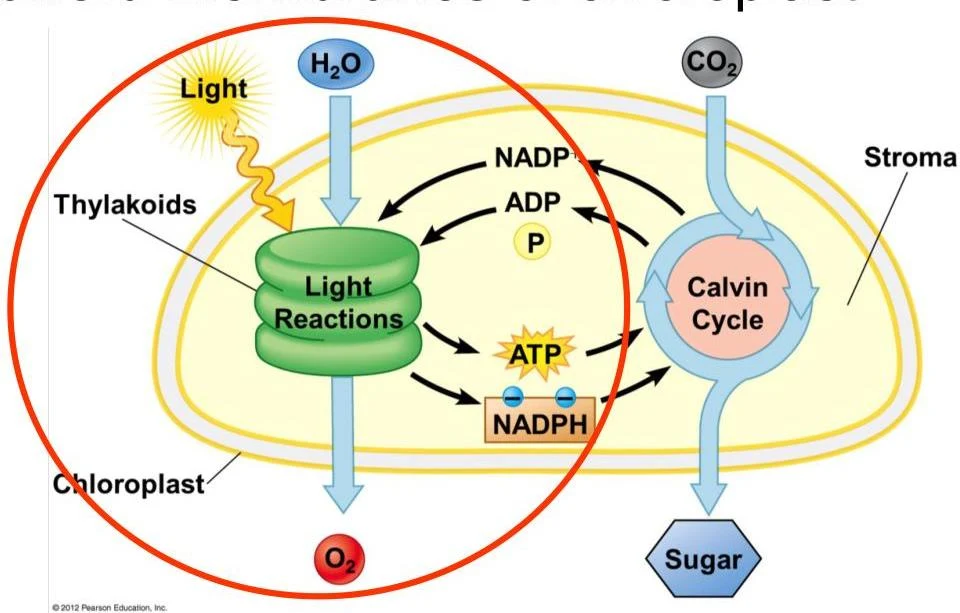
To understand how light is converted to energy, we must first look at the structure of the chloroplast. The light-dependent reactions take place specifically within the thylakoid membranes.
Diagram illustrating the light-dependent reactions and the Calvin cycle in photosynthesis within a chloroplast.
The chloroplast contains a fluid-filled space called the stroma, which surrounds the thylakoids. The thylakoids are often stacked together, and it is within these membrane-bound structures that the machinery for capturing light and transporting electrons is located.
Capturing Solar Energy: Photosystems and Pigments
The primary "engines" of the light-dependent reactions are clusters of pigments called photosystems. These are embedded in the thylakoid membranes and come in two types: Photosystem II (PSII) and Photosystem I (PSI).
The Role of Pigments
Within a photosystem, there are two main types of pigments:
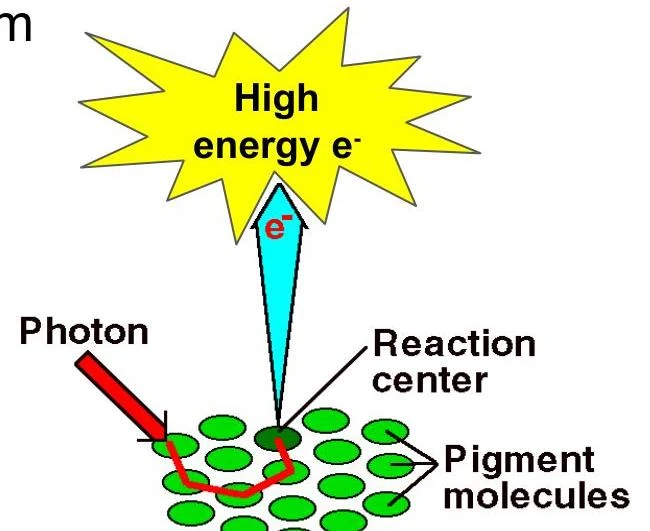
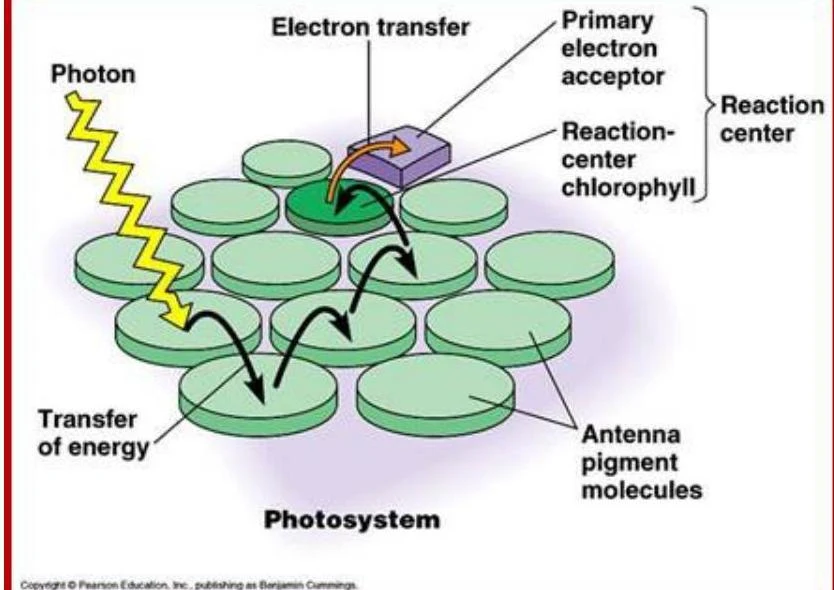
Antenna Pigments: These are accessory pigment molecules that gather light energy from incoming photons and transfer that energy toward the center of the photosystem.
Reaction Center: At the core of the photosystem lies a specific pair of chlorophyll molecules. Unlike the antenna pigments, this reaction center is the only part of the photosystem that actually uses the solar energy to trigger chemical changes.
Diagram illustrating the absorption of a photon by pigment molecules, leading to the excitation of an electron in the reaction center.
Photoactivation
When the reaction center receives the energy transferred from the antenna pigments, it undergoes photoactivation. During this process, the chlorophyll molecules become so energized that they donate high-energy electrons to a primary electron acceptor.
Diagram illustrating the process of electron transfer within a photosystem, involving photons, antenna pigment molecules, and a reaction center.
Photolysis: Replacing Lost Electrons
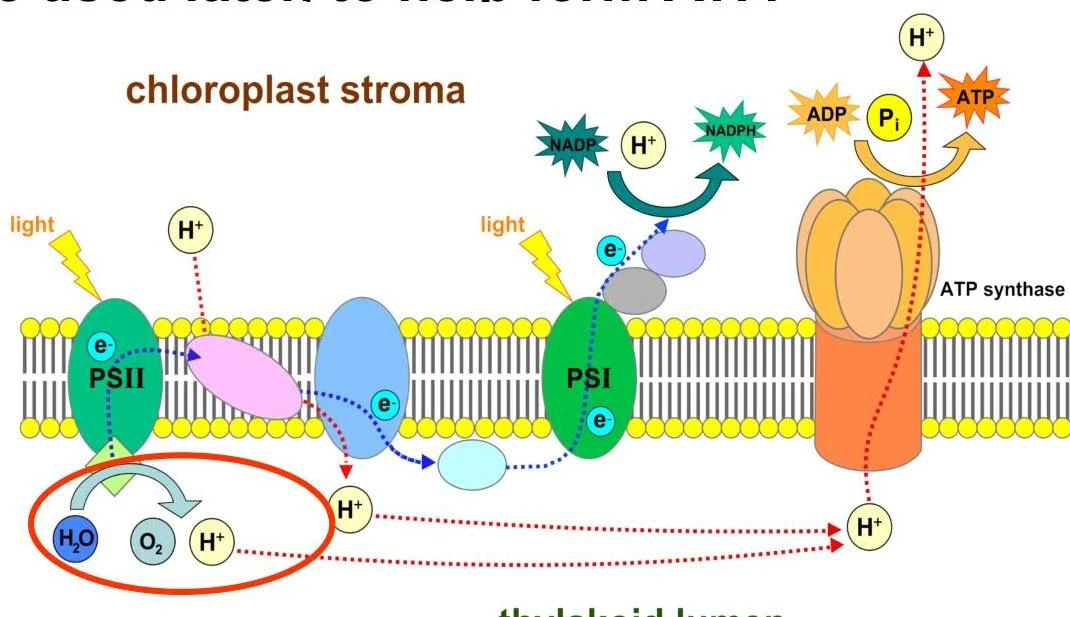
When chlorophyll in Photosystem II donates its electrons, it becomes a powerful oxidizing agent. To continue the cycle, the plant must replace those lost electrons. It does this through a process called photolysis, which is the splitting of water molecules using solar energy.
The chemical equation for this process is:
2H2Oenergy4H++4e−+O2(g)
This reaction serves three critical purposes:
Electrons (e−): Replace the electrons lost by the chlorophyll in PSII.
Oxygen (O2): Released as a byproduct, which exits the plant through the stomata.
Hydrogen Ions (H+): Contained within the thylakoid lumen to be used later in ATP synthesis.
The Electron Transport Chain (ETC) and NADPH Reduction
Once the electrons are energized in the photosystems, they move through an Electron Transport Chain (ETC). This movement is not just a simple transfer; it is used to perform work.
Building the Proton Gradient
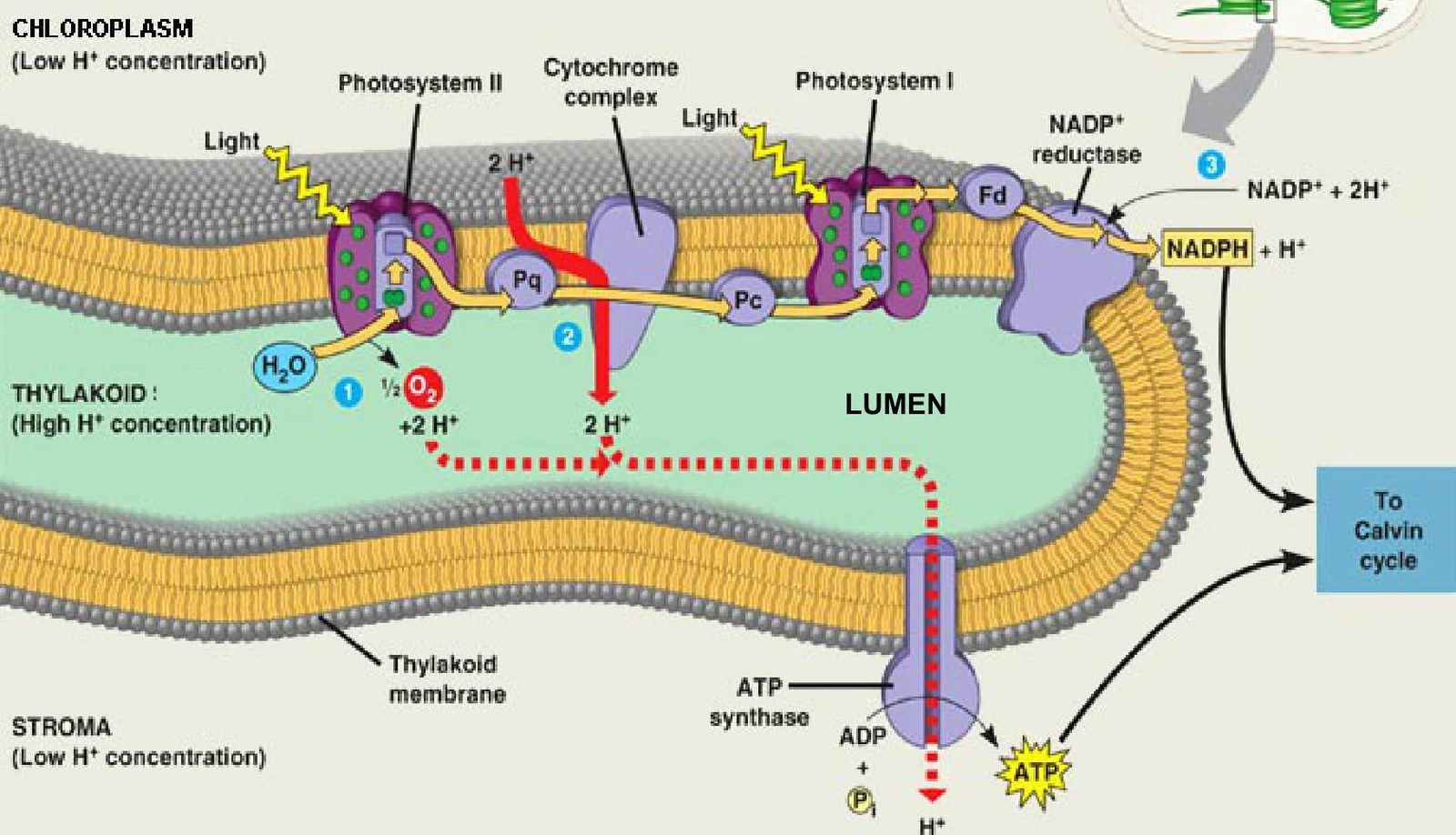
As electrons move through the ETC, their energy is used to pump H+ ions from the stroma into the thylakoid lumen. This creates a high concentration of H+ ions and a positive charge inside the lumen.
Diagram illustrating the process of ATP synthesis during photosynthesis, showing the roles of Photosystem II (PSII), Photosystem I (PSI), and ATP synthase in converting light energy into chemical energy.
NADPH Production
After passing through the ETC, the electrons reach Photosystem I, where they are re-energized by more light. These re-energized electrons are then transferred to NADP+, which acts as the final electron acceptor. When NADP+ gains two electrons and one H+ ion, it is reduced to NADPH.
Diagram illustrating the process of ATP synthesis in chloroplasts, showing the role of light, photosystems I and II, electron transport, and proton gradients in generating ATP and NADPH.
Chemiosmosis and ATP Synthesis
The final major goal of the light-dependent reactions is the production of ATP. This is achieved through chemiosmosis.
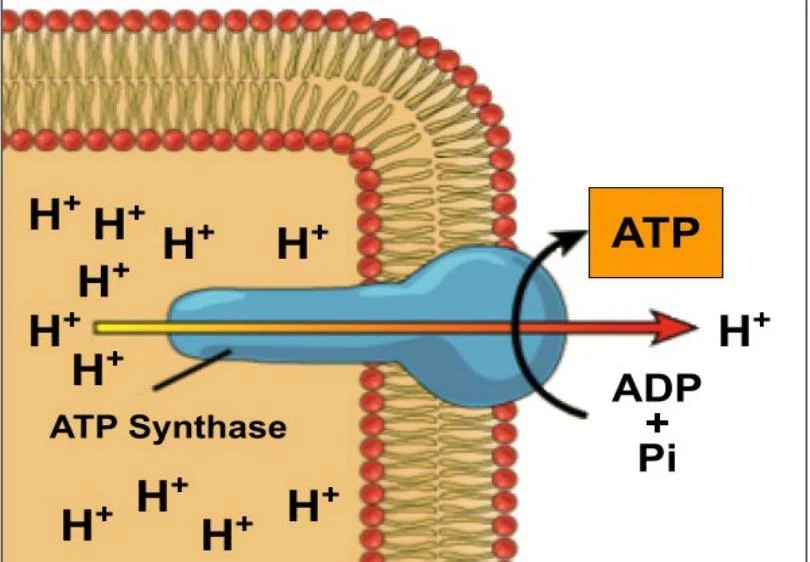
Because the ETC has built up a massive concentration of H+ ions inside the thylakoid lumen, an electrical and chemical gradient is formed. The H+ ions "want" to move back to the stroma where the concentration is lower. They can only do this by passing through a special enzyme complex called ATP synthase.
Diagram illustrating the function of ATP synthase, an enzyme that synthesizes ATP from ADP and inorganic phosphate, driven by the flow of protons (H+) across a membrane.
As the H+ ions rush through the ATP synthase (much like water flowing through a water wheel), the energy released is used to attach a phosphate group to ADP, creating ATP.
Exam Tip: Remember that while the light-dependent reactions produce the energy (ATP) and the reducing power (NADPH) needed for sugar production, no sugar is actually produced during this stage. Sugar production happens later in the Calvin Cycle.
Summary of the Light-Dependent Reactions
To recap the flow of energy:
Light Absorption: Antenna pigments capture photons and transfer energy to the reaction center.
Photoactivation: Electrons are energized and donated to the ETC.
Photolysis: Water is split to replace lost electrons, releasing O2 and H+.
Electron Transport: Electrons move through the ETC, powering the pumping of H+ into the lumen.
Reduction: Electrons are re-energized at PSI and used to reduce NADP+ to NADPH.
Chemiosmosis: The H+ gradient drives ATP synthase to produce ATP.
Diagram illustrating the light-dependent reactions of photosynthesis within a chloroplast, showing the electron transport chain, water splitting, oxygen release, and ATP and NADPH production.
Keep reading for free.
Create an account to finish this reading and make it part of your study routine.