Explore the molecular structure and regulatory mechanisms of the lac operon in E. coli, a key example of how bacteria control gene expression for efficient lactose metabolism.
In the world of microbiology, efficiency is the key to survival. For the bacterium E. coli, managing energy resources is a constant balancing act. One of the most elegant examples of this resource management is the lac operon, a functional unit of DNA that controls the expression of genes required for lactose metabolism.
Instead of constantly producing enzymes to digest lactose—which would be a waste of energy if lactose isn't around—E. coli uses the lac operon as a molecular switch to turn these genes on or off based on the environment.
The Three Layers of the Operon
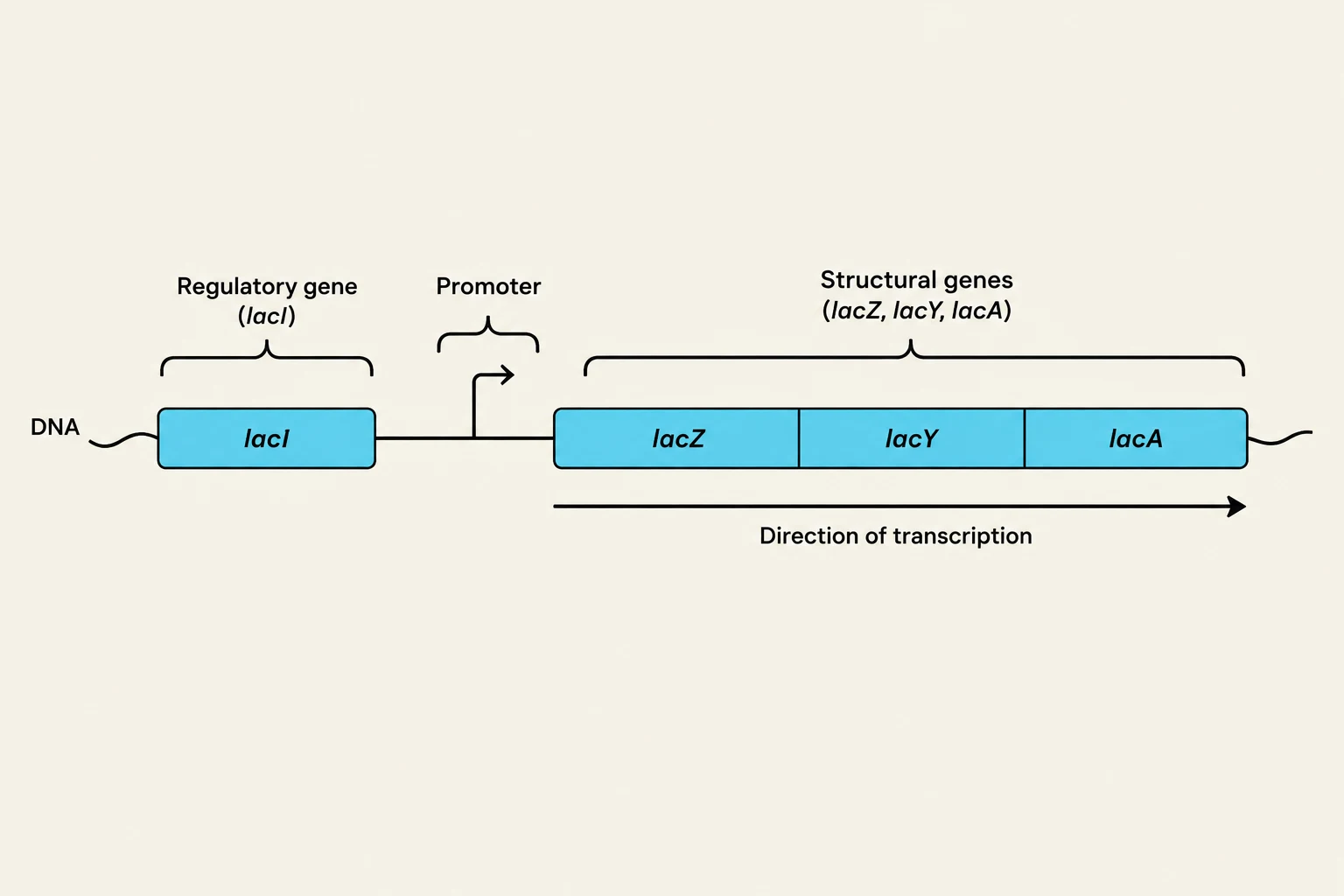
Diagram illustrating the lac operon, a genetic unit in bacteria that regulates lactose metabolism. It shows the regulatory gene (lacI), promoter, and structural genes (lacZ, lacY, lacA) on a DNA strand, with the direction of transcription indicated.
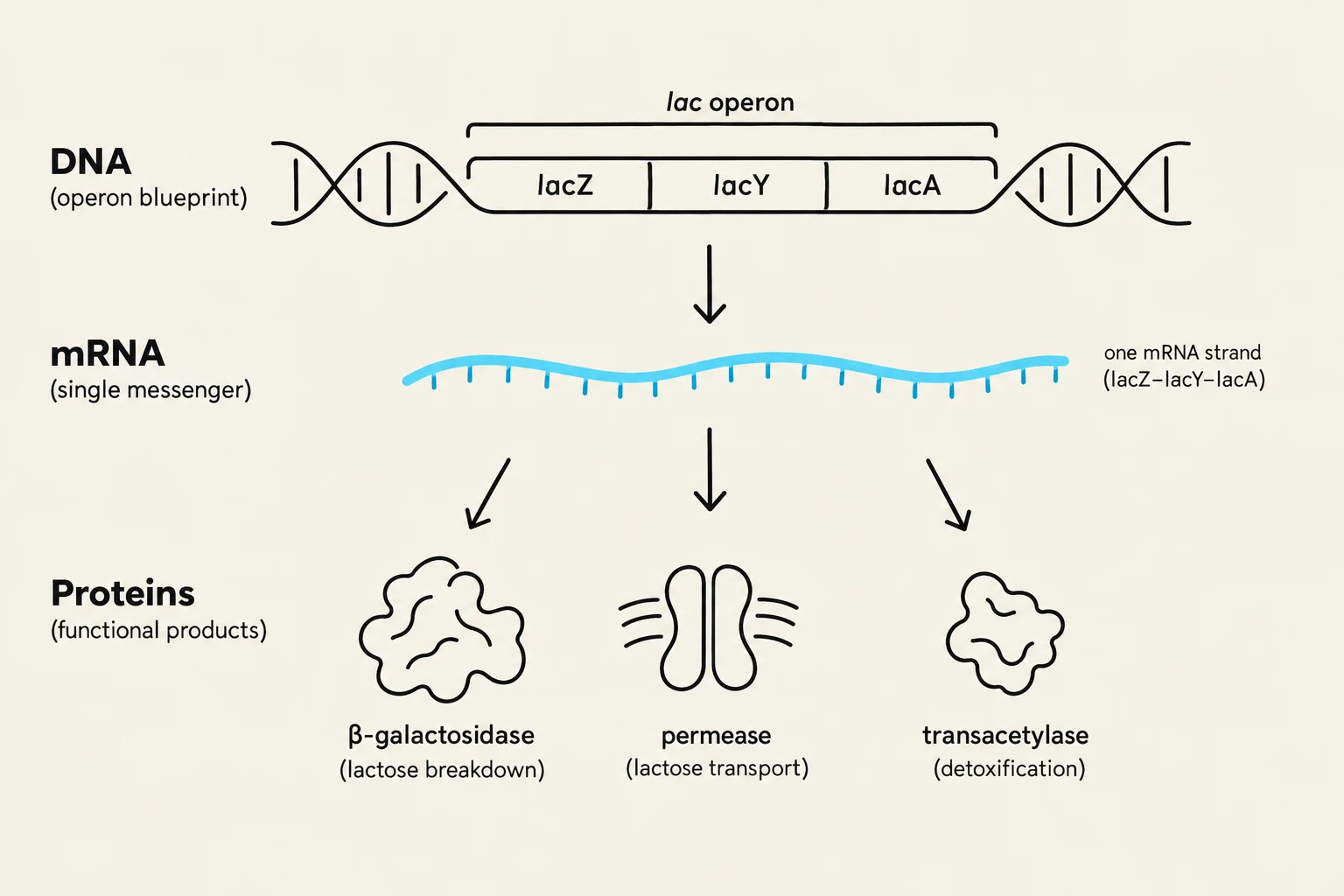
To understand how the lac operon functions, it is helpful to view it through three distinct biological layers: the DNA (the blueprint), the mRNA (the messenger), and the Protein (the functional tools).
1. The DNA Layer: The Blueprint
The DNA of the lac operon is organized into specific segments that dictate when and how much of a protein is made.
lacI (Regulatory Gene): Located at the beginning of the sequence, this gene encodes the repressor protein. This protein acts as the "lock" on the system.
Promoter Region: This is the specific binding site for RNA polymerase, the enzyme responsible for reading the DNA and initiating transcription.
Structural Genes: These are a cluster of three genes that are transcribed together as a single unit. They are bounded by a start codon at the beginning of the first gene and a stop codon at the end of the last gene.
lacZ: Encodes the enzyme β-galactosidase (β-Gal), which is responsible for splitting lactose into simpler sugars.
lacY: Encodes permease, a protein that facilitates the transport of lactose into the cell.
lacA: Encodes transacetylase.
2. The mRNA Layer: The Messenger
When the operon is active, RNA polymerase moves along the DNA from the promoter, transcribing the structural genes into a single strand of mRNA. This mRNA strand runs from the $5'$ end to the $3'$ end and carries the genetic instructions to the ribosomes for protein synthesis.
3. The Protein Layer: The Functional Enzymes
The final products of the operon are the enzymes themselves. These proteins carry out the actual work of metabolism: β-Gal splits the sugar, permease brings the sugar in, and transacetylase assists in the metabolic process.
Figure 5.3 - The lac operon illustrates the molecular structure and components in an inactive state.
How Regulation Works: The Repressor and the Inducer
Diagram illustrating the lac operon mechanism in bacteria, showing how lactose presence or absence affects gene transcription by RNA polymerase.
The "switch" of the lac operon is controlled by the interaction between a repressor protein and a molecule called an inducer.
The Inactive State (No Lactose)
When lactose is absent, the lacI gene produces a repressor protein. This repressor binds to the operator region (the area between the lacI gene and the structural genes). By binding here, the repressor physically blocks RNA polymerase from moving down the DNA strand. Because the polymerase cannot pass, the structural genes cannot be transcribed into mRNA, and no enzymes are produced.
The Active State (Lactose Present)
When lactose enters the cell, it acts as an inducer. The lactose interacts with the repressor protein, causing it to undergo a conformational change that turns it into an inactive repressor. In this inactive state, the repressor can no longer grip the DNA. With the "roadblock" removed, RNA polymerase is free to move along the DNA, transcribing the lacZ, lacY, and lacA genes into mRNA, which is then translated into the enzymes needed to digest the lactose.
Exam Tip: Remember that the repressor's job is to stop transcription. The inducer (lactose) doesn't "turn on" the DNA directly; instead, it "turns off" the repressor, which indirectly allows transcription to proceed.
The lac operon in DNA is transcribed into mRNA, which is then translated into three proteins: beta-galactosidase, permease, and transacetylase, each with a specific function in lactose metabolism.
Metabolic Efficiency: The Two-Part Control Mechanism
You might wonder: why doesn't E. coli just keep the operon ready at all times? The answer lies in energy conservation.
Digesting lactose is "costly" for the cell. It requires the production of specific proteins, and the process of breaking down lactose yields less energy than breaking down glucose. To maximize efficiency, E. coli employs a two-part control mechanism to ensure the operon is only active when it is absolutely necessary.
The operon is expressed only when these two conditions are met:
Lactose is present: To provide the substrate (the food) for the enzymes.
Glucose is scarce: To ensure the cell isn't wasting energy on the "costly" lactose metabolism when a more efficient energy source (glucose) is available.
If glucose is abundant, the cell will prioritize it, even if lactose is present, because glucose is the preferred and more efficient fuel source.
Summary Table: Lac Operon Components
Component
Type
Function
lacI
Regulatory Gene
Encodes the repressor protein
Promoter
DNA Region
Binding site for RNA polymerase
lacZ
Structural Gene
Encodes β-galactosidase (splits lactose)
lacY
Structural Gene
Encodes permease (transports lactose)
lacA
Structural Gene
Encodes transacetylase
Lactose
Inducer
Inactivates the repressor to allow transcription
Keep reading for free.
Create an account to finish this reading and make it part of your study routine.