The Journey to the Double Helix: A History of DNA as Genetic Material
Explore the historical experiments and discoveries that led to the identification of DNA as the molecule of heredity and the elucidation of its double helix structure. Learn about key scientists and their contributions, from Miescher's nuclein to Watson and Crick's model.
For decades, the scientific community faced a profound mystery: while the existence of genes was well-established by the early 20th century, no one knew what they were actually made of. Was the blueprint of life a complex protein, or a simpler molecule like DNA? The answer was not found in a single moment of brilliance, but through a series of rigorous experiments that moved from observing mysterious "transforming substances" to identifying the specific chemical structure of the double helix.
The Early Clues: From Nuclein to Transformation
The chemical journey began in 1869 when Friedrich Miescher isolated a substance from the nuclei of white blood cells. He noted that this substance was unusually rich in phosphorus, a characteristic that would later prove vital in identifying DNA. Miescher called this substance "nuclein," though he did not yet realize its role in heredity.
In 1928, Frederick Griffith provided the first functional clue through his work with Streptococcus pneumoniae. He observed a phenomenon known as bacterial transformation. When he mixed heat-killed virulent (S) bacteria with living non-virulent (R) bacteria, the resulting mixture could kill a mouse. This suggested that something had passed from the dead S cells to the living R cells, transforming them into a deadly state. Griffith called this mysterious agent the "transforming substance," but he could not identify its chemical nature.
Identifying the Transforming Principle
The search for the identity of the transforming substance reached a turning point in 1944. Oswald Avery, Colin MacLeod, and Maclyn McCarty sought to isolate the specific molecule responsible for Griffith's transformation. By using targeted enzymatic treatments to destroy proteins, RNA, and DNA separately, they discovered that only the destruction of DNA prevented transformation from occurring.
Despite this, many scientists remained skeptical. At the time, the tetranucleotide theory suggested that DNA was merely a repetitive, monotonous polymer of four bases, making it "too simple" to carry complex genetic information. It was widely believed that proteins, with their 20 different amino acids, were the only molecules capable of such complexity. However, several lines of evidence began to tilt the scales toward DNA:
UV Absorption: DNA absorbs light most strongly at 260 nm, whereas proteins absorb at 280 nm.
Stability: DNA is highly stable and persists across generations, while proteins are constantly degraded.
Consistency: The same DNA is found in every cell of an organism, regardless of the different proteins those cells produce.
The Definitive Proof: Hershey and Chase
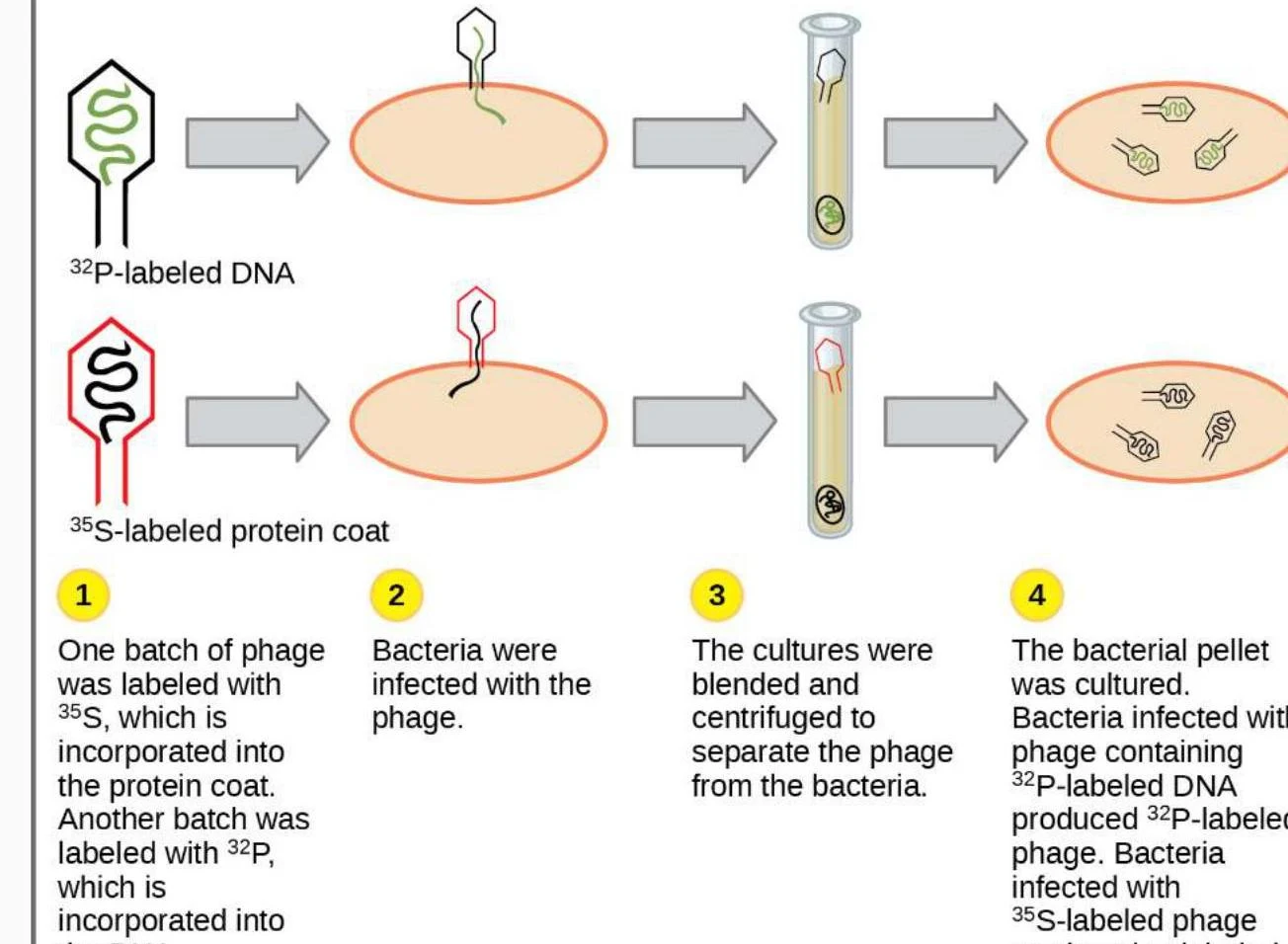
The debate was finally settled in 1952 by Alfred Hershey and Martha Chase through an elegant experiment using bacteriophages (viruses that infect bacteria). They utilized radioactive labeling to distinguish between the two main components of the virus: protein and DNA.
They knew that sulfur is found in certain amino acids but never in DNA, while phosphorus is a key component of the DNA backbone but is absent in proteins. By labeling phage proteins with radioactive 35S and phage DNA with radioactive 32P, they could track which substance entered the bacteria during infection.
This diagram illustrates the Hershey-Chase experiment, which used radioactive isotopes to determine whether DNA or protein is the genetic material. Phages were labeled with either 32P (DNA) or 35S (protein) and allowed to infect bacteria. Subsequent steps involved blending, centrifugation, and culturing to analyze the results, ultimately showing that DNA carries genetic information.
The results were conclusive: only the 32P (the DNA) entered the bacterial cells to direct the production of new viruses. This proved once and for all that DNA, not protein, is the molecule that carries genetic information.
Historical Note: While Hershey and Chase's work was monumental, it is a reminder of the historical erasure of women in science. Although they published together, Alfred Hershey received the Nobel Prize in 1969, while Martha Chase was not mentioned.
The Structure of Life: The Double Helix
With the identity of the genetic material confirmed, the next challenge was understanding its structure. Erwin Chargaff provided a crucial piece of the puzzle by discovering that in any organism, the amount of Adenine (A) always equals Thymine (T), and Guanine (G) always equals Cytosine (C).
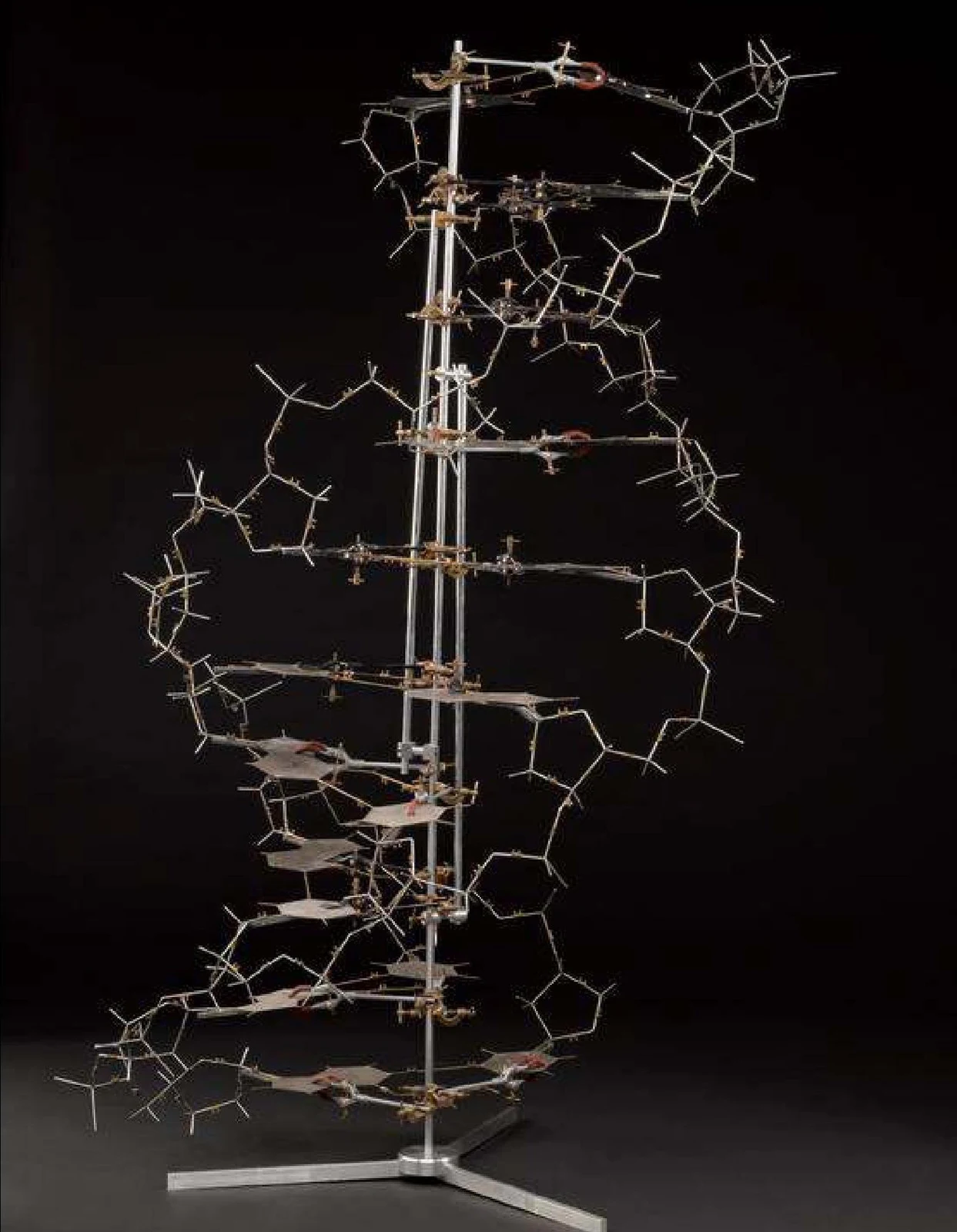
In 1953, James Watson and Francis Crick, building upon the X-ray diffraction data of Rosalind Franklin, proposed the double helix model. This structure consists of two antiparallel strands twisted around each other.
A physical model of the DNA double helix structure.
Molecular Components
The building blocks of this structure are nucleotides. Each nucleotide is composed of three parts:
A nitrogenous base: Either a purine (Adenine or Guanine, which have a double-ring structure) or a pyrimidine (Cytosine or Thymine, which have a single-ring structure).
A 5-carbon sugar (deoxyribose).
A phosphate group.
The two strands are held together by hydrogen bonds between the complementary bases: A pairs with T via two hydrogen bonds, and G pairs with C via three hydrogen bonds. The "backbone" of the molecule is formed by the sugar and phosphate groups, connected by $5'$-$3'$ phosphodiester bonds.
Sequencing and Modern Analysis
Today, we no longer just wonder what DNA is; we can read its entire sequence. Techniques like the Sanger method allow scientists to determine the exact order of nucleotides. This method uses dideoxynucleotides (ddNTPs), which lack a free 3' OH group. When a ddNTP is added to a growing DNA strand, it acts as a chain terminator, stopping further growth.
By analyzing the lengths of these terminated fragments using gel electrophoresis—a process where negatively charged DNA fragments move through a gel toward a positive electrode based on their size—researchers can reconstruct the genetic code. This technology has revolutionized biology, allowing us to trace human migrations and study the evolutionary relationships between humans and extinct species like Neanderthals.
Exam Tip: When studying DNA structure, remember that "structure determines function." The complementary nature of the base pairing (A-T, G-C) is exactly what allows DNA to be copied so accurately during cell division.
Keep reading for free.
Create an account to finish this reading and make it part of your study routine.