The Jefferson Presidency and the Shaping of the Early Republic
An overview of Thomas Jefferson's presidency, covering the Election of 1800, landmark judicial decisions like Marbury v. Madison, the Louisiana Purchase, and foreign policy challenges leading to the War of 1812.
The presidency of Thomas Jefferson marked a transformative era in American history, characterized by a profound tension between revolutionary ideals and the harsh realities of governing a growing nation. As the leader of the Democratic-Republican Party, Jefferson sought to dismantle the centralized power favored by the Federalists, yet his tenure would ultimately see the expansion of federal authority and the doubling of the nation's size. This period was defined by intense partisan conflict, landmark judicial rulings, and a shifting global landscape that forced the young republic to find its footing on the world stage.
The Election of 1800 and the Rise of the Democratic-Republicans
The Election of 1800 is often referred to as a "revolution" because it marked the first peaceful transfer of power between opposing political parties. Under the original constitutional framework, the electoral process was flawed; the runner-up in the presidential race became the Vice President. In 1800, this resulted in an awkward political situation where Thomas Jefferson and his rival Aaron Burr received the same number of electoral votes, leading to a deadlock that required the House of Representatives to intervene.
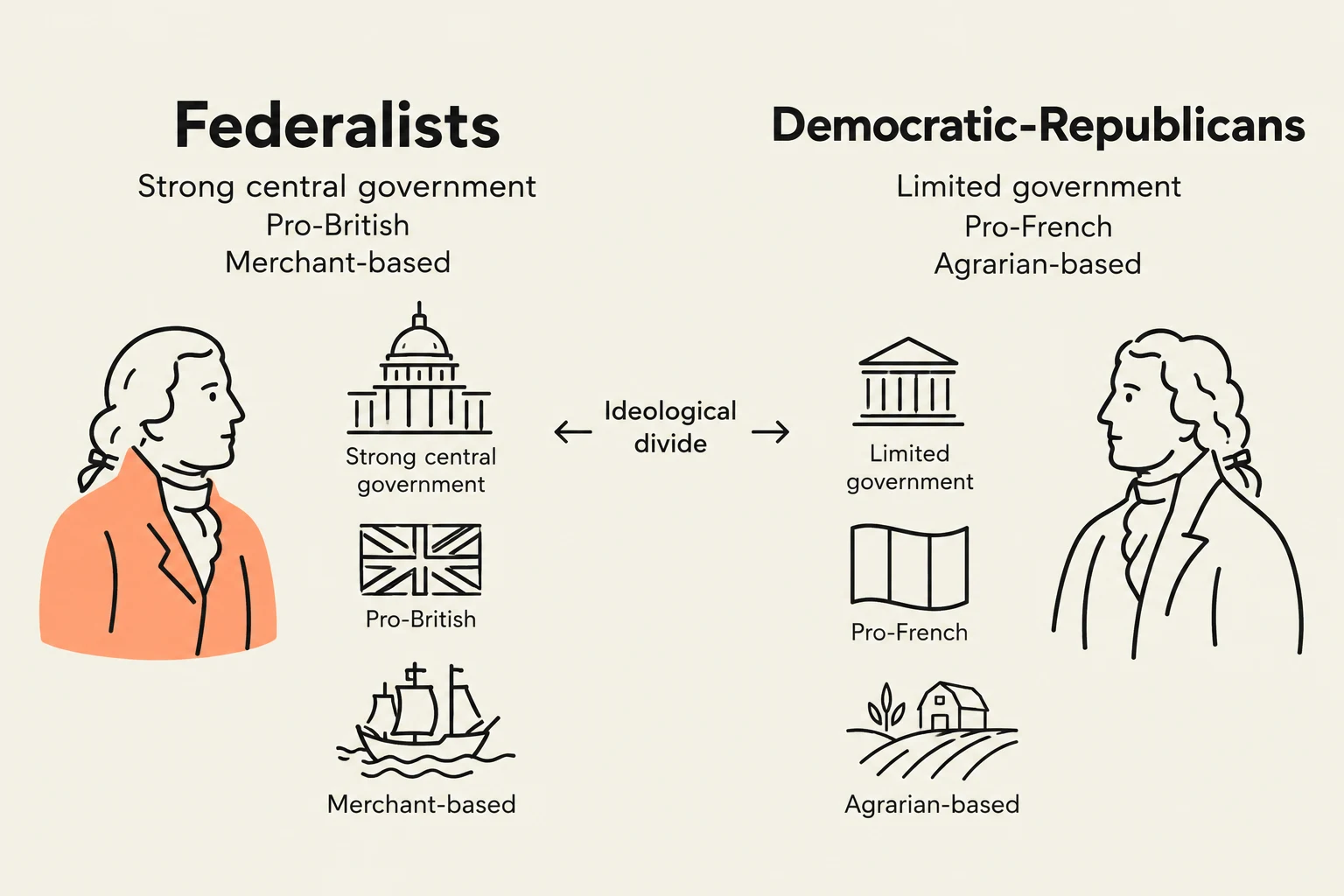
The victory of the Democratic-Republicans signaled a shift away from the Federalist vision of a strong, centralized government led by merchants and bankers. The new administration, known as the Jefferson Cabinet, included key figures like James Madison as Secretary of State. This era was defined by a clash of ideologies: the Federalists were often anglophiles (supporters of England) who favored Alexander Hamilton’s financial systems, while the Democratic-Republicans were francophiles (supporters of France) who championed states' rights and small-scale farmers.
Exam Tip: If a question asks about the primary difference between Federalists and Democratic-Republicans, focus on their views on central authority and their foreign allegiances (England vs. France).
This illustration contrasts the Federalist and Democratic-Republican parties in early American history, highlighting their differing views on government, foreign alliances, and economic bases.
Judicial Supremacy and the Midnight Appointments
As the Federalists prepared to leave office, they attempted to retain influence through the Judiciary Act of 1801. This act created new circuit court positions, allowing outgoing President John Adams to make what became known as "midnight appointments"—judicial commissions signed in the final hours of his term to ensure Federalist control of the courts.
This maneuver led to the landmark Supreme Court case Marbury v. Madison. When the new administration refused to deliver the commissions, the case reached Chief Justice John Marshall. Marshall’s ruling was a masterstroke of political maneuvering: he declared that while Marbury was entitled to his commission, the part of the Judiciary Act of 1801 that allowed the Court to issue such orders was unconstitutional. This established the principle of judicial supremacy, asserting that the Supreme Court has the final authority to interpret the Constitution and strike down laws passed by Congress.
Pragmatism in Action: The Louisiana Purchase
Thomas Jefferson entered office as a strict constructionist, arguing that the federal government only possessed powers explicitly granted by the Constitution. However, his presidency frequently required him to act as a pragmatist—prioritizing national interest over rigid ideology.
The most significant example of this was the Louisiana Purchase. Originally, Napoleon Bonaparte intended to use the Louisiana Territory to provide food for the sugar plantations in the Caribbean. However, the Haitian Revolution, led by Toussaint L'Ouverture, disrupted French control in the Caribbean and forced Napoleon to abandon his American colonial ambitions. Needing funds for his wars in Europe, Napoleon offered to sell the entire Louisiana Territory to the United States.
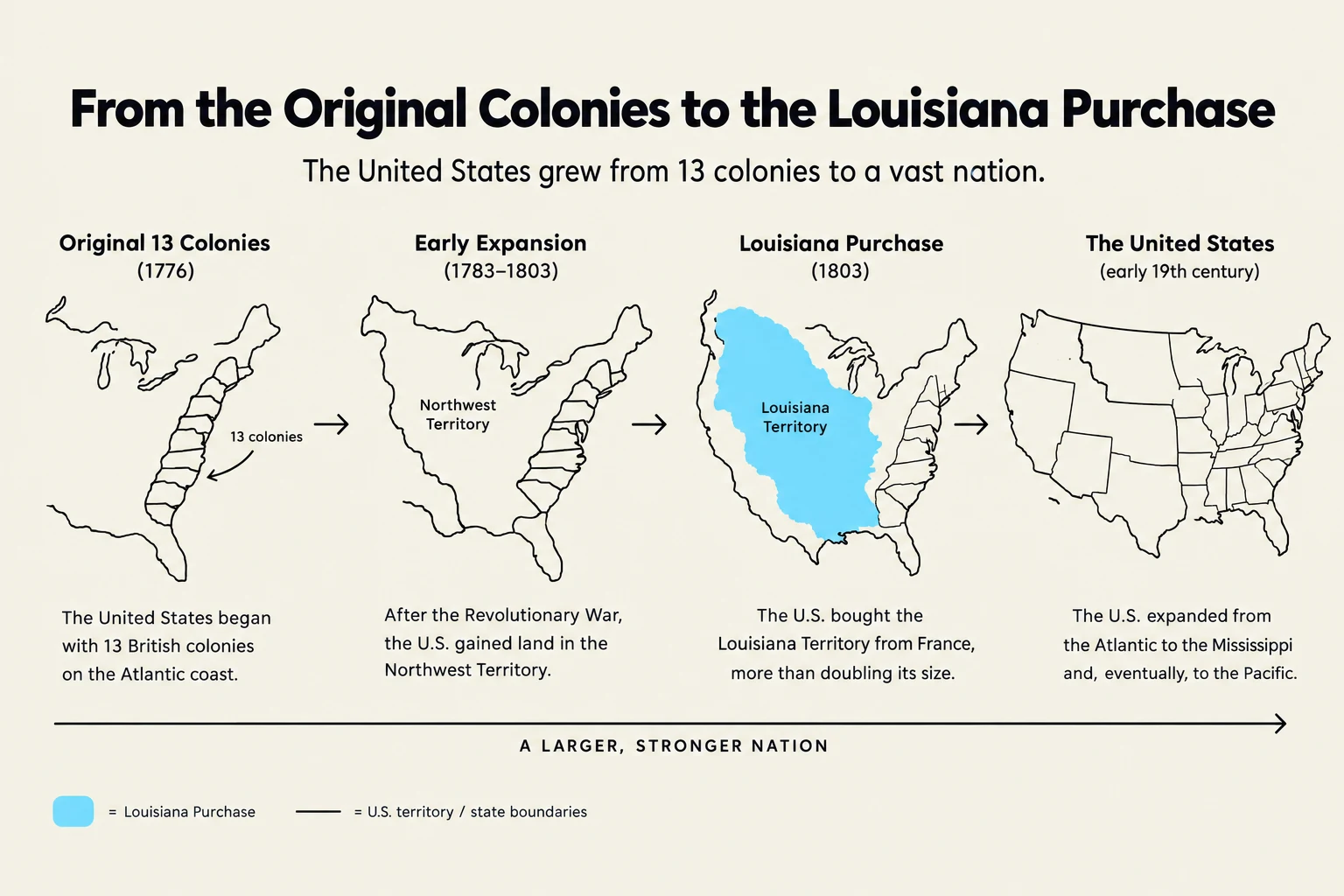
Despite his belief that the Constitution did not explicitly grant the president the power to acquire new territory, Jefferson accepted the deal. This purchase more than doubled the size of the United States, providing vast amounts of land for future expansion. To explore this new frontier, Jefferson commissioned the Lewis and Clark Expedition, which was famously aided by the linguist Sacagawea.
This illustration shows the territorial expansion of the United States from the original 13 colonies to the Louisiana Purchase and beyond, illustrating its growth into a larger nation.
Foreign Conflict and the Embargo Act
Jefferson's foreign policy was often reactive. When Barbary pirates began seizing American merchant vessels in the Mediterranean, Jefferson abandoned his anti-militarist stance and deployed the Marines to Tripoli to protect national interests.
Domestically, the tension between the states and the federal government remained high. In response to the Alien and Sedition Acts (which targeted critics of the government), Jefferson and Madison authored the Virginia and Kentucky Resolutions, introducing the concept of nullification—the idea that states could invalidate unconstitutional federal laws.
As international tensions between Britain and France escalated, the United States found itself caught in the crossfire. The British practiced impressment, forcibly drafting American sailors into the British Navy. In an attempt to maintain neutrality and avoid war, Jefferson implemented the Embargo Act of 1807, which closed all American ports to foreign trade. While intended to pressure Europe, the act severely damaged the American economy, particularly hurting the Federalist-leaning merchant class.
The Road to the War of 1812
The friction caused by British interference and the failure of the Embargo Act eventually led to the War of 1812. The conflict was characterized by significant struggles, including the British burning the capital and the rise of "War Hawks" in Congress who pushed for military action.
The war saw various turning points:
Naval Success: While the British Navy was a global hegemon, American warships, often featuring double-hulled designs, performed remarkably well at sea.
The Battle of New Orleans: General Andrew Jackson achieved a decisive victory against the British, which bolstered his national reputation.
Native American Resistance: Leaders like Tecumseh attempted to unite various tribes to resist American expansion, leading to significant conflict in the interior.
The war concluded with the Treaty of Ghent, which largely restored the status quo ante bellum (the state of affairs before the war). Despite the lack of clear territorial gains, the era solidified the role of the federal government and set the stage for the industrial and territorial growth of the 19th century.
Key Concept Summary:
Strict Constructionism: Interpreting the Constitution narrowly.
Pragmatism: Acting based on practical necessity rather than theory.
Judicial Supremacy: The Court's power to declare laws unconstitutional.
Keep reading for free.
Create an account to finish this reading and make it part of your study routine.