The Interplay of Nature, Nurture, and Evolutionary Psychology
Explore the complex interaction between genetics (nature) and environment (nurture) in shaping human behavior. This guide covers behavioral genetics, evolutionary psychology, and the role of epigenetics.
How much of who we are is written in our DNA, and how much is shaped by the world around us? For decades, psychologists debated whether "nature" or "nurture" was the primary driver of human behavior. Today, we understand that this is not a competition between two forces, but a complex, lifelong interaction. To understand human psychology, we must look at three distinct but overlapping lenses: behavioral genetics, evolutionary theory, and the molecular mechanisms of epigenetics.
Nature vs. Nurture and Behavioral Genetics
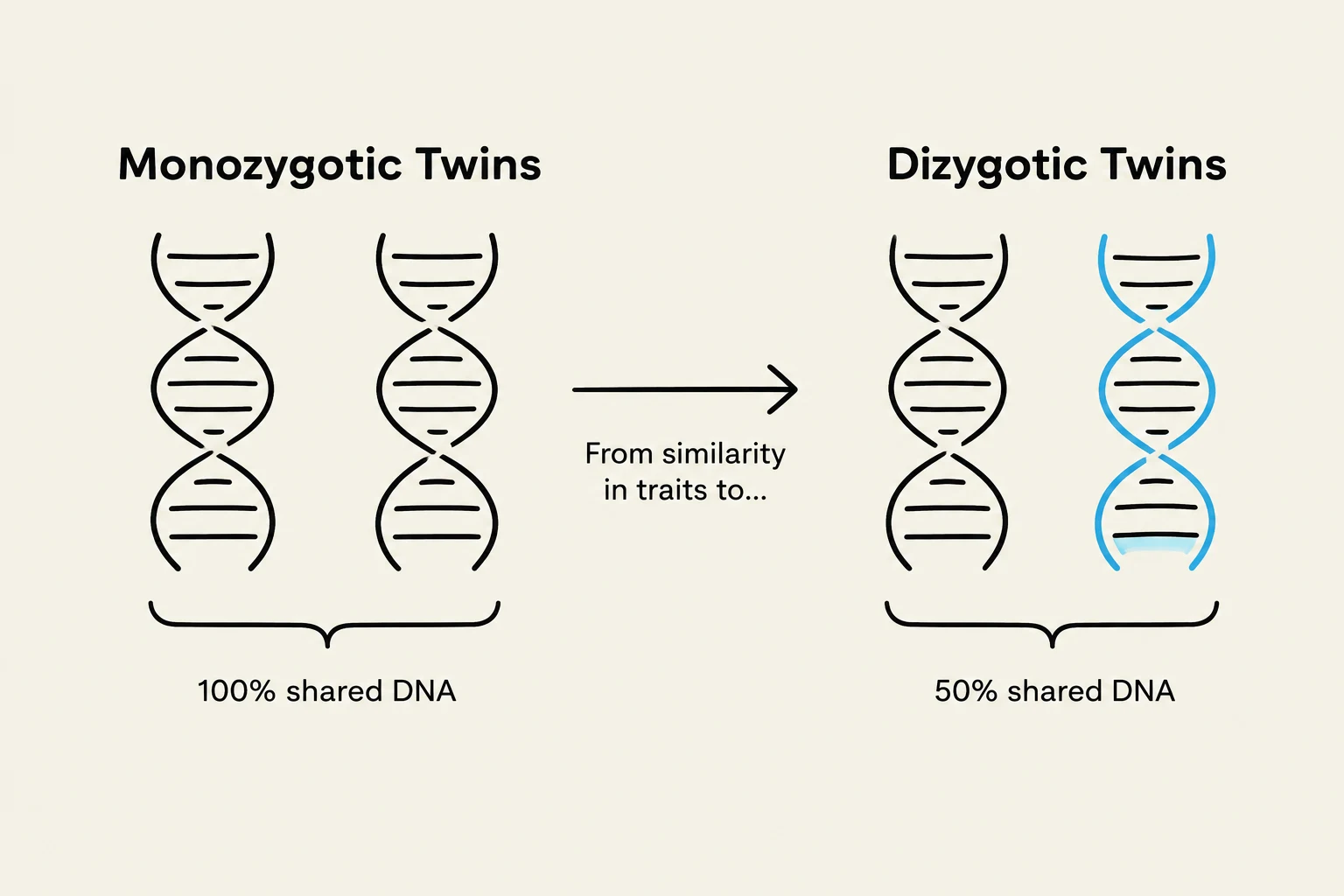
This illustration compares monozygotic (identical) twins, who share 100% of their DNA, with dizygotic (fraternal) twins, who share approximately 50% of their DNA.
In modern psychology, nature refers to our genes and biological inheritance, while nurture encompasses our environment, upbringing, culture, and life experiences. Rather than choosing one over the other, researchers study how they work together.
Disentangling Genes from Environment
To figure out how much of a trait is due to biology, scientists use behavioral genetics, primarily through two research designs:
Adoption Studies: These compare children to their biological parents (who share genes) and their adoptive parents (who share the environment).
Twin Studies: Researchers compare monozygotic twins (identical twins who share 100% of their DNA) with dizygotic twins (fraternal twins who share approximately 50% of their segregating genes). If identical twins are significantly more similar in a trait than fraternal twins, it suggests a strong genetic influence.
Exam Tip: Understanding Heritability
Do not confuse "heritability" with an individual's genetic makeup. Heritability is a population statistic ranging from 0 to 1. It measures how much of the variation in a trait within a specific population is due to genetic differences. For example, if everyone in a group has the same environment, heritability might be high even if the trait is biologically driven, because the only differences left are genetic.
Gene-Environment Interaction (G x E)
Genes do not act in a vacuum; their effects often depend on the environment. This is known as gene-environment interaction (G x E).
Worked Example: PKU
Phenylketonuria (PKU) is a genetic condition. However, the severe cognitive consequences typically associated with the disorder can be significantly mitigated through strict dietary management. Here, the genetic "nature" (the PKU gene) interacts with the "nurture" (nutritional environment) to determine the final behavioral outcome.
Evolutionary Psychology
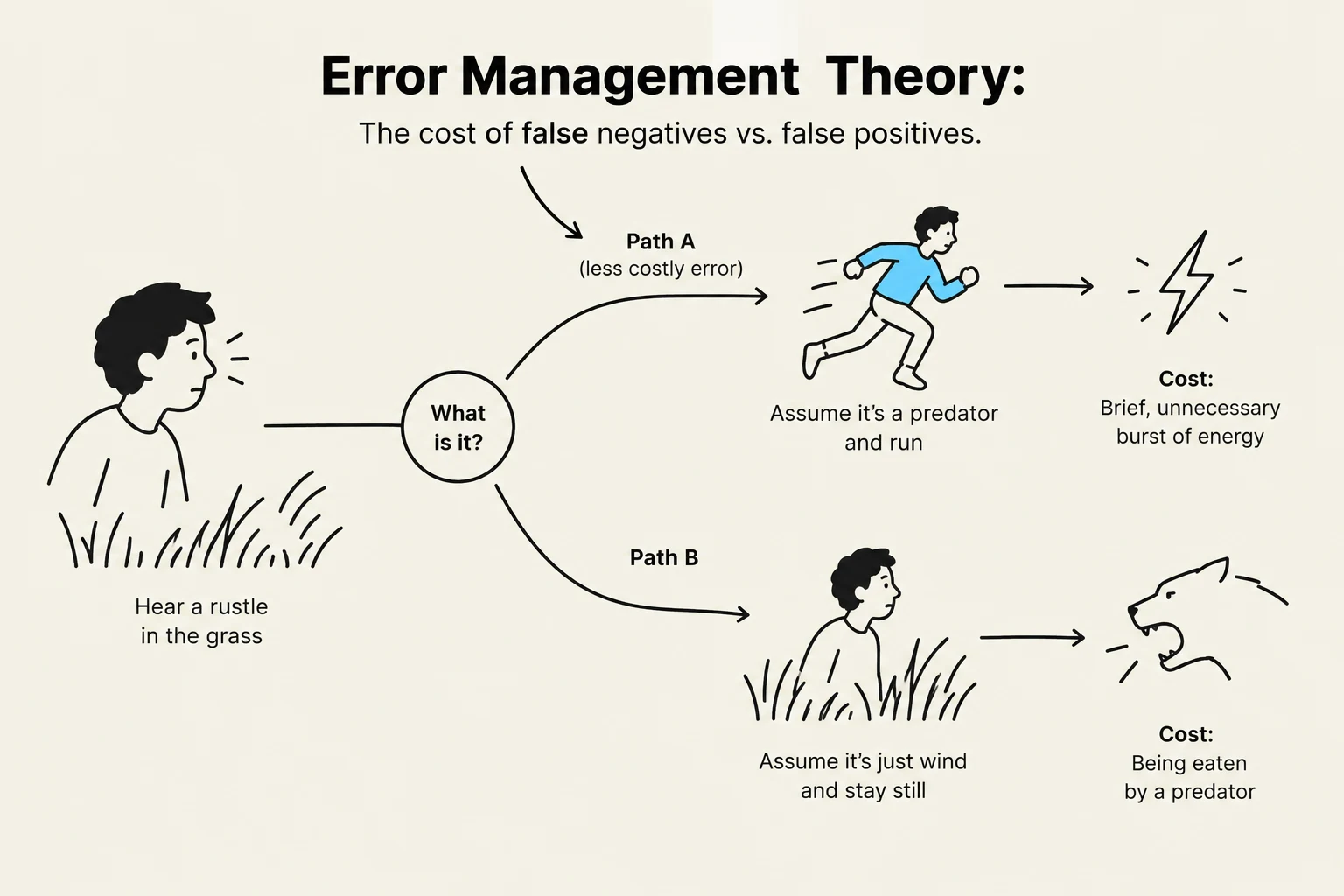
This diagram illustrates Error Management Theory, explaining the costs associated with false negatives and false positives in decision-making, using the example of hearing a rustle in the grass.
While behavioral genetics looks at how traits are passed down, evolutionary psychology looks at why certain traits exist in the first place. This field is rooted in natural selection, the process where traits that increase reproductive success are favored and passed to the next generation.
Adaptations and Selection
Evolutionary pressures generally fall into two categories:
Survival Adaptations: Traits that help an organism stay alive long enough to reproduce (e.g., a fear response to predators).
Reproductive Adaptations: Traits that help an organism attract mates or successfully raise offspring.
Within these categories, sexual selection plays a massive role. This occurs through intrasexual competition (competition between members of the same sex, such as males competing for access to females) and intersexual selection (mate choice, where one sex chooses a partner based on specific desirable traits).
Complex Evolutionary Theories
Inclusive Fitness: This theory suggests that behaviors can evolve to increase the representation of shared genes, even in non-descendant relatives (like cousins or aunts), because they carry some of your DNA.
Psychological Adaptations: These are flexible mental mechanisms—such as jealousy, cooperation, or attention biases—that evolved to solve recurring survival or reproductive problems.
Sexual Strategies Theory: This proposes that humans have evolved flexible mating strategies that change based on whether the context is short-term or long-term.
Error Management Theory (EMT): This explains why our brains are often biased. When faced with uncertainty, natural selection favors the "less costly error". For example, it is safer to overestimate the danger of a rustle in the grass (a false positive) than to underestimate a predator (a false negative).
Epigenetics: The Molecular Bridge
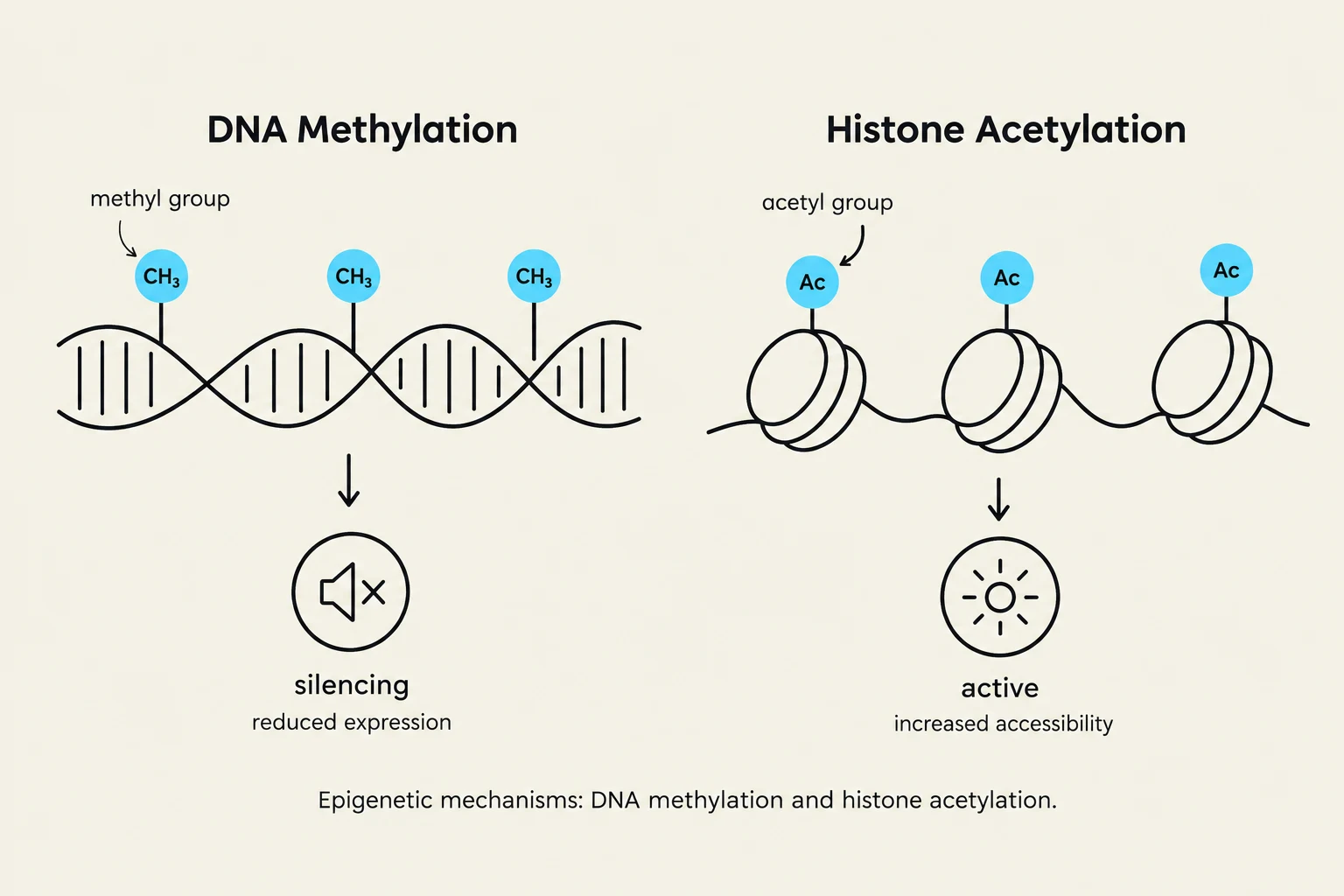
This illustration depicts two epigenetic mechanisms: DNA methylation, which leads to gene silencing and reduced expression, and histone acetylation, which results in active gene expression and increased accessibility.
If nature and nurture are interacting, how does the environment actually "talk" to our genes? The answer lies in epigenetics. Epigenetics refers to changes in gene expression that occur without altering the underlying DNA sequence.
Our DNA is wrapped around proteins called histones, and together they form a structure called chromatin. The way this structure is packaged determines whether a gene is "on" (accessible for transcription) or "off" (hidden away).
Key Epigenetic Mechanisms
There are two primary ways the cell regulates this access:
DNA Methylation: This typically reduces gene expression. Enzymes add methyl groups to regulatory regions of the DNA, acting like a "silencer" that makes the gene less active.
Histone Acetylation: This generally increases gene expression. By adding acetyl groups to the histones, the chromatin structure loosens, making the DNA more accessible for the cell to read.
Clinical Connection: Learning and Memory
Epigenetic mechanisms are vital for synaptic plasticity—the ability of the brain to change and form new connections. Research shows that increased histone acetylation is often associated with improved memory and learning, whereas excessive activity in enzymes that remove these groups can interfere with cognitive function.
Through these mechanisms, our experiences—such as nutrition, stress, and even maternal care—can leave "marks" on our epigenome, influencing how our genes function throughout our lives.
Keep reading for free.
Create an account to finish this reading and make it part of your study routine.