The Inland Hydrologic Cycle and Properties of Water
Explore the inland hydrologic cycle, including water transfer processes like precipitation, evaporation, transpiration, and infiltration. Learn about the unique physical properties of water, such as density, specific heat, and viscosity, and their impact on aquatic environments and the cycle itself.
The movement of water on Earth is not a static state but a continuous, dynamic process of transfer. Within terrestrial environments, this movement is described by the inland hydrologic cycle, a system where water moves between various "compartments" or reservoirs—such as the atmosphere, soil, rivers, and groundwater—through specific physical and biological processes. Understanding this cycle requires looking beyond simple movement; we must examine the fluxes, which represent the rate at which water moves between these compartments, typically measured in units such as volume per year.
The Drivers of Water Flux
The hydrologic cycle is powered by several key processes that facilitate the transfer of water across the landscape. These processes act as the "engines" of the cycle, moving water from one storage compartment to another.
Precipitation
Precipitation serves as the primary input of water into the terrestrial system. Whether in the form of rain, snow, or sleet, it delivers water from the atmospheric compartment to the land surface, setting the entire cycle in motion.
Evaporation and Transpiration
Once water is on the surface, it can return to the atmosphere through two distinct pathways:
Evaporation: This is the physical process where liquid water changes into water vapor.
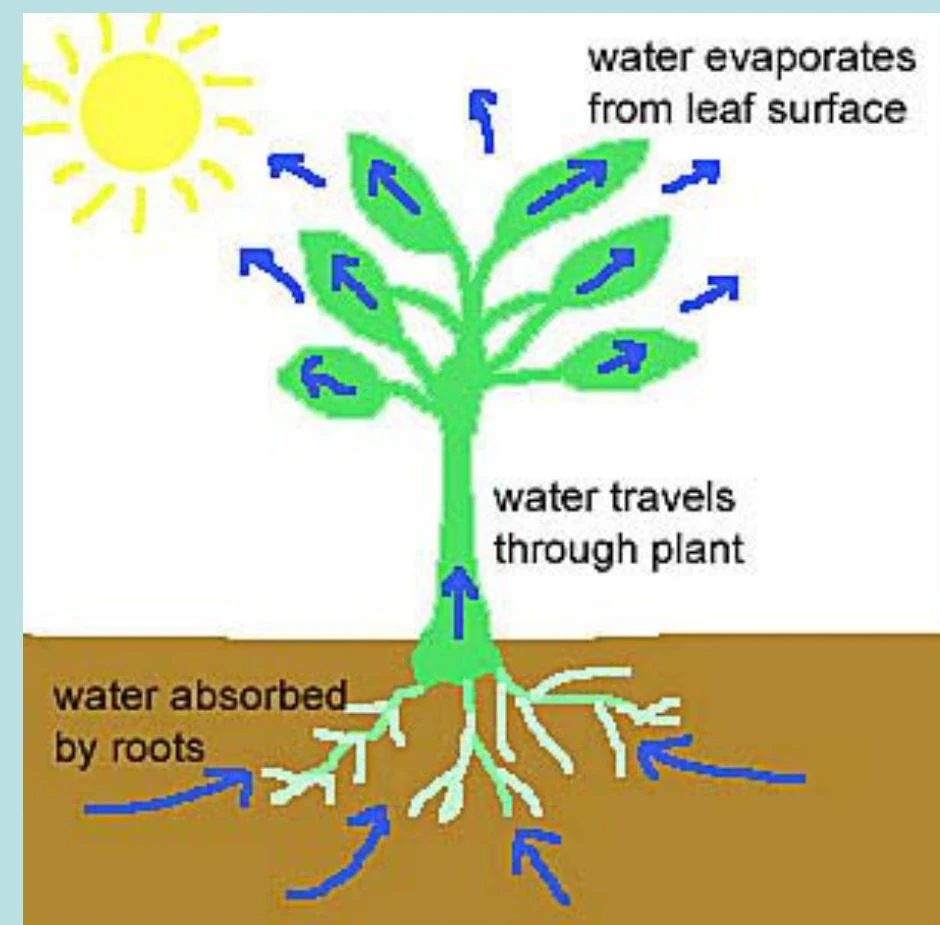
Transpiration: This is a biological process. Plants absorb water through their roots and eventually release it into the atmosphere as vapor through tiny pores in their leaves called stomata.
Diagram illustrating the process of transpiration in plants, showing water absorption by roots, transport through the plant, and evaporation from leaf surfaces.
Evapotranspiration (ET)
In environmental science, we often combine these two processes into a single term: Evapotranspiration (ET). ET represents the total water loss from a landscape due to both the physical evaporation from soil and water bodies and the biological transpiration from vegetation.
Study Tip: When calculating water budgets for a specific region, always look for the ET rate. High ET rates often indicate dense vegetation or high temperatures, which can significantly deplete available surface water.
Run-off and Infiltration
After precipitation reaches the land, it follows one of two main paths:
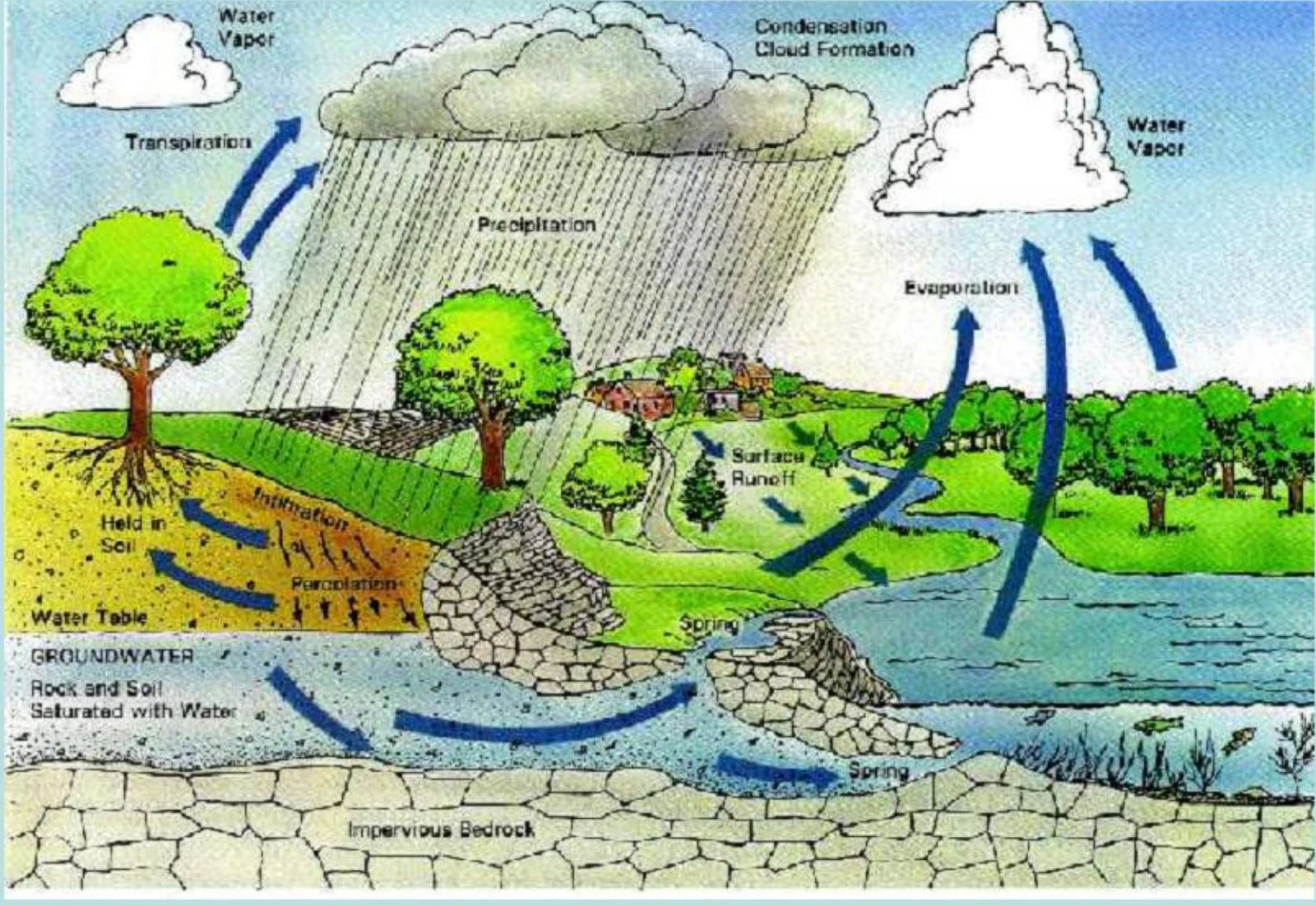
Run-off: If the water does not soak into the ground, it moves across the land surface, flowing into streams, rivers, and eventually larger bodies of water.
Infiltration: This is the process by which water penetrates the soil surface and moves downward into the subsurface.
Once water has infiltrated the soil, it can contribute to groundwater flow, moving through underground aquifers and eventually resurfacing in springs or rivers.
Diagram illustrating the water cycle, including evaporation, transpiration, condensation, precipitation, infiltration, percolation, surface runoff, and groundwater flow.
Compartments, Fluxes, and Residence Time
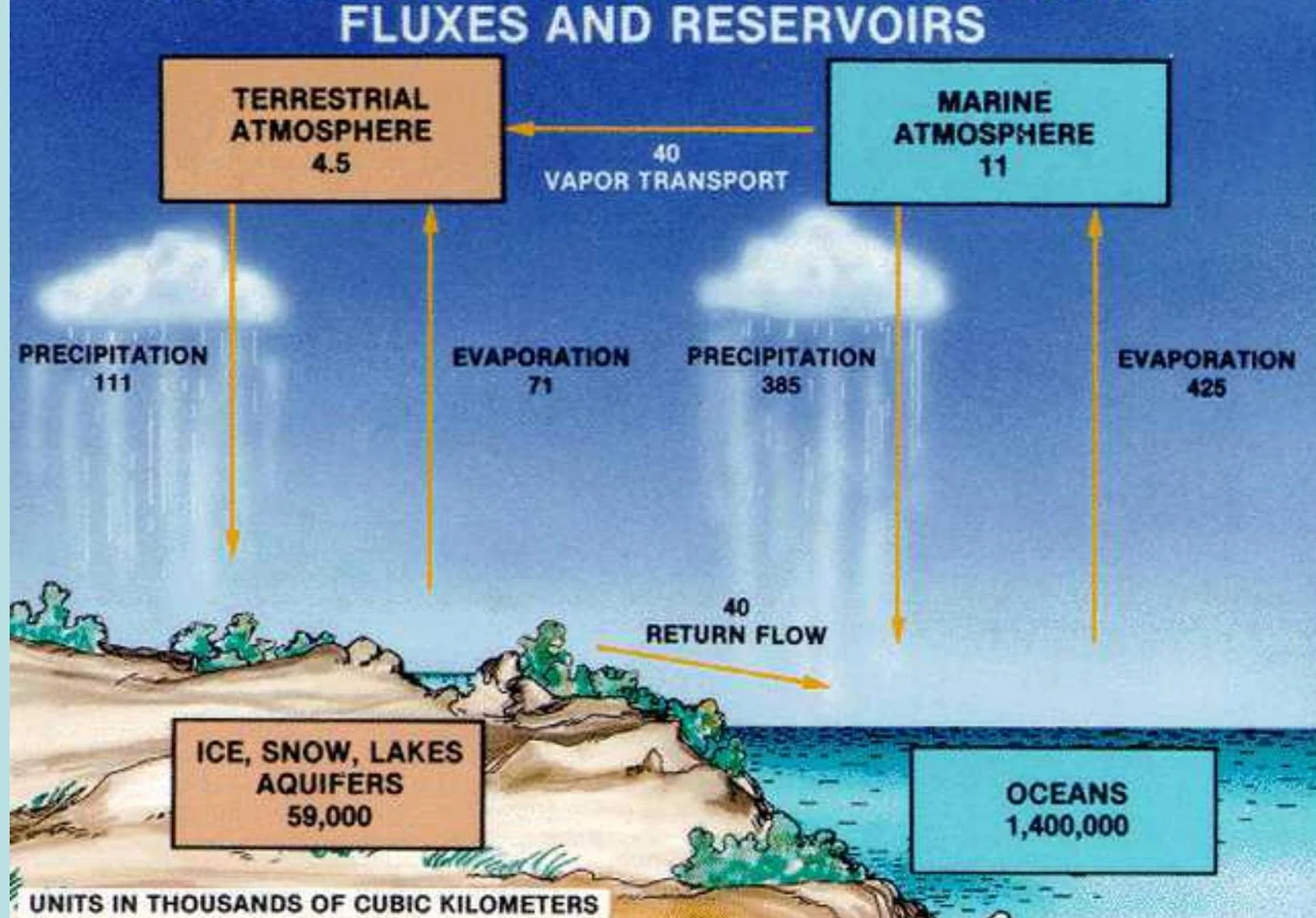
To model the hydrologic cycle, scientists divide the world into compartments (reservoirs where water is stored) and fluxes (the rate of transfer).
A critical concept in this study is residence time. This refers to the average duration that a water molecule remains within a specific compartment. Residence times vary wildly; for example, water may stay in the atmosphere for only a few days, while water in a deep groundwater aquifer might remain for centuries.
This diagram illustrates the global water cycle, showing the fluxes and reservoirs of water between the terrestrial atmosphere, marine atmosphere, ice/snow/lakes/aquifers, and oceans. Units are in thousands of cubic kilometers.
Regional Variations: The Riparian Zone Example
While global averages provide a baseline for the hydrologic cycle, they often hide significant regional differences. A prime example can be found in riparian zones—the interface between land and a river or stream.
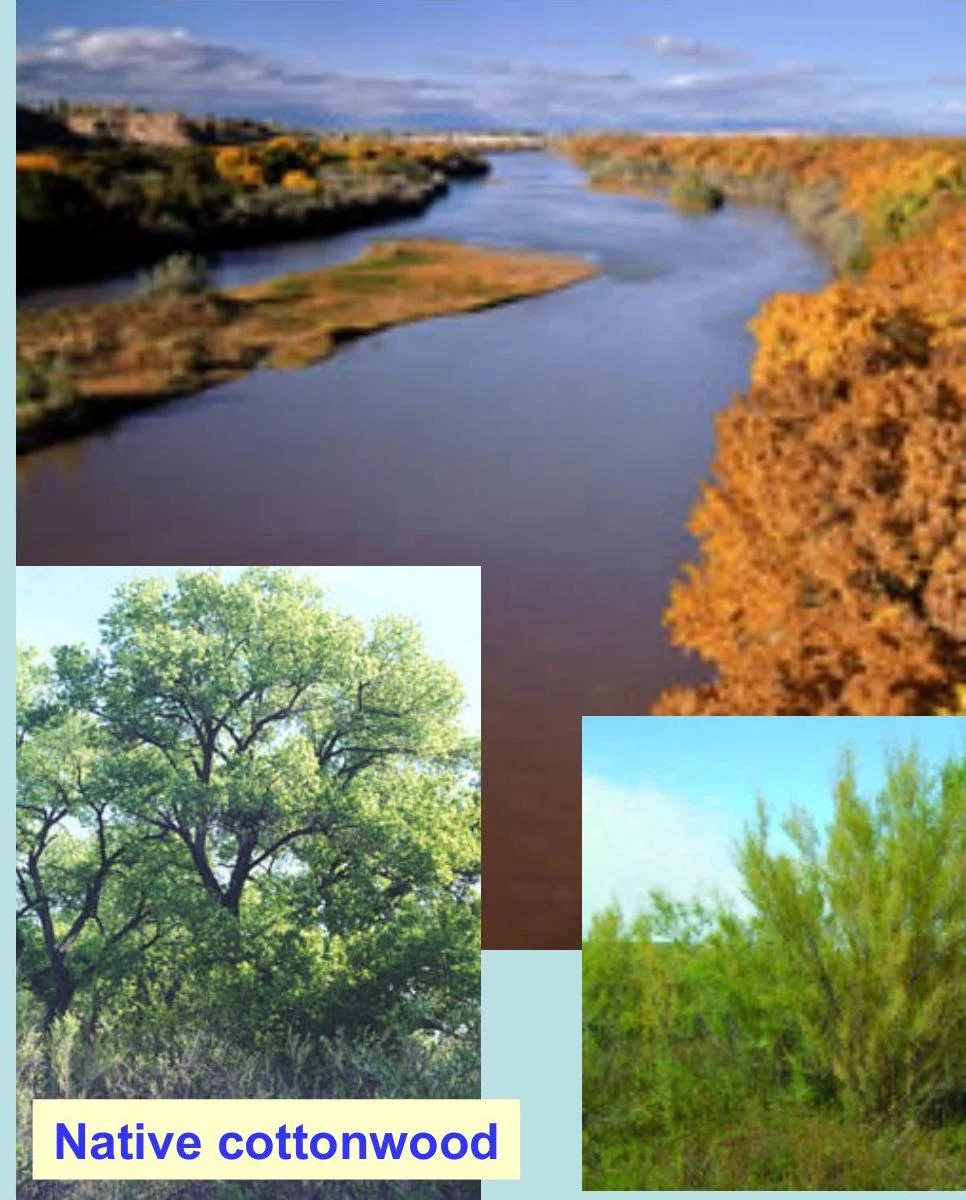
In the Middle Rio Grande of New Mexico, the type of vegetation present can drastically alter the local water flux. For instance, invasive plant species may have much higher evapotranspiration rates compared to native species like cottonwoods. This means that even in the same geographic area, the "water footprint" of the landscape changes depending on whether the vegetation is native or invasive.
Native cottonwood trees along a river.
Climate Change and the Future of Water Flux
Global warming is expected to fundamentally alter the inland hydrologic cycle. While a warmer atmosphere can hold more moisture—potentially creating a "more humid world" overall—it also increases local variability.
We can expect:
More rapid movement among compartments (faster cycling).
Increased variability in precipitation patterns (more intense storms followed by longer droughts).
The Physical Properties of Water
The movement of water is also dictated by its unique chemical and physical properties. Because of its molecular structure (one oxygen atom and two hydrogen atoms), water exhibits behaviors that influence how it moves through the cycle.
Density and Thermal Stratification
Water's density changes with temperature in a way that is vital for aquatic ecosystems. Unlike most substances, water reaches its maximum density at approximately 4°C.
Above 4°C: Water becomes less dense and "floats" on top of cooler water.
Below 4°C: As water cools toward freezing, it becomes less dense again, which is why ice floats on liquid water.
In lakes, these density differences lead to thermal stratification, where the water divides into layers: the warm surface layer (epilimnion), the middle layer (metalimnion), and the cold bottom layer (hypolimnion).
Diagram illustrating wind-driven circulation and temperature stratification in a body of water.
Specific Heat and Viscosity
Water also possesses a high specific heat, meaning it does not change temperature as quickly as air. This allows large bodies of water to moderate the temperature of surrounding land. Additionally, water has a high viscosity compared to air, creating resistance to flow that aquatic organisms must overcome when moving.