The Index of Consumer Sentiment: Bridging Psychology and Economics
An explanation of the Index of Consumer Sentiment (ICS), its role as a leading economic indicator, and its significance in economic psychology. It covers how the index measures consumer confidence and expectations, and its relationship to classical economic theory and behavioral reality.
In classical economic theory, the "Homo Economicus" is a creature of pure logic—a being with perfect knowledge, unbounded computational power, and unwavering willpower. However, real-world markets rarely behave with such mathematical precision. To understand why people deviate from these idealized models, economists and psychologists look toward the human mind. One of the most vital tools in this endeavor is the Index of Consumer Sentiment (ICS), a metric designed to capture the subjective, psychological heartbeat of the economy.
What is the Index of Consumer Sentiment?
The Index of Consumer Sentiment (ICS) is a psychological indicator used to quantify the level of confidence households have regarding the economy. Rather than looking solely at "hard" data like Gross Domestic Product (GDP) or industrial production, the ICS focuses on subjective feelings about financial situations. It asks: How do people feel about their money, and how do they expect the world to change?
The index was pioneered by George Katona in 1951. Katona, a Hungarian psychologist, was a central figure in the movement to reconnect psychology and economics, arguing that macroeconomic processes are deeply influenced by the psychological states of individuals. To ensure consistency over time, the index was standardized to a value of 100 in 1964.
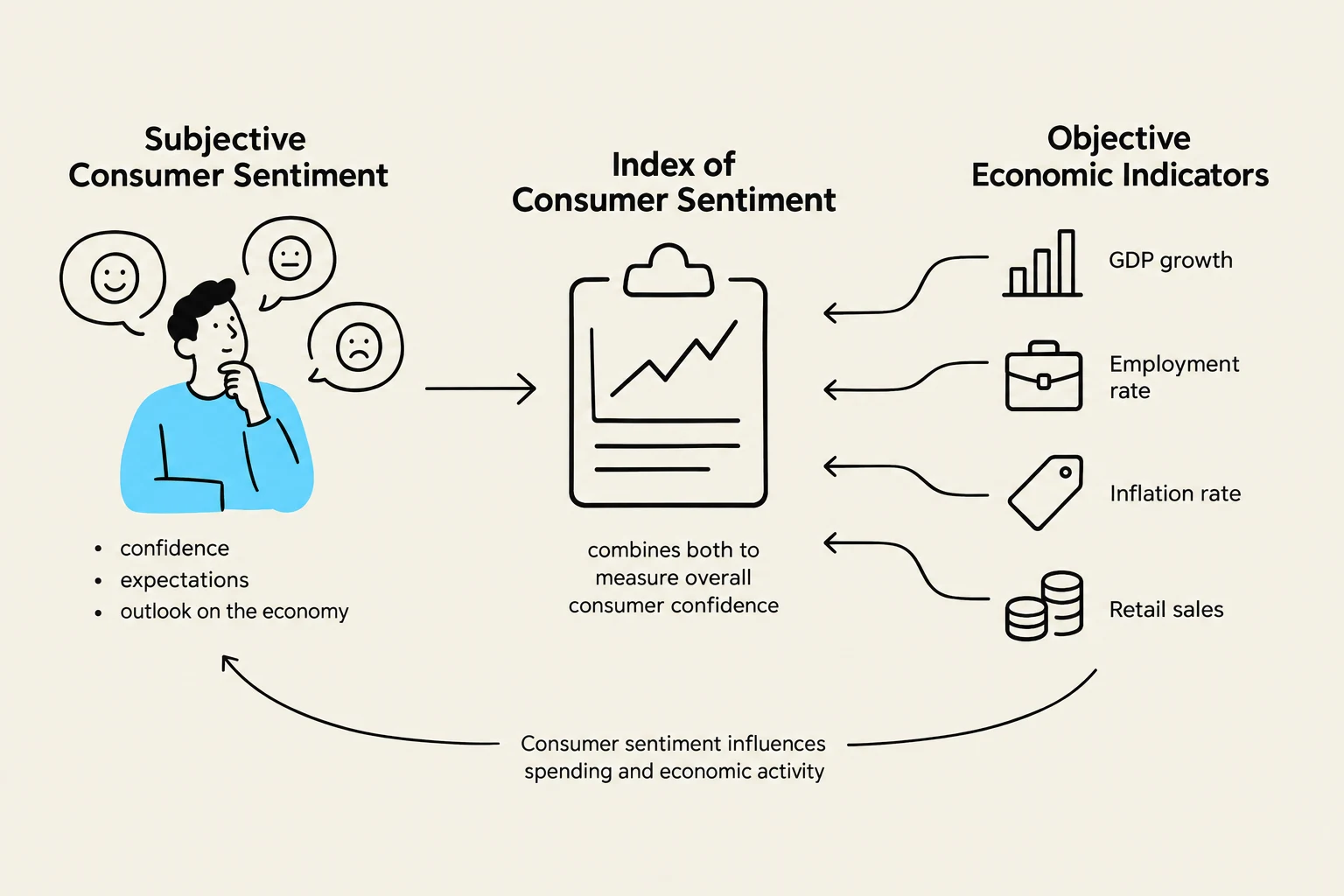
This diagram illustrates the relationship between subjective consumer sentiment, the index of consumer sentiment, and objective economic indicators such as GDP growth, employment rate, inflation rate, and retail sales. It explains that consumer sentiment influences spending and economic activity.
A Leading Indicator of Economic Activity
One of the most significant roles of the ICS is its function as a leading indicator of future economic activity. In economics, a "leading indicator" is a variable that changes before the economy as a whole begins to follow a particular trend.
Because consumer spending is a massive driver of economic growth, the way people feel about their future purchasing power often dictates their actual behavior. If consumers feel pessimistic about the coming year, they are likely to reduce spending, save more, and delay large purchases, which can subsequently lead to a slowdown in the actual economy.
Research has demonstrated that the ICS possesses high predictive validity for economic developments. This means that by observing shifts in the index, economists can often forecast upcoming shifts in consumer behavior and broader economic cycles.
Exam Tip: If asked to distinguish between a "lagging" and a "leading" indicator, remember that the ICS is leading because it captures expectations and intentions before they manifest in hard economic data like employment rates or retail sales.
Measuring the Human Element: Dimensions of the Survey
To capture these complex attitudes, surveys (such as those conducted in the EU since 2007) ask consumers to evaluate several specific dimensions of their lives. These questions are designed to move beyond simple "happy/sad" metrics and instead probe specific consumer expectations and attitudes:
General Economic Conditions: Participants evaluate how the economy performed in the past year and what they expect for the coming year.
Employment and Inflation: Consumers project changes in the unemployment rate and future price developments (inflation).
Personal Finances: This involves evaluating the household's own economic position and their specific intentions regarding saving or making large purchases.
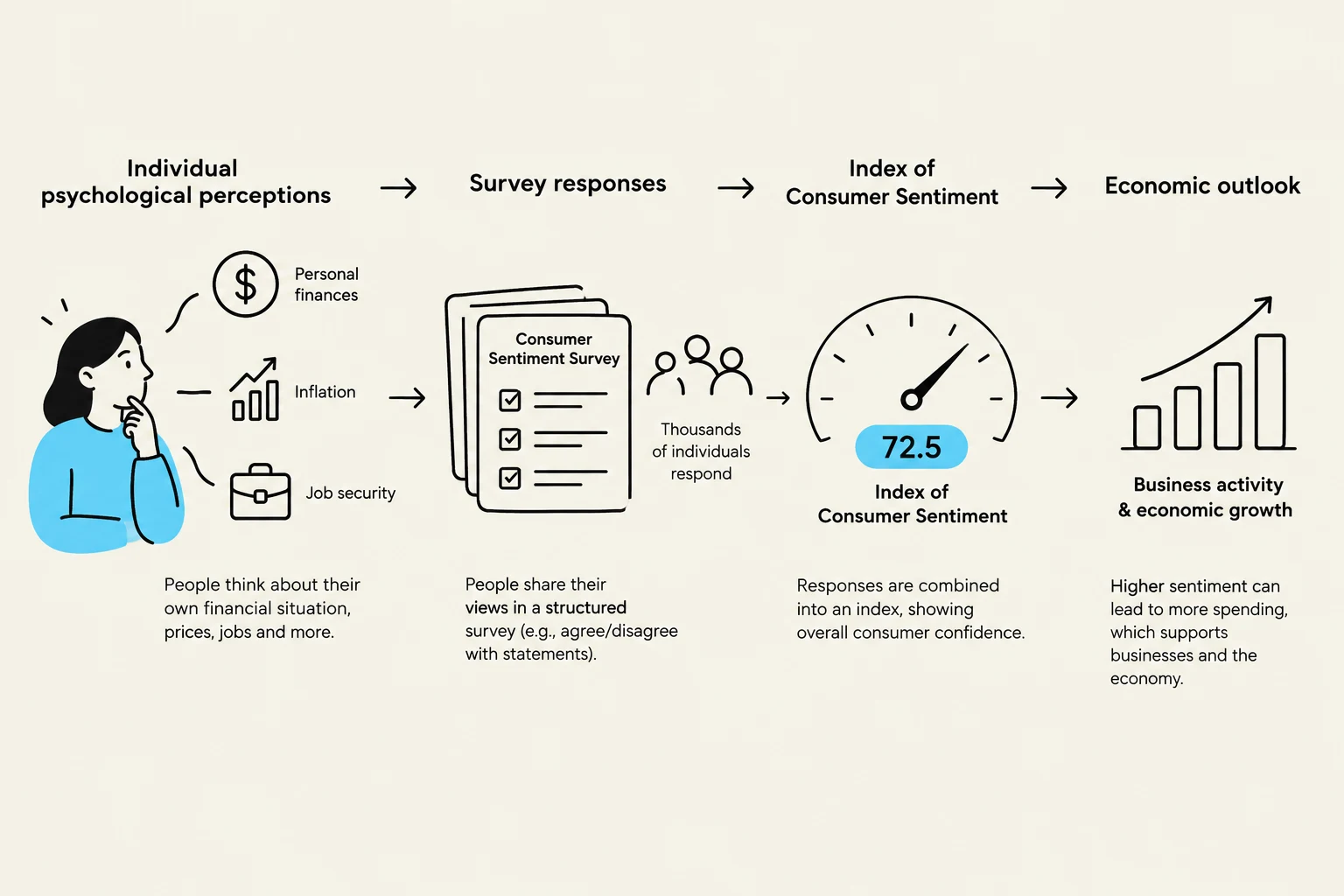
This diagram illustrates the process of how individual psychological perceptions about personal finances, inflation, and job security are translated into survey responses, which are then used to calculate an Index of Consumer Sentiment. This index, in turn, influences business activity and economic growth.
The Role of Economic Psychology
The development of the ICS is a hallmark of the field of economic psychology. While behavioral economics often focuses on how people deviate from the "rational" model (such as the anchoring effect or loss aversion), economic psychology seeks to understand the underlying psychological mechanisms that drive these deviations.
The impact of psychological indicators on economic behavior is a core economic psychology research area. By studying how mental processes—such as how we process information or how we perceive risk—interact with financial decisions, researchers can build more accurate models of how the world actually works.
Feature
Classical Economics (Homo Economicus)
Economic Psychology / Behavioral Reality
Decision Making
Rational and Unbiased
Biased and Unpredictable
Information
Perfect Knowledge
Limited/Imperfect Information
Motivation
Utility Maximization
"Satisficing" (Good enough)
Social Influence
Solitary Decision Maker
Influenced by Social Norms/Peers
Academic Criticisms and Limitations
Despite its widespread use, the ICS is not without its critics. Some scholars argue that it is a simplified measure that cannot capture the full complexity of human attitudes.
The primary critique is that economic outcomes are the result of a complex interplay between subjective perceptions and objective factors. For example, a consumer might feel very optimistic (high sentiment), but if they are simultaneously facing a massive, objective increase in interest rates or a loss of employment, their subjective optimism may not translate into actual spending. Because the index relies on a limited number of questions, it may miss the nuanced "why" behind consumer behavior.
In summary, while the Index of Consumer Sentiment is a simplified tool, it remains one of the most powerful psychological instruments available to economists, providing a window into the collective mind of the marketplace.
Keep reading for free.
Create an account to finish this reading and make it part of your study routine.