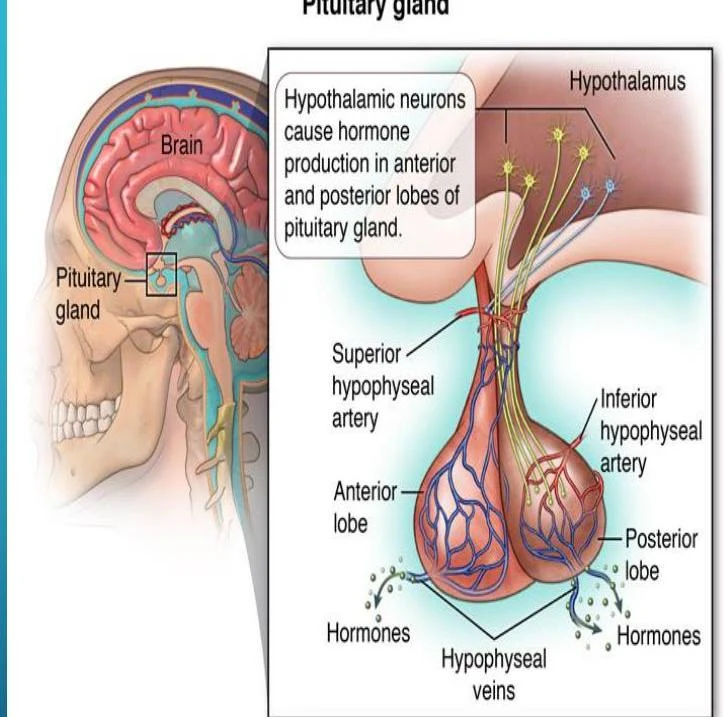
Hypothalamic and Anterior Pituitary Hormones
The communication between the hypothalamus and the anterior pituitary involves two distinct classes of hormones: hypophysiotropic hormones and pituitary hormones.
Hypophysiotropic Hormones
These are hormones produced by the hypothalamus that travel to the anterior pituitary to either stimulate or inhibit the release of other hormones.
| Hormone | Action |
|---|
| TRH (Thyrotropin-releasing hormone) | Releases TSH and prolactin |
| GnRH (Gonadotropin-releasing hormone) | Releases LH and FSH |
| CRH (Corticotropin-releasing hormone) | Releases ACTH |
| GHRH (Growth hormone-releasing hormone) | Releases GH |
| Somatostatin | Inhibits GH and TSH release |
| Dopamine | Inhibits prolactin release (Prolactin Inhibitory Factor) |
Tropic vs. Direct Effector Hormones
The anterior pituitary produces two types of hormones:
- Tropic Hormones: These act on other endocrine glands to stimulate further hormone production (e.g., TSH acts on the thyroid, ACTH acts on the adrenal cortex).
- Direct Effector Hormones: These act directly on peripheral tissues to produce a physiological effect (e.g., Growth Hormone and Prolactin).
Clinical Implications of Growth Hormone (GH)
Growth hormone (also known as somatotropin) is vital for normal body growth and possesses "amphibolic" properties, meaning it influences both anabolic (building) and catabolic (breaking down) processes. It stimulates protein synthesis, lipolysis, and the production of insulin-like growth factors (IGF-1).
GH Excess: Acromegaly
Pathological, autonomous excess of GH—usually caused by a pituitary tumor—leads to significant clinical issues. In adults, this results in acromegaly, characterized by the progressive enlargement of the hands, feet, mandible, and skull. Patients often face comorbidities such as diabetes, hypertension, sleep apnea, and an increased lifetime risk of cancer.
GH Deficiency
A deficiency in GH can lead to growth failure in children. This may be caused by structural lesions in the pituitary or hypothalamus, or genetic mutations in the GHRH gene.
Exam Tip: When testing for GH disorders, clinicians do not rely on a single baseline measurement due to the hormone's pulsatile nature. Instead, they use suppression tests (e.g., glucose suppression to check for excess) or stimulation tests (e.g., GHRH or L-arginine infusion to check for deficiency).
Prolactin and Hyperprolactinemia
Prolactin is unique among anterior pituitary hormones because its primary regulation is tonic inhibition by dopamine. While most hormones require a stimulating signal to be released, prolactin is constantly being "held back" by the hypothalamus; if dopamine levels drop, prolactin levels rise.
Prolactinomas and Hyperprolactinemia
A prolactinoma is a tumor that directly secretes excess prolactin. This is the most common type of functional pituitary tumor.
- In premenopausal women: Symptoms include menstrual irregularity, infertility, and galactorrhea (milk production).
- In men/postmenopausal women: Symptoms often present as headaches or visual complaints.
Other causes of hyperprolactinemia (elevated prolactin) include pituitary stalk interruption, certain medications (dopaminergic antagonists), and thyroid or renal failure.
Hypopituitarism
Hypopituitarism refers to the loss of anterior pituitary function due to failure of the hypothalamus or the gland itself.
- Monotropic deficiency: The loss of only a single hormone.
- Panhypopituitarism: The complete loss of all pituitary hormone production.
Common causes include tumors, trauma, radiation therapy, infection, or infarction. Treatment for panhypopituitarism requires lifelong hormone replacement, including thyroxine, glucocorticoids, and sex steroids.
Posterior Pituitary: Oxytocin and Vasopressin
Unlike the anterior pituitary, the posterior pituitary does not synthesize its own hormones. Instead, it stores and releases two cyclic nonapeptides produced in the hypothalamus:
- Oxytocin: Plays a critical role in labor, birth, and lactation. Synthetic oxytocin (Pitocin) is used medically to induce labor.
- Arginine Vasopressin (AVP): Also known as Anti-Diuretic Hormone (ADH), AVP regulates water excretion in the kidneys to maintain body water balance.
- Deficiency: Leads to diabetes insipidus, characterized by polyuria (excessive urination) and polydipsia (excessive thirst).
- Excess: Can lead to pathological water retention.