The Human Reproductive System: Gametogenesis and Hormonal Regulation
An in-depth explanation of the human reproductive system, covering gametogenesis (spermatogenesis and oogenesis), the male and female reproductive organs, and the hormonal regulation of reproductive cycles and pregnancy.
The human reproductive system is a complex network of organs and signaling molecules designed for the primary purpose of reproduction: the production of specialized haploid cells known as gametes. This process, known as gametogenesis, ensures that when fertilization occurs, the resulting zygote possesses the correct diploid number of chromosomes. To achieve this, the body utilizes intricate hormonal feedback loops to regulate the development of these cells and the cycles of the reproductive organs.
The Male Reproductive System
The male reproductive system is centered around the testes, which serve as the primary gonads. Within the testes, the process of spermatogenesis occurs inside the seminiferous tubules. A critical anatomical feature is the scrotum, which houses the testes outside the main body cavity to maintain a temperature lower than normal body temperature; this cooler environment is a strict requirement for proper sperm formation.
Spermatogenesis and Sperm Path
The stages of spermatogenesis within the seminiferous tubules.
Spermatogenesis is a continuous process that begins at puberty. The process follows a specific cellular progression:
Primary Spermatocytes: These cells undergo Meiosis I.
Spermatids: The first haploid cells produced.
Spermiogenesis: A maturation phase where spermatids undergo morphological changes—such as nuclear condensation, acrosome formation (an enzyme-filled cap), and flagellum development—to become mature spermatozoa.
Once mature, sperm travel through a specific pathway:
Seminiferous tubules→Epididymis→Vas deferens→Ejaculatory duct→Urethra.
Male Hormonal and Autonomic Regulation
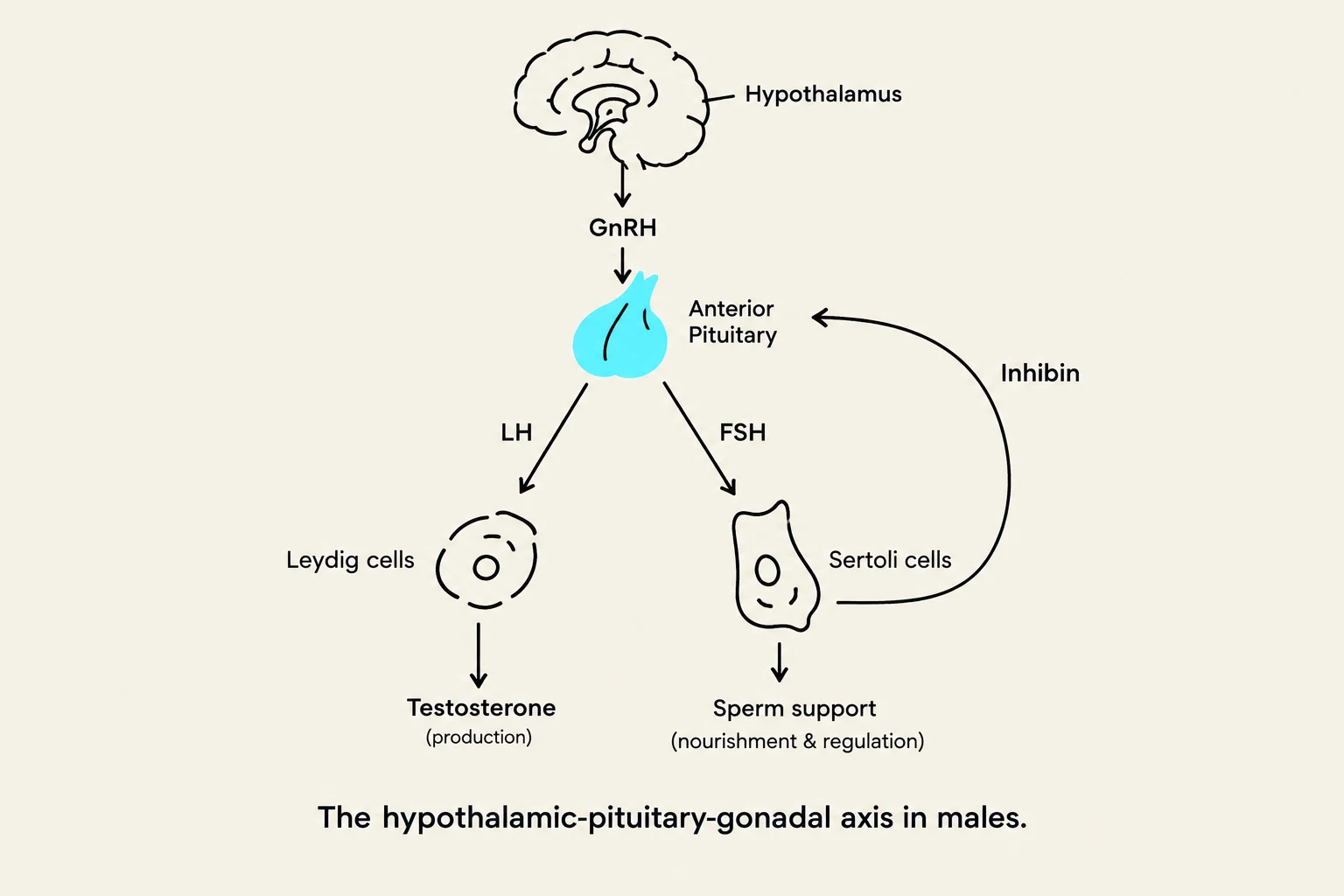
Diagram illustrating the hypothalamic-pituitary-gonadal axis in males, showing the roles of the hypothalamus, anterior pituitary, Leydig cells, and Sertoli cells in regulating testosterone production and sperm support.
The male system is controlled by the hypothalamus and the anterior pituitary gland. The hypothalamus releases GnRH, which stimulates the anterior pituitary to release FSH and LH.
LH (Luteinizing Hormone): Acts on the Leydig cells (interstitial cells) to produce testosterone, which drives spermatogenesis and libido.
FSH (Follicle-Stimulating Hormone): Acts on the Sertoli cells (sustentacular cells) to support sperm development and provide nourishment.
Inhibin: Secreted by Sertoli cells, this hormone provides negative feedback to the pituitary to reduce FSH production, maintaining homeostasis.
The sexual response is also managed by the autonomic nervous system:
Parasympathetic nervous system: Responsible for vasodilation, leading to an erection.
Sympathetic nervous system: Responsible for the release of seminal fluid during orgasm and ejaculation.
Exam Tip: Remember the distinction between the two branches of the ANS: Parasympathetic is for Preparation (erection/lubrication), while Sympathetic is for Semen release (orgasm/ejaculation).
The Female Reproductive System
The female reproductive system is characterized by cyclical changes designed to prepare for potential pregnancy. The ovaries are the primary gonads, responsible for oogenesis.
Oogenesis vs. Spermatogenesis
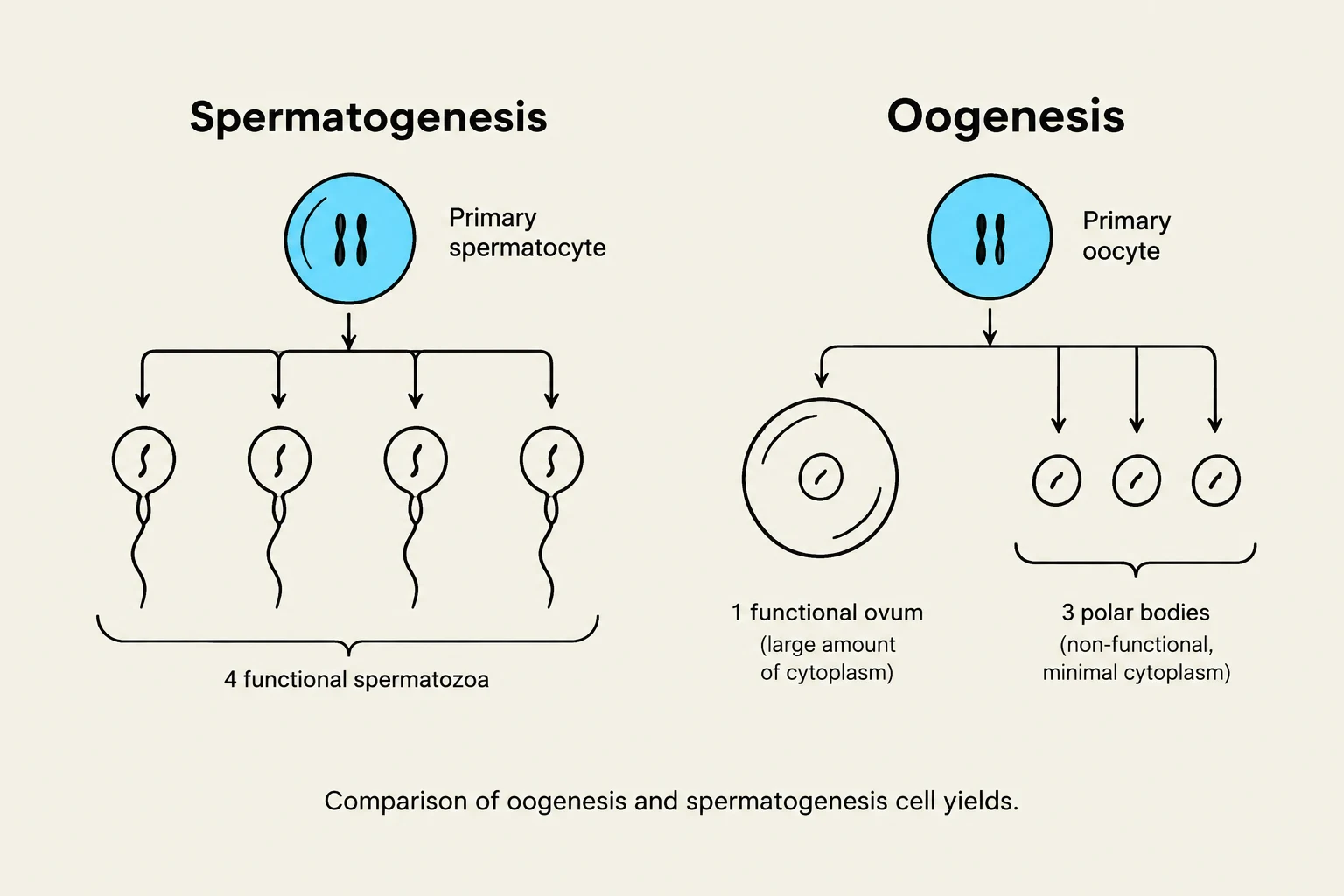
Comparison of oogenesis and spermatogenesis cell yields.
Unlike the continuous production of many sperm cells, oogenesis is a discontinuous process that results in fewer functional cells because the cytoplasm is concentrated into a single cell.
In oogenesis, the first haploid cell produced is the secondary oocyte.
The final division, Meiosis II, is only completed if fertilization occurs.
While one primary spermatocyte produces four functional sperm, one primary oocyte produces only one functional ovum and three non-functional polar bodies.
The Ovarian and Uterine Cycles
The female reproductive cycle is a synchronized dance between the ovaries and the uterus, governed by several key hormones:
1. The Ovarian Cycle
Follicular Phase: Driven by FSH, which stimulates follicle maturation within the ovaries.
Ovulation: A sudden surge in LH triggers the release of the secondary oocyte from the mature follicle.
Luteal Phase: After ovulation, the ruptured follicle transforms into the corpus luteum, which secretes hormones to support a potential pregnancy.
2. The Uterine Cycle
The uterine lining (endometrium) changes in response to ovarian hormones:
Menstrual Phase (Menses): If no pregnancy occurs, progesterone levels drop, causing the endometrial functional layer to shed.
Proliferative Phase: Estrogen, secreted by the developing follicles, stimulates the rebuilding and thickening of the uterine lining.
Secretory Phase: Following ovulation, the corpus luteum secretes progesterone, which makes the endometrium highly vascularized and glandular, preparing it for implantation.
Maintaining Pregnancy
If fertilization occurs, the developing embryo (specifically the trophoblast) secretes hCG (Human chorionic gonadotropin). This hormone is vital because it maintains the corpus luteum, ensuring that progesterone levels remain high to prevent menses and keep the uterine lining intact for the developing fetus.
Summary Table: Key Hormonal Functions
Hormone
Primary Source
Main Function
GnRH
Hypothalamus
Stimulates Anterior Pituitary to release FSH/LH
FSH
Anterior Pituitary
Follicle maturation (F) / Sperm support (M)
LH
Anterior Pituitary
Triggers Ovulation (F) / Testosterone production (M)