An examination of the legal frameworks, labor practices, and resistance movements related to slavery in Canada from its colonial beginnings through to abolition.
For many, the history of Canada is framed as a narrative of "freedom" and "refuge," particularly during the era of the Underground Railroad. However, this national identity often obscures a darker, institutionalized reality: for over two hundred years, slavery was a legal and pervasive practice in Canada. While Canada may not have been a "slave society" in the sense that its entire economy was built upon it—unlike the American South—it was undeniably a "society with slaves". From the early days of New France to the transition into British rule, Black lives were systematically exploited through legal frameworks that treated human beings as property.
The Legal Framework: From Code Noir to Chattel
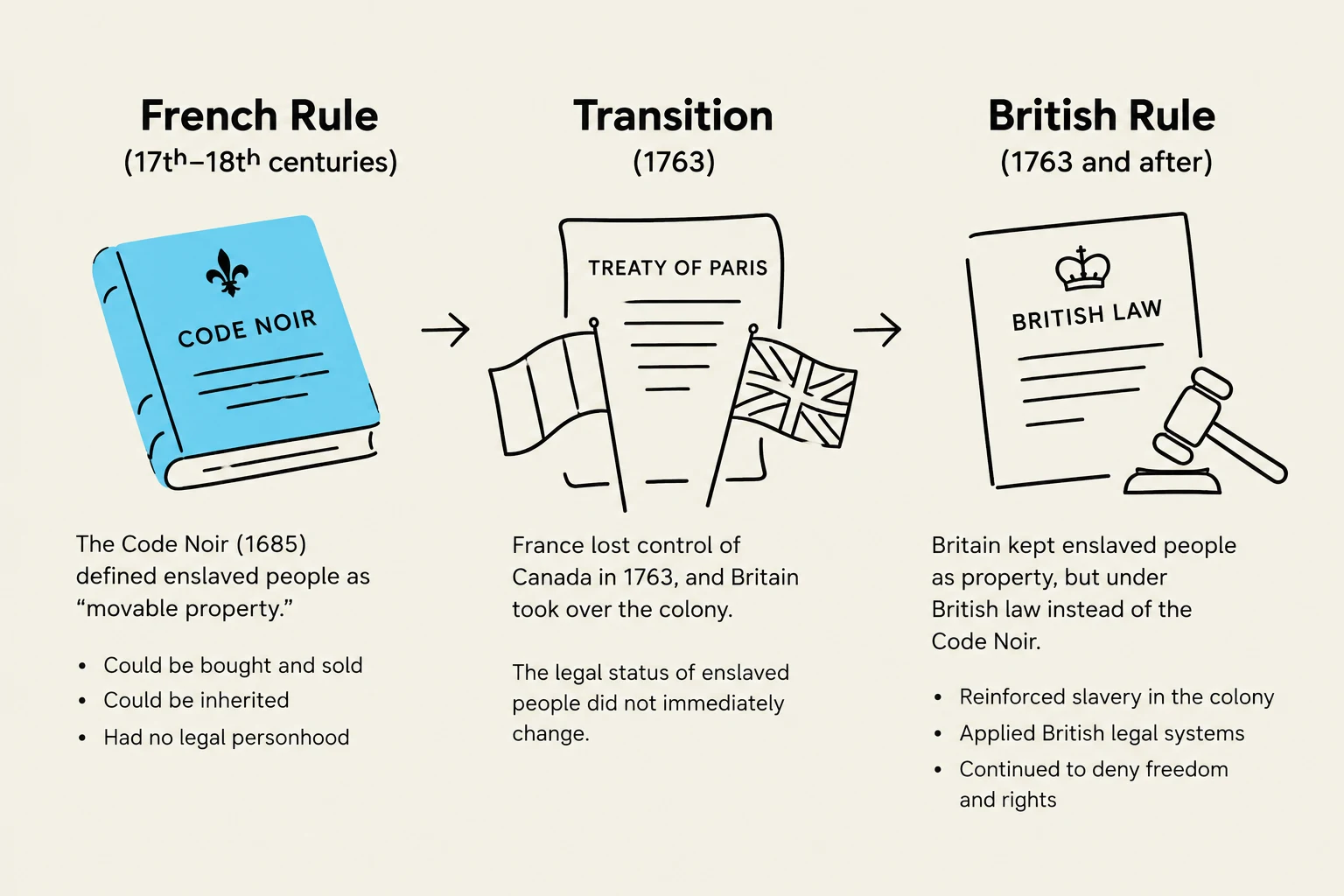
Under the French regime, slavery was regulated by the Code Noir, a legal code originally designed for the West Indies. Although it was not formally enacted as law in Canada, colonial officials applied its principles to provide a legal foundation for enslavement. A central tenet of this system was the classification of enslaved people as "movable" property—essentially placing them in the same legal category as livestock, furniture, or trade goods.
When the British took control of Canada following the Seven Years' War, they did not abolish this system; instead, they confirmed the rights of French colonists to retain their enslaved property through the Treaty of Paris. Under British rule, the status of enslaved people shifted toward being regarded as chattel—pure personal property to be bought, sold, or traded at the owner's discretion.
Study Tip: When analyzing colonial history, distinguish between a "slave society" (economy based on slavery) and a "society with slaves" (slavery exists as a legal institution within a different economic model).
This illustration depicts the historical transition of rule in Canada from French to British, detailing the legal status of enslaved people under both regimes, specifically referencing the Code Noir and British Law.
Labor, Gender, and the Economy
The demand for Black enslaved labourers was driven by chronic labor shortages in the colonies. In New France, officials argued that importing enslaved Africans was the "surest means" of ensuring economic prosperity. This demand was highly gendered, as owners sought specific types of labor based on the perceived "utility" of men and women.
Gendered Labor and Domesticity
Men were frequently sought for "country business" or heavy agricultural work, such as clearing land or working in the fur trade. Women, conversely, were often relegated to domestic housework, including cooking, washing, and childcare.
Reproductive Exploitation
The system also relied on the reproductive exploitation of Black women. Because the legal status of a child followed that of the mother, the children of enslaved women—often fathered by White men—were born into slavery, ensuring a self-perpetuating labor force for the colonial elite.
Resistance and Marronage
Enslaved individuals were not passive victims; they actively resisted their conditions through various means, including breaking tools, disobedience, and organized uprisings. One of the most significant forms of resistance was marronage—the act of running away.
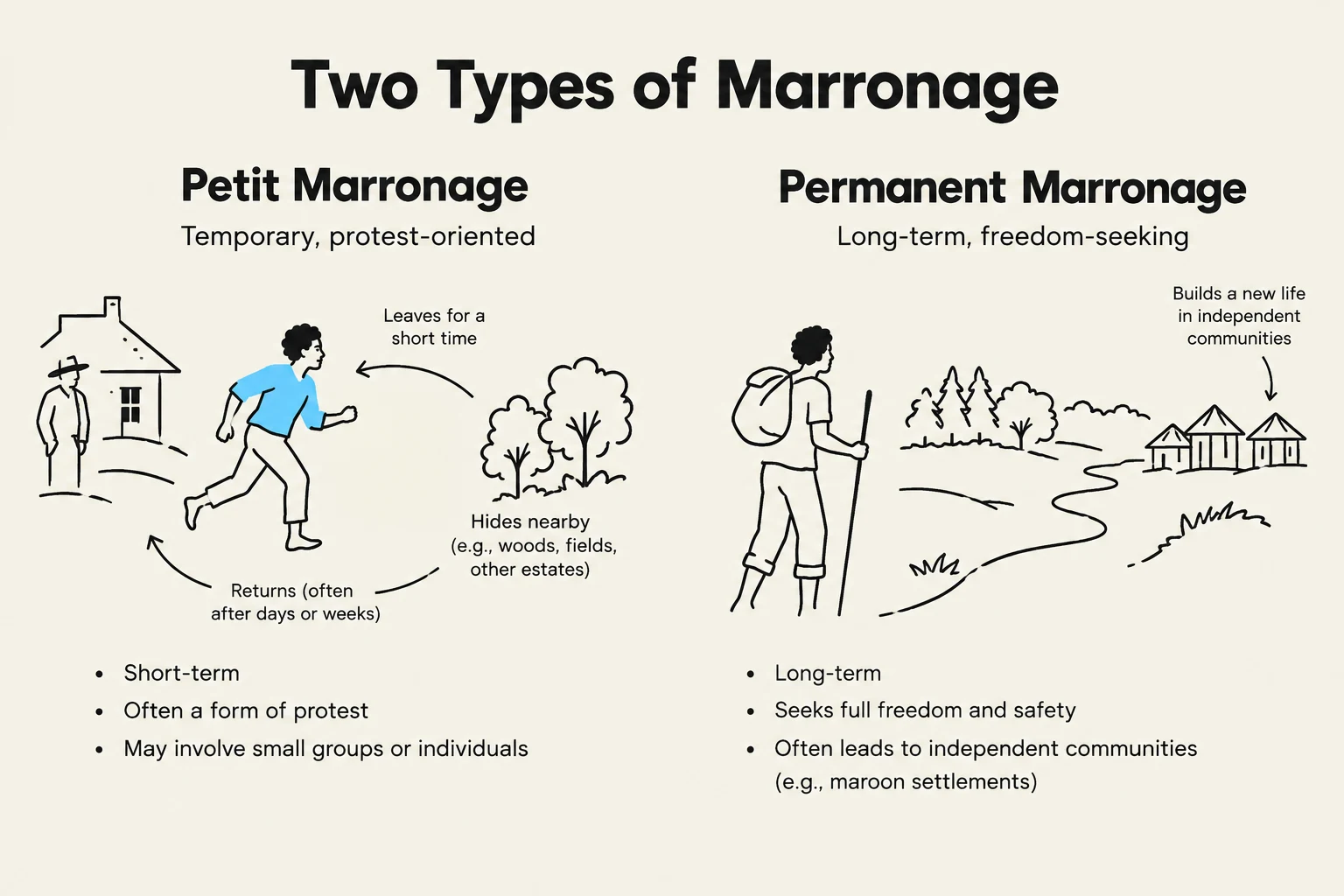
Marronage generally took two forms:
Petit marronage: Temporary escapes used as a tool of protest, to express anger, or to seek short-term relief from harsh conditions.
Permanent marronage: Escaping into remote wildernesses or across borders to seek long-term freedom.
This illustration contrasts two types of marronage: Petit Marronage, which is temporary and protest-oriented, and Permanent Marronage, which is long-term and freedom-seeking, often leading to independent communities.
The Expansion of Slavery under British Rule
The population of enslaved people in Canada saw significant shifts due to political changes and immigration. Following the American Revolutionary War, Black Loyalists—Black people who had fought for the British or sought protection from the Americans—fled to the Maritimes and Quebec, often accompanied by their White owners.
British officials also actively encouraged the importation of enslaved people to bolster the English-speaking population and solve labor issues. For example, Governor James Murray specifically requested "stout young fellows" for agricultural work and "young wives" to serve as domestic laborers. This was further supported by legal mechanisms like the Immigration Act of 1790 (often associated with the broader British imperial policies), which facilitated the movement of people and property within the empire.
The Path to Abolition
The movement toward abolition was often a conflict between humanitarian ideals and economic interests. In Upper Canada, Lieutenant Governor John Graves Simcoe attempted to pass a bill to abolish slavery in 1793. However, he faced intense opposition from legislators and merchants who argued that slave labor was essential to the colony's economy.
The resulting compromise, "An act to prevent the further introduction of slaves," did not free existing slaves but did ban the importation of new ones. This effectively meant that while slavery could not be expanded through new arrivals, it would gradually decline as the enslaved population was not replenished. Ultimately, slavery in all British North American territories was formally abolished by the British Parliament in 1834.
Exam Note: Note the paradox of Simcoe’s legislation: while it is often celebrated as a landmark for antislavery, it was a compromise that protected the property rights of current slaveholders and did not grant immediate freedom to those already enslaved.
Keep reading for free.
Create an account to finish this reading and make it part of your study routine.