The History of French Indochina and the Rise of Vietnam
An overview of the history of French Indochina, focusing on the rise of Vietnamese nationalism, the leadership of Ho Chi Minh, and the conflicts that led to Vietnamese independence.
The history of Southeast Asia in the 20th century is defined by the turbulent transition from colonial rule to national independence. Central to this narrative is the story of French Indochina, a colonial entity that shaped the political landscape of Vietnam, Cambodia, and Laos. This article explores the rise of Vietnamese nationalism, the leadership of Ho Chi Minh, and the violent conflicts that ultimately reshaped the region.
The Era of French Indochina
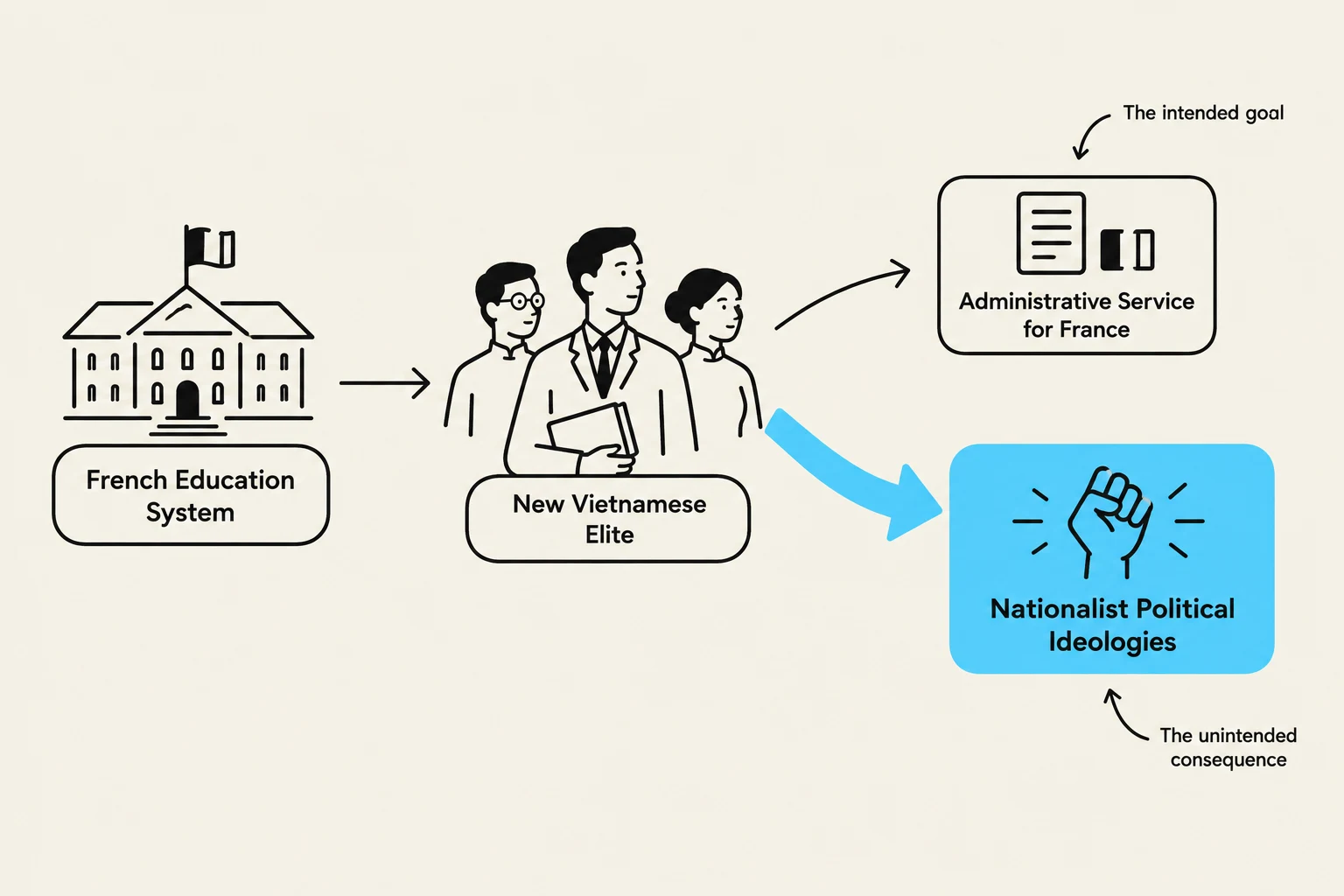
This diagram illustrates the historical development of the French Education System in Vietnam, leading to the formation of a new Vietnamese elite. The intended goal was administrative service for France, but an unintended consequence was the rise of nationalist political ideologies.
The roots of French colonial influence in the region date back to the early 1820s. Over time, France consolidated its control over a territory comprising Vietnam, Cambodia, and Laos, forming a colonial union known as French Indochina.
One of the most significant social consequences of this period was the transformation of the local social hierarchy. As the French established their administration, a new Vietnamese elite class emerged. This group was characterized by:
An education rooted in the French academic system.
Fluency in the French language.
Exposure to Western political philosophies.
While this education was intended to create a loyal administrative class, it inadvertently provided the intellectual tools that future nationalist leaders would use to challenge colonial rule.
Study Tip: When analyzing colonial history, look for "unintended consequences." In this case, the French education system provided the very language and political concepts that Vietnamese nationalists used to argue for their own independence.
The Rise of Ho Chi Minh and the Viet Minh
As nationalist sentiment grew, the movement required centralized leadership. This role was filled by Ho Chi Minh, a complex and influential figure who identified as both a nationalist and a communist. His political vision was not merely about social revolution, but about the fundamental liberation of the Vietnamese people from foreign rule.
In 1930, Ho Chi Minh played a pivotal role in establishing the Vietnamese Communist Party, providing a structured political organization for the growing resistance.
World War II and the Japanese Occupation
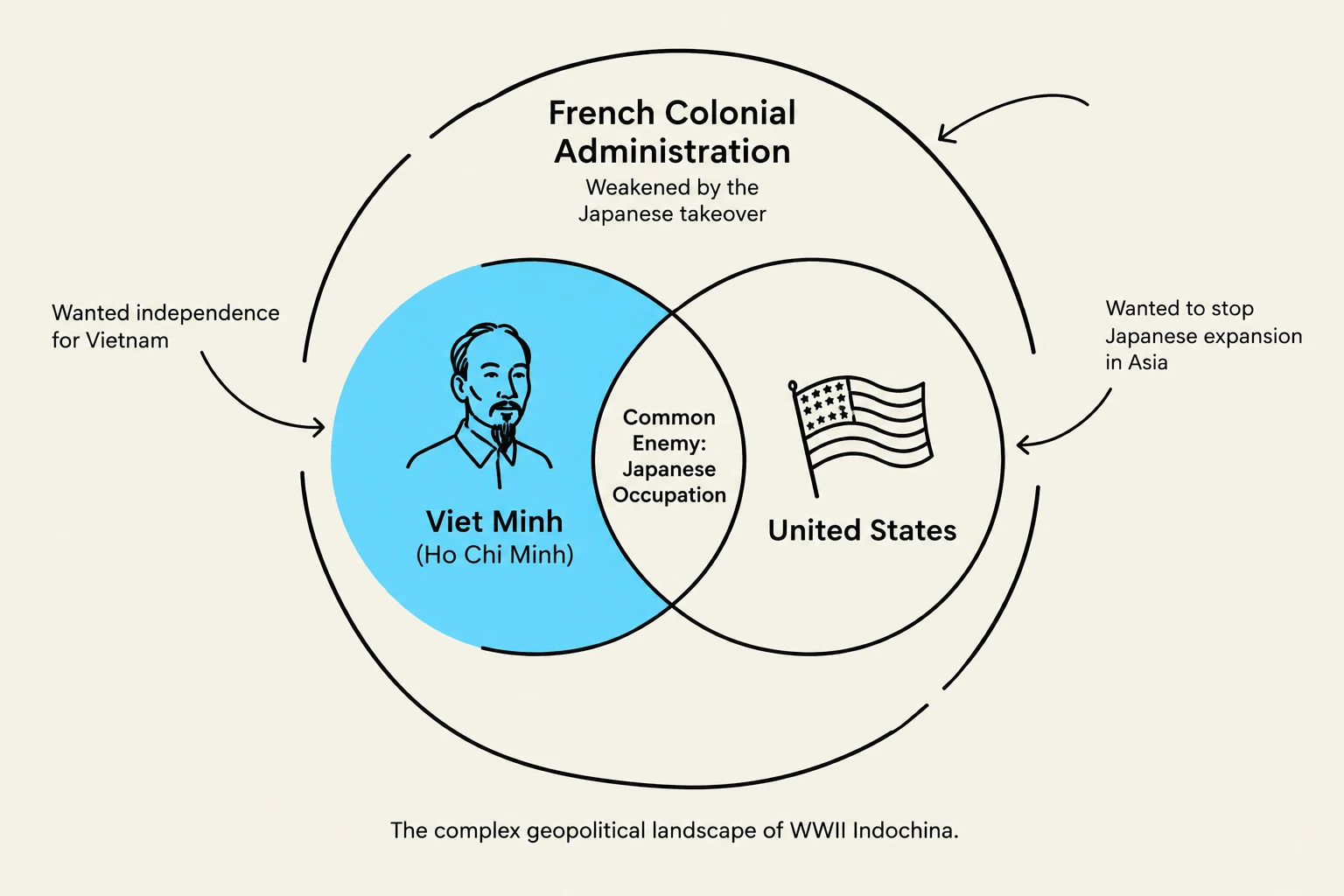
This diagram illustrates the geopolitical landscape of WWII Indochina, showing the interests of the Viet Minh, the United States, and the French Colonial Administration in relation to the Japanese occupation.
The geopolitical landscape shifted dramatically during World War II. Although France held nominal control over Indochina, Japan moved in and took control of the region. This dual occupation—by both the French and the Japanese—created a chaotic environment for the Vietnamese people.
In response to the Japanese occupation, Ho Chi Minh formed the Viet Minh, a resistance movement specifically dedicated to fighting Japanese forces. Interestingly, during this period, the United States acted as an ally to both Ho Chi Minh and the Viet Minh. Because the U.S. and the Viet Minh shared the common enemy of Japan, they found themselves on the same side of the global conflict.
The Declaration of Independence
With the conclusion of World War II, a brief window of opportunity opened for the Vietnamese people. On September 2, 1945, Ho Chi Minh officially declared Vietnamese Independence.
The declaration was notable for its rhetorical style. Reflecting the wartime alliance between the U.S. and the Vietnamese resistance, Ho Chi Minh utilized language and themes drawn directly from the United States' own Declaration of Independence. This was a strategic attempt to appeal to international legitimacy and the democratic ideals shared by his former allies.
The First Indochina War
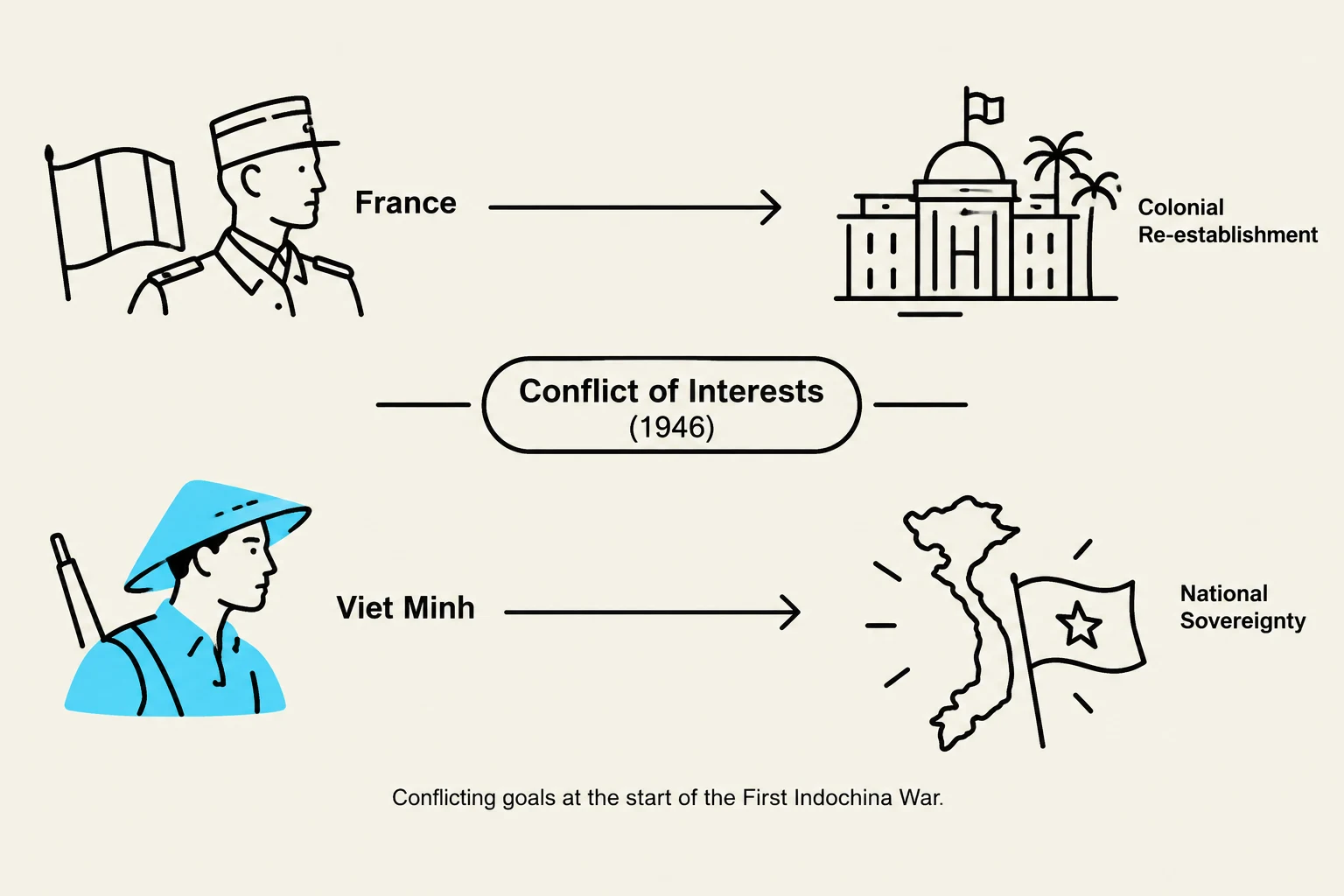
A diagram illustrating the conflicting goals of France and Viet Minh at the start of the First Indochina War in 1946, representing colonial re-establishment versus national sovereignty.
The hope for a peaceful, independent Vietnam was quickly extinguished. Following the end of World War II, France sought to reclaim its former colonial territory and re-establish its authority over Indochina.
This refusal to recognize Vietnamese sovereignty led to the First Indochina War, which commenced in 1946. The conflict was a direct and violent military struggle between:
France: Seeking to restore its colonial empire.
The Viet Minh: Fighting for national sovereignty and communist ideals.
This war marked a violent and decisive transition period, signaling the end of the colonial era and the beginning of a long, arduous struggle for the modern nation of Vietnam.
Key Entity
Primary Goal during 1945-1946
France
Reclaim colonial territory and authority
Viet Minh
Achieve national independence and sovereignty
Ho Chi Minh
Unify nationalist and communist movements
Keep reading for free.
Create an account to finish this reading and make it part of your study routine.