The history of human knowledge changed forever in the mid-15th century in Mainz, Germany. Before this era, the reproduction of written works was a laborious, manual process that limited the availability of books to the elite and the clergy. The arrival of the mechanical printing press, developed by Johannes Gutenberg, transformed the written word from a rare luxury into a tool for mass communication, fundamentally altering the course of Western civilization.
Johannes Gutenberg: The Inventor Behind the Revolution
Johannes Gutenberg (c. 1395–1468) was a German inventor whose background in metalwork provided the technical foundation for his most famous achievement. While little is known about his early life, he was the son of a patrician (an aristocrat) and acquired significant metalworking skills that would later prove essential to his invention.
Gutenberg's journey was not without significant struggle. He faced conflicts with local guilds and patricians in Mainz, leading to a period of exile in Strasbourg. During his time in France, he engaged in various crafts, including gem cutting, and worked on secret inventions to offset financial losses from previous business ventures. It was not until he returned to Mainz and secured a substantial investment from the wealthy financier Johann Fust that he was able to finalize his printing technology.
Historical Note: Despite his technological genius, Gutenberg's personal finances were tragic. A lawsuit with his investor, Johann Fust, resulted in Gutenberg losing his equipment and facing heavy debts, meaning he did not profit significantly from the invention that changed the world.
The Mechanics of the Printing Press
The "Gutenberg Press" was not a single invention but a sophisticated integration of three core technological advancements that allowed for the mass production of books.
1. Moveable Type and Metal Alloy
Unlike ancient Asian printing methods that often utilized wood, Gutenberg developed a system of moveable type made from a specific metal alloy. This alloy was crucial because it was easy to melt, cooled quickly, and was durable enough to be reused for thousands of impressions. This allowed printers to arrange individual characters into words and sentences, print a page, and then disassemble the type to be used again for a different text.
2. Oil-Based Ink
Traditional inks used in manuscript copying were often too watery for metal surfaces. Gutenberg developed a specialized oil-based ink that was thick enough to adhere well to the metal type and transfer cleanly onto paper or vellum.
3. The Press and the Central Screw Column
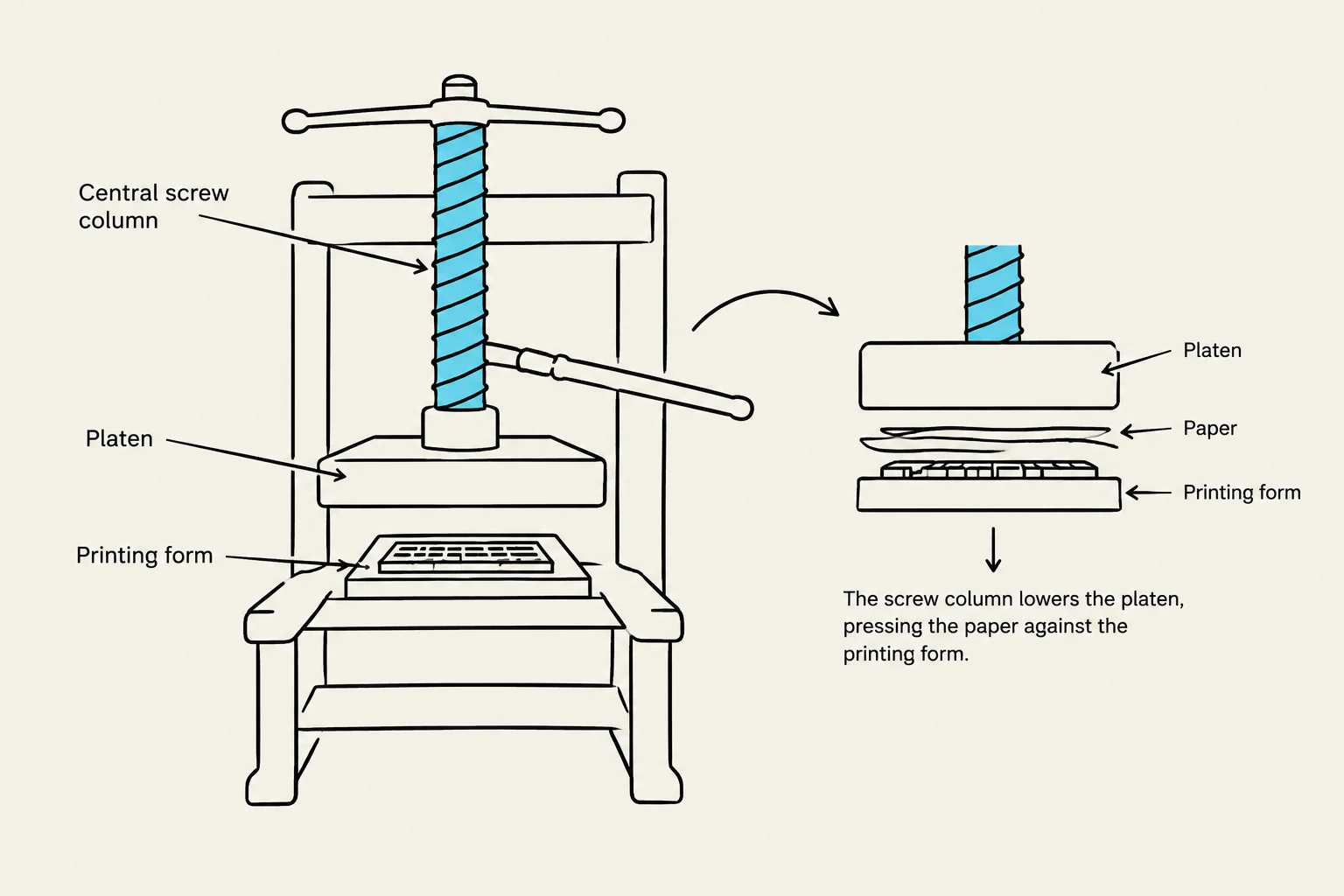
Gutenberg adapted the mechanical principles of wine and olive presses to create his machine. The defining feature of his design was a central screw column. When the operator pulled the lever, this column applied firm, even pressure onto the printing forms, ensuring that the ink was distributed equally across the page for a clean, professional reproduction.
Diagram illustrating the mechanism of a printing press, showing the central screw column, platen, printing form, and paper.
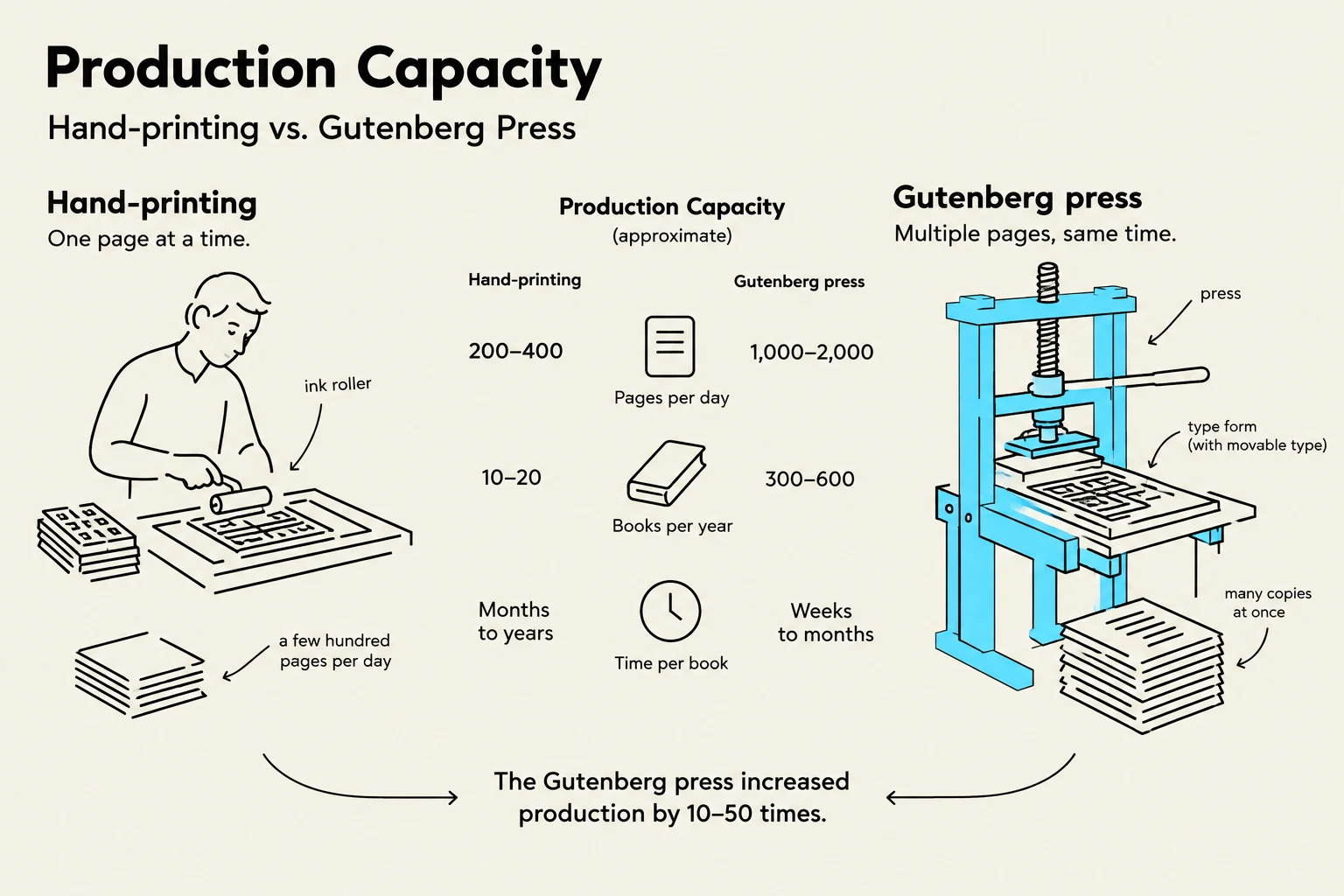
The difference in efficiency between manual and mechanical printing was staggering. While a person performing manual hand-printing could only produce approximately 40 pages per day, a single Gutenberg press could produce up to 3,600 pages.
The Gutenberg Bible: A Landmark Achievement
The first major demonstration of this technology was the Gutenberg Bible (also known as the 42-line Bible), printed in Mainz around 1455. This was the first book in Western Europe to be produced entirely through a printing press.
Gutenberg produced approximately 180 copies of the Bible. These were printed on two different materials:
Paper: The majority of the copies (around 135).
Vellum: High-quality parchment made from calfskin.
The Bible was a massive undertaking; a single volume could weigh around 70lbs (32kg) and contained 1,286 pages. While the text was printed in black and white, many copies were decorated by hand with colorful "drop caps" and illustrations to suit the preferences of wealthy owners, making each copy unique.
This illustration compares the production capacity of hand-printing versus the Gutenberg press, detailing pages per day, books per year, and time per book.
The Multifaceted Impact of Mass Production
The ability to rapidly disseminate information triggered a chain reaction across every sector of human society.
Religious and Sociopolitical Impact
The press was a primary driver of the Protestant Reformation. When Martin Luther published his "95 Theses" in 1517, the printing press allowed his criticisms of the Catholic Church to be quickly translated from Latin into German and other languages, spreading his ideas faster than the Church could suppress them. This contributed to religious wars, the rise of Calvinism in France, and the eventual English Reformation under Henry VIII.
In the long term, this era of printed debate fueled the Age of Enlightenment and the rise of "salon culture," where ideas regarding independence and revolution were shared through pamphlets and newspapers.
Economic and Military Impact
The standardization of the printed word had practical administrative benefits:
Economic: The press provided standardized documentation for banking, insurance, government records, and bills of sale.
Military: It allowed for the efficient and uniform distribution of military dispatches and official ordinances.
Diagram illustrating the impact of the Gutenberg Press on the dissemination of information and its influence on cultural, religious, economic, and social/political spheres.
Study Tip: When analyzing the impact of the printing press, remember that it didn't just "make books"—it "standardized information." This standardization is what allowed banking, law, and science to become more precise and globalized.
By moving from the slow, error-prone world of hand-copying to the rapid, mechanical world of the press, Gutenberg laid the essential foundation for the modern information age.
Keep reading for free.
Create an account to finish this reading and make it part of your study routine.