The Green Revolution: Agricultural Advancements and Environmental Impacts
Explore the Green Revolution, a period of significant agricultural transformation driven by mechanization, biotechnology (HYVs and GMOs), synthetic fertilizers, and irrigation. Understand its role in increasing food production while examining the associated environmental challenges such as soil erosion, biodiversity lo
The history of human civilization is inextricably linked to our ability to produce food. For millennia, agriculture was characterized by small-scale, family-operated farms that relied on natural cycles and organic materials. However, the mid-20th century ushered in the Green Revolution, a fundamental shift toward large-scale, industrial agribusiness. By integrating advanced technology, chemistry, and biology, this movement aimed to maximize land efficiency, increase short-term profitability, and stabilize the global food supply. While these advancements have successfully increased the Earth's carrying capacity for humans and decreased world hunger in regions like India, Pakistan, and Mexico, they have also introduced significant environmental challenges.
Mechanization and the Industrial Landscape
One of the most visible hallmarks of the Green Revolution is mechanization. Instead of manual labor or animal power, modern agribusiness relies on heavy machinery such as tractors for plowing and tilling, and combines for harvesting.
This shift provides massive increases in crop yield and profit by allowing farmers to manage much larger areas of land in less time. However, this efficiency comes at an environmental cost. The operation of heavy machinery increases a farm's reliance on fossil fuels (gasoline and diesel), which releases greenhouse gases (GHGs) into the atmosphere, contributing to climate change. Furthermore, the sheer weight of these machines leads to soil compaction. Compacted soil has a reduced capacity to hold water (H2O), which makes the topsoil more vulnerable to soil erosion.
This diagram illustrates how heavy machinery can lead to soil compaction, reducing water infiltration and increasing surface runoff.
Biotechnology: HYVs and GMOs
To further boost production, scientists developed specialized plant varieties designed for maximum output. This is achieved through two primary methods: High-Yield Variety (HYV) crops and Genetically Modified Organisms (GMOs).
HYV Crops: These are often hybrid crops created by cross-pollinating different species or parent plants that possess ideal traits. The goal is to produce a higher yield—the amount of crop produced per unit of area—than traditional varieties.
GMOs: This involves more precise genetic engineering, where specific genes are "spliced" into a plant's genome. For example, Bt corn has been modified with a gene from the soil bacterium Bacillus thuringiensis to produce a protein that kills specific corn pests.
While these technologies provide drought tolerance, pest resistance, and faster growth, they create a significant ecological risk: biodiversity loss. Because GMO crops are often genetically identical, the resulting genetic uniformity means that if a new disease or pest evolves to bypass their defenses, the entire crop could be wiped out simultaneously.
Exam Tip: When asked to compare the benefits and risks of GMOs, remember that the primary benefit is food security (stability in famine-prone areas), while the primary risk is reduced genetic diversity, which increases vulnerability to widespread disease.
Chemical Inputs: Fertilizers and Pesticides
The Green Revolution replaced organic matter, such as manure and compost, with synthetic fertilizers. These man-made nutrients allow for precise control over the chemical ratios of Nitrogen (N), Phosphorus (P), and Potassium (K) provided to the soil. While this maximizes plant growth, the excess nutrients often wash off fields during rain. When these nitrates and phosphates enter nearby water bodies, they trigger eutrophication, a process characterized by massive algal blooms that can deplete oxygen in the water. Additionally, the industrial production of these fertilizers requires fossil fuels, releasing CO2 into the atmosphere.
To protect these high-value crops, agribusinesses also utilize pesticides—synthetic chemicals designed to kill weeds, insects, and rodents. While they prevent crop loss, pesticides can harm "non-target" species, such as bees or amphibians. For instance, the chemical DDT was famously linked to the thinning of bird eggshells, while Atrazine has been shown to affect the reproductive systems of fish and amphibians.
One of the most complex challenges in pest management is the pesticide treadmill. This occurs when pests naturally develop immunity to a specific chemical, forcing farmers to use even higher doses or more toxic varieties to achieve the same results, creating a continuous cycle of increasing chemical use.
This diagram illustrates the cycle of pest resistance to pesticides, where repeated exposure leads to the development of immunity in pests, necessitating increased pesticide use.
Water Management: Irrigation
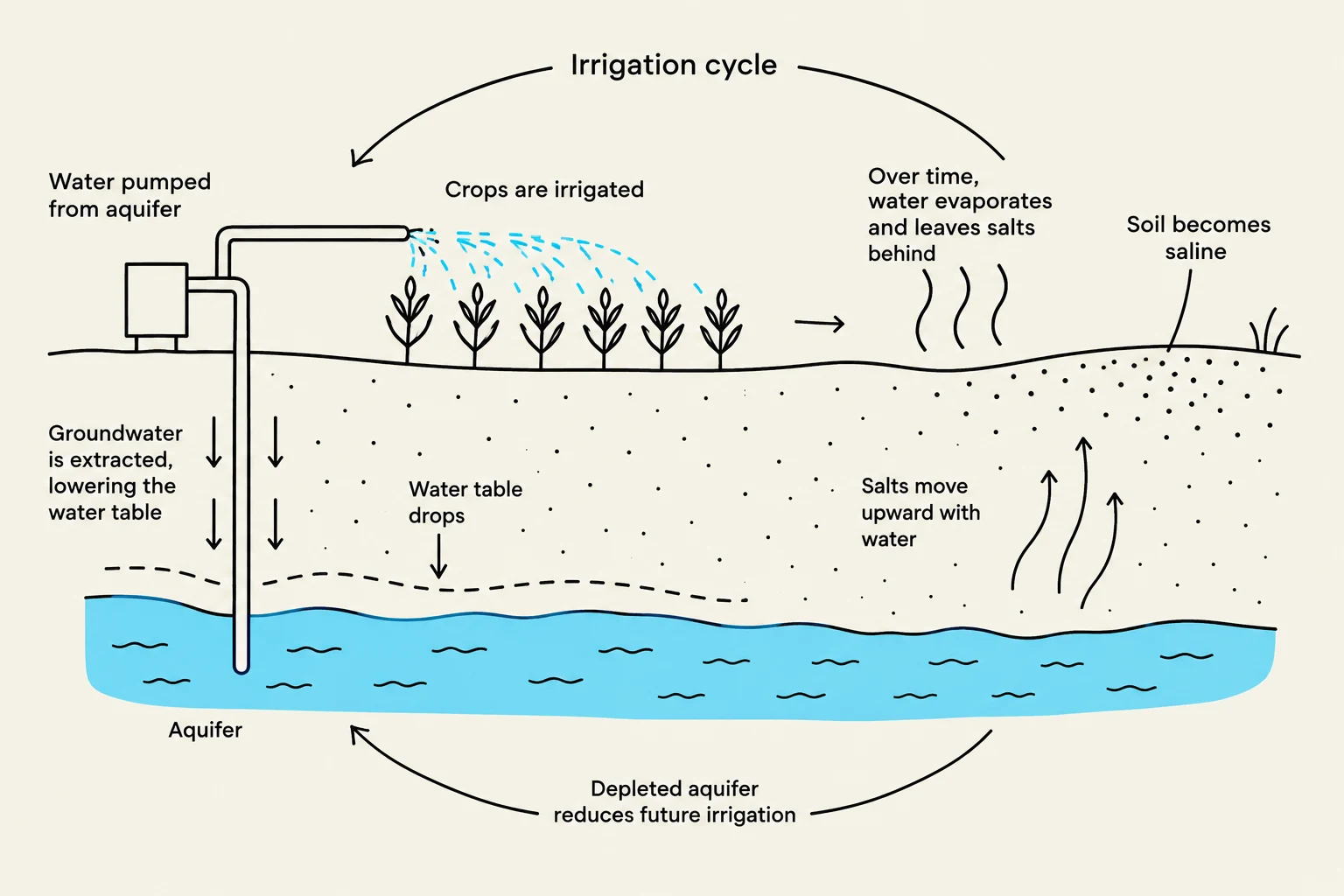
To expand agriculture into arid regions that do not receive enough rainfall, the Green Revolution relies heavily on irrigation. This involves drawing water from groundwater (aquifers) or surface water and distributing it across fields.
While irrigation makes farming possible in many parts of the world, it carries heavy environmental risks:
Aquifer Depletion: Drawing water faster than it can be replenished can dry up vital groundwater sources.
Root Drowning: Over-watering can saturate the soil to the point where plant roots cannot access oxygen (O2).
Soil Salinization: Excessive irrigation can lead to an increase in salt levels within the soil, eventually making the land toxic to most crops.
This diagram illustrates the irrigation cycle and its potential consequences, including groundwater depletion and soil salinization.
Summary of Impacts
The Green Revolution is a double-edged sword. It has fundamentally increased the Earth's ability to support a growing human population, but it has done so by trading long-term ecological stability for short-term productivity.
Driver
Primary Benefit
Primary Environmental Risk
Mechanization
Increased yield and profit
Soil compaction and erosion
HYVs / GMOs
Food stability/pest resistance
Biodiversity loss
Synthetic Fertilizers
Precise nutrient control (N, P, K)
Eutrophication
Irrigation
Farming in arid regions
Aquifer depletion and salinization
Pesticides
Protection from pests
Pesticide treadmill
Keep reading for free.
Create an account to finish this reading and make it part of your study routine.