The French and Indian War and its Impact on Colonial America
Explore the causes, key events, and consequences of the French and Indian War (1754-1763), including the "Middle Ground," the Treaty of Paris, the Proclamation of 1763, and the end of salutary neglect, which ultimately set the stage for the American Revolution.
The mid-18th century was a period of profound transformation for the North American continent. What began as a struggle between European superpowers for territorial dominance would ultimately reshape the relationship between Great Britain and its American colonies. The conflict known as the French and Indian War (1754–1763) did more than just redraw maps; it dismantled long-standing diplomatic strategies, ended a period of relaxed imperial oversight, and planted the seeds of rebellion that would bloom in 1776.
Imperial Rivals and the "Middle Ground"
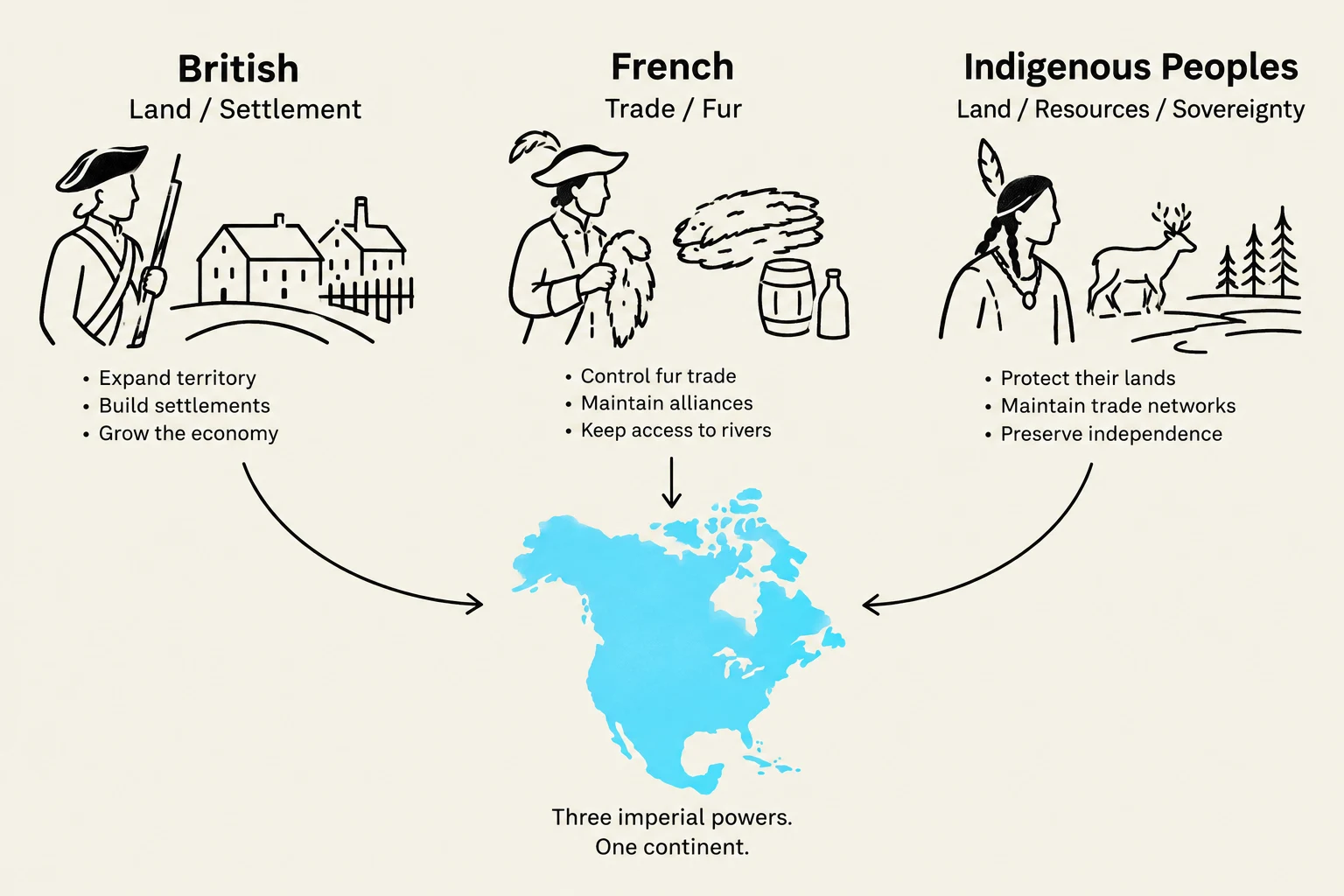
Before the outbreak of formal war, North America was a chessboard for competing empires. While Spain held sparsely populated lands in the north, the primary tension existed between the British and the French. The British were an agrarian settler empire, focused on expanding land for farming and permanent habitation. In contrast, the French operated a trade-based empire centered on commerce and alliances with Native American populations.
This competition created a unique geopolitical space known as the "Middle Ground". Located primarily in the Ohio River Valley, this was a zone where Native Americans acted as sophisticated diplomatic actors. By playing the British and French against one another, Native tribes could maintain economic leverage through trade and prevent either empire from becoming a permanent, overwhelming enemy.
This diagram illustrates the differing objectives of the British, French, and Indigenous Peoples in North America during the colonial era, focusing on land, trade, and sovereignty.
The War and the Treaty of Paris (1763)
The conflict, also known as the Seven Years' War, centered on the contested Ohio Country. Following a decisive British victory, the geopolitical landscape was fundamentally altered by the Treaty of Paris (1763). Under the terms of the treaty, Britain gained control of all French territory east of the Mississippi River.
While this was a massive victory for the British Empire, it proved disastrous for the existing social and political order in North America. The removal of the French meant the "Middle Ground" had vanished. Native Americans could no longer use the French as a diplomatic counterweight to British expansion. This loss of leverage led directly to Pontiac’s Rebellion in 1763, as Native groups sought to confront the new reality of British dominance.
The Proclamation of 1763 and Colonial Friction
In an attempt to manage the chaos following the war and prevent further costly conflicts with Native Americans, the British government issued the Proclamation of 1763. This decree prohibited colonial settlement west of the Appalachian Mountains.
This policy created an immediate rift between the Crown and the colonists. While the British viewed the proclamation as a necessary tool for frontier stability, the colonists—many of whom had fought in the war specifically to secure new lands—viewed it as an infringement on their rights and a barrier to their economic future.
Exam Tip: If a question asks about the primary cause of tension between the British government and colonists regarding land, look for the Proclamation of 1763. It represents the clash between British "stability" and colonial "expansion."
The End of Salutary Neglect
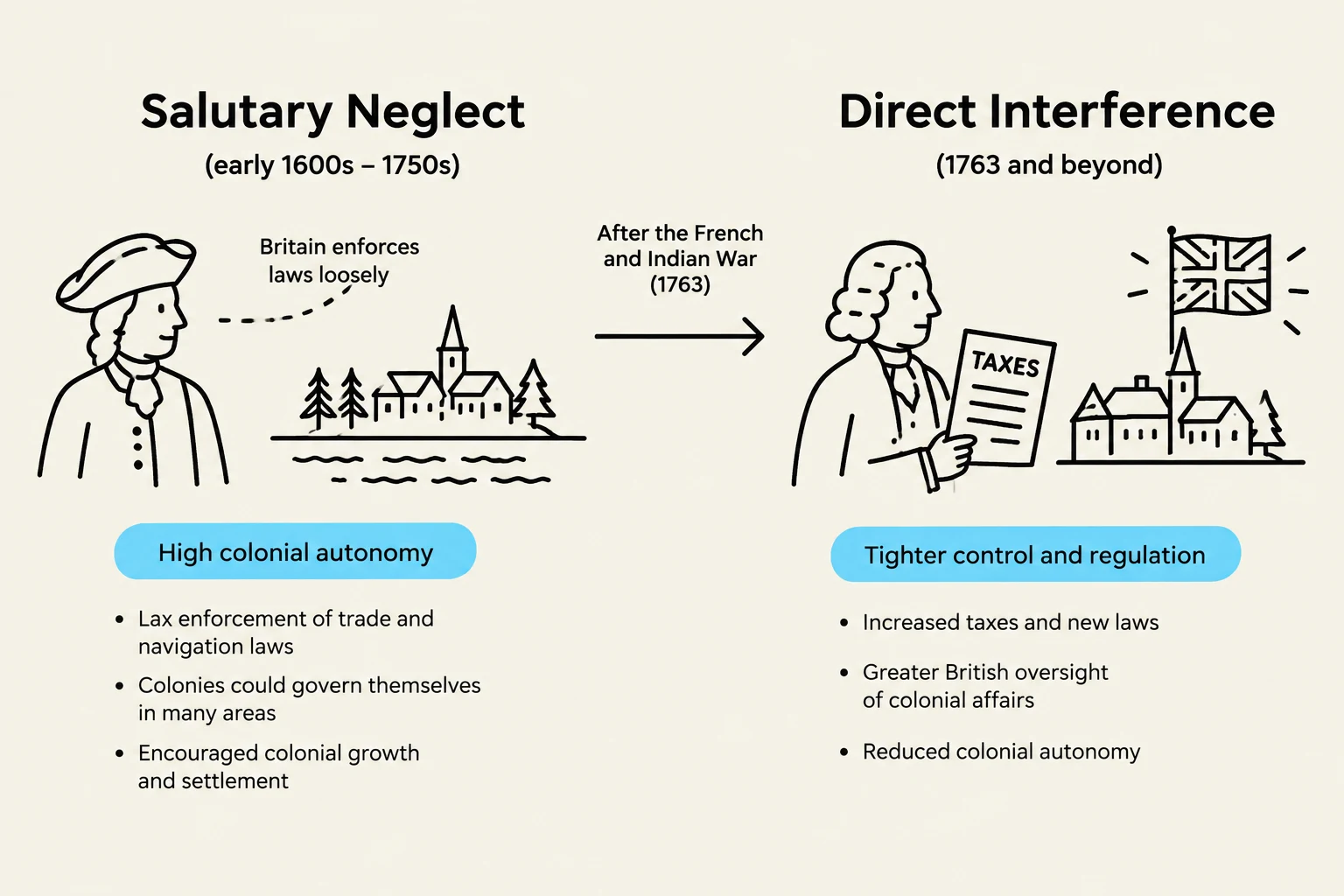
Perhaps the most significant long-term consequence of the war was the shift in how Britain governed its colonies. For decades, the colonies had existed under a policy of salutary neglect—a period where British trade laws were loosely enforced, allowing the colonies a high degree of economic and political autonomy.
However, the French and Indian War left Britain with an enormous imperial debt. Furthermore, during the war, British officers observed that colonists were frequently "avoiding" trade laws and smuggling goods. To pay for the war and the continued presence of British troops in North America, Parliament decided to end salutary neglect and move toward direct intervention.
The new goal was twofold:
Ensure colonial trade strictly conformed to the Navigation Acts.
Raise revenue through new taxes to offset the war debt.
This illustration contrasts "Salutary Neglect" (early 1600s-1750s), where Britain enforced laws loosely, leading to high colonial autonomy, with "Direct Interference" (1763 and beyond), where Britain increased control and regulation after the French and Indian War.
New Parliamentary Measures and Colonial Resistance
To implement this new posture, Parliament passed several controversial acts that the colonists viewed as violations of their traditional rights.
The Sugar Act (1764)
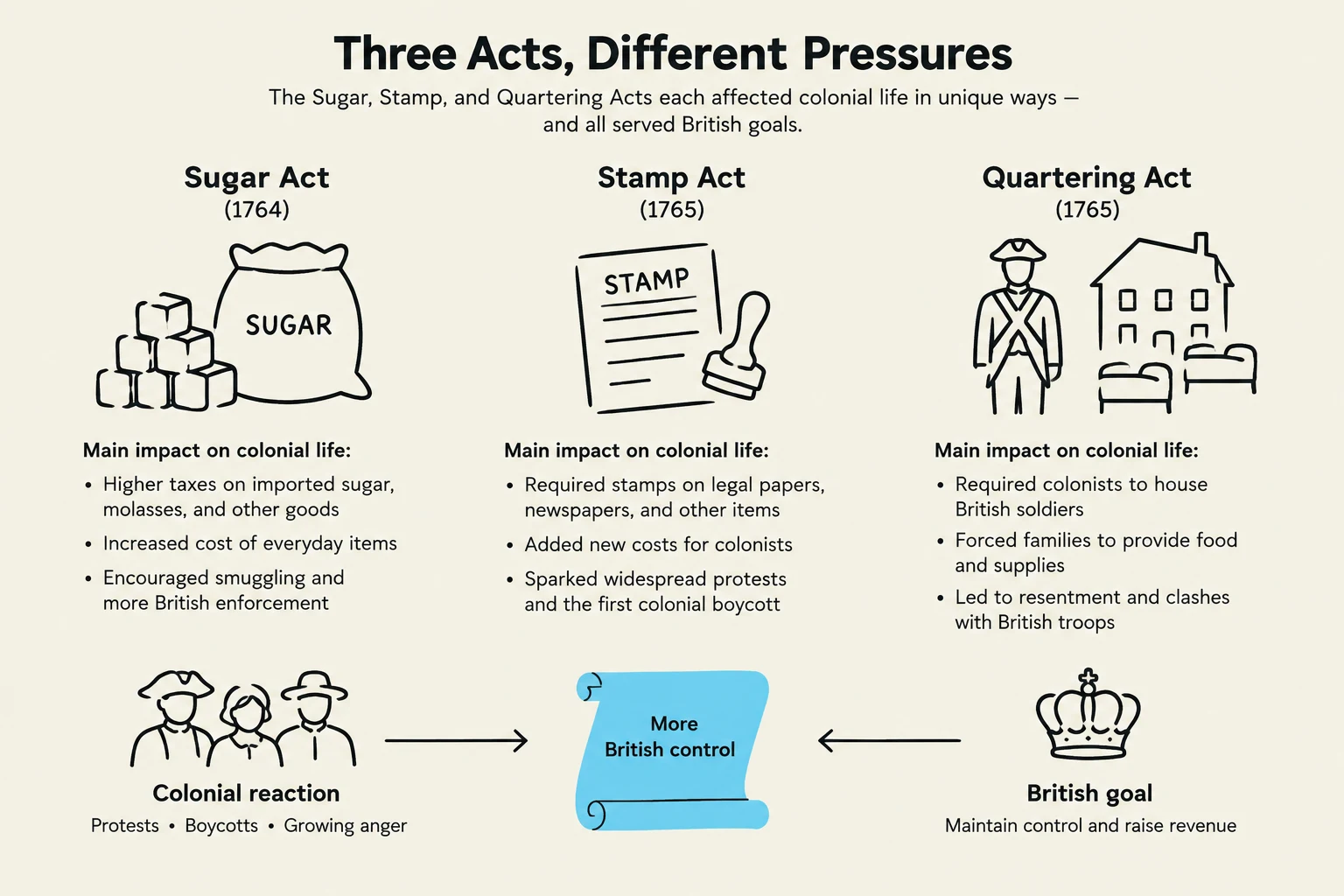
The Sugar Act was designed to curb smuggling and enforce trade laws. Interestingly, while it actually reduced the tariff on foreign sugar, it significantly increased enforcement. Britain deployed more vigilant customs officials to search ships and warehouses, and utilized Vice Admiralty courts—Crown-controlled military courts—to hear smuggling cases, bypassing traditional colonial juries.
The Stamp Act (1765)
Unlike previous measures that regulated external trade, the Stamp Act was an "internal" tax intended to raise revenue directly from the colonies. This was a major turning point; colonists viewed this as Parliament infringing upon the traditional prerogative of the colonies to govern their own internal affairs.
The Quartering Act (1765)
To maintain a military presence on the frontier without the massive expense of a large standing army, Britain stationed troops in coastal cities. The Quartering Act required the colonists to provide housing and provisions for these troops, adding another layer of financial and social tension.
This illustration outlines the Sugar Act, Stamp Act, and Quartering Act, detailing their main impacts on colonial life and the resulting colonial reactions and British goals.
Conclusion: The Paradox of Victory
The French and Indian War presents a historical paradox. In the immediate aftermath of the victory in 1763, there was a surge of British pride among the colonists. Having fought alongside the British army, many colonists felt they had proven themselves "fully English".
However, the very victory that united them also provided the catalyst for their separation. The debt incurred by the war, the loss of the "Middle Ground," and the end of salutary neglect transformed the British from protective guardians into perceived oppressors, setting the stage for the American Revolution.
Keep reading for free.
Create an account to finish this reading and make it part of your study routine.