The Four Goals of Psychology: Description, Explanation, Prediction, and Control
This article explains the four fundamental goals of psychology: description, explanation, prediction, and control. It uses the bystander effect as a case study to illustrate how psychologists move from observing behavior to understanding its causes, anticipating future occurrences, and ultimately influencing it for pos
Have you ever wondered why people act differently in a crowd than they do when they are alone? Or why certain habits are so difficult to break? Psychology is much more than just "reading minds." It is a rigorous scientific discipline dedicated to studying the complexities of human thought, emotion, and behavior. To make sense of this complexity, psychologists follow a structured framework consisting of four primary goals: description, explanation, prediction, and control.
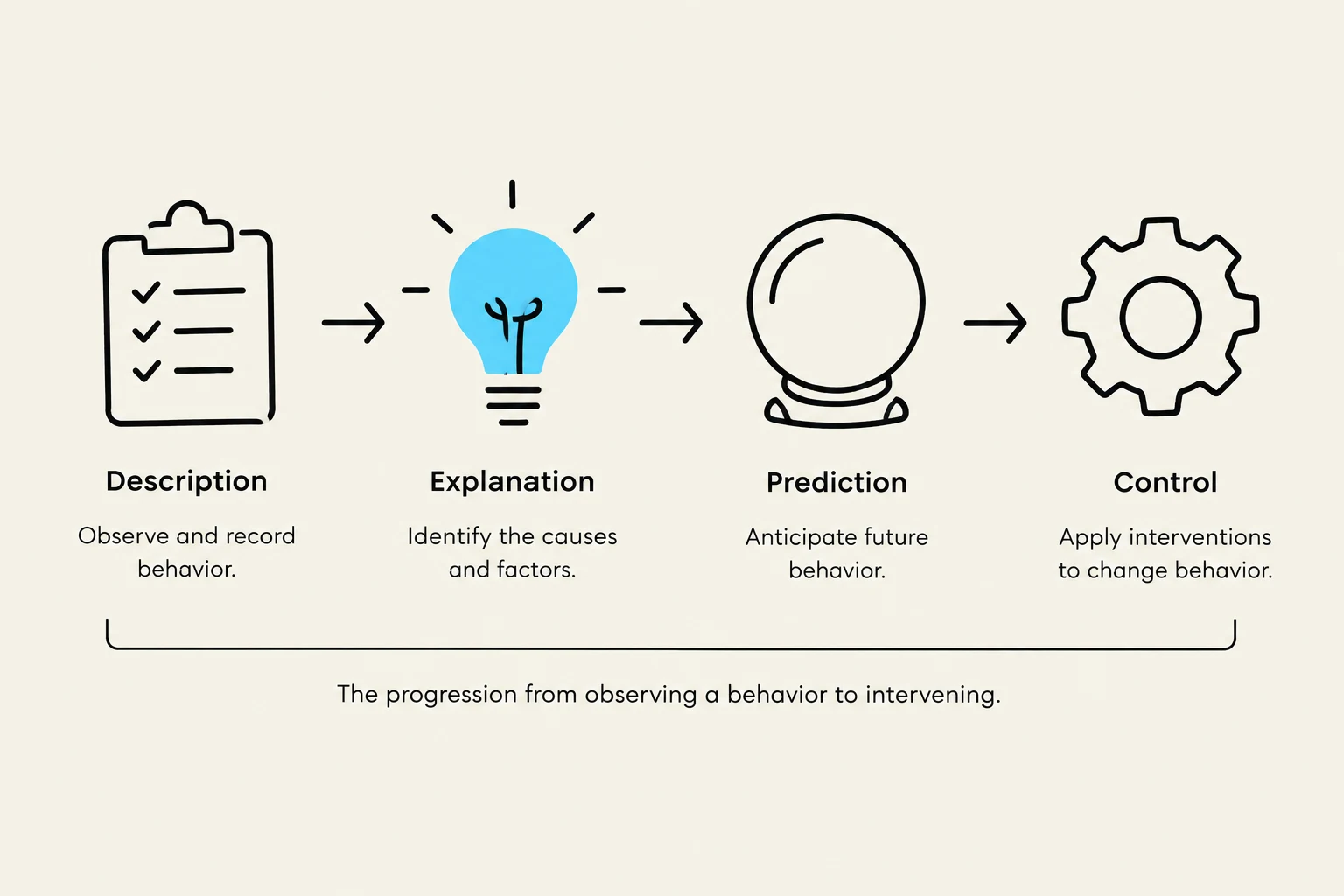
A diagram illustrating the four stages of understanding and influencing behavior: Description, Explanation, Prediction, and Control.
By mastering these four goals, researchers can move from simply noticing a phenomenon to actively improving lives through psychological intervention.
1. Description: What is happening?
The first step in any psychological inquiry is description. Before a scientist can explain why something happens, they must first accurately observe and record what is occurring. Description involves defining the behavior, noting its frequency, duration, and intensity, and documenting the context in which it takes place.
In this stage, psychologists aim to be as objective as possible. They use various tools—such as naturalistic observation, case studies, or surveys—to create a clear "picture" of the behavior.
Example: The Bystander Effect
Imagine a researcher observing a busy city square. They notice that when a person trips and falls in the middle of a crowd, many passersby continue walking without stopping to help. The researcher records how many people stopped, how long it took for the first person to react, and the approximate number of people present. This is the descriptive phase: documenting the "what" without yet jumping to the "why."
2. Explanation: Why is it happening?
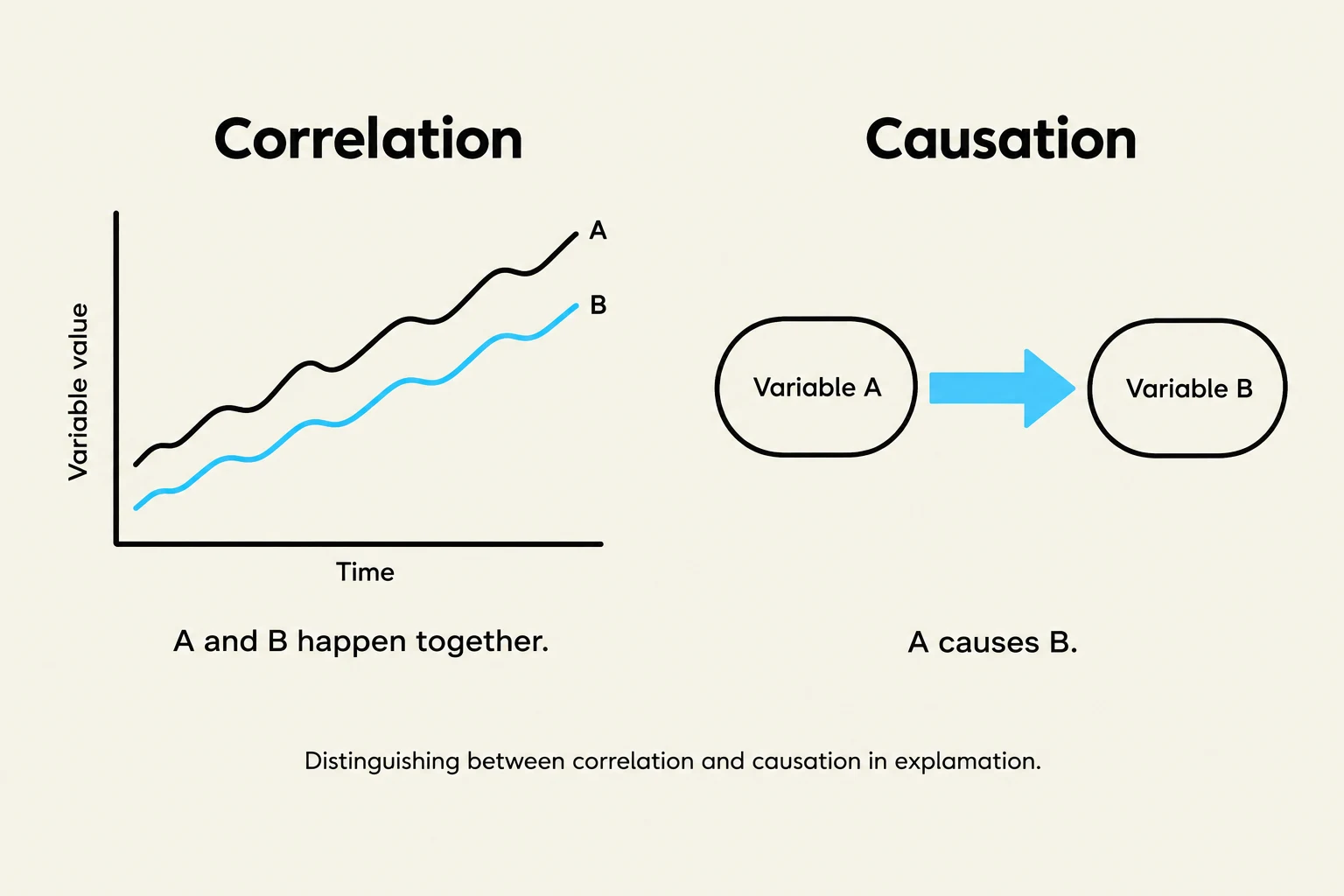
This illustration distinguishes between correlation, where two variables change together, and causation, where one variable directly influences another.
Once a behavior has been clearly described, the next goal is explanation. This is where psychologists attempt to understand the underlying causes of the behavior. An explanation seeks to identify the "why" by looking at various factors, such as biological processes, environmental triggers, or cognitive patterns.
To move from description to explanation, researchers often develop theories. A theory is a set of principles that organizes observations and predicts behaviors or events.
Exam Tip: Correlation vs. Causation
When moving into the explanation phase, be careful! Just because two things happen at the same time (correlation) does not mean one caused the other (causation). To truly explain a cause, psychologists often need to conduct controlled experiments to rule out other variables.
In the case of the bystander effect, an explanation might suggest that "diffusion of responsibility" is occurring. This theory posits that when more people are present, each individual feels less personal responsibility to act, assuming someone else will take charge.
3. Prediction: When will it happen again?
After understanding the causes of a behavior, psychologists aim to predict when that behavior is likely to occur in the future. Prediction is the ability to use past observations and established theories to anticipate how a person (or group) will act under specific circumstances.
If we have a strong explanation for a behavior, we can create "if-then" scenarios. For example:
If a person is in a highly crowded environment where they feel anonymous, then they are less likely to intervene in an emergency.
Predictive power is essential for many fields, including clinical psychology (predicting if a patient might relapse) and industrial-organizational psychology (predicting which employees might thrive in a specific work environment).
4. Control: How can we change it?
This illustration depicts the bystander effect, where individuals are less likely to offer help to a victim when other people are present. The "Problem" section shows a group of people observing someone in distress, illustrating diffusion of responsibility. The "Control" section shows a single person being directed to call for help, suggesting a solution to the bystander effect.
The final and perhaps most impactful goal is control. In a psychological context, "control" does not mean manipulation or coercion; rather, it refers to the ability to influence, modify, or manage behavior to improve lives.
When psychologists reach the goal of control, they are applying their knowledge to solve real-world problems. This might involve:
Clinical Intervention: Using Cognitive Behavioral Therapy (CBT) to help a patient control anxiety symptoms.
Educational Strategies: Implementing new teaching methods to help students better retain information.
Social Engineering: Designing environments that encourage prosocial behavior (like helping others) and discourage harmful behaviors.
Returning to our bystander effect example, if we know that the lack of responsibility is the cause, a "control" strategy might involve training people to point to a specific individual in a crowd and say, "You in the red shirt, call 911!" This breaks the diffusion of responsibility and directs action.
Summary Table: The Four Goals in Action
To help you study, here is a quick breakdown of how these goals flow into one another:
Goal
Core Question
Action Taken
Description
What is happening?
Observing and recording data.
Explanation
Why is it happening?
Developing theories to find causes.
Prediction
When will it happen?
Anticipating future behavior based on patterns.
Control
How can we change it?
Implementing interventions to improve outcomes.
By following this progression, psychology moves from a collection of interesting observations to a powerful science capable of understanding and improving the human experience.
Keep reading for free.
Create an account to finish this reading and make it part of your study routine.