The Flaws of Moral Relativism: Inconsistency and Consequence
An analysis of moral relativism, exploring its different forms and critiquing its logical inconsistencies regarding tolerance, moral progress, and human flourishing. It contrasts relativism with moral realism.
In the study of metaethics—the branch of philosophy concerned with the nature of morality—one of the most debated positions is moral relativism. At its core, moral relativism is a form of anti-realism which suggests that there are no mind-independent moral facts. Instead, ethical truths are seen as being relative to the standpoints of specific groups, cultures, or individuals.
While relativism often stems from a desire to promote humility and avoid cultural imperialism, critics argue that the theory collapses under its own weight. By examining the logical inconsistencies regarding tolerance, the impossibility of moral progress, and the failure to account for human well-being, we can see why many philosophers reject relativism in favor of moral realism.
Understanding the Layers of Relativism
To critique relativism, one must first distinguish between its different forms. Not all relativists make the same claims.
Descriptive Relativism: This is the purely observational claim that moralities and ethical codes are radically different across cultures. For example, some cultures permit polygamy while others mandate monogamy.
Metaethical Relativism: This is a stronger claim that moral truths are only true relative to a specific group. In this view, "X is moral" is true if, and only if, the culture in question believes X to be moral.
Normative Relativism: The strongest form, which asserts that no person or culture ought to judge the ethical codes of others.
The Hierarchy of Relativism illustrates three levels: Normative, Metaethical, and Descriptive, moving from practical to philosophical abstraction.
Study Tip: When analyzing an ethical argument, identify if the speaker is making a descriptive claim (stating what is happening) or a normative claim (stating what should happen). Relativists often jump from a descriptive observation to a normative conclusion without sufficient logical justification.
The Paradox of Tolerance
One of the most common arguments in favor of moral relativism is that it promotes tolerance. The logic suggests that if we accept that no culture's code is superior, we will be more humble and less likely to condemn others.
However, this creates a profound logical contradiction. If all moralities are equally valid, then tolerance cannot be a universal requirement. If a specific culture has a moral code that is inherently intolerant—for example, a culture that mandates the oppression of outsiders—the relativist must concede that this intolerance is "right" for that culture.
By arguing that we ought to be tolerant, the relativist inadvertently admits that there is at least one objective moral value (tolerance) that applies to everyone, regardless of their cultural beliefs. This admission contradicts the fundamental premise that no universal moral facts exist.
Moral Change vs. Moral Progress
Perhaps the most significant consequence of relativism is its inability to account for social reform and moral improvement.
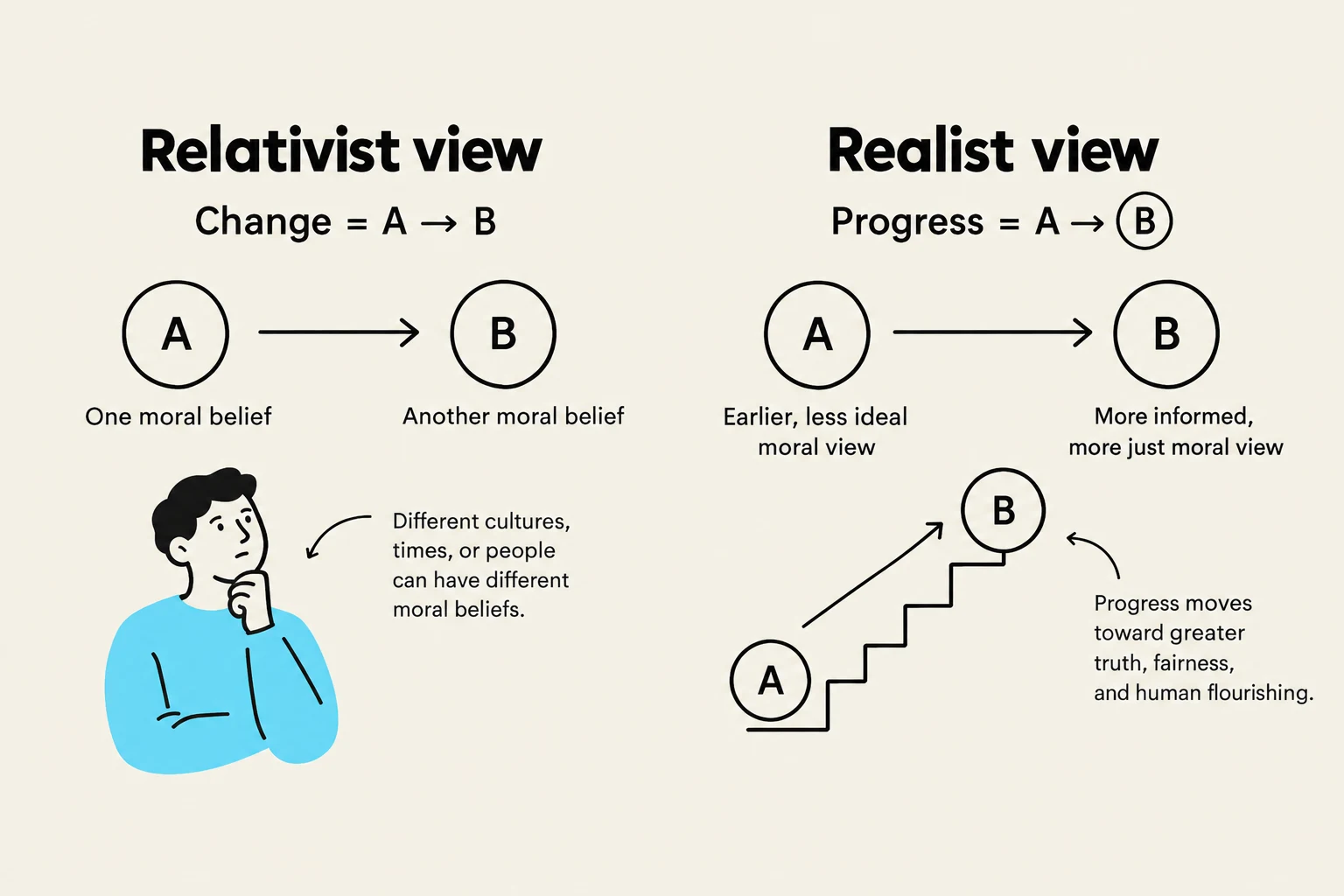
In a relativistic framework, if a society changes its laws, it has undergone a moral change, but it has not made moral progress. To say that a society has "improved" (such as the abolition of slavery or the advancement of women's rights) requires an independent, objective standard to measure that improvement against.
Consider the following comparison:
Relativist View: A society moving from a pro-slavery code to an anti-slavery code is simply moving from "Code A" to "Code B." Neither is better; they are just different.
Realist View: The abolition of slavery represents a movement toward a more correct moral truth. The anti-slavery code is objectively superior because it aligns better with moral facts.
This illustration contrasts the relativist view of change in moral beliefs (A to B) with the realist view of progress, which moves towards greater truth, fairness, and human flourishing.
Without an objective benchmark, figures like Martin Luther King Jr. or William Wilberforce—who fought to change the status quo—cannot be described as "improving" society; they would merely be seen as people advocating for a different, equally valid preference.
Human Flourishing and Objective Standards
Critics also argue that relativism fails to account for the biological and psychological realities of human flourishing and well-being.
While relativists claim that morality is a social construct, many philosophers argue that certain conditions are necessary for sentient beings to thrive. If a moral code enables human flourishing while another causes widespread suffering, we can judge them objectively based on their outcomes.
Moral Framework
Basis of Judgment
View on Oppressive Practices
Moral Relativism
Cultural acceptance/tradition
Acceptable if the culture endorses them
Moral Realism
Objective facts/Human flourishing
Wrong if they impede well-being
If a relativist attempts to rescue their position by suggesting that "better" moralities are those that better meet human needs, they have effectively abandoned relativism. By acknowledging that some moralities are superior because they promote flourishing, they are admitting to the existence of an objective standard.
Conclusion: The Counterintuitive Nature of Relativism
Ultimately, moral relativism struggles to explain the profound moral outrage that humans feel toward historical atrocities. When we look at events like the Holocaust or the practice of suttee (the immolation of widows), we do not view them as mere "cultural differences" or "matters of opinion". Instead, we experience them as objective evils, comparable to the certainty of a mathematical fact.
While the impulse toward humility and tolerance is noble, a philosophy that renders slavery, oppression, and senseless violence "morally acceptable" simply because they are culturally endorsed is a philosophy that fails to meet the requirements of human reason and justice.
Final Summary for Exams:
Relativism's Core: Morality is relative to culture/opinion; no objective truths.
The Tolerance Trap: Arguing for universal tolerance contradicts the denial of universal values.
The Progress Problem: Relativism allows for change but forbids improvement.
The Flourishing Benchmark: Using well-being as a standard turns relativism into realism.
Keep reading for free.
Create an account to finish this reading and make it part of your study routine.