The Five Roles of Parliament in Modern Democracies
An explanation of the five core functions of Parliament: legitimizer, policy maker, creator, financier, and scrutineer. This content details how Parliament balances executive power, represents citizens, and ensures governmental accountability through various mechanisms.
In any modern democracy, the Parliament serves as the central nervous system of the state. It is far more than just a room where politicians debate; it is a complex institution designed to balance the power of the executive, represent the will of the people, and ensure the orderly management of national affairs. To understand how a state functions, one must look past the daily headlines and examine the fundamental roles that Parliament performs to maintain stability and justice.
These roles can be categorized into five distinct functions: acting as a legitimizer, a policy maker, a creator, a financier, and a scrutineer. By performing these tasks, Parliament ensures that the government operates within the bounds of the law and remains accountable to the citizens it serves.
1. The Legitimizer: Providing the Mandate to Rule
The first and perhaps most foundational role of Parliament is that of the legitimizer. In a representative democracy, power does not reside in individuals, but in the people. However, because millions of people cannot govern simultaneously, they delegate this power to elected representatives.
When a government takes office, its authority to make decisions is derived from the fact that it was chosen through a process overseen by Parliament. Parliament provides the "stamp of approval" that transforms raw political power into legitimate legal authority. Without this legitimizing function, a government's actions might be viewed as mere coercion rather than lawful governance.
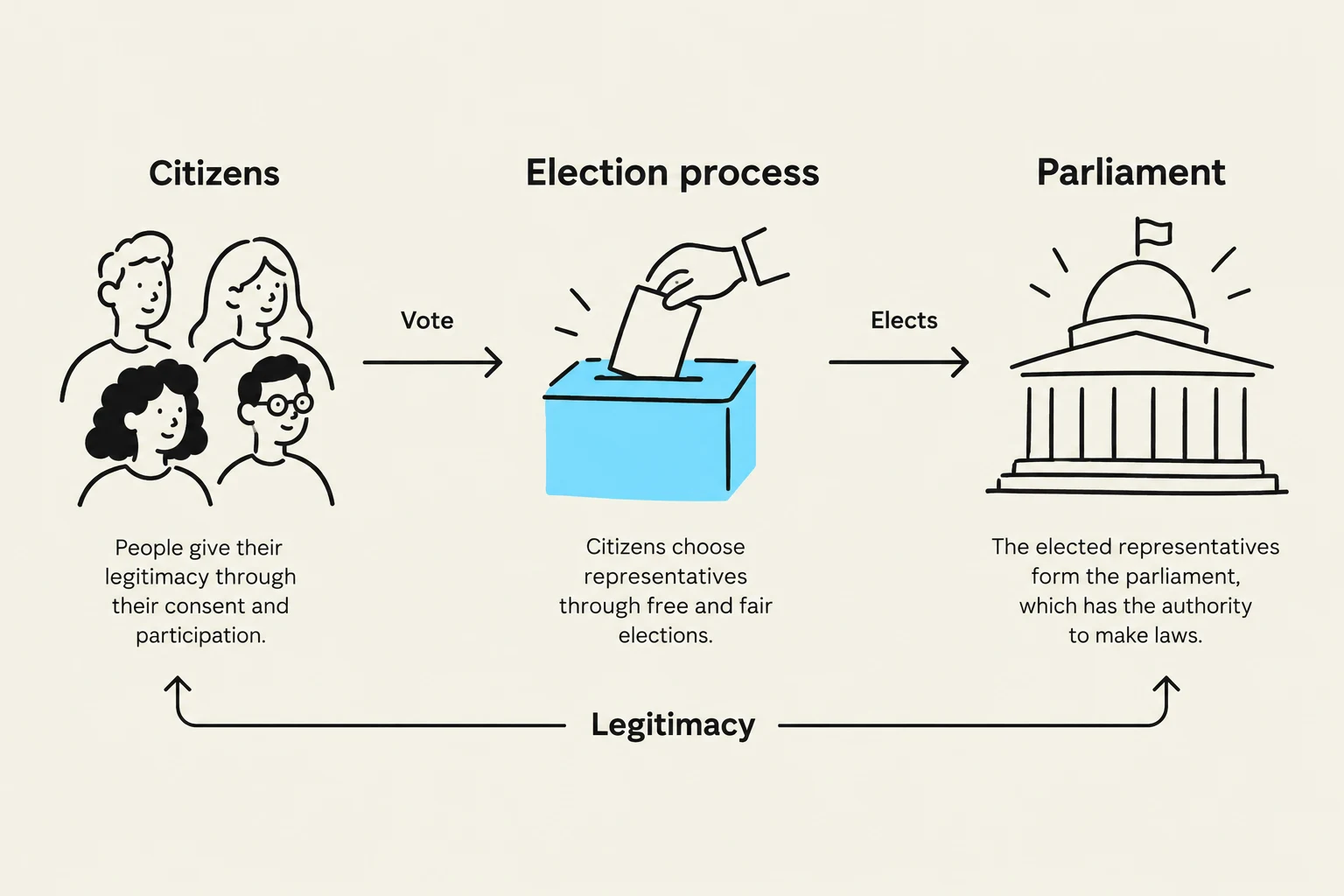
This diagram illustrates the election process, showing how citizens vote to elect representatives who form a parliament with law-making authority, thereby establishing legitimacy.
Exam Tip: If asked about the difference between "power" and "authority," remember that power is the ability to influence others, while authority (legitimacy) is the recognized right to do so. Parliament is the bridge between the two.
2. The Policy Maker: Shaping the National Direction
While the executive branch (the Prime Minister and Cabinet) often proposes the direction of the country, Parliament acts as the primary policy maker. This role involves the deliberation, refinement, and debate of the strategic goals of the nation.
Through committee hearings and floor debates, Parliament members scrutinize proposed policies to ensure they are practical, equitable, and aligned with the public interest. This process ensures that policy is not just a top-down imposition from the executive, but a negotiated outcome that has undergone rigorous testing.
3. The Creator: The Law-Making Function
The most visible role of Parliament is that of the creator. This is the formal legislative function: the process of drafting, debating, and passing new laws (statutes) and amending existing ones.
The legislative process typically follows a structured path:
Introduction: A bill is proposed.
Debate: Members discuss the merits and flaws of the bill.
Amendment: Changes are proposed to improve the bill.
Voting: The bill is put to a vote to determine if it becomes law.
This diagram illustrates the legislative lifecycle, from a bill proposal through committee review and passage to becoming law.
4. The Financier: Controlling the Purse Strings
A government cannot function without money, but in a democracy, the executive is not allowed to spend public funds at its own discretion. This is where Parliament fulfills its role as the financier.
Through the "power of the purse," Parliament must approve the national budget and all significant taxation measures. This ensures that the government's spending priorities reflect the needs of the electorate. By controlling the budget, Parliament exerts significant influence over almost every aspect of government activity, as no department can operate without parliamentary authorization of its funds.
5. The Scrutineer: Ensuring Accountability
The final, and perhaps most critical role for the protection of civil liberties, is that of the scrutineer. This role is focused on oversight and accountability.
As a scrutineer, Parliament monitors the executive branch to ensure that laws are being implemented correctly, money is being spent honestly, and officials are acting within their legal mandates. This is achieved through several mechanisms:
Question Time: Where ministers must answer direct questions from members.
Select Committees: Small groups of MPs who conduct deep-dive investigations into specific issues or departments.
Inquiries: Formal investigations into government failures or systemic issues.
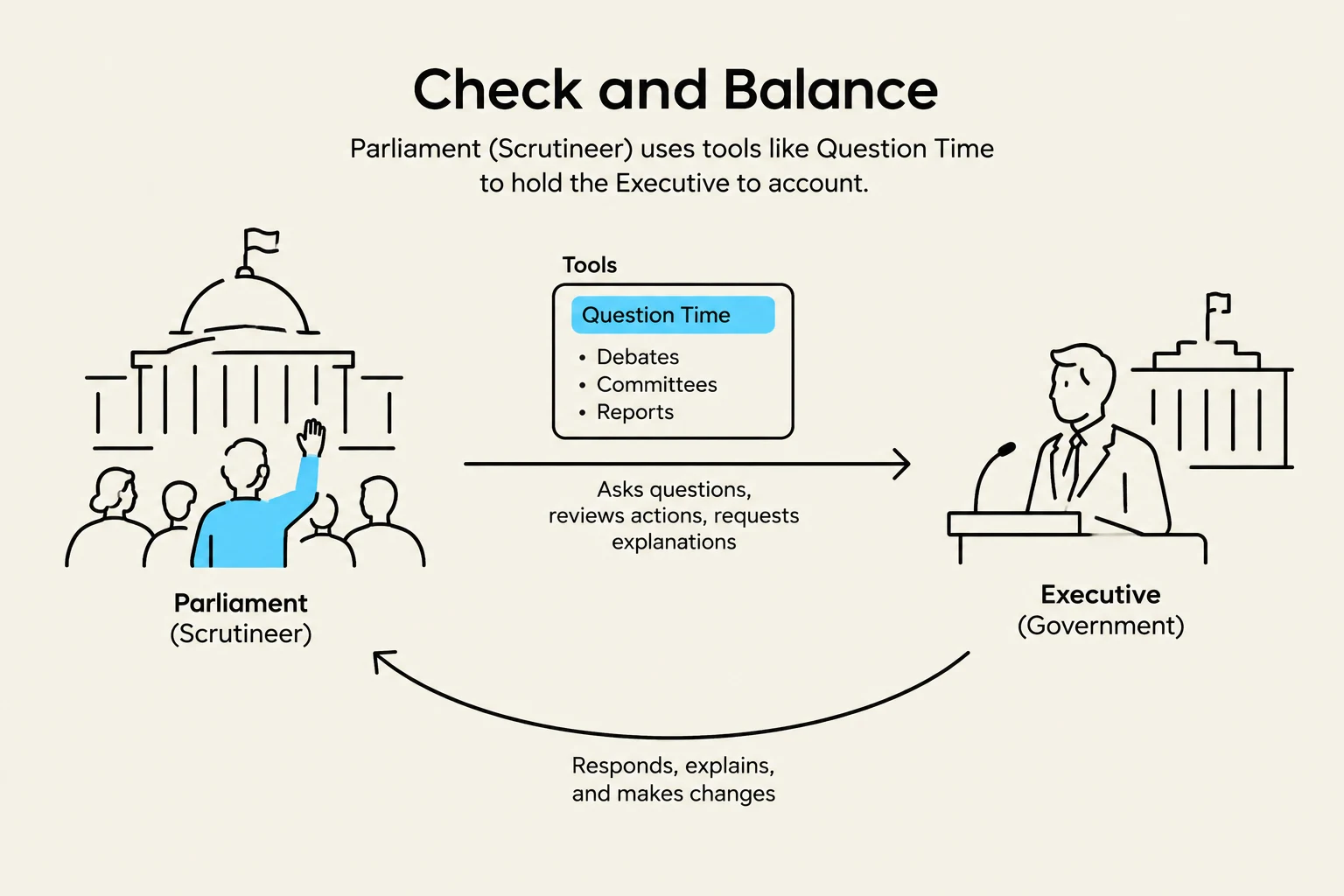
This diagram illustrates the concept of checks and balances in a government, showing how Parliament (Scrutineer) uses tools like Question Time to hold the Executive (Government) accountable through questions, reviews, and explanations.
Student Note: Scrutiny is often paired with Judicial Oversight. While Parliament scrutinizes the policy and political decisions of the government, the courts (the judiciary) scrutinize the legality of those decisions to ensure they do not violate the constitution or human rights.
Summary Table: The Five Roles at a Glance
Role
Primary Function
Key Mechanism
Legitimizer
Validates the government's right to rule
Elections and constitutional recognition
Policy Maker
Determines the strategic direction of the state
Debate and deliberation
Creator
Formulates and enacts new laws
The legislative process (Bills/Acts)
Financier
Controls public revenue and expenditure
Budget approval and taxation laws
Scrutineer
Holds the executive accountable
Question time, committees, and inquiries
By balancing these five roles, Parliament acts as both a driver of progress and a brake on potential tyranny, ensuring that the state remains responsive to the people it represents.
Keep reading for free.
Create an account to finish this reading and make it part of your study routine.