The First New Deal: Economic Reforms and Social Programs
An overview of President Franklin D. Roosevelt's First New Deal (1933-1935), detailing key legislative actions, banking and Wall Street reforms, public works programs like the CCC and TVA, and their impact on American society during the Great Depression.
In the wake of the Great Depression, the United States faced a systemic collapse of its financial institutions and a desperate need for economic relief. Upon taking office, President Franklin Delano Roosevelt (FDR) launched a series of aggressive legislative actions known as the First New Deal (1933–1935). During his first 100 days in office, Congress approved 15 major pieces of legislation designed to stabilize the economy, provide relief to the unemployed, and reform the banking and securities industries. To maintain public support and explain these complex changes, FDR utilized "fireside radio chats," a method of direct communication that allowed him to speak personally to the American people.
Banking Reform and Financial Stability
One of the most immediate priorities for the Roosevelt administration was restoring faith in the American banking system, which had been decimated by bank runs and panics.
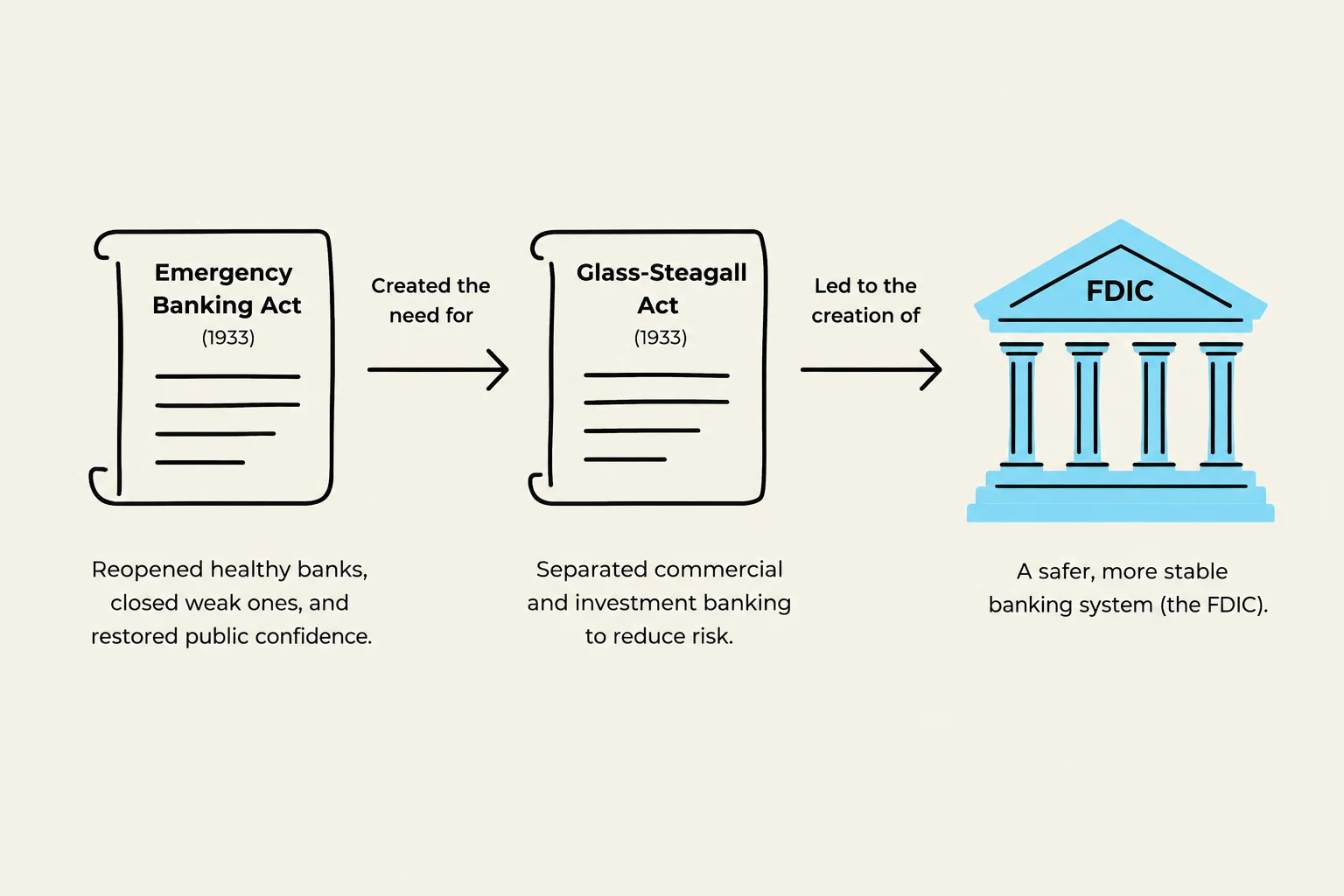
The Emergency Banking Act of 1933 was a critical first step in stabilizing the financial sector. This was closely followed by the Glass-Steagall Banking Act of 1933, which introduced a fundamental structural change to the financial industry: the separation of commercial banking from investment banking. By preventing banks from using depositors' money for high-risk stock market speculation, the government aimed to protect the savings of everyday citizens.
To further ensure that a bank failure would not result in the total loss of a family's savings, the government created the Federal Deposit Insurance Corporation (FDIC). The FDIC provided federal insurance for customer bank accounts—up to a limit of $2,500 at the time—which significantly reduced the likelihood of future bank panics.
This diagram illustrates the historical progression from the Emergency Banking Act of 1933 to the Glass-Steagall Act, which led to the creation of the FDIC, establishing a safer and more stable banking system.
Study Tip: When studying banking reform, remember the "Separation Principle." The Glass-Steagall Act was designed to keep "safe" money (commercial banking) away from "risky" money (investment banking) to prevent a repeat of the 1929 crash.
Wall Street Regulation
While banking reform focused on protecting depositors, a second wave of legislation targeted the stock market to prevent the speculative excesses that led to the Great Depression.
The Securities Act of 1933 was designed to increase transparency by holding corporations accountable regarding their stocks and the true state of their companies. This was complemented by the Securities Act of 1934, which established the Securities & Exchange Commission (SEC). The SEC was granted the authority to enforce new laws and regulations governing the issuance and trading of stocks and bonds, acting as a "watchdog" for Wall Street.
This diagram illustrates the process of a corporation issuing stocks, the role of the SEC in reviewing and approving these offerings, and how investors participate in the market. It also outlines the SEC's functions of review, monitoring, and enforcement.
Relief and Public Works Programs
Beyond financial regulation, the First New Deal sought to provide direct relief to the millions of Americans suffering from unemployment and poverty through massive public works projects.
The Civilian Conservation Corps (CCC)
The Civilian Conservation Corps (CCC) was one of the most impactful relief programs. Over a nine-year period, nearly 3 million men, aged 17 to 27, were employed by the CCC. The program provided participants with:
Shelter, uniforms, and food.
A small monthly wage of $30 (with $25 of that amount required to be sent home to support their families).
Opportunities for education, including the chance to earn high school diplomas.
It is important to note that while Black and Native Americans were included in the CCC, the program remained segregated.
The Tennessee Valley Authority (TVA)
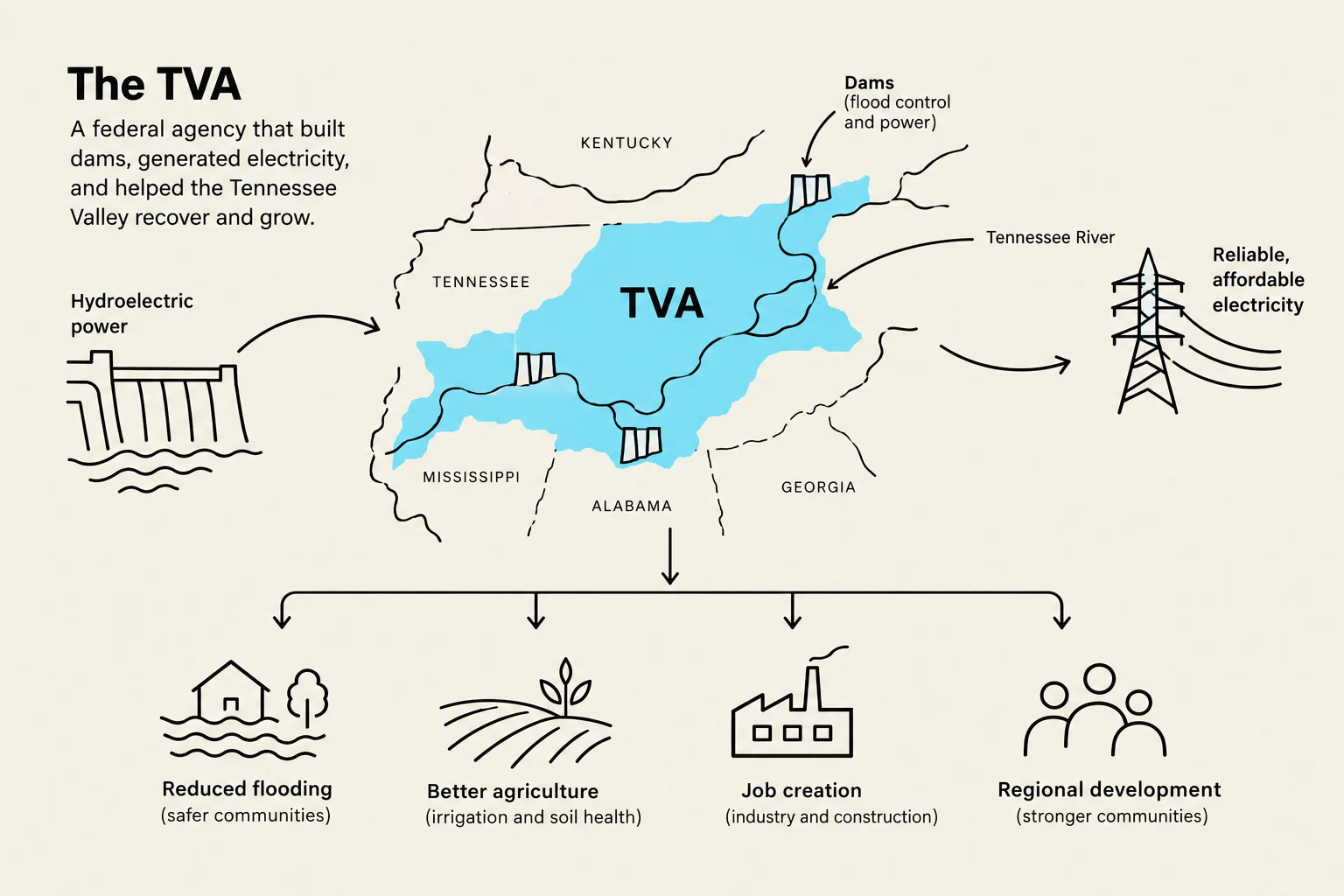
In the rural South, the Tennessee Valley Authority (TVA) was established to address systemic poverty and lack of infrastructure. The TVA brought much-needed electrical power, flood control efforts, and jobs to the Appalachian region, modernizing one of the country's most impoverished areas.
This diagram illustrates the Tennessee Valley Authority (TVA) and its contributions to the region, including hydroelectric power, flood control, reliable electricity, better agriculture, job creation, and regional development.
Expanding Presidential Power and Social Change
The era of the First New Deal saw a significant expansion of executive authority. FDR passed laws that allowed the President to reorganize federal agencies, cut federal worker salaries, and reduce pay for veterans with non-service-connected disabilities. Additionally, the era saw the end of Prohibition via the 21st Amendment.
While FDR managed the legislative and economic machinery, his wife, Eleanor Roosevelt, emerged as a powerful political force in her own right. Rather than being a traditional, silent First Lady, Eleanor Roosevelt formed a political partnership with her husband. She became an influential leader of the 20th century, using her platform to fight for the rights of women, children, and Black Americans.
Summary Table: Key New Deal Components
Program/Act
Primary Goal
Key Outcome
Glass-Steagall Act
Banking Reform
Separated commercial and investment banking.
FDIC
Consumer Protection
Insured bank deposits to prevent panics.
SEC
Market Regulation
Enforced rules on stock and bond trading.
CCC
Unemployment Relief
Provided jobs and education to young men.
TVA
Regional Development
Brought power and jobs to Appalachia.
Keep reading for free.
Create an account to finish this reading and make it part of your study routine.