The Federal Judicial System: Structure, Power, and Process
An overview of the U.S. federal judicial system, including its constitutional basis, the power of judicial review, the hierarchy of courts, and the process of deciding cases and issuing opinions.
The United States Constitution established the judiciary as a separate and independent branch of government, designed to act as a co-equal pillar alongside the legislative and executive branches. While the Constitution explicitly creates the U.S. Supreme Court, it grants Congress the authority to establish lower federal courts as needed. This system serves a vital role in interpreting the law and ensuring that government actions remain within the boundaries of constitutional authority.
Constitutional Authority and Judicial Power
The foundation of the federal judiciary is found in Article III of the Constitution. This article reserves specific judicial powers to the courts, allowing them to oversee three primary areas of law:
Criminal Law: Acts that the government deems illegal.
Civil Law: Disputes between parties regarding which individual or entity is in the right.
Procedural Law: The rules that the government must follow to act lawfully.
To ensure fairness, the Constitution requires that trials arising under federal law be decided by a jury rather than a judge acting alone, and these jury decisions must be unanimous.
The Power of Judicial Review
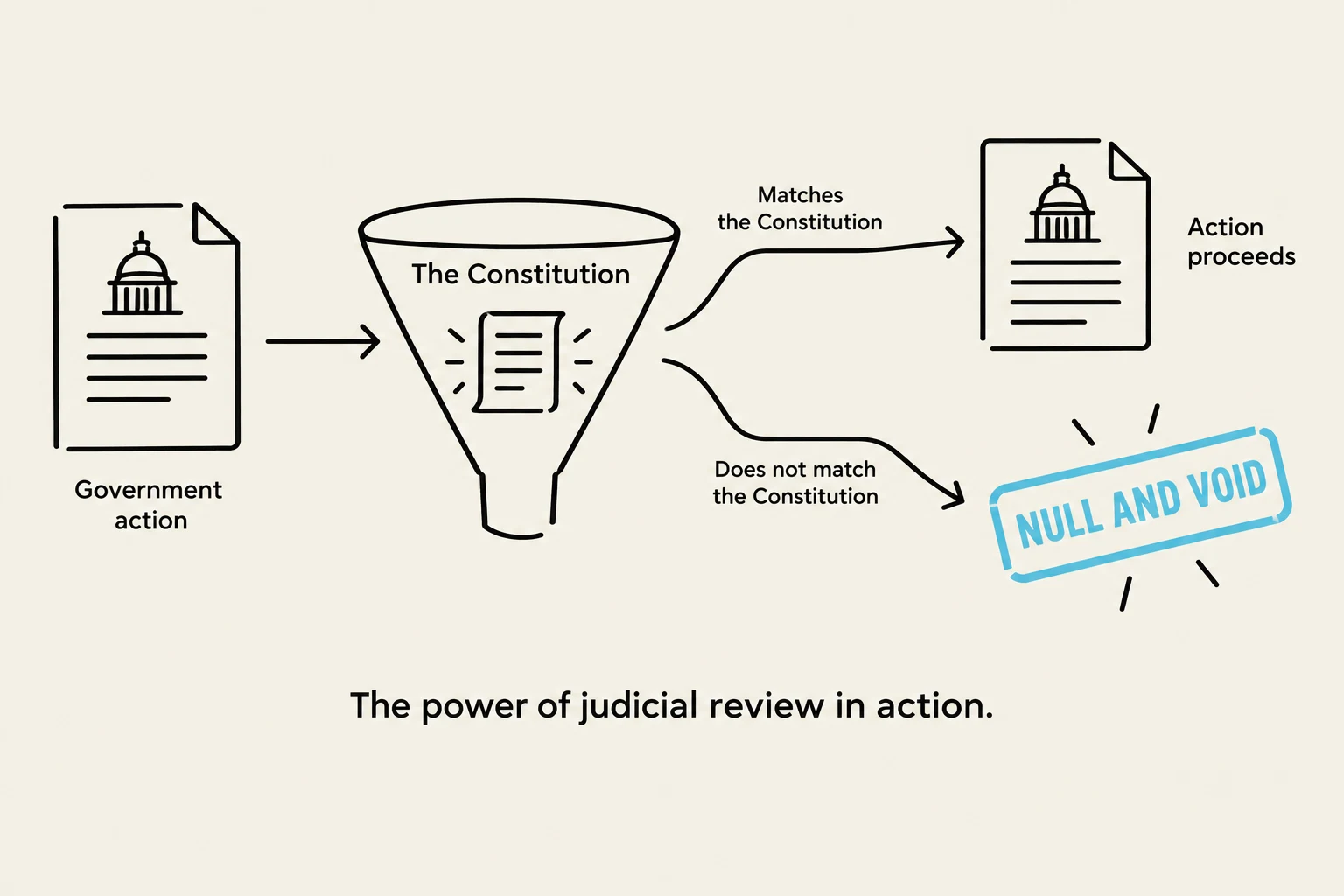
This diagram illustrates the process of judicial review, where government actions are checked against the Constitution. If an action aligns with the Constitution, it proceeds; otherwise, it is declared null and void.
Perhaps the most significant expansion of judicial power came through the landmark case Marbury v. Madison (1803). This case established the principle of judicial review, which is the power of the courts to decide whether a government official or institution has acted within the limits of the Constitution. If a court finds that an action violates the Constitution, it has the authority to declare that action null and void. This ruling cemented the judiciary's position as a co-equal branch of government.
Exam Tip: Jurisdiction
When studying the court system, distinguish between these two types of authority:
Original Jurisdiction: The authority to be the first court to hear a case.
Appellate Jurisdiction: The authority to review cases that have already been decided by lower courts.
The Hierarchy of the Federal Court System
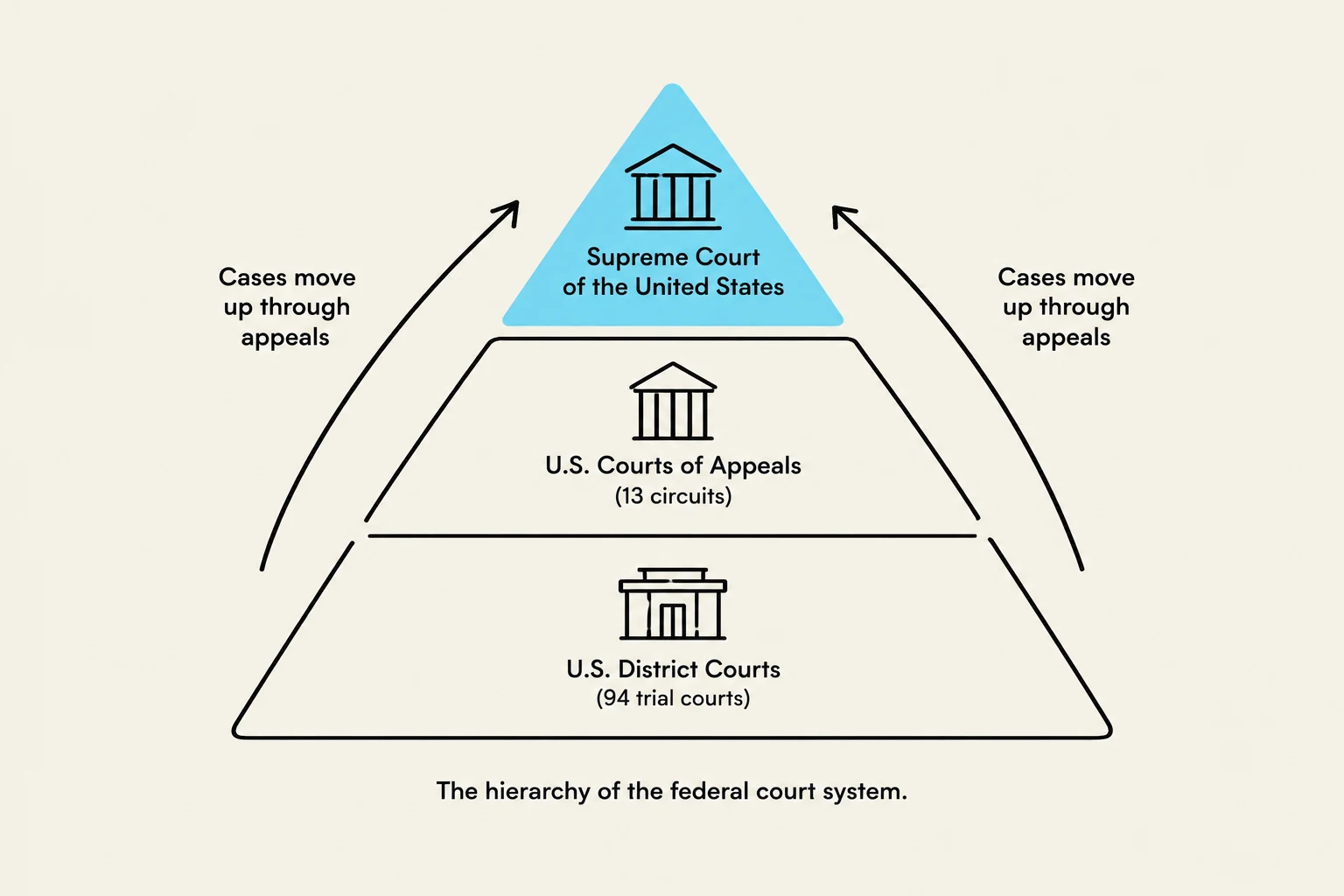
The hierarchy of the federal court system, illustrating the progression of cases through appeals from U.S. District Courts to the Supreme Court of the United States.
The federal court system is organized into several layers, moving from trial courts to the nation's highest court.
U.S. District Courts
There are 94 federal district courts, which serve as the "lower" courts and the chief trial courts of the federal system. Most of these cases are presided over by a single judge. District courts have the power to strike down congressional or executive acts if they are found to be unconstitutional.
U.S. Courts of Appeals
If a party loses in a district court, they can appeal to the U.S. Courts of Appeals. There are 13 circuits in total:
Geographic Circuits: Eleven circuits have jurisdiction over specific geographic regions (e.g., District 1 covers Maine, New Hampshire, and Massachusetts).
Specialized Circuits: One circuit has jurisdiction over the District of Columbia, and another (the Federal Circuit) specializes in areas like patents and international trade.
Appeals are typically heard by panels of judges rather than a single judge.
Specialty Courts
Congress has also created specialty courts with jurisdiction limited to specific types of cases. Examples include:
The U.S. Court of International Trade.
The U.S. Court of Federal Claims.
The U.S. Court of Military Appeal.
Unlike most federal judges, some judges in these specialty courts serve fixed 15-year terms rather than lifetime appointments.
The Supreme Court of the United States
The Supreme Court is the highest court in the nation, consisting of nine members: one Chief Justice and eight Associate Justices. It possesses both original jurisdiction (for disputes involving foreign diplomats or suits between states) and appellate jurisdiction.
Because the Court receives thousands of requests but accepts fewer than 100 cases each year, it uses a specific selection process:
Writ of Certiorari: A formal request for a record of a case.
The Rule of Four: At least four justices must agree to hear a case for a writ of certiorari to be issued.
Deciding Cases and Issuing Opinions
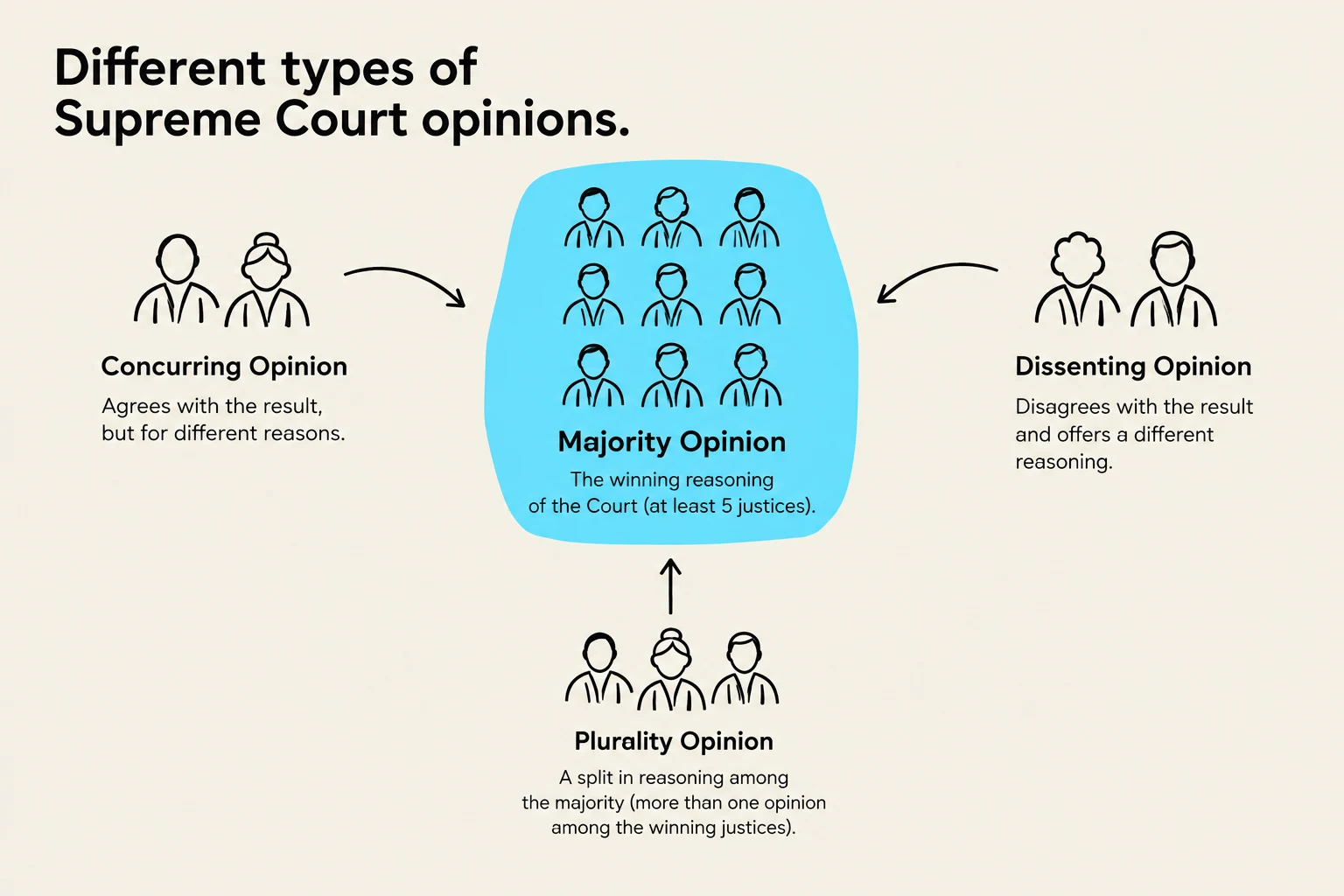
This diagram illustrates the different types of opinions issued by the Supreme Court: Majority Opinion, Concurring Opinion, Dissenting Opinion, and Plurality Opinion.
When the Supreme Court or other federal courts reach a conclusion, they issue a decision (identifying the winner) and an opinion (explaining the legal reasoning). Because the Court is a collective body, different types of opinions may be issued:
Majority Opinion: The official decision where a majority of justices agree on both the outcome and the legal reasoning.
Plurality Opinion: A decision where a majority agrees on the outcome, but they cannot agree on a single legal reasoning.
Concurring Opinion: An opinion written by a justice who agrees with the majority's result but disagrees with the reasoning used to get there.
Dissenting Opinion: An opinion written by one or more justices on the losing side to explain why they disagree with the majority.
Per Curiam Opinion: An unsigned decision written by the Court as a whole.
In recent years, legal scholars have also noted the use of the shadow docket, which refers to brief decisions made without oral presentations that are often rendered within days of a case being filed.
Politics and the Judiciary
While judges are expected to be guided by the Constitution, legislative statutes, and legal precedents (stare decisis), the judiciary is not immune to political influence.
Selection of Judges
Federal judges are nominated by the President and must be confirmed by the Senate. This process is highly partisan, as presidents often nominate individuals with similar political philosophies to influence judicial policy for decades.
Judicial Philosophy
Judges often operate under different philosophical frameworks:
Judicial Restraint: The belief that judges should strictly abide by precedent and legislation, applying the law without creating it.
Judicial Activism: The belief that courts should not blindly uphold the decisions of elected officials, especially when core constitutional principles are at stake.
Originalism vs. Living Constitution: Originalists believe constitutional meaning is fixed at the time of writing, while proponents of a "living constitution" believe the law should evolve to reflect changing societal values.
The Role of State Courts
It is a common misconception that the federal system handles all major legal issues. In reality, state courts handle more than 95% of the nation's legal cases. Each state manages its own court structure and has different methods for the selection of state judges, including:
Elections: The most common method, which can be partisan or nonpartisan.
Appointments: Where the governor or legislature selects judges.
Merit System (Missouri Plan): A system where a judge is appointed from a list of candidates and then faces a retention election to decide if they stay in office.
Most cases that begin in state courts stay there and do not enter the federal system unless they involve a U.S. constitutional issue.
Keep reading for free.
Create an account to finish this reading and make it part of your study routine.