This document explores the extended IS-LM model, nominal and real interest rates, risk premiums on bonds, and financial policy interventions like the Troubled Asset Relief Program and quantitative easing.
In standard macroeconomic models, we often assume that the interest rate used in investment decisions is the same as the policy rate set by a central bank. However, in the real world, there is a significant gap between the rate at which the government borrows and the rate at which private firms and households borrow. This gap is driven by risk, uncertainty, and the health of the financial system. To capture this reality, economists use the Extended IS-LM Model, which incorporates the concept of a risk premium to better understand how financial crises and policy interventions affect the broader economy.
The Extended IS-LM Model: Beyond the Basics
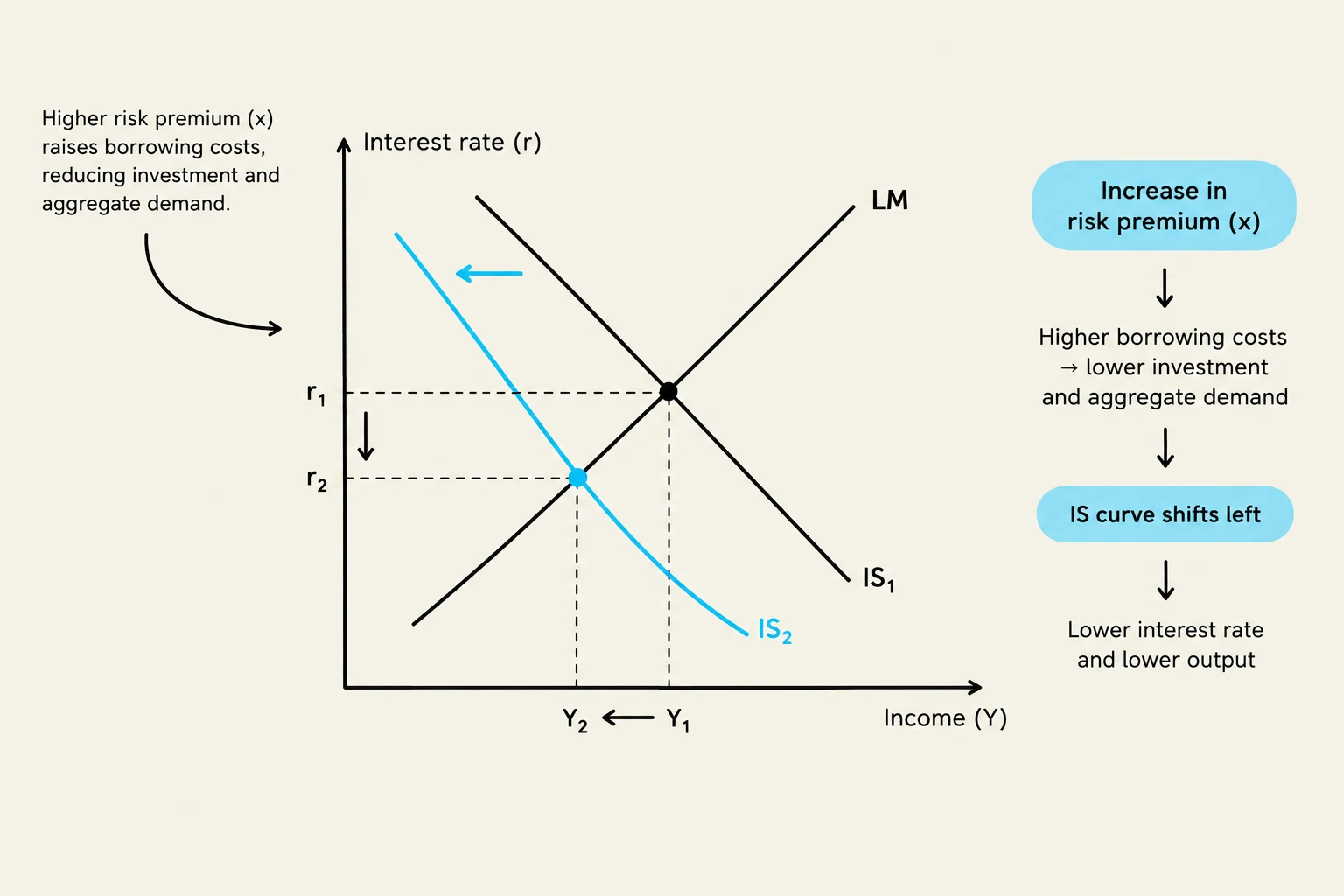
The standard IS-LM model relates output (Y) to the interest rate (r). In the extended version, we recognize that the interest rate affecting investment is not just the nominal policy rate, but the policy rate plus a risk premium (x). The IS relation can be expressed as:
$Y = C(Y - T) + I(Y, r + x) + G$
In this equation, x represents the extra compensation investors demand for holding risky assets rather than risk-free government bonds. When financial markets are stable, x is low. During a financial crisis, x spikes, which can cause investment to collapse even if the central bank keeps its policy rate low.
This diagram illustrates the IS-LM model, showing how an increase in risk premium leads to higher borrowing costs, reduced investment and aggregate demand, a leftward shift of the IS curve, and consequently, lower interest rates and output.
Interest Rates: Nominal vs. Real
To understand the drivers of economic activity, we must distinguish between nominal and real interest rates.
Nominal Interest Rate (i): This is the interest rate as it is typically quoted in the market (e.g., a bank loan rate of 5%).
Real Interest Rate (r): This is the nominal rate adjusted for expected inflation (πe). It is defined by the Fisher equation:
r≈i−πe
In certain economic environments, such as in Switzerland between 2014 and 2022, nominal interest rates have actually turned negative. While a negative nominal rate might seem counterintuitive, it can occur when central banks attempt to aggressively stimulate the economy. Furthermore, the real interest rate can also be negative if inflation is higher than the nominal rate. A negative real interest rate effectively means that the purchasing power of money increases over time, which can significantly impact borrowing and lending behaviors.
The Risk Premium and the Probability of Bankruptcy
The risk premium (x) is not an arbitrary number; it is mathematically linked to the perceived risk of default. If we consider a bond that might not pay back at all, the relationship between the nominal interest rate on the risky bond (i), the nominal policy rate (ipolicy), and the risk premium (x) can be modeled as:
(1+i)=(1−p)(1+ipolicy+x)+p(0)
Where p is the probability of bankruptcy (the bond issuer defaulting).
Exam Tip: If the probability of bankruptcy (p) is zero, the formula simplifies to (1+i)=(1+ipolicy+x), meaning the interest rate on the bond is simply the policy rate plus the risk premium.
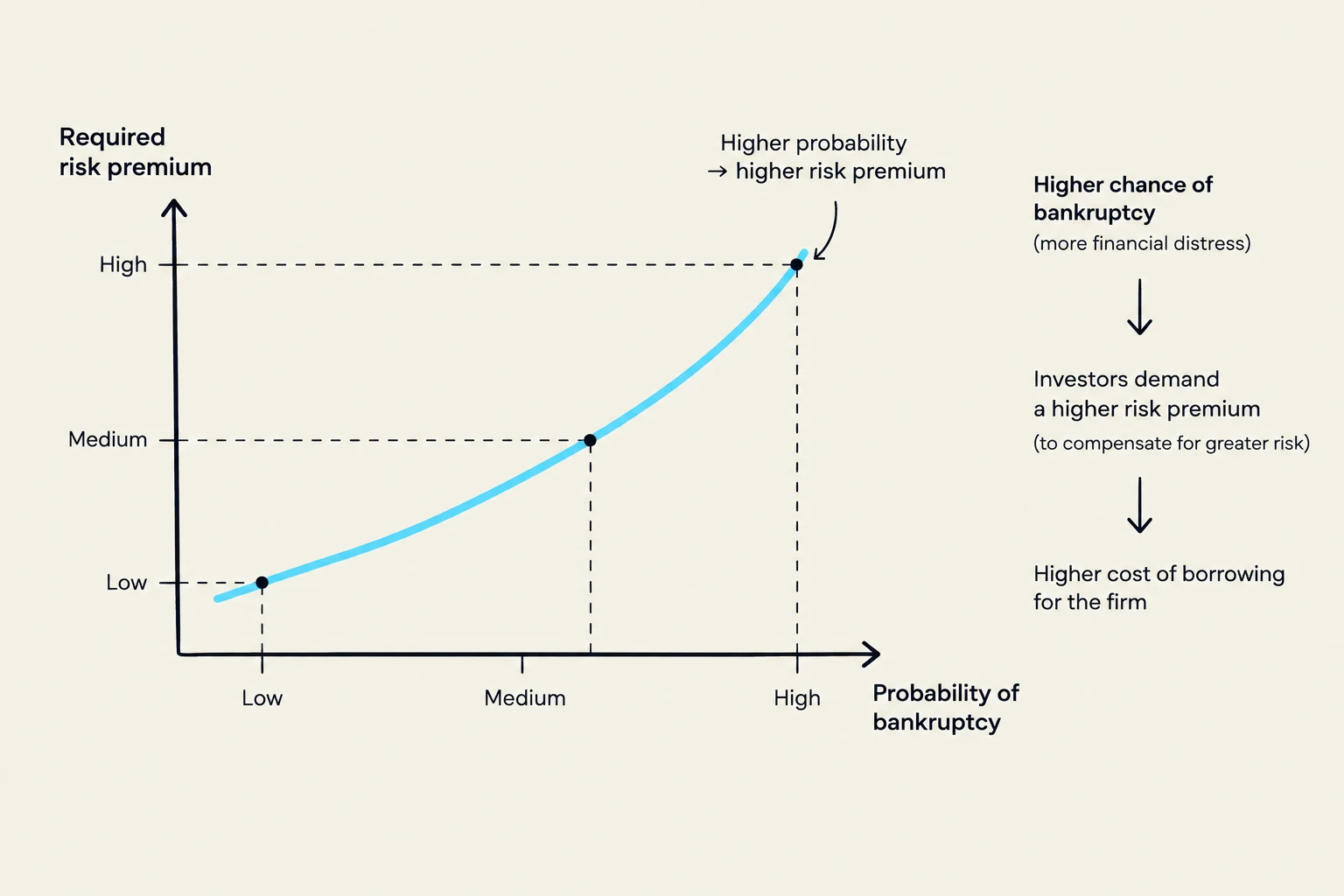
As the probability of bankruptcy increases, lenders demand a higher x to compensate for the risk, which shifts the IS curve inward and reduces total output.
This graph illustrates the relationship between the probability of bankruptcy and the required risk premium. As the probability of bankruptcy increases, so does the required risk premium, leading to a higher cost of borrowing for a firm.
Financial Policy and Crisis Management
When the risk premium rises due to systemic instability, traditional monetary policy (adjusting the policy rate) may become less effective—a situation often referred to as a "liquidity trap" if rates are already near zero. In such cases, governments and central banks must turn to financial policy.
The Troubled Asset Relief Program (TARP) and Recapitalization
During the 2008 financial crisis, many banks faced insolvency because the value of their assets (such as securitized mortgages) plummeted, eroding their capital. There are two primary ways a government can intervene:
Buying Troubled Assets: The government purchases "toxic" assets from banks to clean up their balance sheets. However, this carries the risk that the government might overpay, bearing the cost if the assets' value continues to fall.
Recapitalization: Instead of buying assets, the government provides capital directly to the bank by purchasing ownership shares (equity) in exchange for Treasury bonds.
Recapitalization is often considered a superior policy because it directly strengthens the bank's capital buffer without the government having to take on the specific risks associated with the "troubled" assets themselves.
Quantitative Easing (QE)
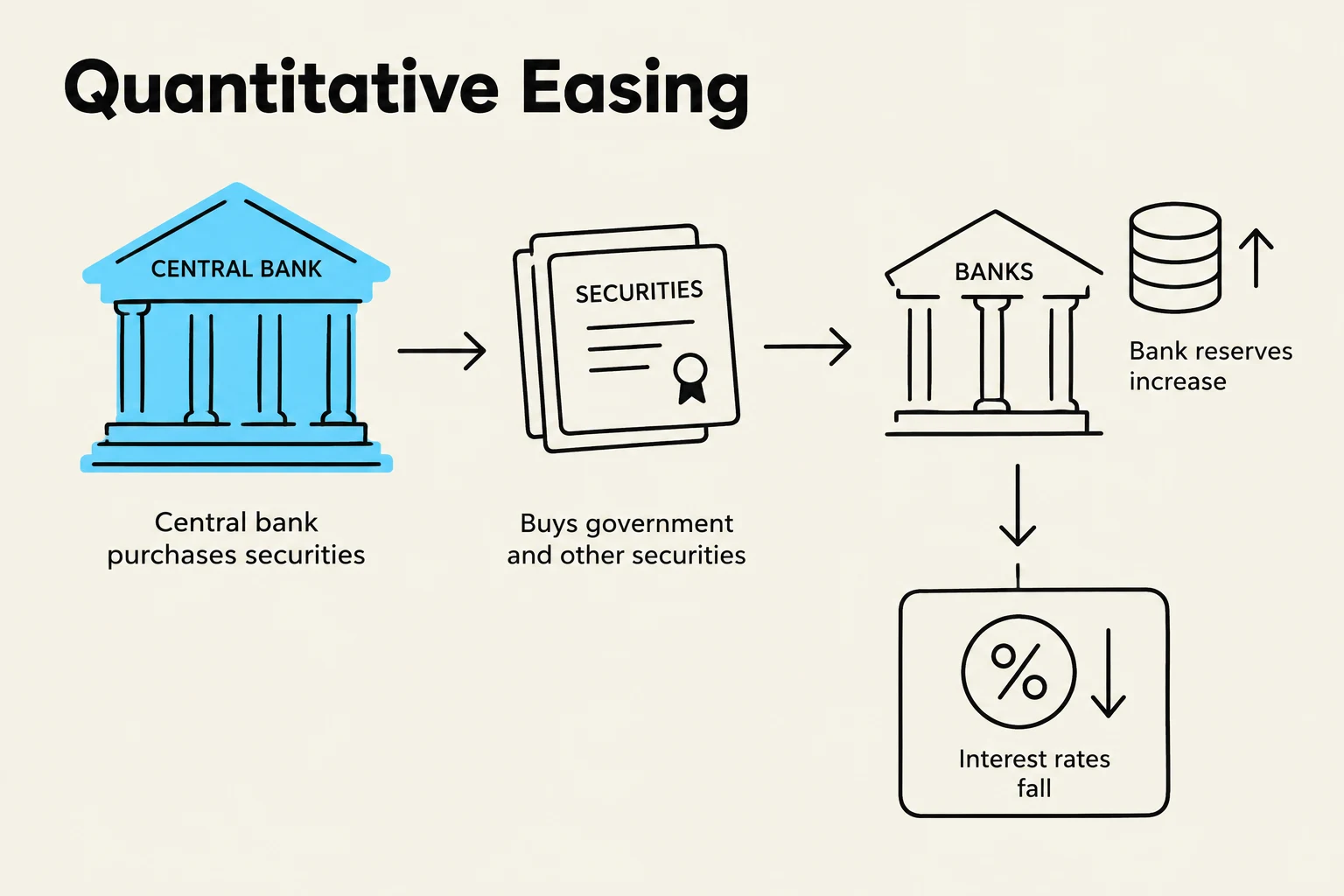
When the nominal policy rate hits the "zero lower bound," central banks may employ Quantitative Easing. This is an unconventional monetary policy where the central bank purchases securities directly from the market to increase the money supply and facilitate the flow of credit. By doing so, the central bank aims to lower long-term interest rates and reduce the risk premium, thereby shifting the IS curve back to the right and stimulating economic activity.
This diagram illustrates the process of quantitative easing, where a central bank purchases securities, leading to an increase in bank reserves and a subsequent fall in interest rates.
Summary of Policy Options
When a rising risk premium threatens to decrease output, policymakers have several tools at their disposal:
Fiscal Policy: Increasing government spending (G) or decreasing taxes (T) to shift the IS curve to the right.
Monetary Policy: Lowering the nominal policy rate (ipolicy) to offset the rise in x.
Financial Policy: Implementing measures like recapitalization or quantitative easing to directly target the risk premium (x) and restore confidence in the financial system.
Keep reading for free.
Create an account to finish this reading and make it part of your study routine.