The Evolutionary Journey of Plants from Water to Land
Explore the transformative evolutionary steps that allowed photosynthetic organisms to transition from aquatic environments to terrestrial landscapes, overcoming challenges like desiccation and gravity.
The history of life on Earth is marked by several "great transitions," but few are as transformative as the movement of photosynthetic organisms from aquatic environments to the terrestrial landscape. For millions of years, life was confined to the oceans, where water provided buoyancy, constant hydration, and easy nutrient absorption. The transition to land required a complete biological overhaul to survive in an environment characterized by drying winds, intense UV radiation, and the relentless pull of gravity.
The Ancestors: Charophytes and the Green Lineage
The story of land plants does not begin on land, but in the water. The closest living relatives to all land plants are a group of green algae known as charophytes. While they appear superficially like many other types of algae, charophytes share specific biochemical pathways and specialized reproductive structures that foreshadow the complexity of land-dwelling plants.
These ancestral algae provided the "evolutionary toolkit" that would later allow plants to colonize the shorelines. By studying the transition from these aquatic organisms to the first embryophytes (land plants), biologists can trace how specific traits were repurposed for a life without buoyancy.
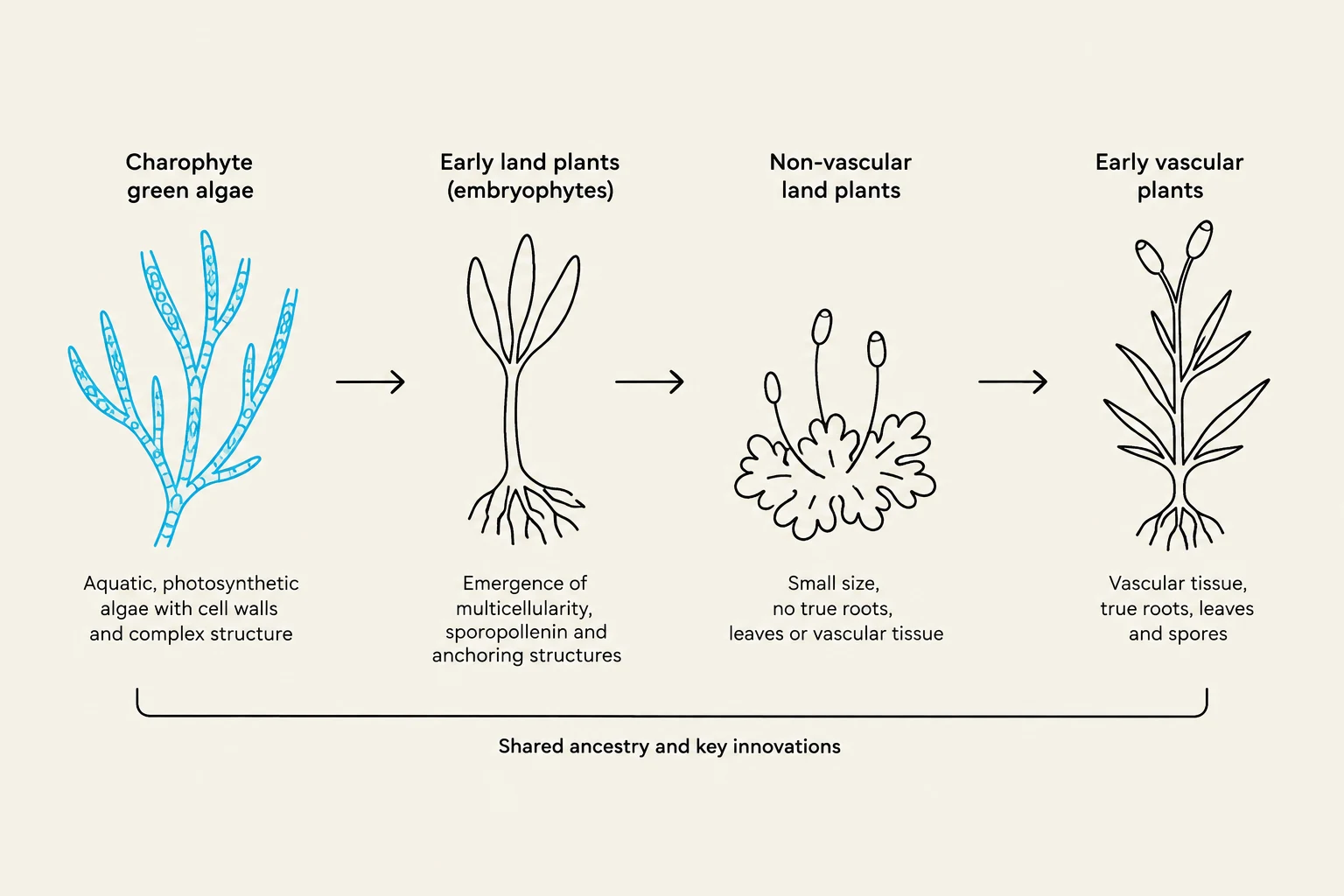
This diagram illustrates the evolutionary progression from charophyte green algae to early vascular plants, highlighting key innovations such as multicellularity, sporopollenin, and vascular tissue.
Overcoming Desiccation: The Battle for Moisture
The single greatest challenge for any organism moving from water to land is desiccation, or drying out. In an aquatic environment, cells are constantly bathed in water; on land, the atmosphere acts as a sponge, constantly pulling moisture away from living tissues.
To combat this, early land plants evolved two critical features:
The Cuticle: A waxy, waterproof layer that covers the epidermis (the outer skin of the plant). This layer acts as a barrier to prevent uncontrolled water loss.
Stomata: While a waxy cuticle is great for holding water, it also blocks the entry of carbon dioxide needed for photosynthesis. To solve this, plants evolved stomata—microscopic pores regulated by specialized guard cells. These pores can open to allow gas exchange and close to prevent dehydration.
Exam Tip: If a question asks about the "trade-off" in plant evolution, remember that the cuticle protects against water loss but creates a barrier to gas exchange, which is why stomata are a necessary evolutionary consequence.
Structural Integrity and the Rise of Vascularity
In the ocean, water provides buoyancy that supports the body of an organism. On land, plants must fight gravity to grow upward toward sunlight.
To achieve height and stability, plants developed lignin. Lignin is a complex, tough polymer that reinforces cell walls, providing the structural "skeleton" necessary for plants to stand upright without collapsing.
As plants grew larger and more complex, they could no longer rely on simple diffusion to move water and nutrients. This led to the evolution of vascular tissue:
Xylem: Specialized tubes that transport water and minerals upward from the roots to the leaves.
Phloem: A transport system that moves sugars (the products of photosynthesis) from the leaves to the rest of the plant.
This illustration compares non-vascular plants (bryophytes) with vascular plants, detailing their structural differences, including the presence or absence of vascular tissue like xylem and phloem, and their respective functions.
Reproductive Innovations: Protecting the Next Generation
Reproduction on land presents a different set of problems than reproduction in water. In water, sperm can simply swim to an egg. On land, reproductive cells are at risk of drying out instantly.
Two major evolutionary shifts addressed this:
Embryo Protection: Unlike algae, which release much of their reproductive material into the water, embryophytes retain the zygote within the maternal tissue. This maternal tissue provides essential nourishment and a physical shield against the harsh terrestrial environment.
Sporopollenin: To protect spores as they travel through the air, plants evolved a coating of sporopollenin. This incredibly durable polymer prevents the reproductive cells from desiccating during dispersal.
The Shift in Life Cycles: Gametophyte to Sporophyte
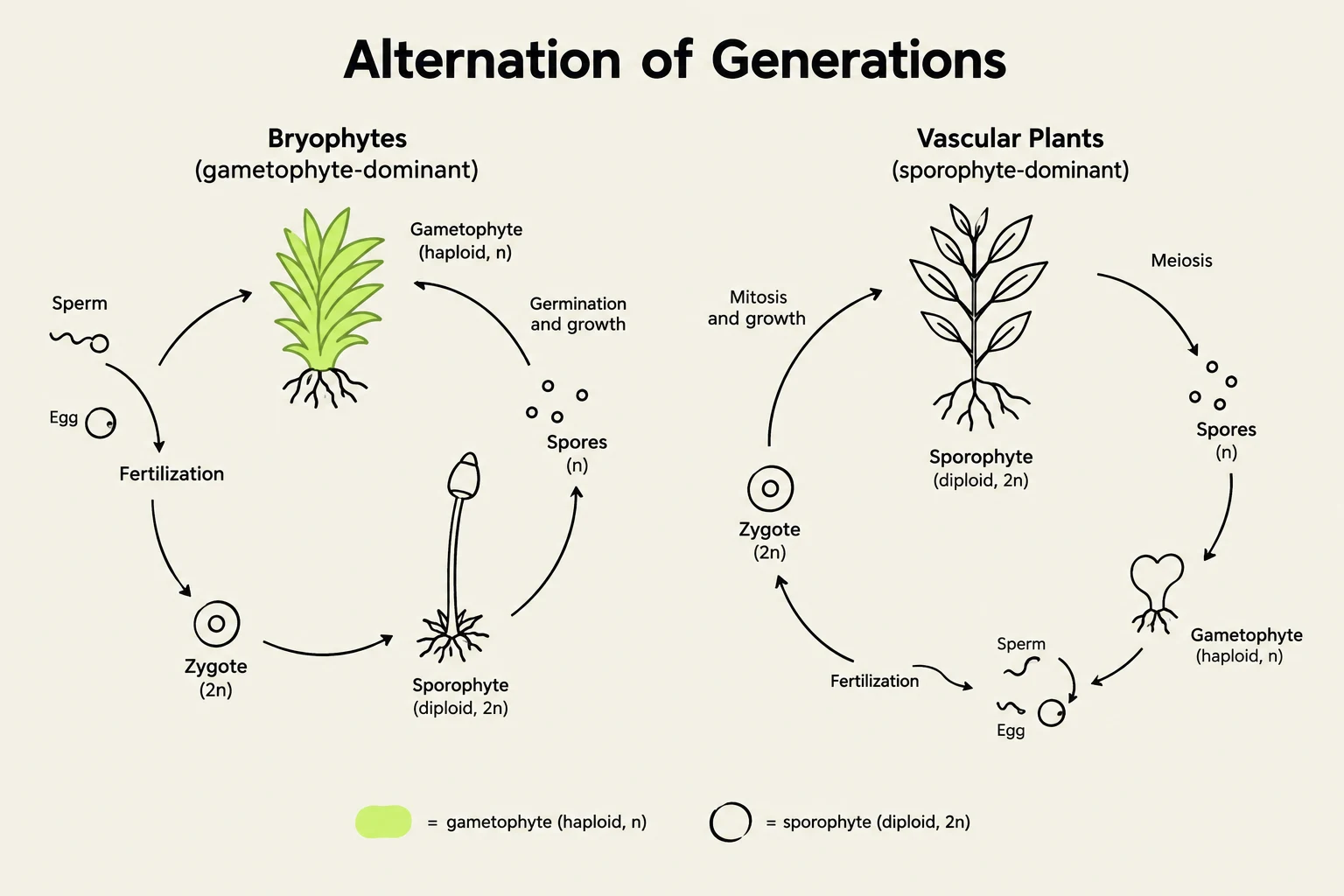
The evolutionary progression of plants is also visible in their life cycles, specifically the relationship between the haploid gametophyte (which produces gametes) and the diploid sporophyte (which produces spores).
Bryophytes (Non-vascular plants): In these primitive land plants, the life cycle is dominated by the gametophyte stage. The sporophyte is often small and dependent on the gametophyte for nutrition.
Vascular Plants: As plants evolved, there was a dramatic shift toward the dominance of the sporophyte stage. Large, complex plants like ferns, conifers, and flowering plants are primarily sporophytes.
This shift toward a dominant sporophyte stage is significant because diploid cells (containing two sets of chromosomes) can mask deleterious mutations, providing greater genetic robustness and allowing for the development of more complex physical structures.
This diagram illustrates the alternation of generations in bryophytes and vascular plants, showing the life cycles of gametophyte-dominant and sporophyte-dominant organisms.
Keep reading for free.
Create an account to finish this reading and make it part of your study routine.