The Evolution of U.S. Political Parties and Systems
Explore the historical development of political parties in the United States, from the early factions to the modern two-party system. Understand the concept of party systems, realignments, and the factors that shape party evolution.
In modern American life, political parties are often viewed through the lens of intense polarization and constant conflict. However, these organizations are much more than just sources of disagreement; they are essential mechanisms for solving "collective action problems". By grouping individuals with similar interests, parties create large electoral coalitions that can win elections and implement public policy. While the United States has maintained a remarkably consistent two-party system, the actual composition of these parties—who they represent and what they stand for—has undergone several massive shifts known as "party systems".
The Birth of Factions: The First Party System
During the earliest years of the American republic, national political parties as we know them did not exist. Politics were largely local, driven by elite interests and limited suffrage. Even George Washington, the nation's first president, warned against the divisive nature of "factions" (what we now call parties) in his farewell address.
Despite these warnings, two distinct philosophies emerged. The Federalists, led by Alexander Hamilton, advocated for a strong centralized government and supported the interests of business elites and merchants. On the other side were the Anti-Federalists, who preferred a system emphasizing state autonomy and equality. These groups eventually coalesced into the first formal party coalitions: the Federalists and the Democratic-Republicans.
The Democratic-Republicans, led by Thomas Jefferson, eventually gained dominance, leading to the "Era of Good Feelings" after the Federalist Party collapsed following the War of 1812.
This diagram illustrates the First Party System in the United States from the 1790s to the 1820s, contrasting the Federalist and Democratic-Republican parties' views on federal versus states' rights and the role of the federal government.
Innovation and Organization: The Second Party System
The "Era of Good Feelings" ended abruptly with the election of 1824, a contentious contest that saw Andrew Jackson win the popular vote but lose the presidency to John Quincy Adams in the Electoral College. Jackson famously labeled this outcome a "corrupt bargain".
This era birthed the Second Party System, characterized by the rise of the Democratic Party and the Whig Party. The Democrats, under the leadership of figures like Martin Van Buren, revolutionized political organization by introducing central party committees, state organizations, and national nominating conventions. They also perfected the spoils system, where political supporters were rewarded with government jobs. This era also saw the rise of political machines—local organizations that secured votes in exchange for political favors, often in large immigrant-heavy cities.
The Whigs emerged primarily as an anti-Jackson faction, often using political theater and emphasizing military heroism to appeal to voters.
Slavery, Reform, and the Third Party Role
The Second Party System was ultimately destroyed by the escalating tensions over slavery. The Whigs collapsed, and the election of Abraham Lincoln in 1860 ushered in the Third Party System.
This era saw the rise of the Republican Party, which was initially a coalition of reformers focused on opposing the expansion of slavery. Meanwhile, the Democratic Party became the dominant force in the South, supported by white Southerners and Northern immigrants.
Throughout this period, third parties—such as the Populist Party (or People's Party)—emerged to challenge the status quo. The Populists advocated for farmers and rural communities, calling for reforms like a national income tax and the regulation of railroads.
Exam Tip: While third parties rarely win elections due to the U.S. electoral structure, they are historically significant because they "shift the terms of debate." Their ideas (like the direct election of senators) are often eventually adopted by the two major parties.
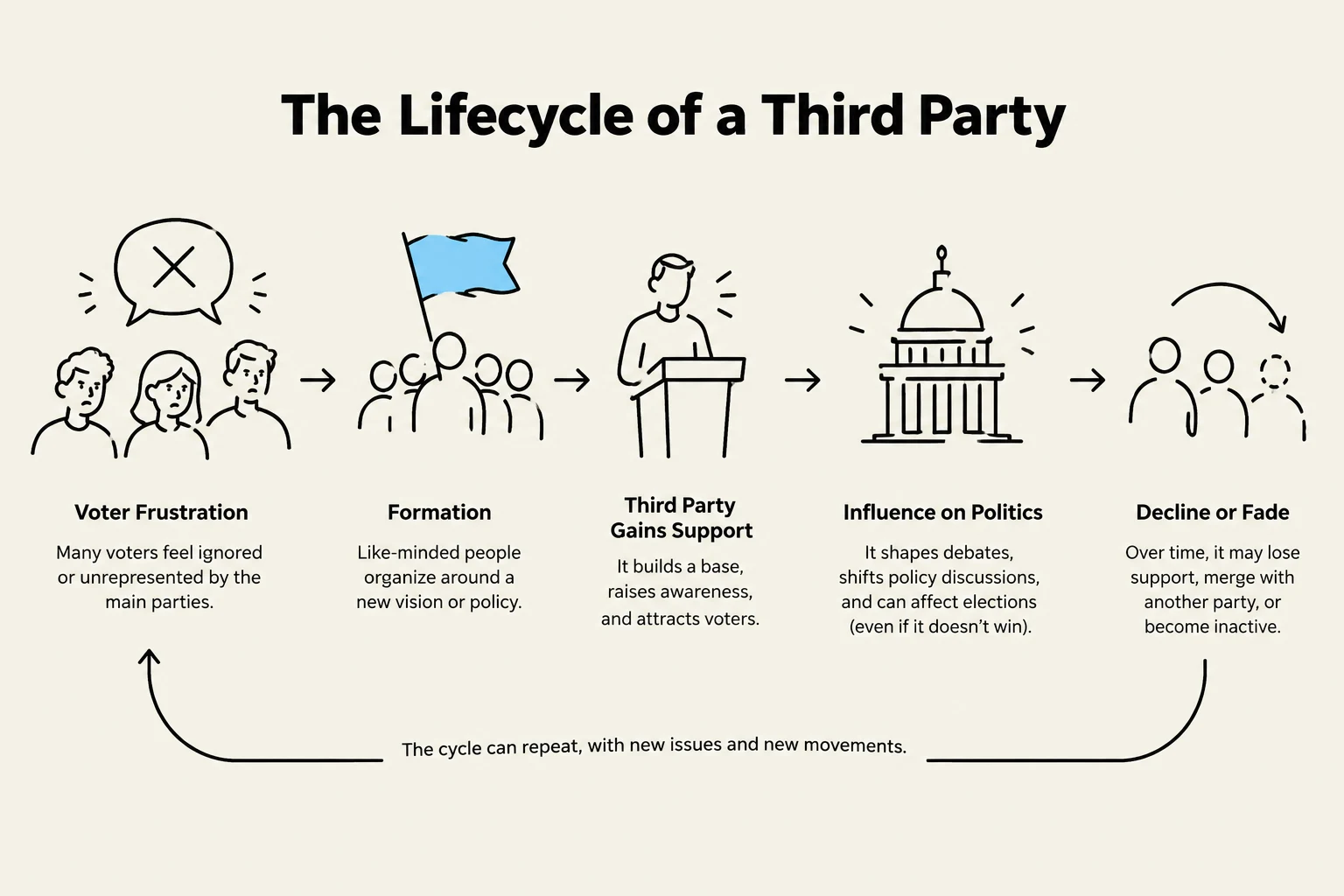
This diagram illustrates the lifecycle of a third party in politics, from voter frustration and formation to gaining support, influencing politics, and eventual decline or fade, with the potential for the cycle to repeat.
Realignment: The New Deal and the Modern Era
The most significant shift in the 20th century occurred during the Great Depression. The election of 1932 saw Franklin D. Roosevelt form the "New Deal coalition". This massive realignment brought together organized labor, urban immigrants, African Americans, and Southern farmers into the Democratic Party.
However, the political landscape shifted again after 1968, leading many historians to identify a Sixth Party System. This realignment was largely driven by civil rights legislation, which caused a massive migration of voters: the South shifted from being "solidly Democratic" to "unshakably Republican". Today, the Republican Party draws heavy support from white, middle-class, and working-class voters, while Democrats maintain a coalition of liberal intellectuals and minority groups. The answer lies largely in the rules of the game:
Plurality Voting (First-Past-the-Post): Most U.S. elections are winner-take-all. The candidate with the most votes wins, even if they do not have a majority. In a proportional system, a party getting 7% of the vote would get 7% of the seats; in the U.S., that 7% results in zero representation.
The Electoral College: The indirect method of electing the president requires candidates to win entire states to gain electoral votes, making it nearly impossible for third parties to build national momentum.
Ballot Access Laws: State laws often create high hurdles for third parties, such as requiring thousands of signatures to even appear on a ballot.
Critical Concept: The "spoiler effect" occurs when a third-party candidate attracts votes from a major party candidate with similar views, inadvertently helping the candidate they like the least to win. A classic example is Ralph Nader in the 2000 election.
In summary, while the names of the parties and the groups they represent have changed through various eras of realignment, the structural dominance of the two-party system remains a defining characteristic of American democracy.
Keep reading for free.
Create an account to finish this reading and make it part of your study routine.