The Evolution of the Mind-Body Relationship in Health
Explore the historical perspectives on the mind-body connection, from ancient beliefs to the modern biopsychosocial model, and its impact on understanding health and illness.
For centuries, Western thinkers have struggled to answer a fundamental question: are the mind and the body two distinct entities, or are they parts of a single, inseparable system? This debate has not merely been an academic exercise for philosophers; it has shaped the very foundation of how we treat disease, how we define wellness, and how we structure our healthcare systems. Understanding this evolution is essential to grasping the modern field of health psychology, which views human health as a complex interplay of biological, psychological, and social factors.
Ancient Perspectives: From Spirits to Humours
In the earliest stages of human history, the distinction between mind and body was virtually non-existent. Early cultures often viewed the human being as a single unit where the physical and the spiritual were intertwined.
During the Stone Age, illness was frequently attributed to supernatural causes, such as evil spirits entering the body. To combat these spiritual intrusions, early "physicians" or shamans practiced trephination—the process of drilling small holes into the skull using sharp stone tools. This procedure was believed to provide an exit path for the malevolent spirits causing the ailment.
As civilization progressed, the Greeks moved toward more naturalistic explanations. Hippocrates and later Galen developed the humoral theory of illness. This theory suggested that health was maintained by a balance of four humours—bodily fluids including blood, black bile, yellow bile, and phlegm. While this was a significant step toward biological medicine, the Greeks still recognized a connection to the mind, believing that these bodily temperaments influenced personality and mental states.
The Middle Ages and the Return to Dualism
The pendulum of thought swung back toward the supernatural during the Middle Ages. While humoral theory remained in practice, concepts of demonology and mysticism began to dominate. Illness was often interpreted as divine punishment for sin, and the roles of the physician and the priest became increasingly indistinguishable.
Interestingly, during this era, the patient's mental state was seen as a bridge to the divine. Emotions and imagination were viewed as tools to connect with God, meaning that a patient's "pure belief" was considered essential for the remission of physical illness. This historical reliance on the power of belief serves as an early, albeit unscientific, precursor to what we now recognize as the placebo effect.
Following the Renaissance, the rise of Descartes' doctrine of mind-body dualism fundamentally changed medicine. This view argued that the mind and body were separate entities. As a result, medicine became increasingly focused on the "body" through laboratory research and organic pathology, while the "mind" was left to the domain of philosophers and theologians. For nearly 300 years, this dualistic approach meant that physical evidence became the sole basis for medical diagnosis, often ignoring the psychological dimensions of health.
Bridging the Gap: Psychosomatic and Behavioural Medicine
The rigid separation of mind and body began to crack with the emergence of modern psychology. Sigmund Freud’s work on "conversion hysteria" suggested that unconscious psychological conflicts could manifest as physical symptoms. Later researchers, such as Alexander and Dunbar, expanded this into the field of psychosomatic medicine, proposing that personality patterns and chronic emotional stress could lead to actual organic disturbances, such as ulcers or hypertension.
While psychosomatic medicine helped bridge the gap, it often lacked testable, objective methods. This led to the rise of behavioural medicine in the 1960s and 1970s, which sought to integrate behavioural science with biomedical science using observable and measurable interventions.
The Modern Era: The Biopsychosocial Model
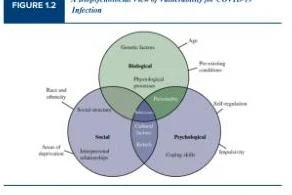
Today, the prevailing view in health psychology is the biopsychosocial model. This model rejects the "reductionistic" nature of the older biomedical model—which viewed illness simply as a biological malfunction—and instead posits that health is an active achievement resulting from the interplay of three distinct domains:
Biological factors: Genetic predispositions, neurophysiology, and cellular processes.
Psychological factors: Cognitions, emotions, coping skills, and personality.
Social factors: Socio-economic status, culture, social support, and the impact of colonialism on specific populations, such as Indigenous peoples in Canada.
A biopsychosocial model illustrating factors influencing vulnerability to COVID-19 infection, categorizing influences into biological, psychological, and social domains.
By considering these social determinants of health, practitioners can move toward a more holistic understanding of why some individuals are more vulnerable to disease than others.
💡 Exam Tip: Biomedical vs. Biopsychosocial
When comparing these models, remember that the Biomedical Model is reductionistic (focusing only on low-level biological processes) and assumes dualism (mind and body are separate). In contrast, the Biopsychosocial Model is multidimensional (looking at macro and micro levels) and views the mind and body as inseparable.
Clinical Application: A Case Study
To see this model in action, consider a high-powered business owner experiencing an early heart attack.
A biomedical approach would focus on her genetics and prescribe medication to manage her blood pressure.
A biopsychosocial approach would look deeper. It might investigate her stress levels, her diet, and her social environment—perhaps noting that as a recent immigrant, she is struggling to balance work and family demands. Treatment would then include not just drugs, but stress management, smoking cessation, and social support strategies.
Through this lens, health is no longer just the absence of disease, but a state of complete physical, mental, and social well-being.
Keep reading for free.
Create an account to finish this reading and make it part of your study routine.