The role of the Medical Assistant (MA) is a cornerstone of the modern healthcare system, acting as the vital link between the patient, the physician, and the administrative machinery of a medical practice. However, this position did not emerge overnight as a standardized profession. Instead, it is the result of decades of evolution, driven by changes in medical technology, shifts in healthcare economics, and an increasing demand for efficient, multi-skilled healthcare providers. Understanding this history is essential for modern students to appreciate the scope of their practice and the professional standards they are expected to uphold.
The Era of General Support and Clerical Roots
In the early 20th century, the concept of a "medical assistant" as we know it today did not exist. Medical offices were typically small, physician-led operations where administrative tasks were handled by general clerks or even the physicians themselves. During this period, the "support" provided to a doctor was almost exclusively clerical in nature.
The primary responsibilities involved managing paper files, handling correspondence, and managing the scheduling of patients. There was little to no clinical interaction between the support staff and the patients. As medical practices grew in complexity, the need for a more organized approach to office management became apparent, but the boundary between "office work" and "patient care" remained strictly defined.
Historical Context Note: During this era, the lack of standardized training meant that any individual with basic literacy and organizational skills could perform clerical duties, but they were legally and professionally prohibited from performing any clinical tasks.
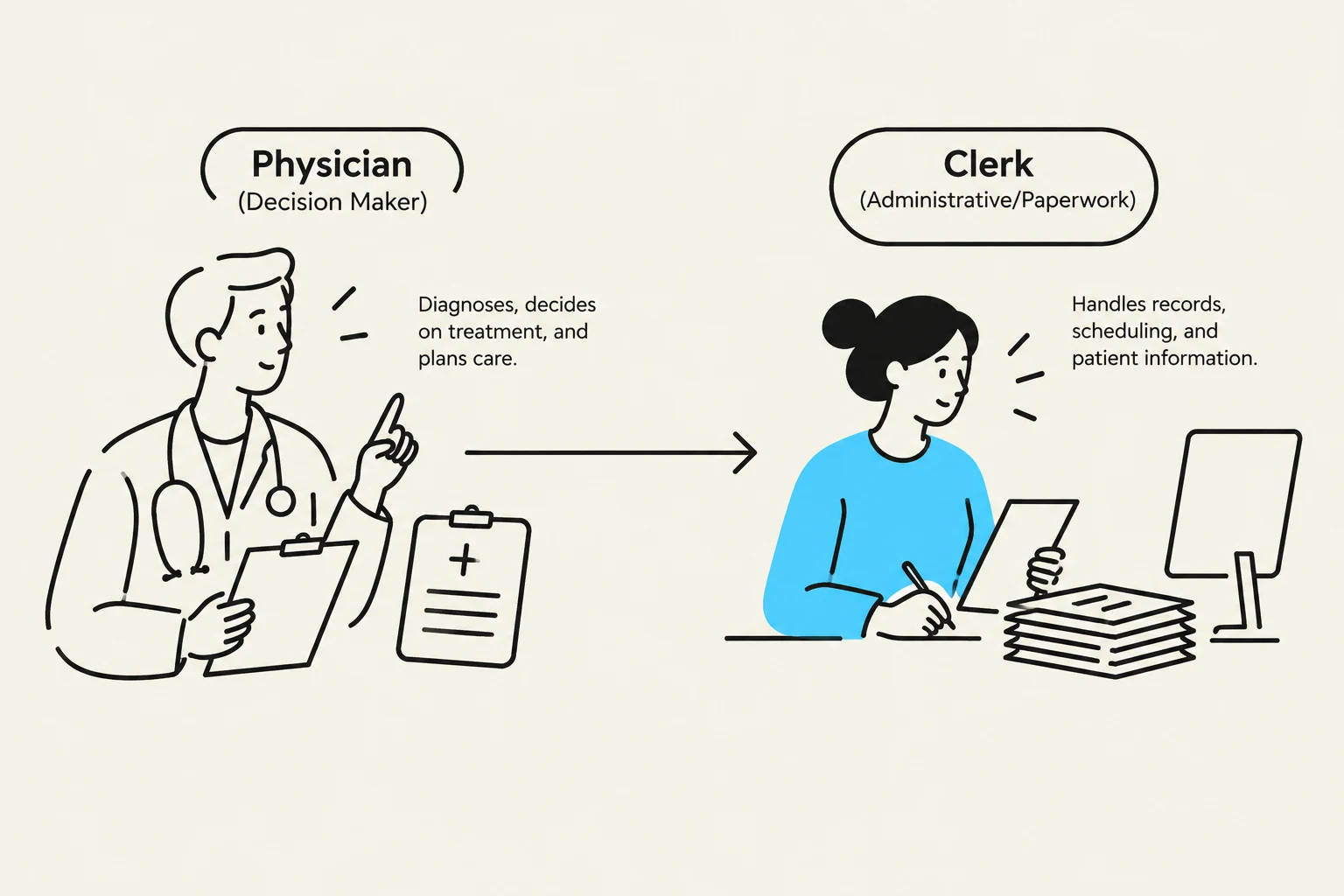
This illustration depicts the roles of a physician and a clerk in a healthcare setting, highlighting their respective responsibilities in patient care and administrative tasks.
The Mid-20th Century: The Emergence of Clinical Duties
The true transformation of the role began following World War II. As medical science advanced, new technologies and diagnostic tools were introduced into the primary care setting. Physicians found themselves overwhelmed by both the increasing volume of patients and the complexity of the new medical procedures being performed.
To manage this, a shift occurred where certain non-physician tasks began to be delegated to trained assistants. This was the "bridge" period where the role moved from purely administrative to a hybrid model. Assistants began to learn basic clinical skills, such as taking vital signs (blood pressure, temperature, pulse) and preparing examination rooms. This shift was not merely a convenience; it was a necessity driven by the rising costs of physician time and the need for more efficient patient throughput.
Formalization and the Rise of Professional Standards
By the 1950s and 1960s, the role had become too complex to be left to informal "on-the-job" training. The medical community recognized that if assistants were to perform clinical tasks, they required standardized education and rigorous oversight to ensure patient safety.
This period saw the birth of formal Medical Assisting programs and the establishment of professional organizations. The focus shifted toward creating a dual-competency model: the Medical Assistant became a professional capable of navigating both the "front office" (administrative) and the "back office" (clinical) environments.
The Dual-Competency Model
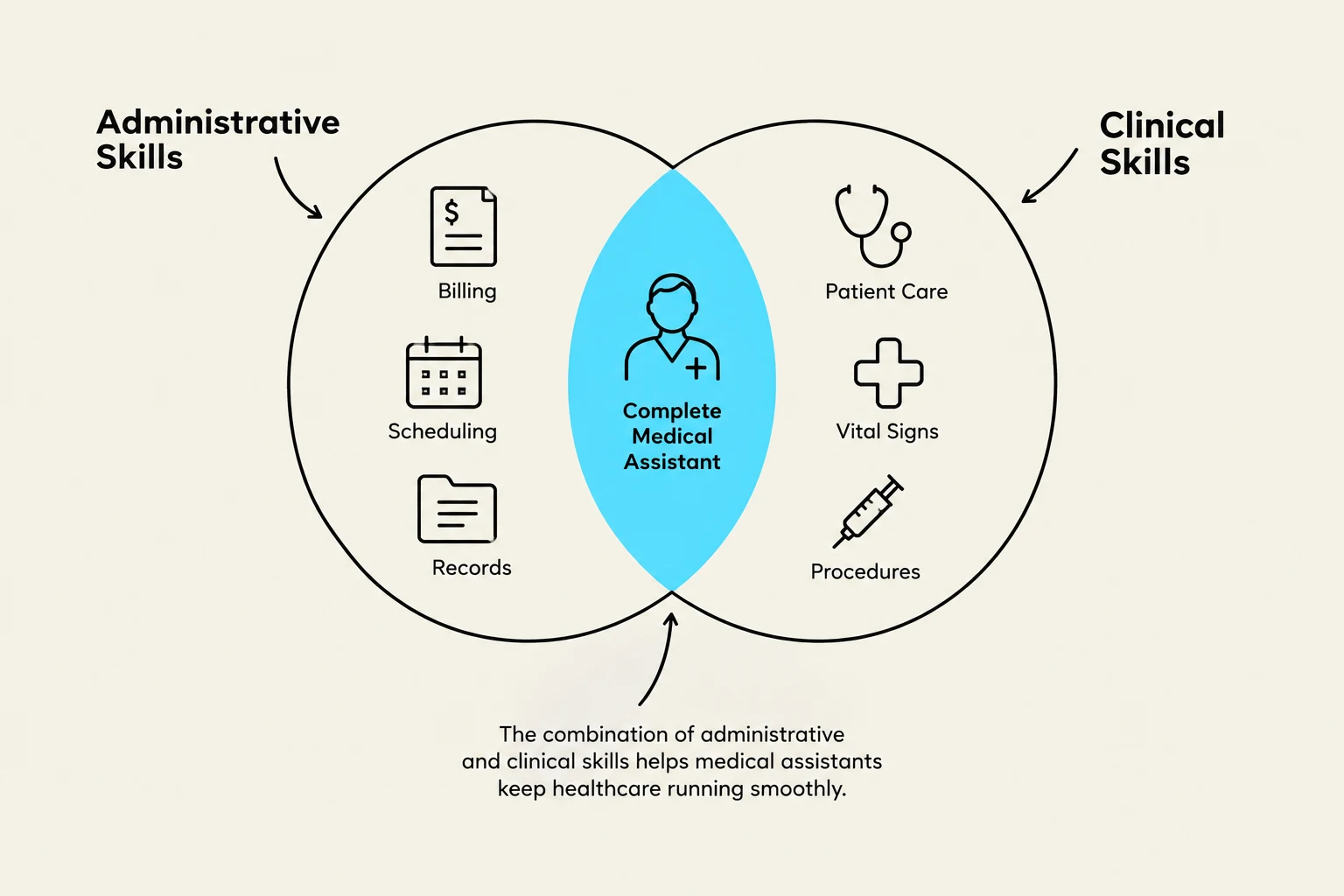
Modern medical assisting is defined by this balance. A student must master two distinct domains:
Administrative Competencies: Including medical billing, coding, electronic health record (EHR) management, and patient scheduling.
Clinical Competencies: Including phlebotomy, administering injections, performing EKGs, and assisting with minor surgical procedures.
This diagram illustrates the administrative and clinical skills required for a medical assistant, emphasizing how their combined expertise contributes to the smooth operation of healthcare.
The Modern Era: Specialization and Certification
Today, the Medical Assistant is a formalized clinical profession. The evolution has moved from "helping the doctor" to "managing the patient encounter." With the advent of the digital revolution in healthcare, the role has expanded once again to include high-level technological proficiency.
Modern MAs are expected to be experts in HIPAA compliance, infection control, and the nuances of various Electronic Health Record systems. Furthermore, the profession has seen a push toward certification. While the specific requirements vary by region, the movement toward national certification (such as through the AAMA or AMT) ensures that the "assistant" is recognized as a skilled healthcare professional with a defined scope of practice.
Exam Tip: When studying the scope of practice, always remember that while the MA's role is expansive, it is strictly governed by state laws and the supervising physician. An MA can perform many tasks, but they can never perform tasks that are legally reserved for licensed practitioners like MDs, RNs, or LPNs.
Summary of Evolution
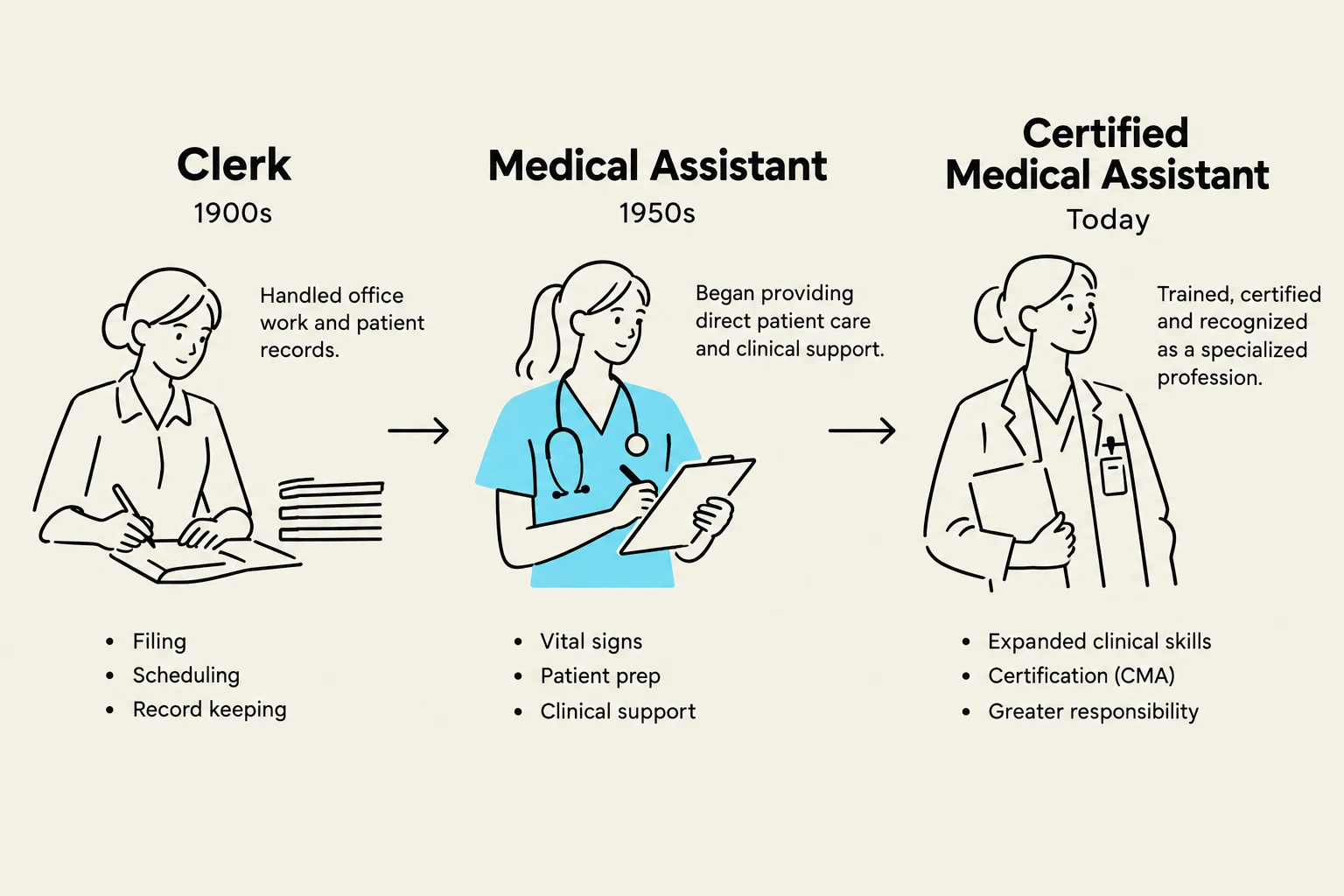
To visualize the progression, consider the following trajectory of the role's complexity:
Era
Primary Focus
Key Skills
Early 20th Century
Clerical Support
Filing, Scheduling, Correspondence
Mid-20th Century
Hybrid Support
Vitals, Room Prep, Basic Clerical
Late 20th Century
Formalized Profession
Clinical Procedures, Specialized Training
21st Century
Integrated Healthcare
EHR Management, Specialized Clinical Care, Compliance
The evolution of the Medical Assistant role from the 1900s to today, highlighting key responsibilities and advancements in the profession.
As you progress in your studies, remember that you are stepping into a role that has been carefully constructed to improve the efficiency and quality of patient care. You are not just an extra set of hands; you are a trained professional managing the intersection of medicine and administration.
Keep reading for free.
Create an account to finish this reading and make it part of your study routine.