An overview of the historical development of the European Monetary Union (EMU), from the European Monetary System (EMS) and the European Currency Unit (ECU) to the establishment of the euro and the challenges faced, including crisis management and the creation of the European Banking Union.
The journey toward a unified European currency is one of the most ambitious economic projects in modern history. It represents a transition from a fragmented landscape of competing national currencies to a highly integrated system governed by a single monetary policy. This evolution was not a single event but a multi-decade process of building stability, creating legal frameworks, and developing institutional safeguards to manage the complexities of a shared economy.
The Foundations: The European Monetary System (EMS)
Before the existence of the euro, European nations sought ways to reduce the volatility of exchange rates that hindered cross-border trade. In 1979, the European Monetary System (EMS) was established to foster exchange rate stability among member nations.
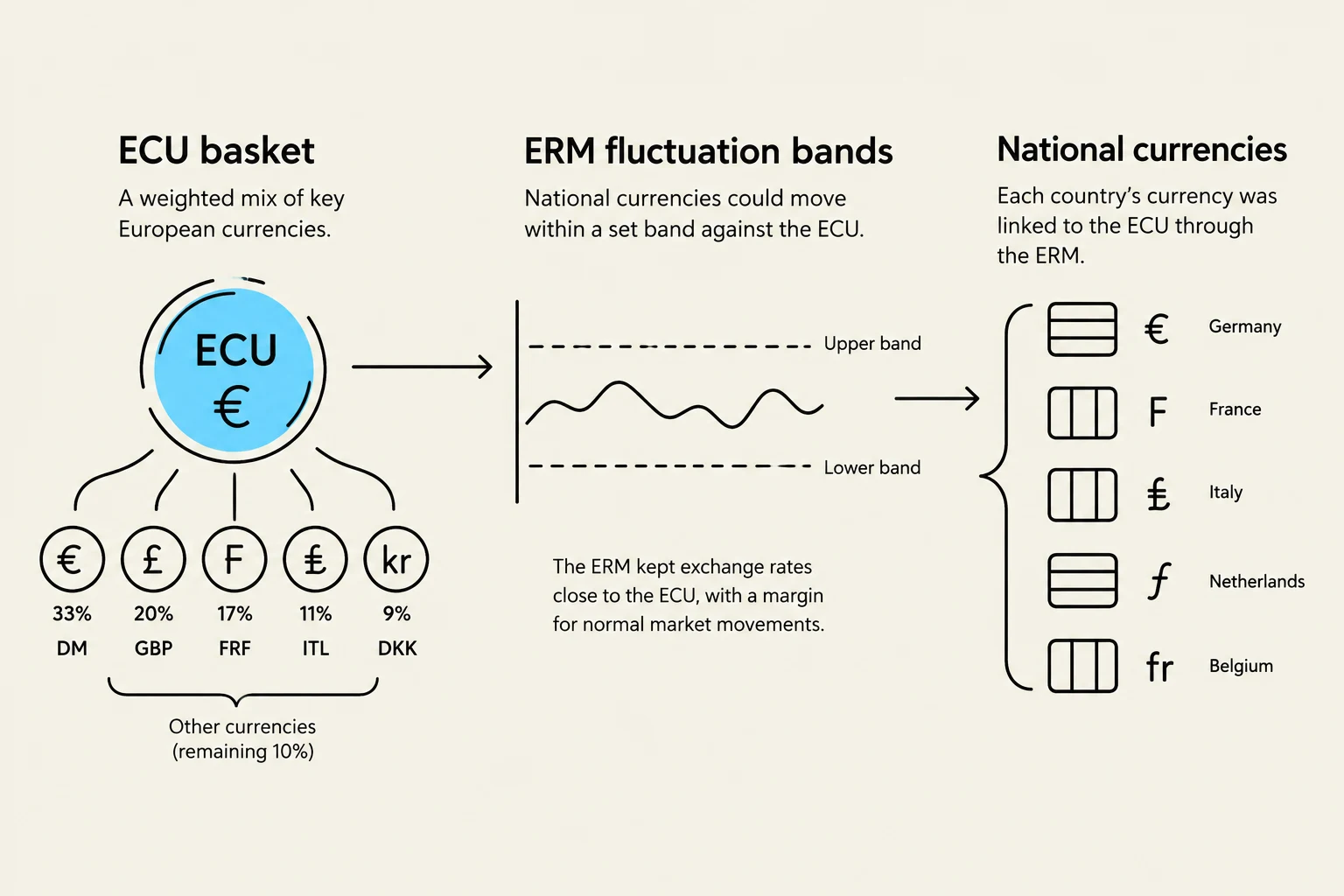
A central component of this system was the European Currency Unit (ECU). The ECU was not a physical currency but a "unit of account"—a basket of different European currencies used to facilitate transactions and provide a stable benchmark. To manage the fluctuations between national currencies and the ECU, the EMS utilized the Exchange Rate Mechanism (ERM). The ERM set specific boundaries within which exchange rates were allowed to fluctuate. To ensure fairness, a "divergence indicator" was used to distribute the costs of currency adjustments among member nations, preventing a single country from bearing the entire burden of economic shifts.
The system became more sophisticated with the Basel-Nyborg Agreement in 1987, which allowed for "intramarginal interventions" and formalized how policy discrepancies between member states would be monitored.
This diagram illustrates the concept of the ECU basket, a weighted mix of European currencies, and how national currencies fluctuated within set bands against the ECU, with examples of countries linked to the ECU through the ERM.
Exam Tip: Remember that the ECU was a unit of account (a basket), whereas the Euro is a legal tender (actual money). The ECU paved the way for the Euro by normalizing the use of a common value in private markets.
The Roadmap to EMU: The Maastricht Treaty
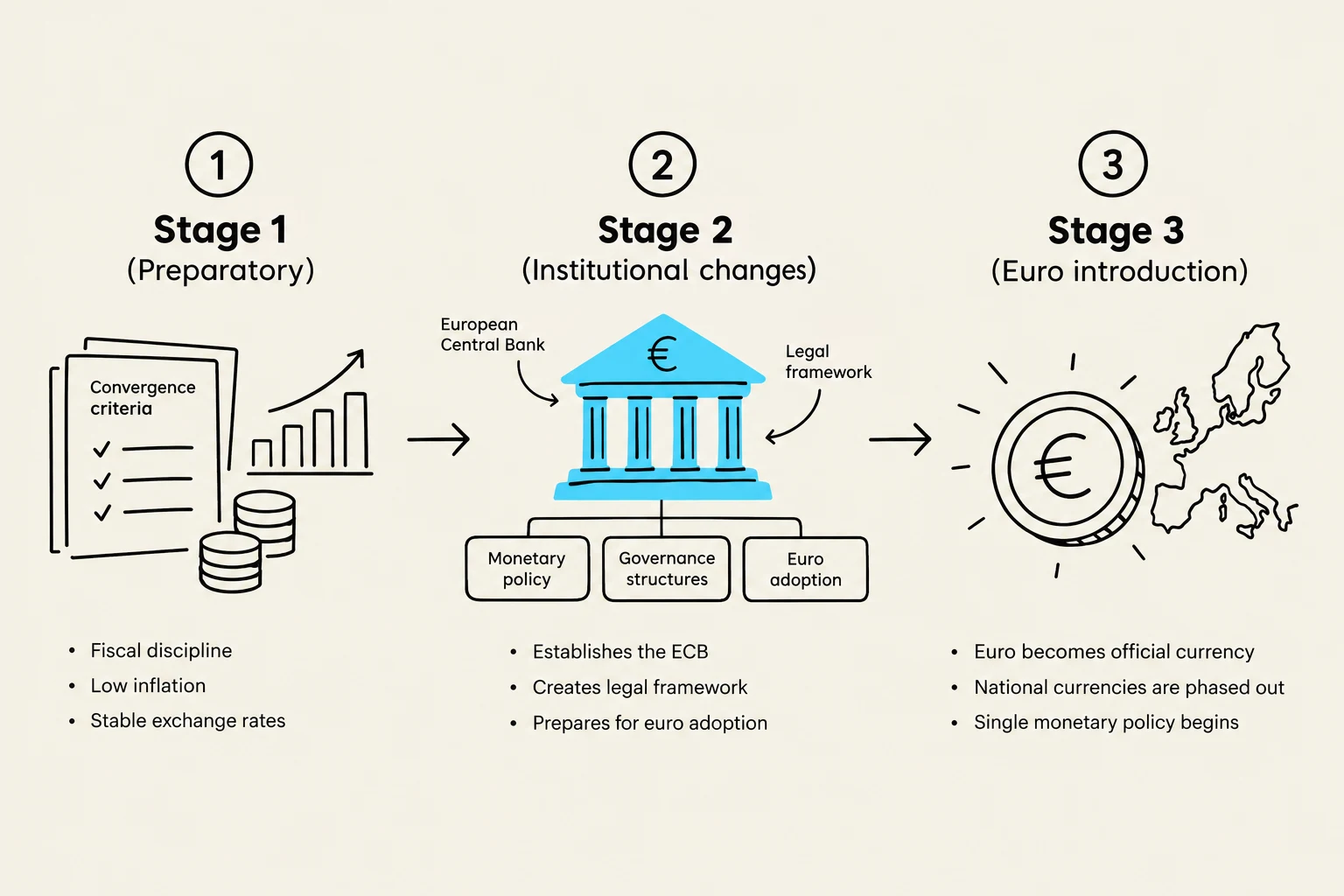
The blueprint for a single currency was drafted by the Delors Committee, a group of central bankers and economic experts who proposed a structured, three-stage transition to a full monetary union. This roadmap was eventually codified in the Maastricht Treaty, signed in February 1992.
The treaty established the legal framework for the Economic and Monetary Union (EMU) and introduced strict convergence requirements. To join the single currency, member nations had to prove they met four specific criteria:
Price stability: Low and stable inflation rates.
Fiscal sustainability: Disciplined government spending and manageable debt levels.
Exchange rate stability: No excessive volatility in currency values prior to joining.
This diagram illustrates the three stages of the Euro introduction: Preparatory, Institutional changes, and Euro introduction. It outlines key criteria, actions, and outcomes for each stage, including fiscal discipline, the establishment of the European Central Bank, and the eventual adoption of the Euro as the official currency.
The implementation followed a strict timeline:
Stage 1 (1990–1993): Focused on preparatory measures, such as increasing economic convergence and ensuring the free movement of capital.
Stage 2 (1994–1998): Involved institutional building, including the creation of the European Monetary Institute and ensuring national central banks were independent.
Stage 3 (1999 onwards): The final phase, marked by the establishment of the European System of Central Banks and the European Central Bank (ECB), the introduction of the euro, and the implementation of a single monetary policy.
Challenges and the Evolution of Crisis Management
The transition was not without turbulence. The early 1990s saw significant currency crises driven by speculation, which threatened the stability of the exchange rate system. However, the most profound test came during the Eurozone crisis of 2008–2009. This crisis exposed structural flaws in the EMU, particularly the tension between a unified monetary policy and fragmented national fiscal policies.
In response to these systemic threats, the ECB had to evolve from a traditional central bank into a more active crisis manager. It introduced advanced monetary tools to provide liquidity and stabilize markets, such as:
Long-Term Refinancing Operations (LTROs): Providing long-term loans to banks to support lending.
Quantitative Easing (PSPP): Large-scale asset purchase programs designed to inject money into the economy and lower interest rates.
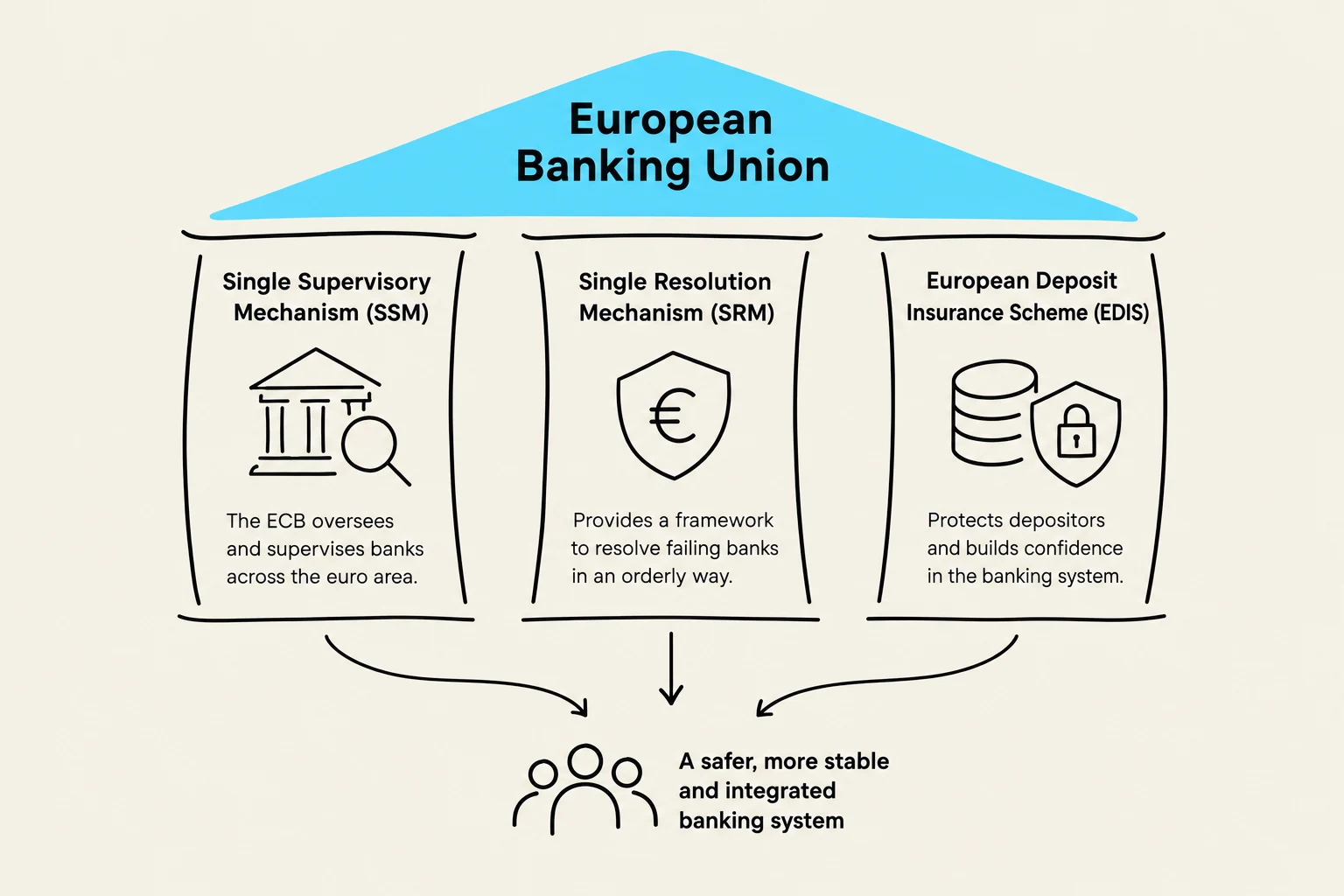
Furthermore, to strengthen the resilience of the entire financial system, the European Banking Union was developed. This initiative aimed to move bank supervision to a European level under the ECB and create standardized mechanisms for bank resolutions and deposit insurance.
The European Banking Union comprises the Single Supervisory Mechanism (SSM), the Single Resolution Mechanism (SRM), and the European Deposit Insurance Scheme (EDIS), aiming to create a safer, more stable, and integrated banking system.
Critical Thinking Note: The Banking Union represents a shift from "national" oversight to "supranational" oversight. While this increases stability, it remains controversial because it involves a form of "debt mutualization" where stronger economies may end up supporting weaker ones.
Summary of the Monetary Evolution
The evolution of the EMU can be viewed as a progression from cooperation to integration. What began as a way to manage exchange rate fluctuations through the EMS and the ECU has become a sophisticated, unified system where the ECB manages a single currency for dozens of nations. While crises like the 2008 recession highlighted the system's vulnerabilities, they also drove the creation of more robust regulatory frameworks like the Banking Union and more powerful monetary tools like quantitative easing.
Keep reading for free.
Create an account to finish this reading and make it part of your study routine.