The Evolution of Medical Thought: From Supernatural Beliefs to Germ Theory
Explore the historical progression of medical understanding, from ancient beliefs in supernatural causes and humoral imbalances to the scientific revolution and the paradigm shift brought by germ theory. This covers the development of anatomy, physiology, and the empirical method, highlighting how scientific inquiry tr
For most of human history, the "why" behind illness remained a profound mystery. Before the advent of modern microscopy and clinical trials, the human body was viewed through lenses of spirituality, cosmic balance, and environmental influence. Understanding how we transitioned from blaming angry deities to identifying microscopic pathogens is not just a history lesson; it is an exploration of how the scientific method transformed the very foundation of healthcare.
The Era of Supernaturalism and Divine Will
In the earliest stages of human civilization, medicine and religion were inextricably linked. When a community faced a sudden outbreak of fever or a sudden death, the cause was rarely attributed to biological processes. Instead, illness was often perceived as a manifestation of the supernatural.
Under this paradigm, disease was frequently interpreted as:
Divine Punishment: An expression of anger from gods or ancestors due to broken social or moral codes.
Demonic Possession: The idea that malevolent spirits had entered the physical body.
Astrological Influence: The belief that the alignment of celestial bodies dictated the health of individuals and populations.
Treatment in this era focused on spiritual intervention rather than physical repair. Rituals, prayers, exorcisms, and offerings were the primary "medical" tools used to appease the unseen forces believed to be causing the ailment.
The Humoral Theory: The Search for Internal Balance
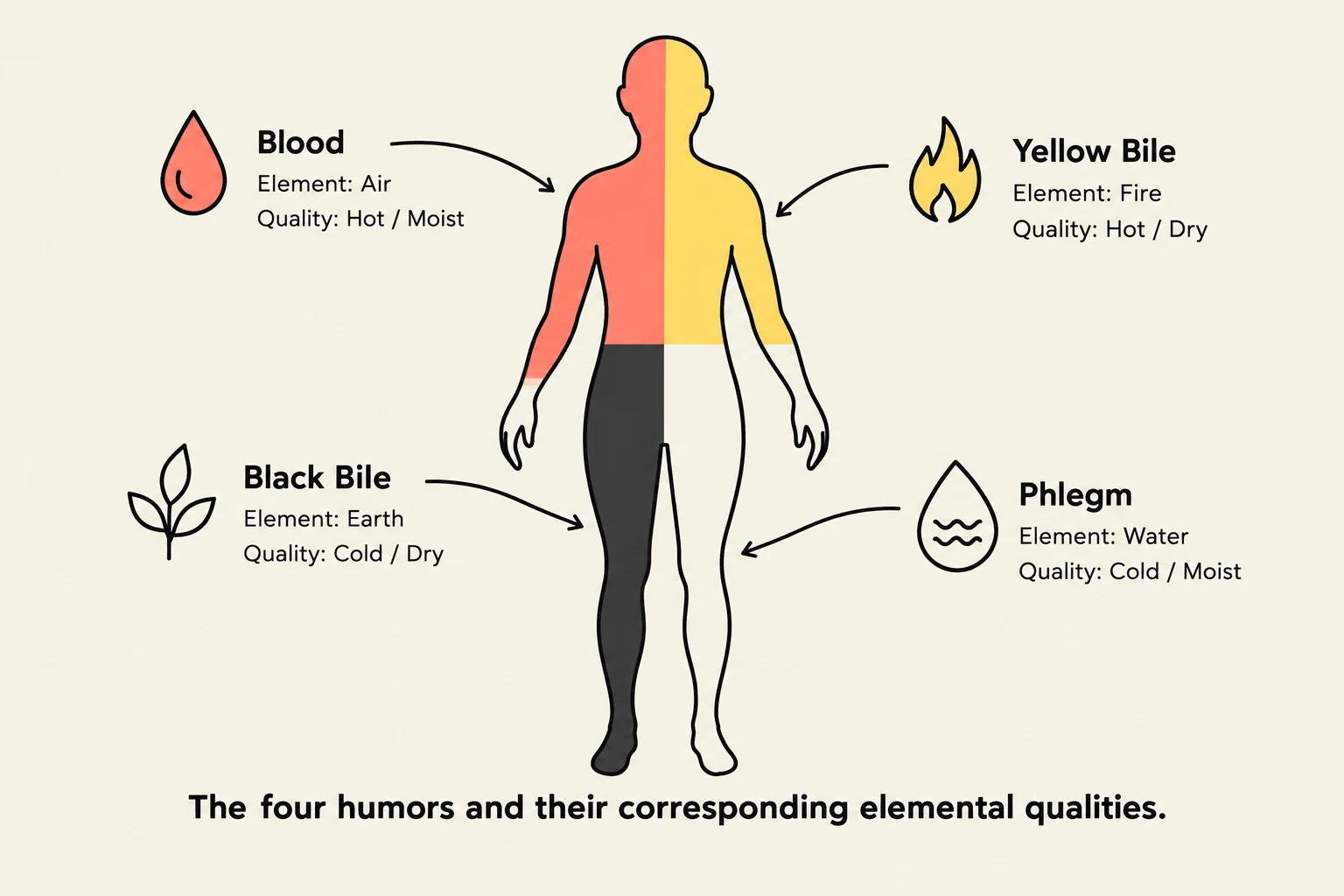
The four humors and their corresponding elemental qualities.
As human thought progressed, a shift occurred from external supernatural causes to internal biological ones. This led to the rise of Humoralism, a theory that dominated Western medicine for nearly two millennia, rooted in the works of ancient Greek physicians like Hippocrates and Galen.
The core of this theory was the belief that the human body was filled with four distinct fluids, or "humors." Health was defined as a state of perfect balance among these fluids, while disease was the result of an imbalance (dyscrasia).
Humor
Element
Qualities
Blood
Air
Hot and Moist
Yellow Bile
Fire
Hot and Dry
Black Bile
Earth
Cold and Dry
Phlegm
Water
Cold and Moist
Student Note: Clinical Application of Humoralism
If a patient presented with a fever (characterized by heat), a physician following humoral theory might conclude the patient had an excess of blood. To restore balance, they might perform bloodletting—a practice that remained common well into the 19th century.
While humoralism was a massive leap forward because it attempted to explain illness through physical properties rather than magic, it was fundamentally flawed because it lacked an understanding of cellular biology and the actual mechanisms of infection.
The Scientific Revolution and the Anatomical Turn
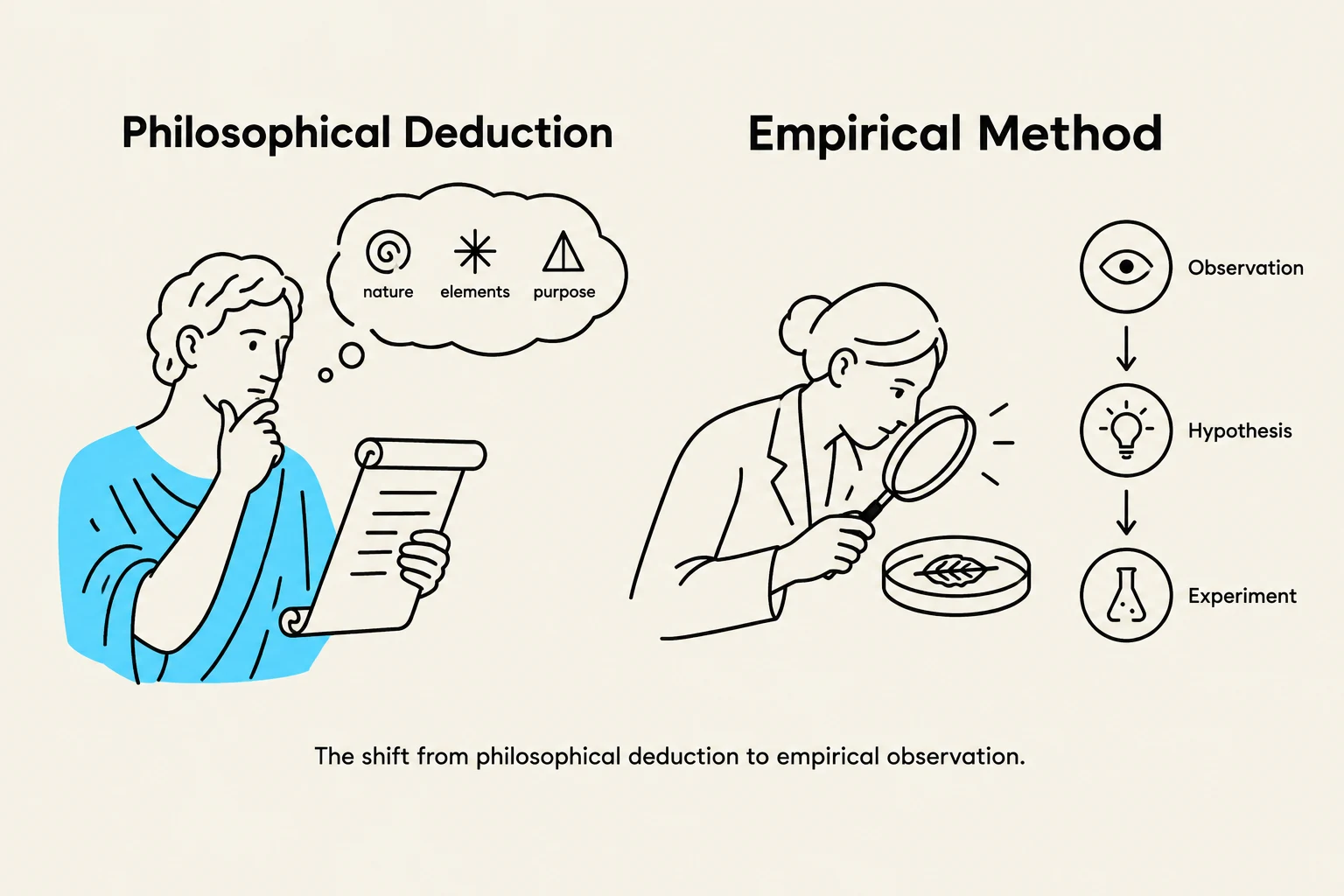
This illustration contrasts philosophical deduction with the empirical method, showing the progression from abstract thought to observation, hypothesis, and experimentation.
The transition toward modern medicine began in earnest during the Scientific Revolution. This era marked a departure from relying solely on ancient texts (like those of Galen) and moved toward direct observation and empirical evidence.
Key developments during this period included:
Advancements in Anatomy: Figures like Andreas Vesalius began performing detailed dissections, proving that many ancient anatomical descriptions were incorrect.
The Rise of Physiology: Scientists began to ask not just what the body looked like, but how its systems (circulatory, respiratory, etc.) actually functioned.
The Empirical Method: The shift toward testing hypotheses through repeatable experiments rather than philosophical deduction.
This period laid the groundwork for the "mechanistic" view of the body—treating the human organism as a complex machine governed by physical laws rather than a vessel for humors or spirits.
The Germ Theory: The Final Paradigm Shift
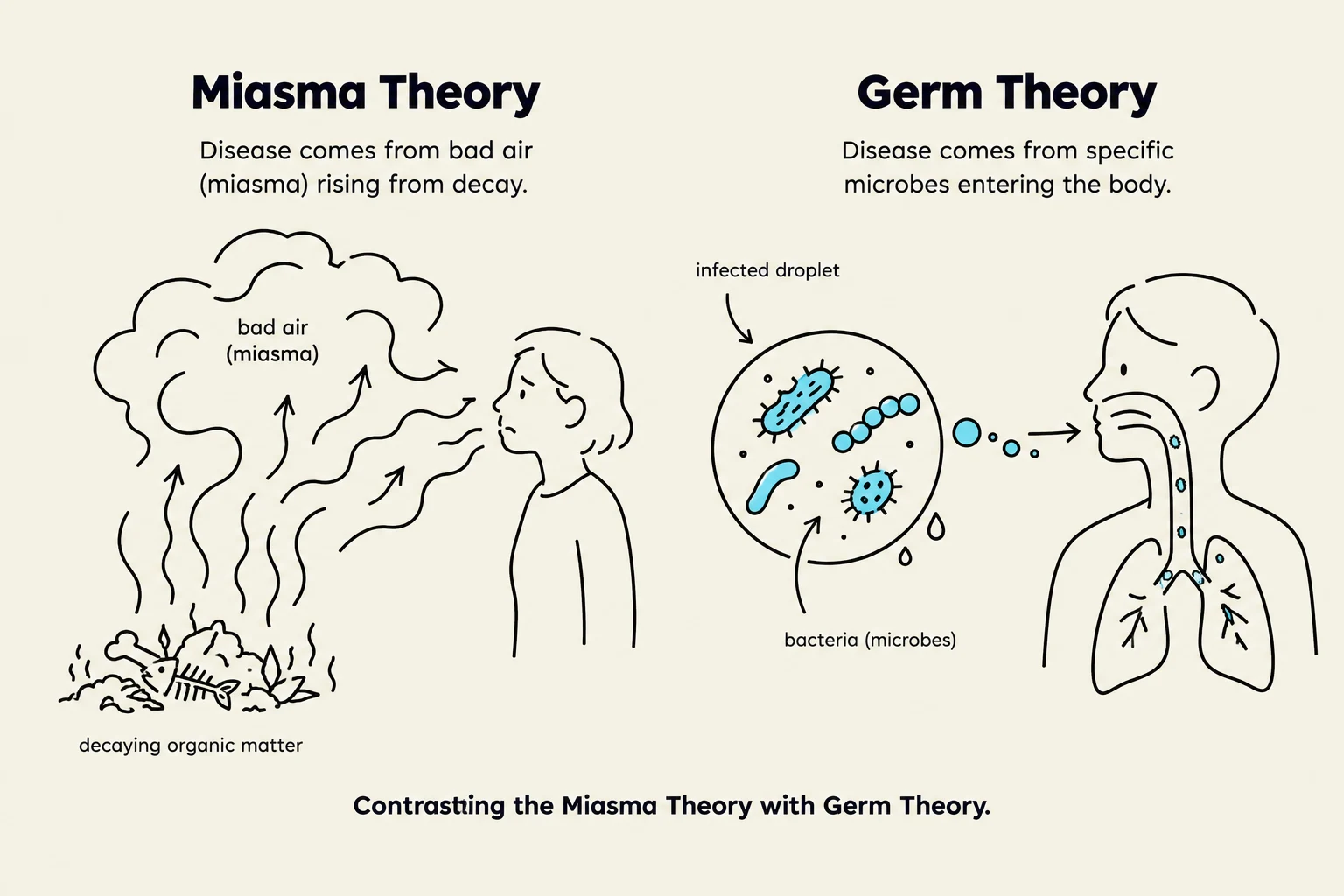
This illustration contrasts the Miasma Theory, which posits disease arises from bad air from decay, with the Germ Theory, which states disease is caused by specific microbes entering the body.
Despite the anatomical progress of the 17th and 18th centuries, doctors still struggled to understand why certain diseases spread through populations. Many still believed in "miasma theory"—the idea that diseases like cholera or the plague were caused by "bad air" or decaying organic matter.
The definitive turning point came with the establishment of Germ Theory in the late 19th century, championed by scientists such as Louis Pasteur and Robert Koch. Germ theory proposed that specific microscopic organisms (microbes), rather than bad air or imbalances, were the direct cause of infectious diseases.
The Impact of Germ Theory
The acceptance of germ theory revolutionized every aspect of healthcare:
Antisepsis and Hygiene: Joseph Lister applied germ theory to surgery, advocating for the sterilization of instruments and wounds, which drastically reduced post-operative mortality.
Vaccination: Understanding pathogens allowed for the development of targeted immunological defenses.
Public Health: Sanitation, water treatment, and food safety protocols were redesigned to target the transmission of microbes.
Exam Tip: Comparing Miasma vs. Germ Theory
When asked to differentiate these, remember: Miasma is an environmental theory (smells/air), whereas Germ Theory is a biological theory (microorganisms). Germ theory provided the "agent" of disease that miasma theory lacked.
Summary of Evolution
The journey of medical thought can be viewed as a narrowing of focus: from the vastness of the cosmos and gods, to the internal fluids of the body, to the microscopic organisms that inhabit it. This evolution from superstition to science has not only increased human life expectancy but has fundamentally changed our relationship with the natural world.
Keep reading for free.
Create an account to finish this reading and make it part of your study routine.