The Evolution of Civil Rights and Voting Legislation in the United States
An overview of the historical struggle for civil rights in the United States, focusing on the evolution of equal protection under the law, voting rights legislation, and the expansion of rights in housing and employment. It examines key amendments, landmark acts, and Supreme Court decisions that have shaped the pursuit
The history of the United States is defined by a persistent tension between its founding ideals of equality and the systemic realities of discrimination. While the nation's rhetoric often emphasizes that "all men are created equal," the legal and social struggle to realize this promise has required decades of intense activism and landmark legislative intervention. This article explores the evolution of civil rights, moving from the struggle for basic voting access to the complex modern debates surrounding housing, employment, and affirmative action.
The Foundation of Equal Protection
At the heart of American civil rights law lies the Fourteenth Amendment, specifically its equal protection clause. This clause forbids states from denying any person equal protection under the law, serving as the primary constitutional tool for challenging discriminatory practices.
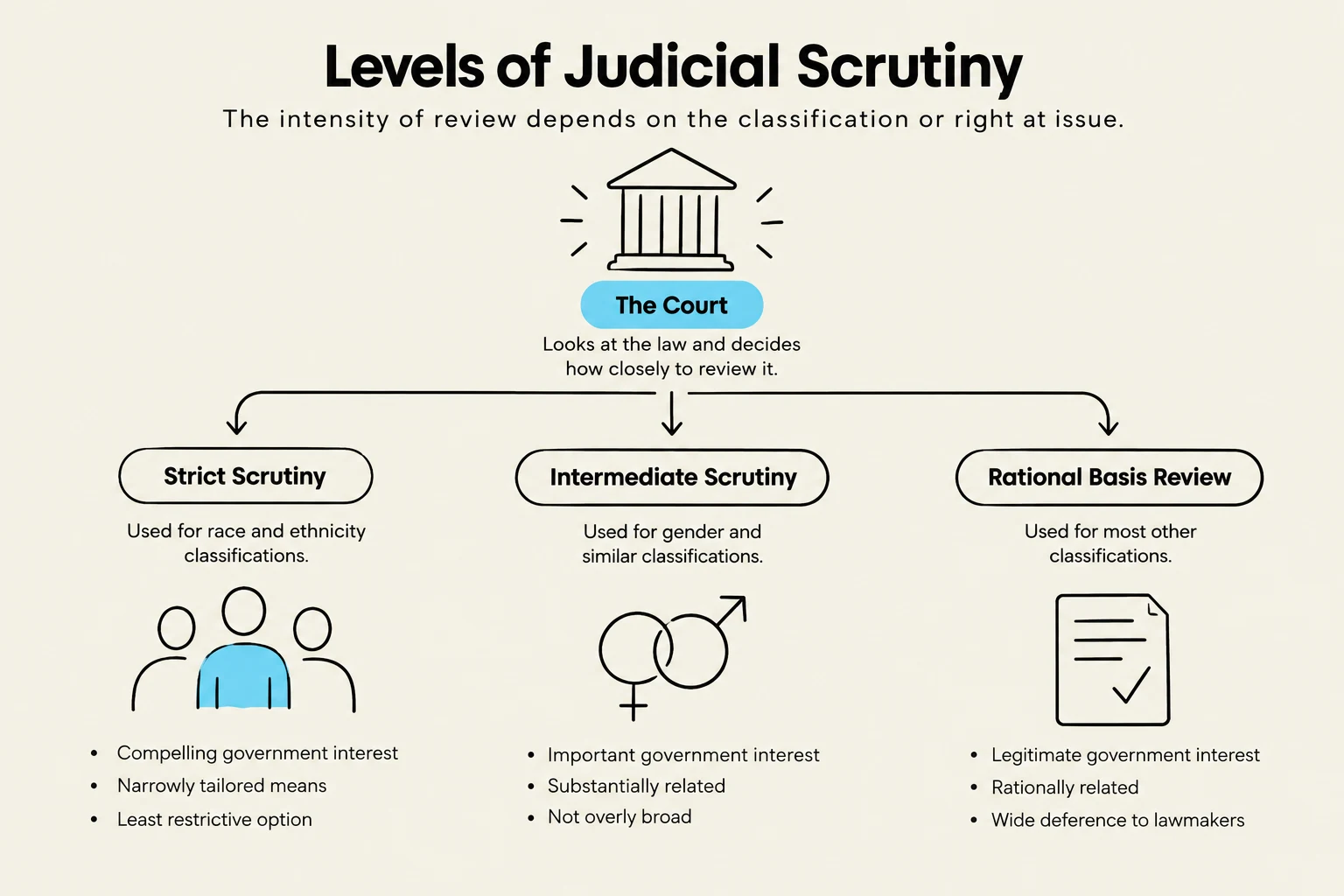
To determine whether a law violates this principle, the Supreme Court employs different "levels of scrutiny" depending on the group being affected:
Strict Scrutiny: Applied to "suspect classifications" such as race or national origin. The law is presumed unconstitutional unless the government can provide an overwhelming, compelling justification.
Intermediate Scrutiny: Applied to categories like gender. The law must serve a clearly compelling and justified purpose.
Reasonable-Basis Test: Applied to non-suspect categories like age or income. The law is assumed constitutional unless no sound rationale can be provided.
This diagram illustrates the three levels of judicial scrutiny: Strict Scrutiny, Intermediate Scrutiny, and Rational Basis Review, used by courts to review laws and government actions.
Exam Tip: If a question asks about a law targeting a specific race, remember that the court will apply strict scrutiny, which is the highest and most difficult standard for the government to meet.
The Battle for the Ballot
The right to vote has been one of the most contested arenas of civil rights. Although the Fifteenth Amendment was ratified in 1870 to grant Black Americans the right to vote, widespread disenfranchisement followed through various state-level barriers. For decades, many Southern states utilized whites-only primaries, literacy tests, and poll taxes to prevent Black citizens from participating in democracy.
Significant progress began with the Twenty-Fourth Amendment in 1964, which outlawed the use of poll taxes in federal elections. However, the most transformative moment came with the Voting Rights Act of 1965. This Act prohibited discrimination in voter registration and empowered federal agents to oversee the process in areas with histories of discrimination.
The impact was immediate and profound. In Mississippi, for example, Black voter registration jumped from just 6% before the Act to 60% by 1967.
This bar chart illustrates the significant increase in Black voter registration rates in several Southern states after the Voting Rights Act of 1965, compared to rates before the act, which were very low due to segregation and other barriers.
Despite these successes, the legal landscape has shifted in recent years. In the 2013 case Shelby County v. Holder, the Supreme Court invalidated key portions of the Voting Rights Act, significantly weakening its ability to preempt discriminatory state laws. More recently, in 2024, the Court addressed issues regarding racial gerrymandering in South Carolina.
Expanding Rights: Housing and Employment
Civil rights efforts eventually expanded beyond the polling booth into the private and economic spheres. The Civil Rights Act of 1964 was a monumental achievement that ensured all persons had equal access to public accommodations and prohibited large firms from discriminating in hiring, promotion, and wages based on race, color, religion, sex, or national origin.
Following this, the Civil Rights Act of 1968 specifically targeted discrimination in housing. A primary focus was the prohibition of redlining—the practice where lenders refused mortgages in neighborhoods with large minority populations. While these laws made overt discrimination illegal, patterns of housing segregation and disparities in mortgage access persist today.
Affirmative Action and the Concept of Equality
To bridge the gap between legal rights and actual social outcomes, the concept of affirmative action emerged. This involves deliberate efforts by organizations to provide equal opportunities in employment and education for traditionally disadvantaged groups.
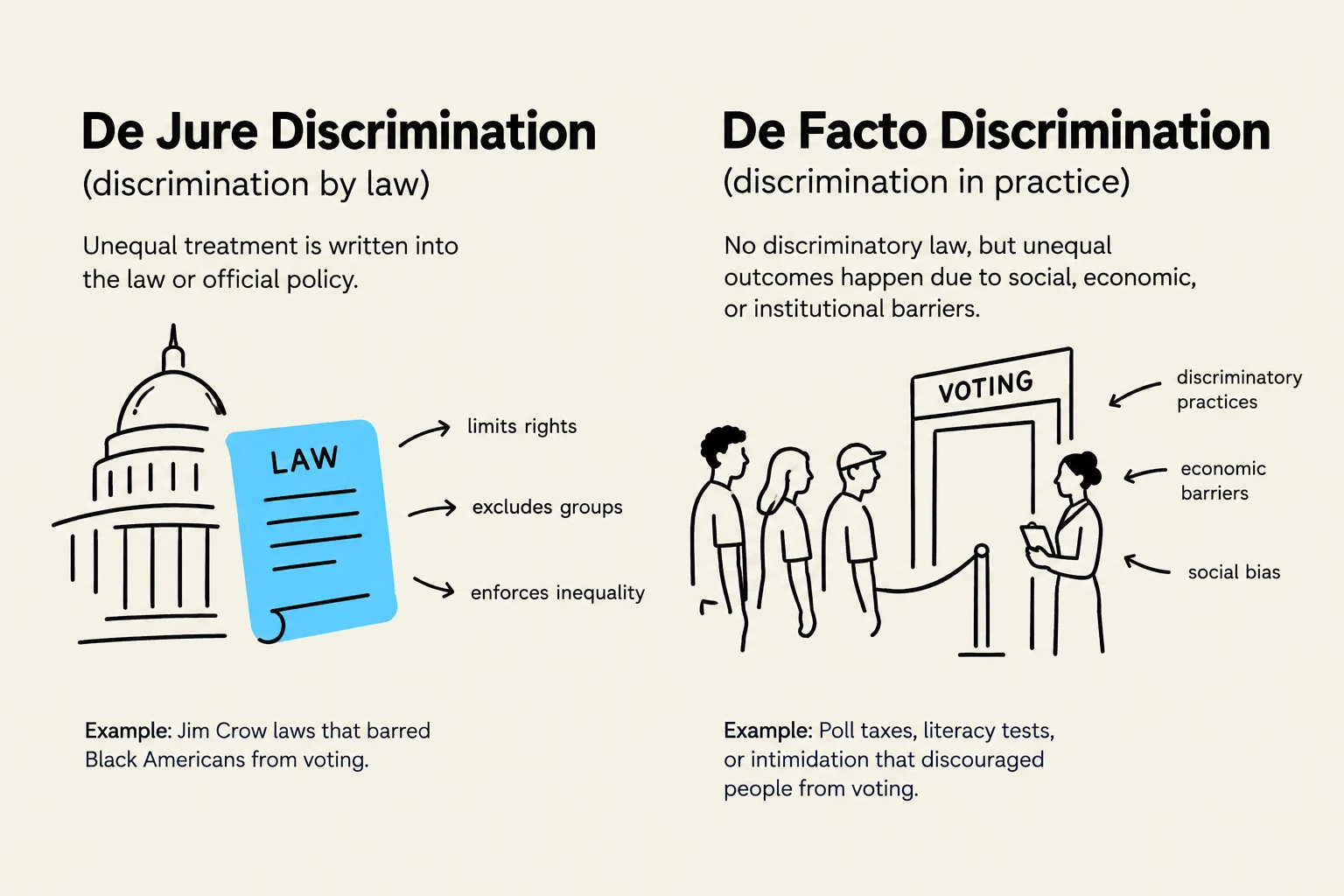
To understand the debate around affirmative action, it is essential to distinguish between two types of discrimination:
De jure discrimination: Discrimination that is explicitly written into law.
De facto discrimination: Inequality that results from social prejudice, historical disadvantage, and financial constraints, even if no law mandates it.
Affirmative action was designed to address de facto discrimination by aiming for an "equality of result" rather than just "equality of opportunity". However, this approach has faced significant judicial pushback. In 2023, the Supreme Court ruled that race-based affirmative action in college admissions violates the equal protection clause of the Fourteenth Amendment.
This illustration contrasts De Jure Discrimination (discrimination by law) with De Facto Discrimination (discrimination in practice), providing examples for each.
While the legal mechanisms for achieving equality continue to evolve, the struggle remains a central theme of the American experience, as different groups—from women and Hispanic Americans to Native Americans and the LGBTQ community—continue to seek full participation in society.
Keep reading for free.
Create an account to finish this reading and make it part of your study routine.