An overview of the development of Canada's Constitution, from the British North America Act of 1867 to the Constitution Act of 1982 and the Canadian Charter of Rights and Freedoms. It covers federalism, division of powers, and the entrenchment of rights.
The legal landscape of Canada is not a static set of rules, but a living evolution that traces its roots from British colonial administration to a fully independent, rights-based sovereign nation. Understanding this journey requires looking at how Canada moved from being a collection of colonies governed by the British Parliament to a country with its own supreme law: the Constitution.
The Road to Confederation and the BNA Act
The idea of uniting the various Canadian colonies was not an overnight decision; discussions regarding a union predated 1867. In 1864, politicians from the Atlantic region and the Province of Canada met in Charlottetown to begin formal discussions about creating a unified dominion. Several key factors drove this movement toward Confederation, including a political stalemate in the Province of Canada, the growing influence of the United States, the need for railway expansion, and the hope for a larger domestic market for manufactured goods.
This process culminated in the British North America Act (BNA Act) of 1867, which established the Dominion of Canada. This Act is now known as the Constitution Act, 1867.
Study Tip: When reviewing historical legal documents, remember that names change. The BNA Act is the "old" name for what we now call the Constitution Act, 1867.
Federalism: Dividing Power
A defining feature of the BNA Act was the adoption of federalism. Rather than a single legislative union—which would have been unacceptable to Quebec and the Maritime provinces—the framers chose to divide powers between a central federal government in Ottawa and various provincial governments.
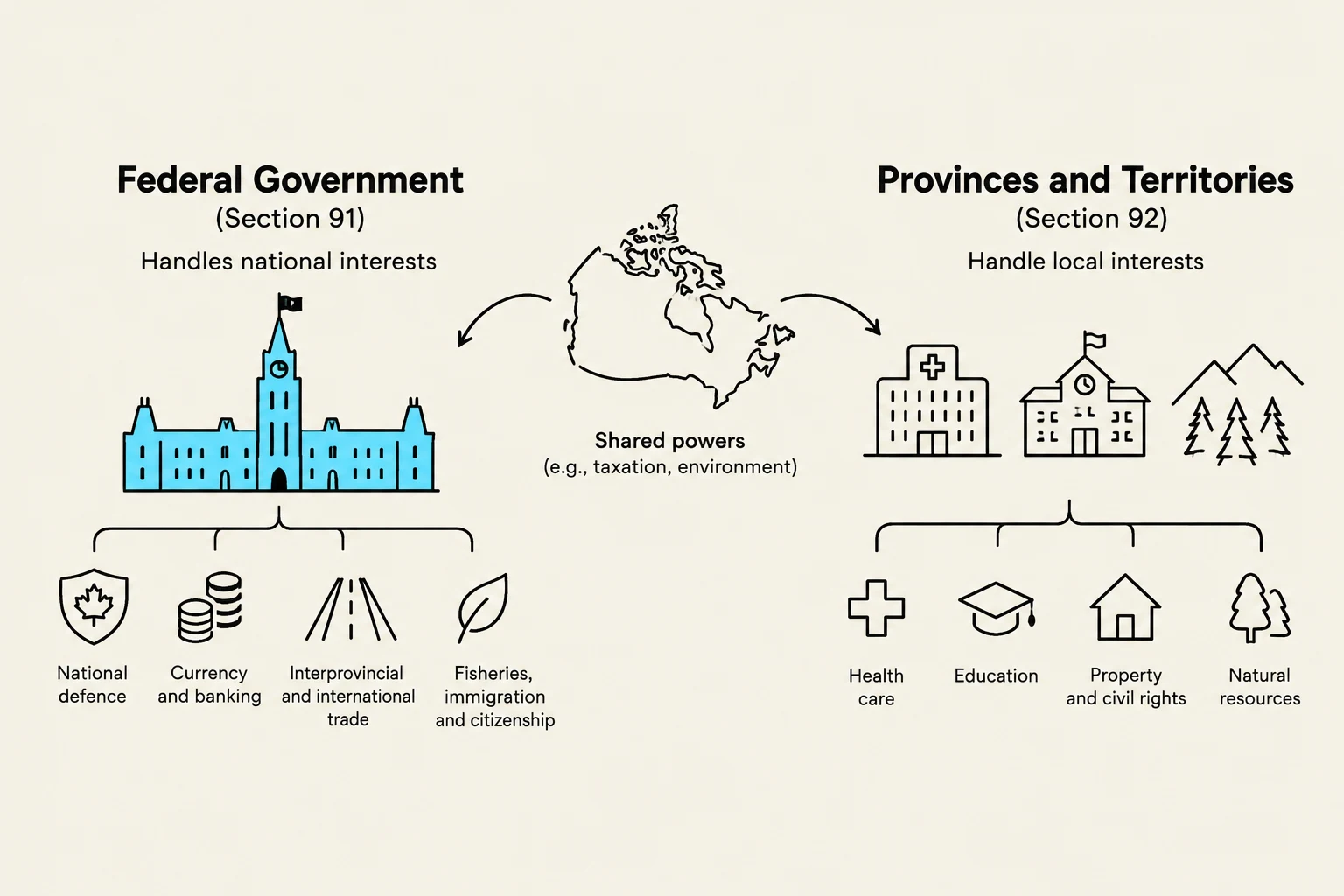
As John A. Macdonald envisioned, the federal Parliament would handle "great questions" affecting the interests of the entire Confederacy, while local bodies would manage "local interests and local laws". This division is codified in the Constitution through Sections 91 and 92, which delineate federal versus provincial jurisdictions.
This diagram illustrates the division of powers between the federal government and provincial/territorial governments in Canada, including areas of shared jurisdiction.
Post-Confederation Challenges
While the BNA Act successfully created a nation, it was far from perfect. As the decades passed, several structural flaws became apparent:
Lack of an Amending Formula: Canadians could not change their own Constitution; any major changes required the approval of the British Parliament.
Absence of Rights Protections: The Act did not contain an entrenched Charter or Bill of Rights to protect individual citizens.
Exclusion of Indigenous Peoples: The Constitution was created without any consultation with Indigenous peoples.
Judicial Ambiguity: There was a lack of clarity regarding the final court of appeal.
Patriation and the Constitution Act, 1982
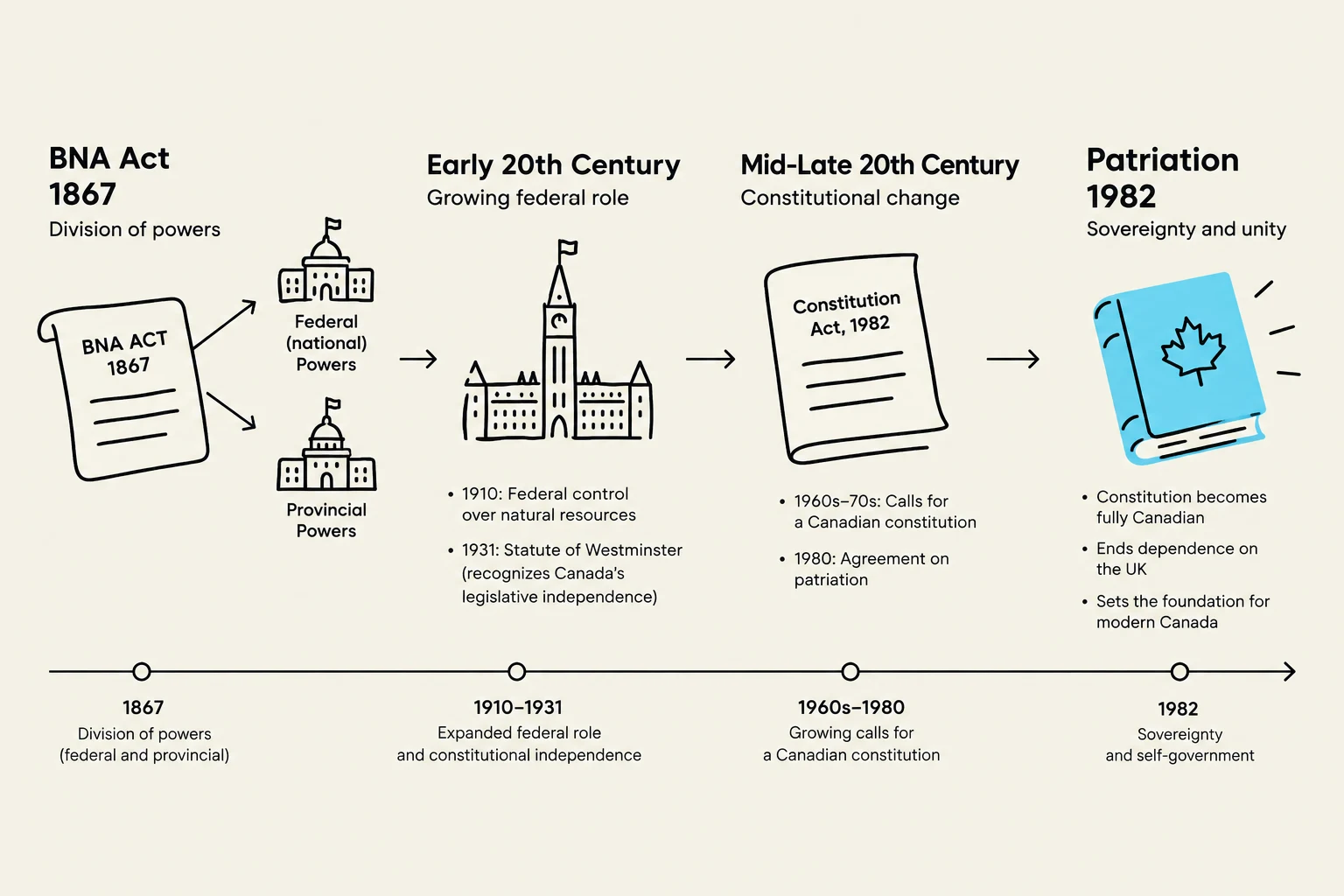
The push for reform intensified following World War II, driven by a desire for full sovereignty. A major catalyst was Pierre Trudeau, who sought to patriate the Constitution—essentially "bringing it home" from Britain so that Canada could amend it independently. This movement was further fueled by the rise of Quebec nationalism in the 1960s and 1970s.
The process reached its climax with the Canada Act 1982, enacted by the UK Parliament on March 29, 1982. This led to the implementation of the Constitution Act, 1982, which included the Canadian Charter of Rights and Freedoms. This landmark achievement ended the authority of the British Parliament to legislate for Canada and provided a mechanism for Canada to govern its own constitutional evolution.
Timeline illustrating key milestones in Canadian constitutional history, from the BNA Act of 1867 to the Patriation of the Constitution in 1982.
The Charter and Modern Protections
The introduction of the Charter changed the relationship between the state and the individual. During the patriation process, various groups lobbied for specific protections: Indigenous peoples sought to ensure their rights were entrenched, and women's groups campaigned for equality provisions.
Equality and Aboriginal Rights
The 1982 Constitution addressed these needs through specific legal mechanisms:
Equality Provisions: Sections 15 and 28 of the Charter provide protections against discrimination.
Aboriginal and Treaty Rights: Section 35 of the Constitution Act, 1982, recognizes existing Aboriginal and treaty rights. Furthermore, Section 25 of the Charter ensures that Charter rights cannot be used to take away or diminish the rights of Indigenous peoples.
Note for Students: While these rights are "entrenched" (meaning they are very hard to change), their specific definitions—such as what constitutes a "hunting right"—are often decided by the courts through ongoing legal disputes.
Understanding Constitutional Law
Today, Canada's Constitution is the supreme law of the land. It is not just a single document, but a collection of statutes, unwritten practices, and long-standing traditions.
Constitutional law is the field that interprets this entire framework. As legal scholar Peter Hogg defined it, constitutional law is the law that prescribes how the organs of a state exercise power:
Constitutional Law=Prescribing the exercise of power by State organs(Legislative, Executive, and Judicial)+ Defining the limitations on those powers
By defining which bodies can make laws and what limits they must respect, constitutional law ensures that the government operates within the boundaries set by the supreme law of Canada.
Keep reading for free.
Create an account to finish this reading and make it part of your study routine.