The Engines of Prosperity: Historical Lessons in Institutional Development
Examines the critical role of inclusive versus extractive institutions in shaping long-term economic growth and national prosperity, drawing on historical case studies from around the world.
Why do some nations flourish while others stagnate? The answer rarely lies in geography or natural resources alone. Instead, historians and economists point to institutional development—the framework of rules, rights, and incentives that govern how a society functions. By examining historical case studies, we can see how the tension between "inclusive" institutions (which spread opportunity) and "extractive" institutions (which concentrate wealth) determines the long-term trajectory of economic growth.
The Core Dichotomy: Inclusive vs. Extractive Institutions
At the heart of institutional theory is the distinction between institutions that promote broad-based participation and those that serve a small elite.
Inclusive institutions are characterized by strong property rights, the rule of law, and a level playing field that encourages innovation and investment. Conversely, extractive institutions are designed to extract incomes and wealth from one subset of society to benefit a different subset.
Study Tip: When analyzing a country's economic performance, don't just look at its GDP. Look at who owns the assets and how much political influence is required to protect those assets.
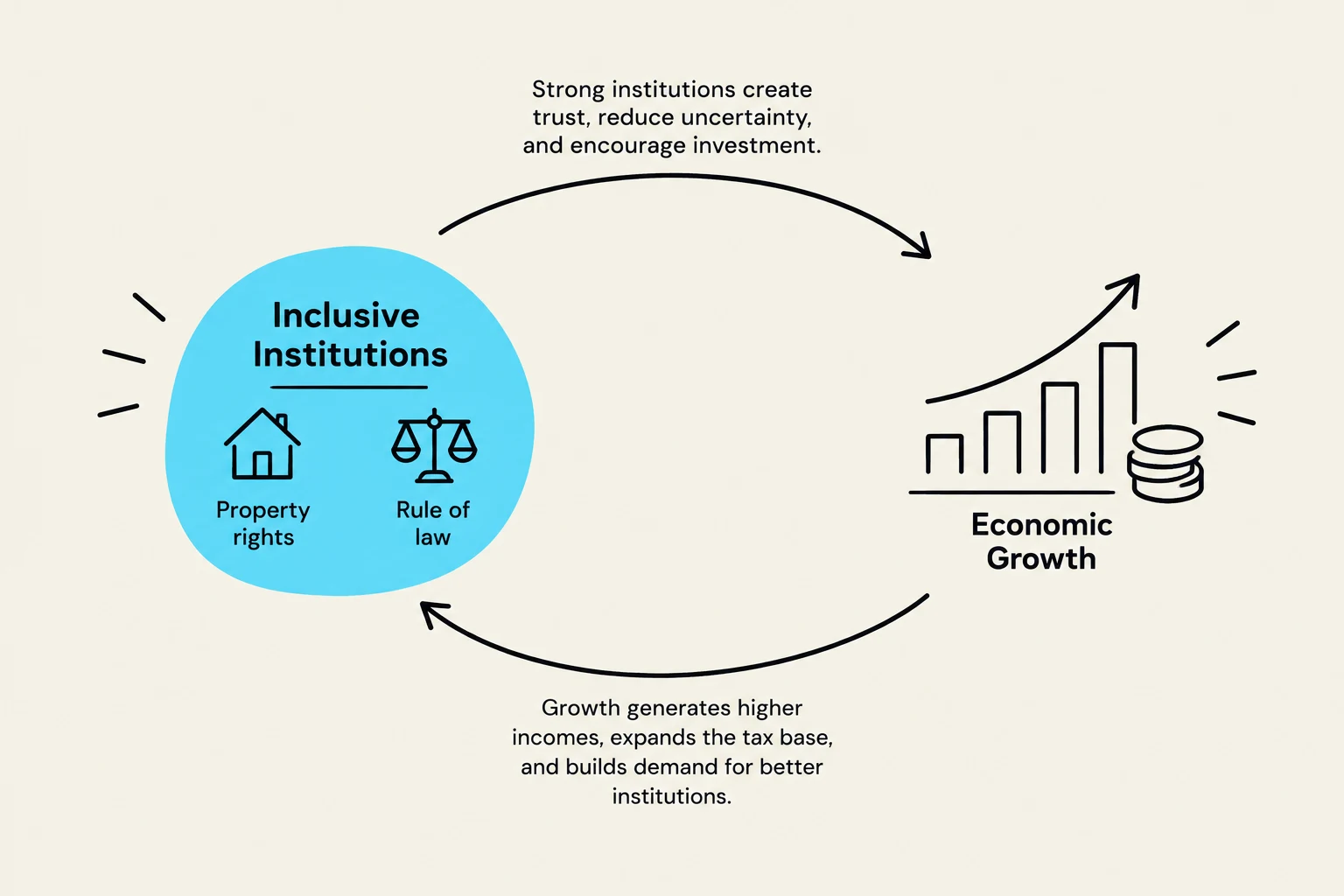
This diagram illustrates the relationship between inclusive institutions, such as property rights and the rule of law, and economic growth. Strong institutions foster trust and investment, while economic growth leads to higher incomes and demand for better institutions.
Paths to Inclusion: Lessons from the West
History shows that inclusion is rarely a sudden event; it is often a gradual, hard-fought process of expanding rights and reducing the power of monopolies.
Britain and the United States
In Britain, the "Glorious Revolution" served as a pivotal moment by limiting absolutism, which helped pave the way for more stable social organizations and reforms. While inclusion was incomplete for much of its history, the trajectory moved toward broader participation.
In the United States, the rise of massive "trusts" created significant economic concentration, threatening the very essence of competition. However, the U.S. demonstrated that inclusive markets can be defended through social mobilization, investigative journalism, and decisive political and judicial responses.
Australia and the Power of Access
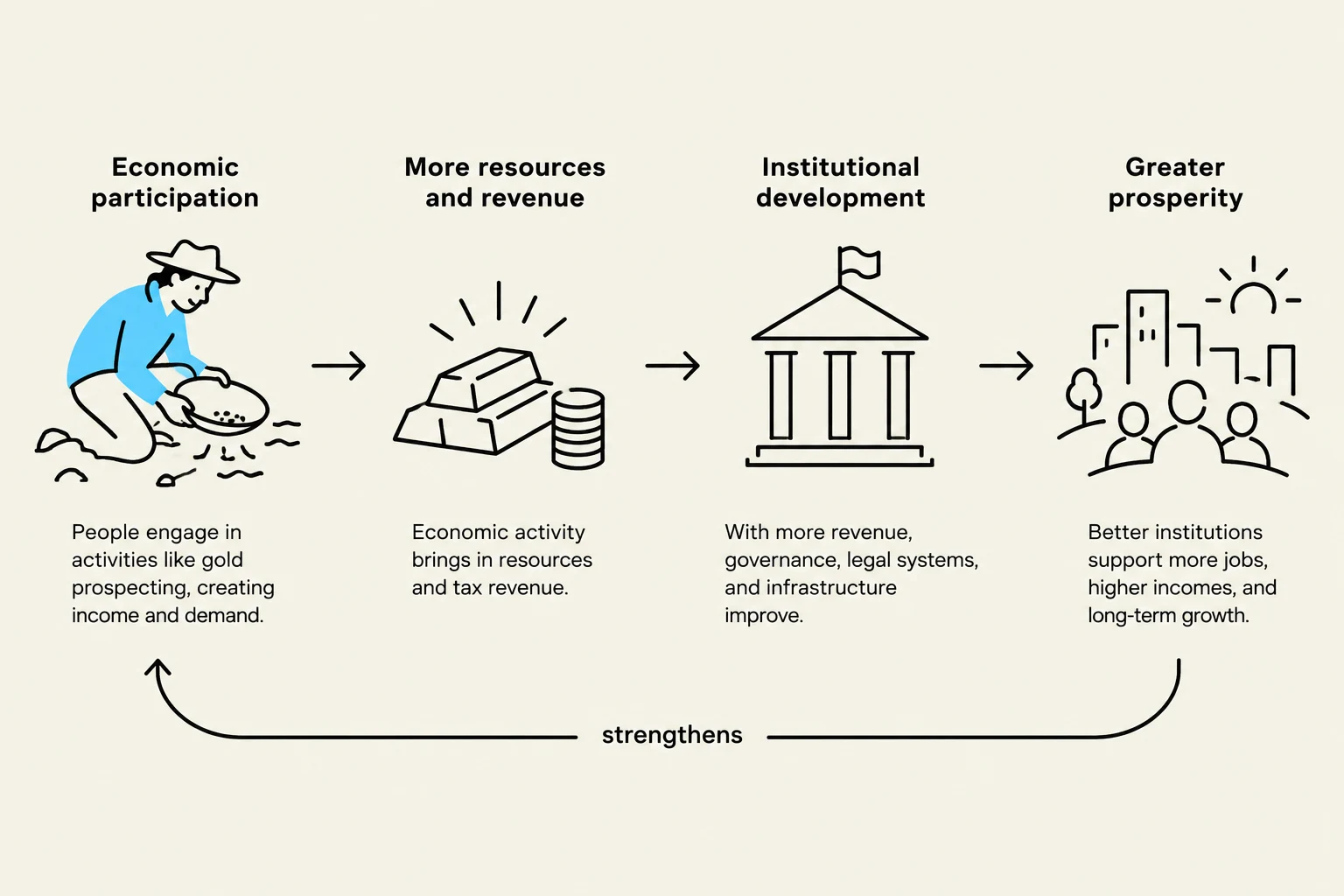
A more sectoral example can be found in Australia during the gold rushes. By providing broader access to gold prospecting through licenses, the state allowed for wider economic participation. This didn't just create wealth; it strengthened the political influence of the miners, showing how economic opportunity can translate into institutional leverage.
This diagram illustrates the relationship between economic participation, resource generation, institutional development, and greater prosperity, showing how economic activities lead to increased revenue, improved governance, and ultimately long-term growth.
The Mechanics of Extraction: How Wealth is Concentrated
When institutions are designed to benefit a few, they often rely on coercion, monopolies, and the manipulation of property rights to maintain control.
Land and Labor Coercion
In many historical contexts, elites have maintained power by controlling the most vital productive assets. In Guatemala, elites adapted extractive forms to maintain concentrated landownership and used coercive labor mechanisms tied to coffee production. Similarly, in the post-slavery U.S. South, while slavery was abolished, landowners maintained economic dominance through Jim Crow laws and other mechanisms of exclusion.
State-Led Extraction and Patronage
In more modern contexts, extraction often takes the form of state control over prices or resources:
Uzbekistan under Karimov: The state used cotton quotas, imposed prices, and even forced child labor to benefit those in power, which ultimately harmed national income, investment, and education.
Zimbabwe under Mugabe: The transition from colonial rule failed to dismantle extractive institutions. Instead, patronage and repression led to insecure property rights and economic deterioration.
Egypt under Mubarak: Even when privatization occurs, it does not guarantee competition. In Egypt, privatization often coexisted with special privileges for politically connected business owners.
Divergent Destinies: The Case of the Koreas
Perhaps the most striking example of institutional impact is the division of the Korean Peninsula. North and South Korea share a common history, culture, and geography. However, following their division, they adopted radically different institutional frameworks.
The contrast in their development highlights how the presence or absence of rights, incentives, and educational opportunities—driven by their respective institutions—can lead to vastly different economic realities.
Summary of Institutional Impacts
To understand the relationship between institutions and growth, we can look at the following variables:
\text{Growth} &\propto \text{Inclusion} \\
\text{Growth} &\propto \frac{1}{\text{Extractive Concentration}}
\end{aligned}$$
| Institution Type | Primary Mechanism | Economic Outcome |
| --- | --- | --- |
| **Inclusive** | Property rights, competition, education | Sustainable economic growth |
| **Extractive** | Coercion, monopolies, political influence | Economic stagnation/deterioration |
As seen in cases like Colombia, even when national elections are held, unequal protection of rights and the presence of armed actors can prevent the establishment of truly inclusive institutions. Ultimately, the history of development is the history of the struggle to build institutions that serve the many rather than the few.
$$$
$$$
Keep reading for free.
Create an account to finish this reading and make it part of your study routine.