


In the complex world of metabolism, cells must constantly manage the flow of energy to survive. While catabolism breaks down molecules to release energy, that energy must be captured in a usable form, such as ATP. One of the most efficient ways cells harvest this energy is through the Electron Transport Chain (ETC). By utilizing the movement of electrons through a series of specialized carriers, cells can create a gradient that ultimately drives the production of ATP.
The Principles of Redox Reactions
To understand the ETC, we must first understand redox reactions. These reactions involve the transfer of electrons between two molecules: a reducing agent (the electron donor) and an oxidizing agent (the electron acceptor).
The direction and energy yield of these reactions are governed by the standard redox potential (), measured in volts (V).
- A more negative indicates a molecule is a better electron donor (reductant).
- A more positive indicates a molecule is a better electron acceptor (oxidant).
The energy released during these transfers is directly related to the difference in potential () between the donor and the acceptor. We can calculate the standard free energy change () using the Nernst equation:
In this equation, is the number of electrons transferred, and is Faraday’s constant ( or ).
Exam Tip: Remember the "OIL RIG" mnemonic: Oxidation Is Loss (of electrons), Reduction Is Gain (of electrons).
The Electron Transport Chain (ETC) and Cellular Location
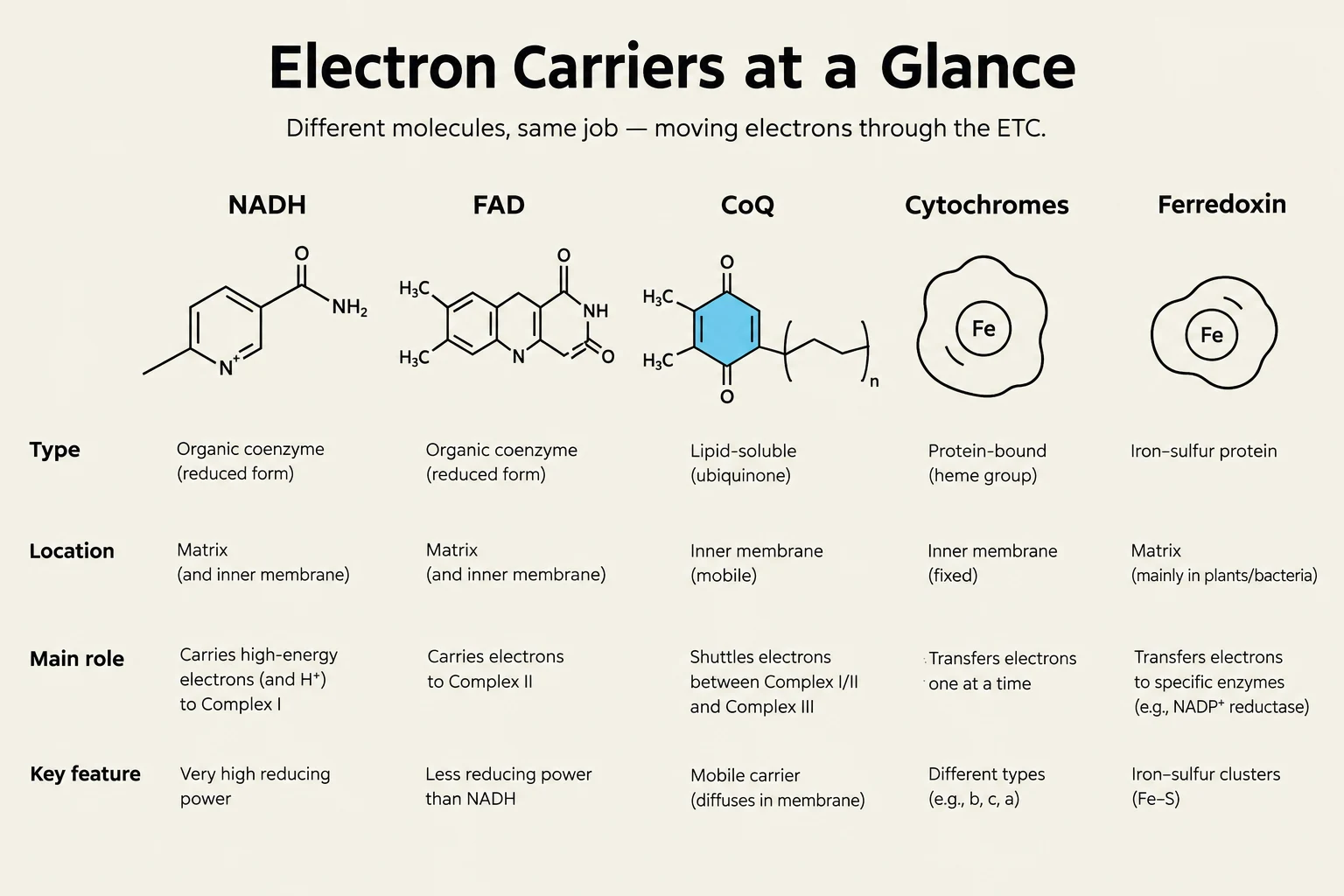
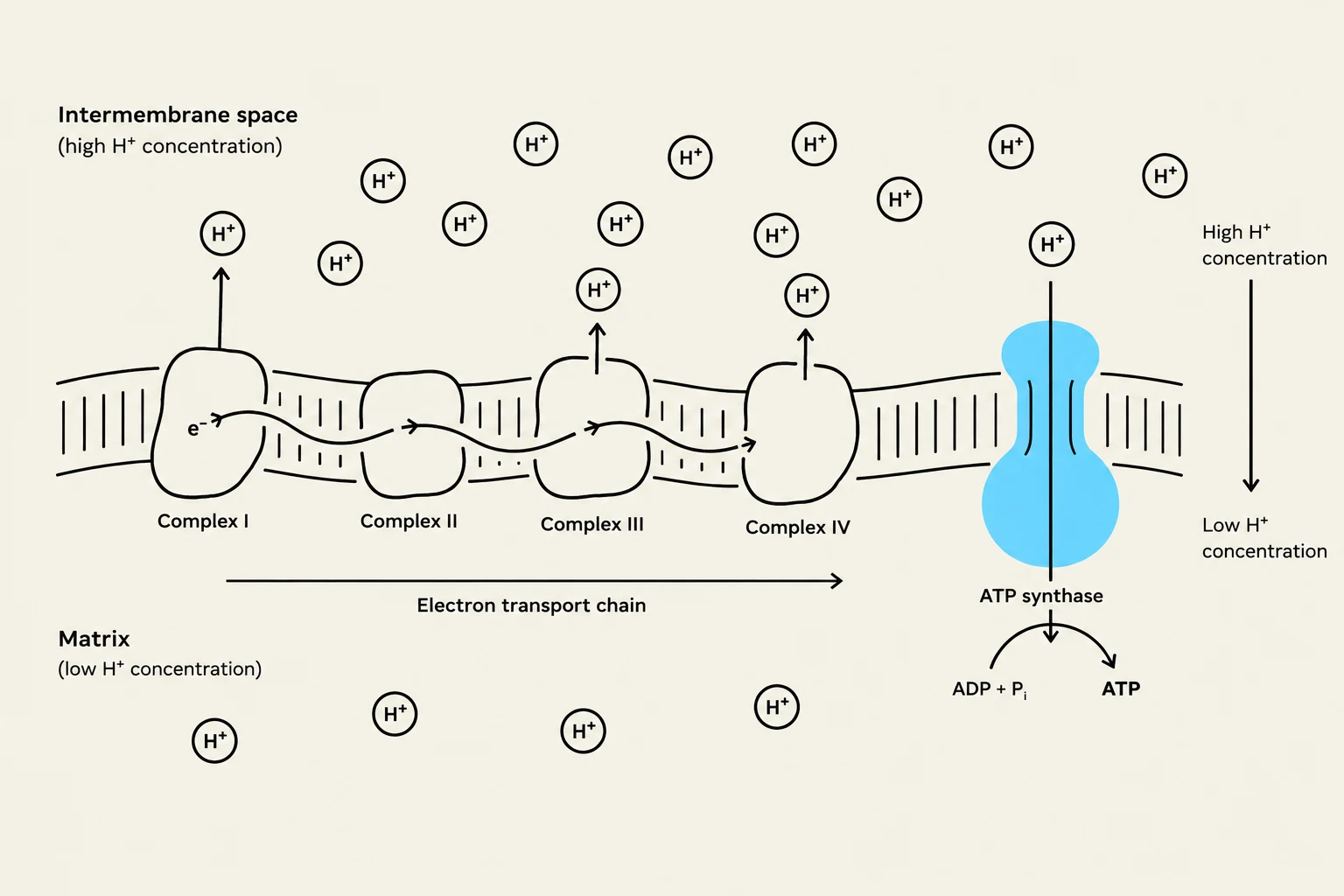
The ETC is a series of protein complexes and electron carriers that facilitate the movement of electrons from a donor with a highly negative to an acceptor with a more positive . As electrons move through the chain, the energy released is used to pump protons ($H^+$) across a membrane, creating a proton motive force (PMF).

Keep reading for free.
Create an account to finish this reading and make it part of your study routine.
Continue reading freeAlready have an account? Log in
Updated