The Electron Transport Chain and Proton Gradients in Cellular Respiration
An explanation of the electron transport chain (ETC), its protein complexes, the role of reduction potential, and how it generates a proton gradient for ATP synthesis. It also covers reactive oxygen species and antioxidants.
The primary goal of cellular respiration is to extract energy from nutrients to produce ATP. While glycolysis and the citric acid cycle (CAC) prepare the fuel, the real "energy payoff" occurs in the mitochondria through the Electron Transport Chain (ETC). The ETC is a series of protein complexes embedded in the inner mitochondrial membrane (IMM) that facilitates the transfer of electrons from high-energy donors like NADH and FADH2 to the final electron acceptor, molecular oxygen (O2). This process is not merely a transfer of particles; it is a sophisticated energy conversion system where the "downhill" flow of electrons is coupled to the "uphill" pumping of protons, creating a reservoir of potential energy used to drive ATP synthesis.
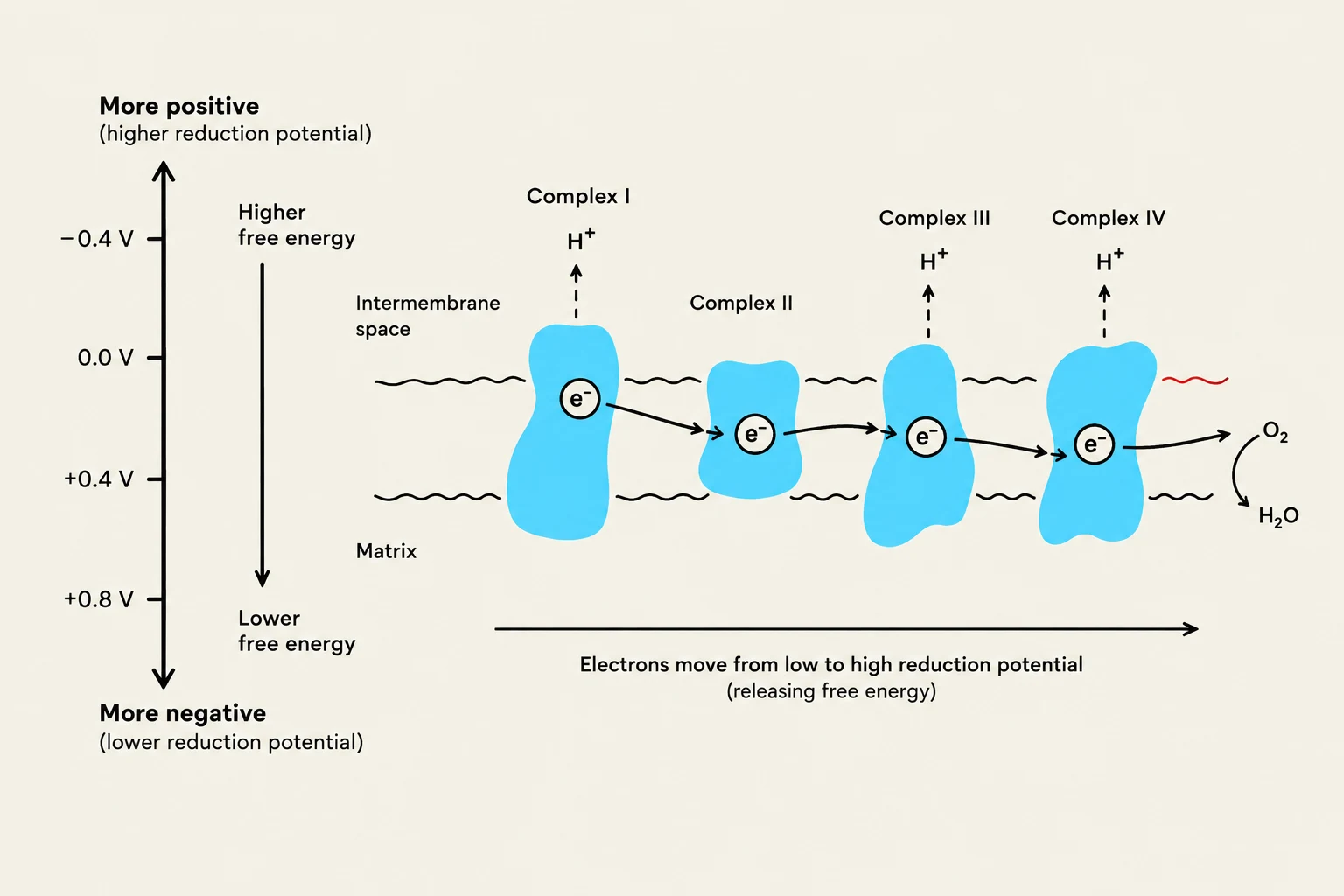
The Driving Force: Reduction Potential
To understand why electrons move through the ETC, we must understand reduction potential (E0′). This value measures a molecule's tendency to either donate or accept electrons.
Reducing agents (like NADH) have a negative E0′ and tend to donate electrons.
Oxidizing agents (like O2) have a positive E0′ and tend to accept electrons.
The movement of electrons from a molecule with a low reduction potential to one with a high reduction potential is energetically favorable. This "downhill" movement releases free energy (ΔG∘′), which is mathematically related to the change in reduction potential (ΔE0′) by the following equation:
ΔG∘′=−nFΔE0′
Where n is the number of electrons transferred and F is the Faraday constant. For example, the transfer of electrons from NADH to O2 releases a massive amount of energy (ΔG∘′=−220 kJ mol−1), which is more than enough to power the phosphorylation of ADP to ATP.
Diagram illustrating the electron transport chain, showing the movement of electrons through protein complexes embedded in the mitochondrial membrane, coupled with the pumping of protons and the release of free energy.
The Protein Complexes of the ETC
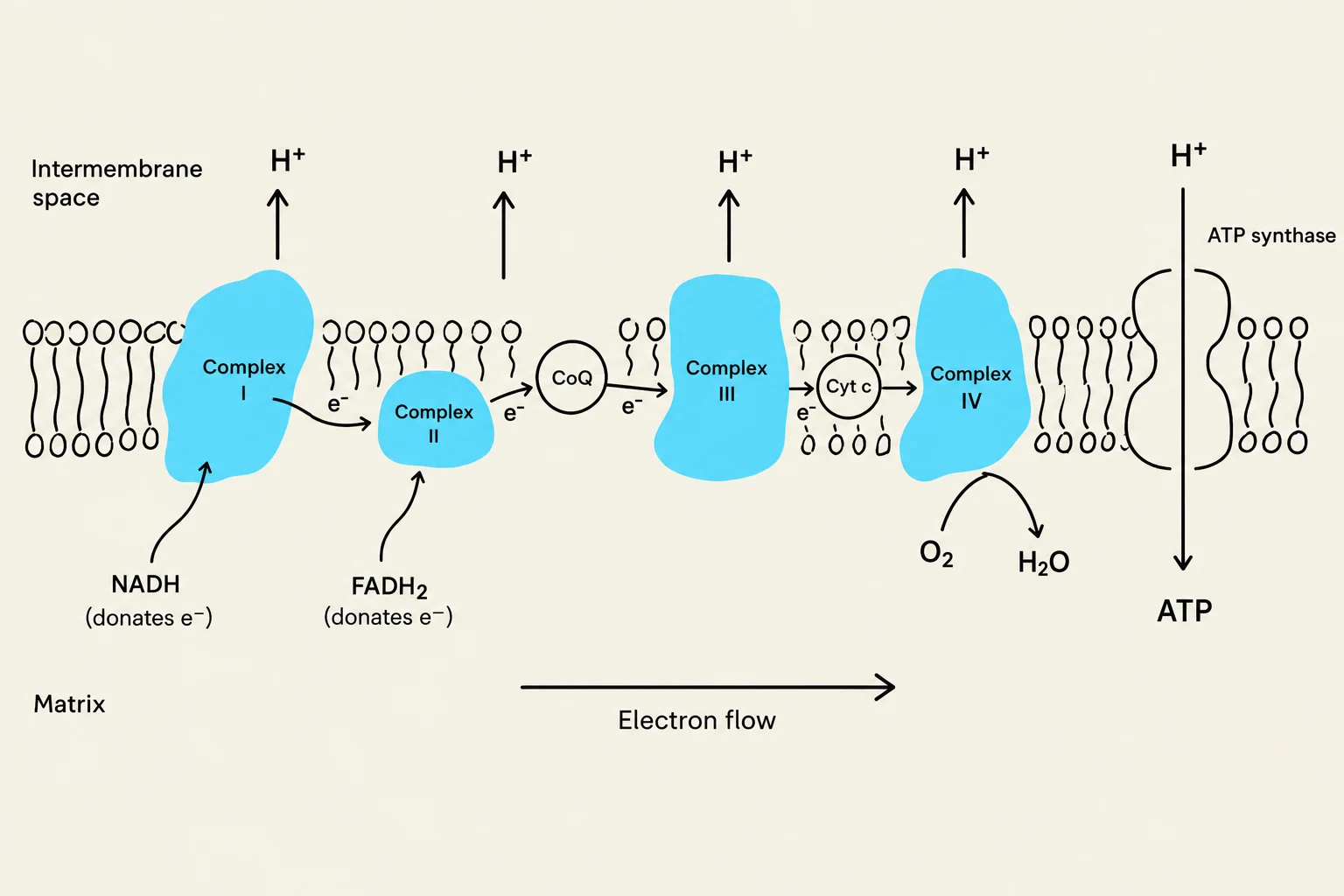
The ETC consists of four primary protein complexes and two mobile carriers that shuttle electrons between them.
Complex I (NADH-Q oxidoreductase)
Complex I is the entry point for electrons donated by NADH. It accepts electrons from NADH and transfers them to the mobile carrier Ubiquinone (Q). This electron transfer is coupled to the pumping of 4 protons from the mitochondrial matrix into the intermembrane space (IMS).
Complex II (Succinate-Q reductase)
Complex II serves as a second entry point, specifically for electrons from FADH2. It is part of the citric acid cycle (as succinate dehydrogenase) and transfers electrons from succinate to Ubiquinone.
Exam Tip: A common trick question is whether Complex II pumps protons. Unlike the other complexes, Complex II does not pump any protons across the IMM.
Ubiquinone (Q) and Cytochrome c: The Mobile Shuttles
Because the large protein complexes are embedded in the membrane, the cell uses small, mobile molecules to bridge the gaps:
Ubiquinone (Q): A hydrophobic, lipid-soluble molecule that moves within the membrane (the "Q-pool"). It carries electrons from both Complex I and Complex II to Complex III.
Cytochrome c: A small, soluble protein located in the intermembrane space that shuttles electrons from Complex III to Complex IV.
Complex III (Q-cytochrome c oxidoreductase)
Complex III receives electrons from reduced ubiquinone (QH2). However, a chemical problem arises here: QH2 carries two electrons, but Cytochrome c can only accept one electron at a time. To resolve this mismatch, the complex utilizes the Q cycle. This mechanism results in the release of 4 protons into the IMS and the removal of 2 protons from the matrix.
Complex IV (Cytochrome c oxidase)
The final destination for electrons is Complex IV. This complex accepts four electrons from four molecules of Cytochrome c and uses them to reduce molecular oxygen (O2) into two molecules of water (H2O). During this process, Complex IV pumps 4 protons into the IMS and consumes 4 matrix protons to form the water molecules.
Diagram illustrating the electron transport chain in cellular respiration, showing the movement of electrons through protein complexes embedded in the mitochondrial membrane, the pumping of protons into the intermembrane space, and the synthesis of ATP by ATP synthase.
The Proton Gradient and ATP Yield
The cumulative effect of proton pumping by these complexes is the establishment of a proton gradient (an electrochemical potential) across the inner mitochondrial membrane. This gradient represents stored chemical energy. When protons flow back into the matrix through ATP synthase, that energy is used to synthesize ATP.
The efficiency of this process depends on which electron donor is used:
NADH Pathway: Electrons pass through Complexes I, III, and IV, resulting in a total of 10 protons pumped.
FADH2 Pathway: Electrons bypass Complex I and enter at Complex II, passing only through Complexes III and IV. This results in only 6 protons pumped.
Consequently, NADH provides more "fuel" for the proton gradient and leads to greater ATP generation than FADH2. In some instances, these complexes can cluster together into larger functional units known as respirasomes.
Managing Side Reactions: ROS and Antioxidants
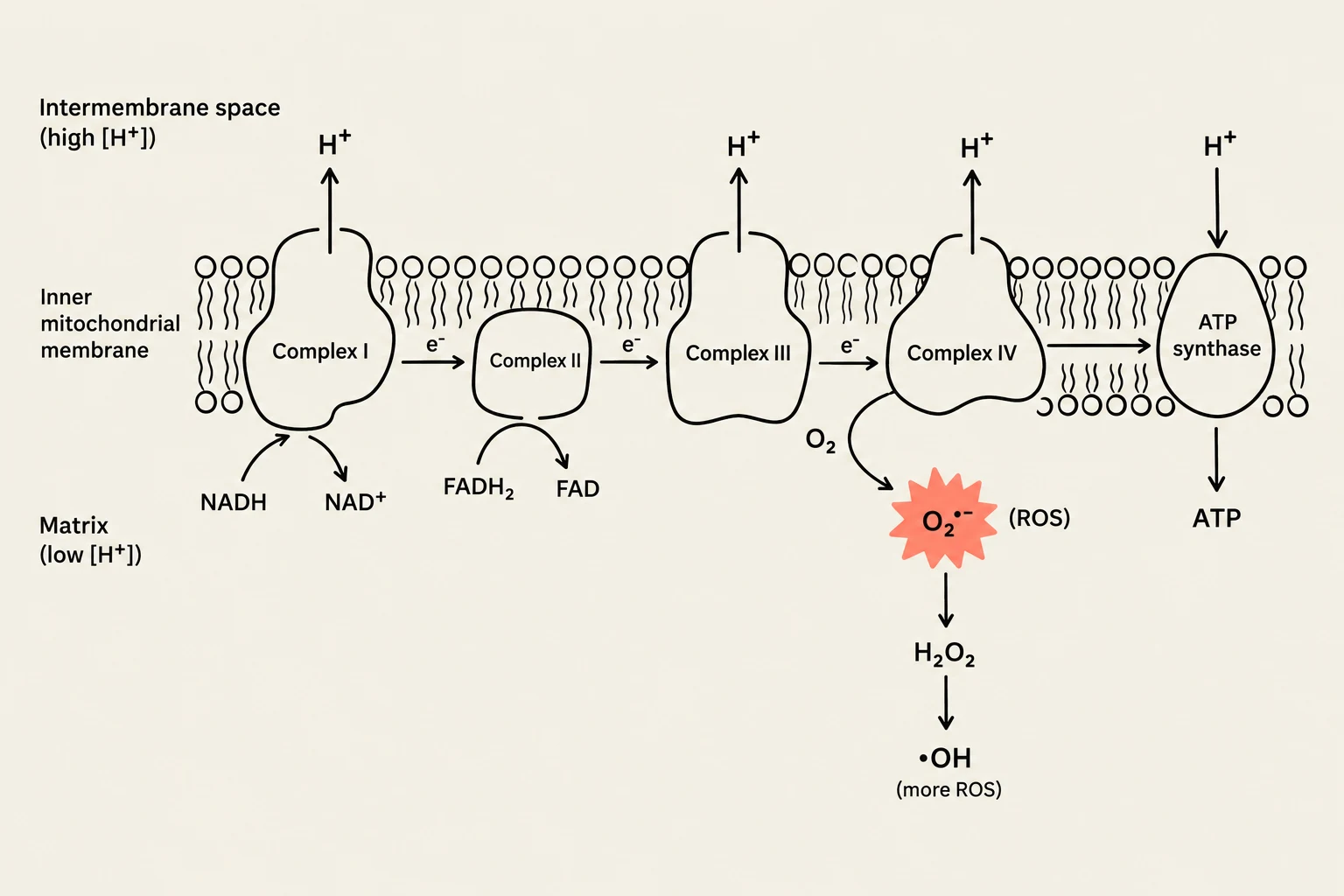
While the ETC is highly efficient, it is not perfect. Occasionally, electrons can "leak" from the chain and react prematurely with oxygen. This incomplete reduction of oxygen produces Reactive Oxygen Species (ROS), such as superoxide (O2⋅−) and peroxide (H2O2).
If left unchecked, ROS can cause significant damage to cellular DNA, proteins, and membranes. To combat this, mitochondria employ specialized antioxidant enzymes that operate with "kinetic perfection":
Superoxide dismutase: Converts the highly reactive superoxide radical into hydrogen peroxide.
Catalase: Converts hydrogen peroxide into harmless water and molecular oxygen.
Diagram illustrating the electron transport chain in the inner mitochondrial membrane, showing the movement of electrons, proton pumping, and ATP synthesis, as well as the production of reactive oxygen species (ROS).
Summary Table for Quick Review
| Complex | Name | Proton Pumping | Electron Source/Sink |
| :--- | :--- | :--- | :--- |
| I | NADH-Q oxidoreductase | 4 $H^+$ | NADH → Q |
| II | Succinate-Q reductase | 0 $H^+$ | FADH2→ Q |
| III | Q-cytochrome c oxidoreductase | 4 $H^+$ | QH2→ Cyt c |
| IV | Cytochrome c oxidase | 4 $H^+$ | Cyt c →O2 |
Total protons from NADH: 10 | Total protons from FADH2: 6
Keep reading for free.
Create an account to finish this reading and make it part of your study routine.