The Elections of 1824 and 1828: Jacksonian Democracy
An overview of the pivotal US presidential elections of 1824 and 1828, detailing the candidates, the "Corrupt Bargain," the rise of Andrew Jackson and the Democratic Party, and the ensuing political realignments and debates over states' rights and economic policy.
The early 19th century marked a transformative period in American politics, characterized by the transition from an era of "elite" leadership to a more populist style of governance. At the heart of this shift were the contentious elections of 1824 and 1828, which fundamentally altered the relationship between the federal government and the citizenry. These elections saw the rise of Andrew Jackson, the emergence of the Democratic Party, and a fierce debate over the nature of democracy, states' rights, and the role of the presidency.
The Election of 1824 and the "Corrupt Bargain"
The election of 1824 was a complex contest involving four major candidates, all of whom were members of the Democratic-Republican Party. The candidates included:
William Crawford (Georgia): The Treasury Secretary.
John Quincy Adams (Massachusetts): The Secretary of State, who enjoyed support from former Federalists.
Henry Clay (Kentucky): A proponent of the "American System".
Andrew Jackson (Tennessee): A war hero with strong support in the South.
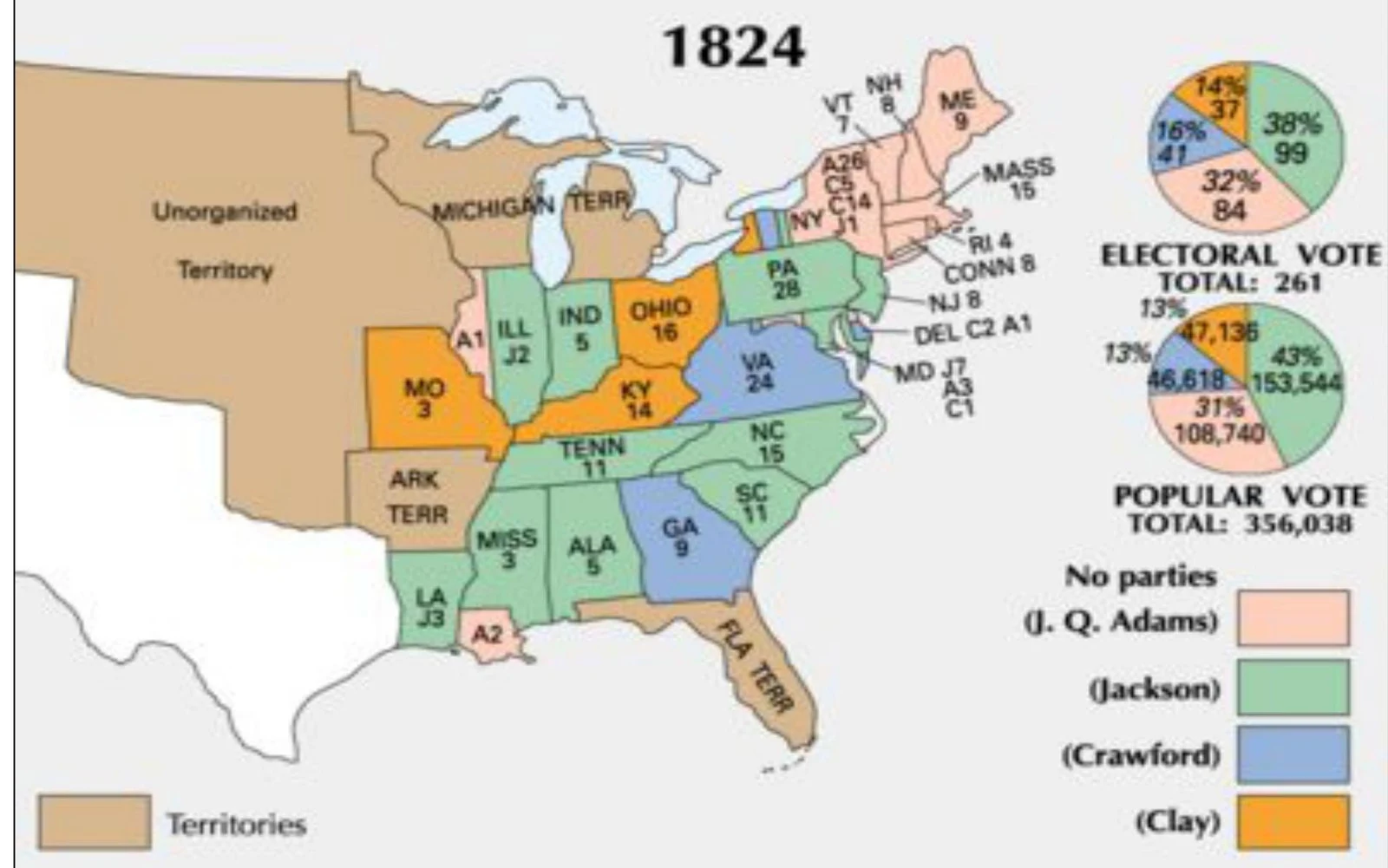
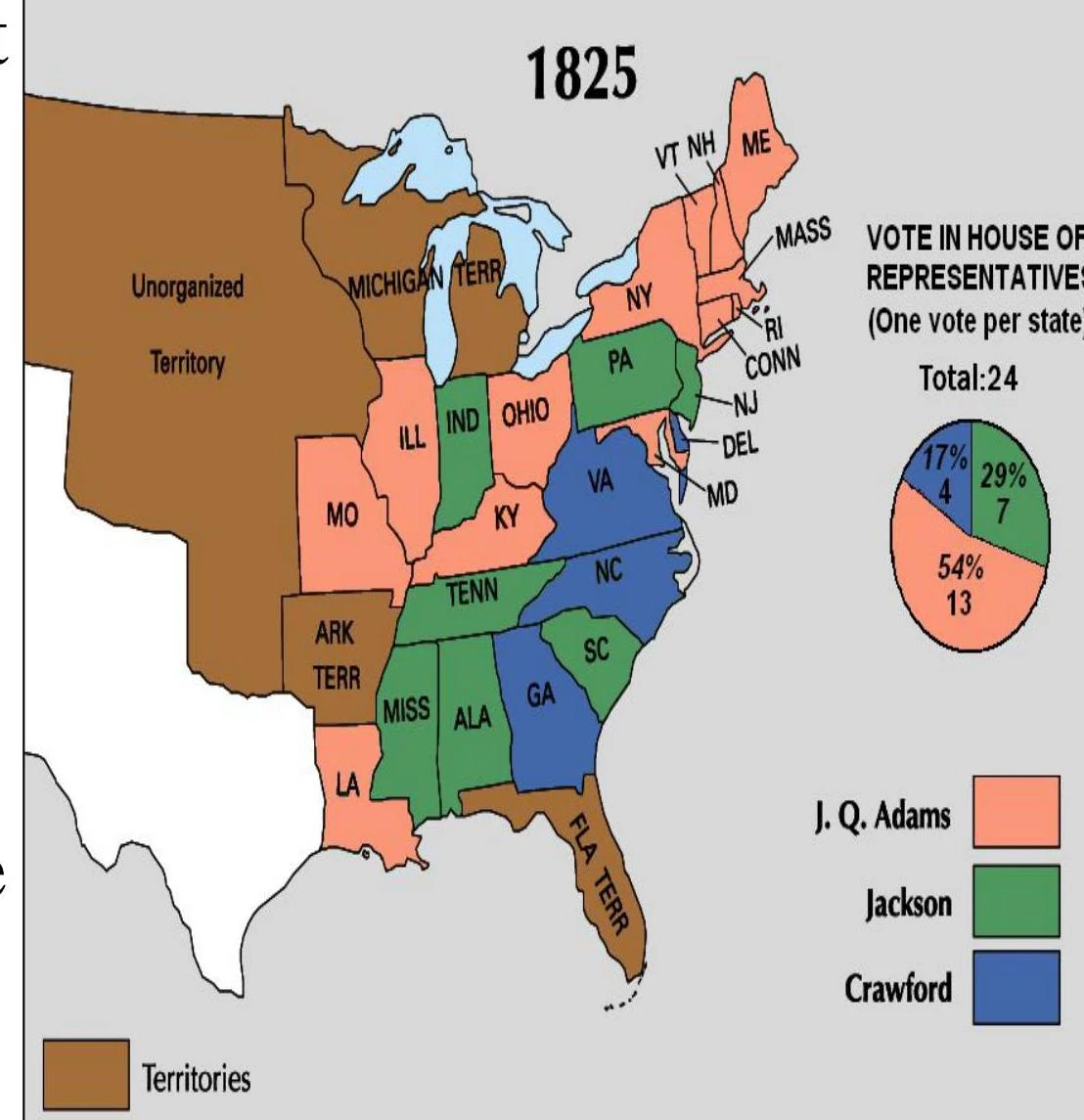
While Andrew Jackson won the plurality of the popular vote, he failed to secure a majority in the Electoral College. Under the rules of the time, when no candidate achieved a majority, the decision moved to the House of Representatives, where each state's delegation received one collective vote.
Map of the United States in 1824 showing electoral and popular vote totals by state and party.
In a move that would define his political career, Henry Clay—whose home states of Missouri, Kentucky, and Ohio were part of the House delegation—switched his support to John Quincy Adams. This maneuver resulted in Adams winning the presidency. Jackson and his supporters immediately denounced this outcome as a "Corrupt Bargain," alleging that Clay had traded his support for the presidency in exchange for political favors.
Map of the United States in 1825 showing the vote in the House of Representatives for President, with J. Q. Adams, Jackson, and Crawford as candidates.
Exam Tip: When studying this period, remember that the "Corrupt Bargain" refers specifically to the House of Representatives' decision to award the presidency to Adams after Clay supported him, despite Jackson winning the popular vote.
The Election of 1828 and the Rise of the Democratic Party
The fallout from 1824 led to a massive shift in the American electorate. During the four years leading up to the next election, many states abolished property requirements for voting, leading to a surge in voter turnout.
In 1828, Andrew Jackson ran a highly organized campaign. His supporters coalesced into what became known as the Democratic Party. The party's platform focused on several key principles:
States' Rights: A preference for limited federal intervention.
Weak Federal Government: Opposing the perceived overreach of eastern elites.
Populism: Extending opportunities to new groups in the West and attacking "entrenched officeholders".
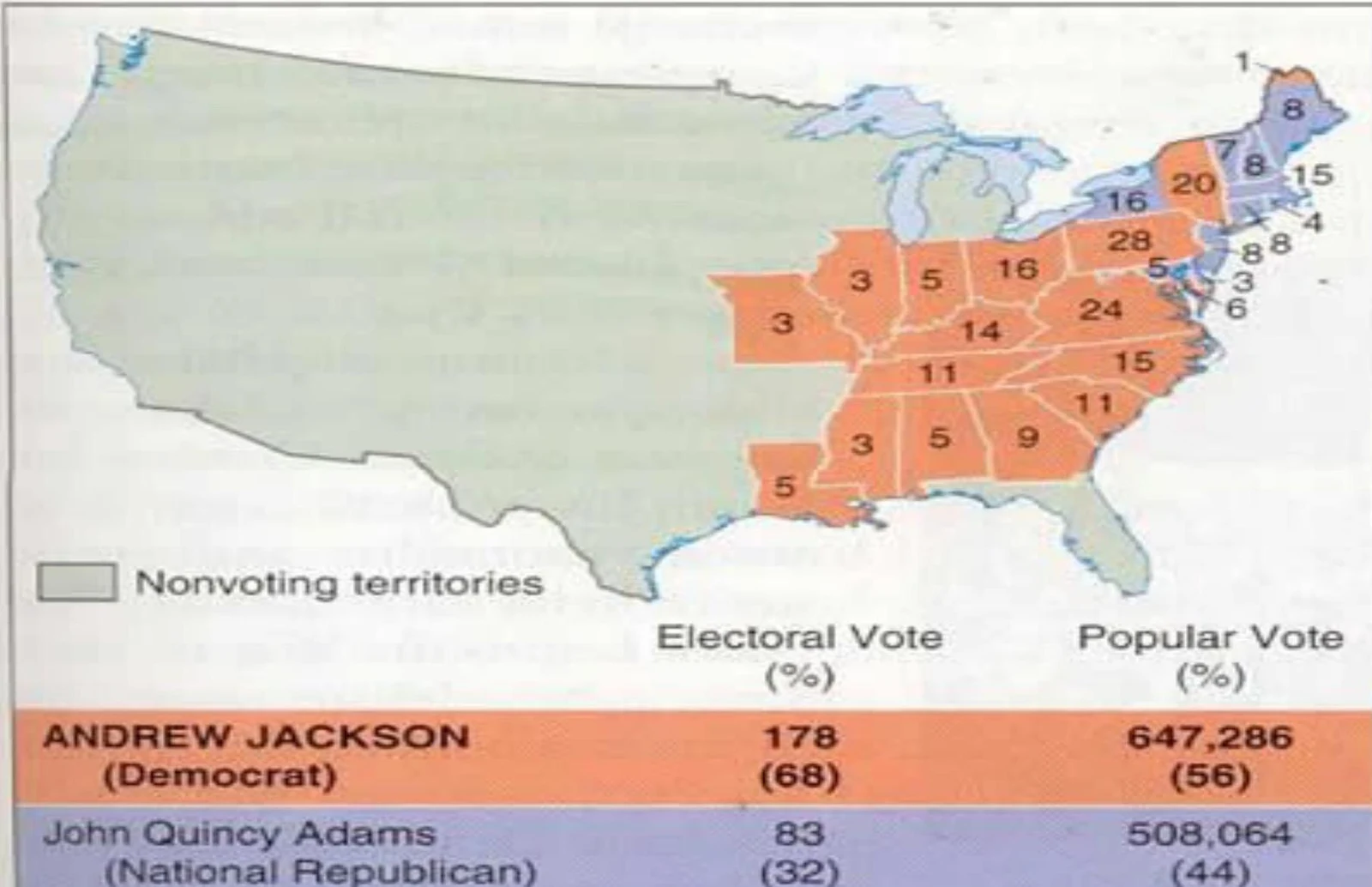
Jackson won the 1828 election decisively, carrying 178 electoral votes to Adams' 83.
Map of the United States showing electoral vote distribution by state for the 1828 presidential election, with a table comparing Andrew Jackson and John Quincy Adams' electoral and popular vote totals.
Candidate
Electoral Vote (%)
Popular Vote (%)
ANDREW JACKSON (Democrat)
178 (68)
647,286 (56)
John Quincy Adams (National Republican)
83 (32)
508,064 (44)
The Spoils System and Political Realignment
Upon taking office, Jackson implemented the spoils system, a practice of rewarding political supporters with government jobs. He viewed this as a way to remove "entrenched officeholders" and ensure that the federal government reflected the will of the people. Over his eight years in office, he removed approximately one-fifth of federal employees to achieve this.
This era also saw the birth of organized opposition. Figures like Henry Clay and Daniel Webster organized the Whig Party to oppose Jackson's perceived "royal" use of federal power. The Whigs advocated for a strong federal government, high tariffs to support industry, and the preservation of the Bank of the United States.
Conflicting Visions: The American System vs. States' Rights
The political battles of this era were often fought over economic policy and the balance of power between the North and South.
The American System
Proponents like Henry Clay supported the "American System," which aimed to strengthen the national economy through internal improvements (like canals and roads) and protective tariffs. This vision sought to link the Midwest's agriculture to the Northeast's manufacturing.
The Tariff Crisis and Nullification
The South, however, often viewed these policies as detrimental. The Tariff of 1828, which doubled rates to 50% to protect Northern manufacturers, was seen as a burden on the South. This led to the "Nullification Crisis," where South Carolina argued that states had the right to refuse to obey federal laws they deemed unconstitutional.
Key Concept: Nullification
Nullification is the theory that a state has the authority to invalidate any federal law which that state has deemed unconstitutional. This was a central argument in the tension between federal authority and states' rights.
Summary of Political Shifts
The transition from the 1824 election to the Jacksonian era represents a fundamental change in the American political landscape. The move from the "Era of Good Feelings" into a period of intense two-party competition (Democrats vs. Whigs) was driven by:
Electoral Reform: The expansion of the popular vote through the removal of property requirements.
Executive Power: The use of the presidency to implement the spoils system and challenge the power of the Bank and the Supreme Court.
Sectionalism: Deepening divides between the industrial North and the agrarian, slave-holding South over tariffs and federal authority.
Keep reading for free.
Create an account to finish this reading and make it part of your study routine.