The Economics of Taxation: Supply, Demand, and the Burden of Cost
An explanation of how taxes, specifically excise taxes, affect market dynamics, including tax incidence, price elasticity, welfare effects like consumer and producer surplus, and deadweight loss. It also touches upon equity vs. efficiency in tax policy and the impact of tariffs on international trade.
Taxes are a fundamental tool used by governments to fund public services, but they are far more than just simple revenue collectors. When a tax is introduced into a market, it fundamentally alters the relationship between buyers and sellers by driving a "wedge" between the price consumers pay and the price producers receive. This shift affects not only the final price of goods but also the quantity traded, the welfare of market participants, and the overall efficiency of the economy.
Understanding Excise Taxes
An excise tax is a per-unit tax imposed on a specific good or service. Unlike a general sales tax that might apply to all transactions, an excise tax targets specific items—such as gasoline, hotel rooms, or luxury goods.
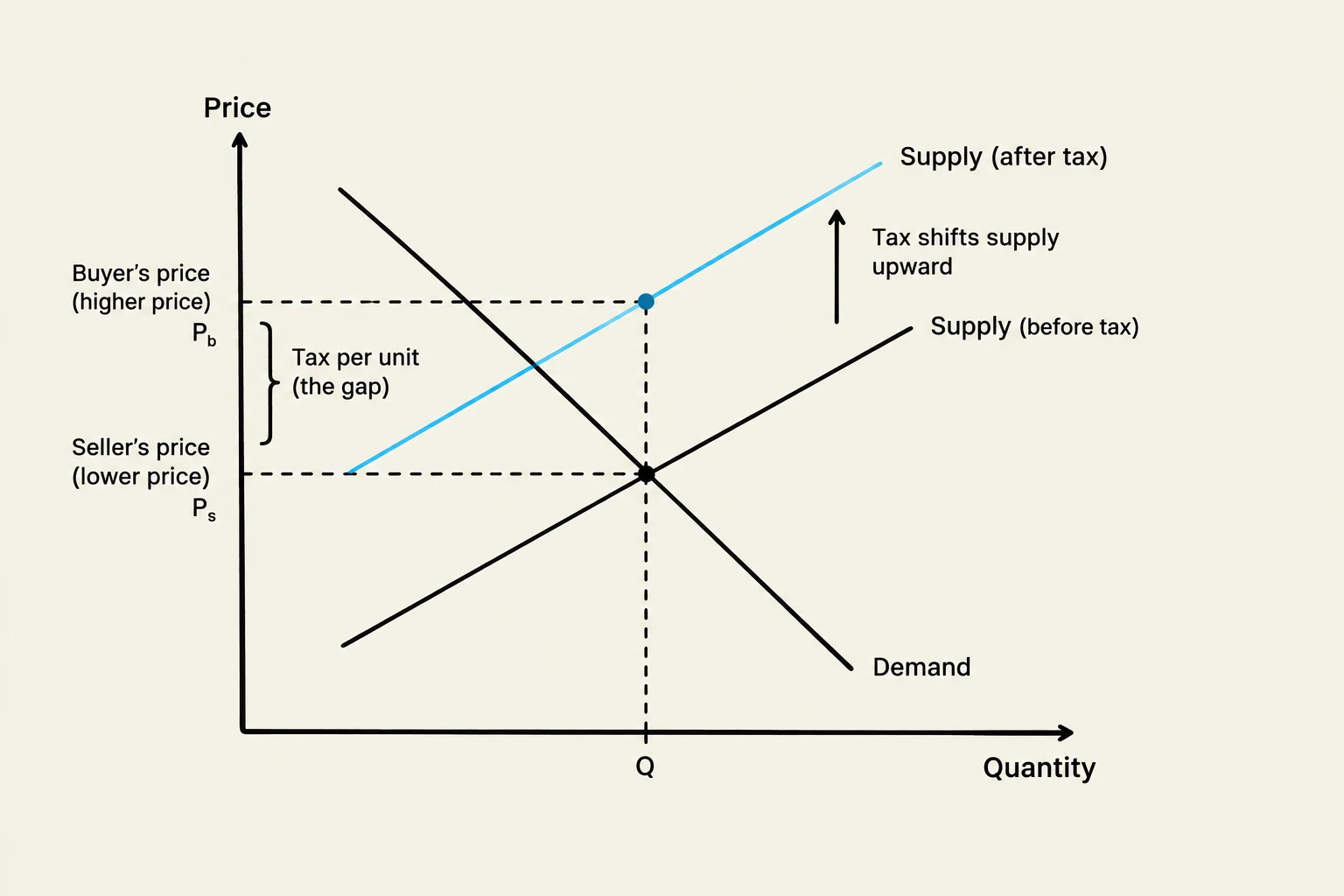
The way a tax is legally levied can change how we graph it, but it does not change the ultimate economic outcome. If a tax is levied on sellers, the supply curve shifts upward by the amount of the tax. If it is levied on buyers, the demand curve shifts downward by the same amount. Regardless of who "officially" hands the money to the government, the result is a higher price for the buyer and a lower net price for the seller.
This graph illustrates the economic impact of a tax on supply and demand. The tax shifts the supply curve upward, leading to a higher price for buyers (Pb) and a lower price for sellers (Ps), with the difference representing the tax per unit.
Tax Incidence and Price Elasticity
One of the most critical questions in economics is: Who actually pays the tax? This is known as tax incidence. Even if a law states that a business must pay a tax, the business may pass some or all of that cost onto the consumer through higher prices.
The distribution of this burden is determined by the price elasticity of demand and the price elasticity of supply. Elasticity measures how sensitive buyers and sellers are to changes in price.
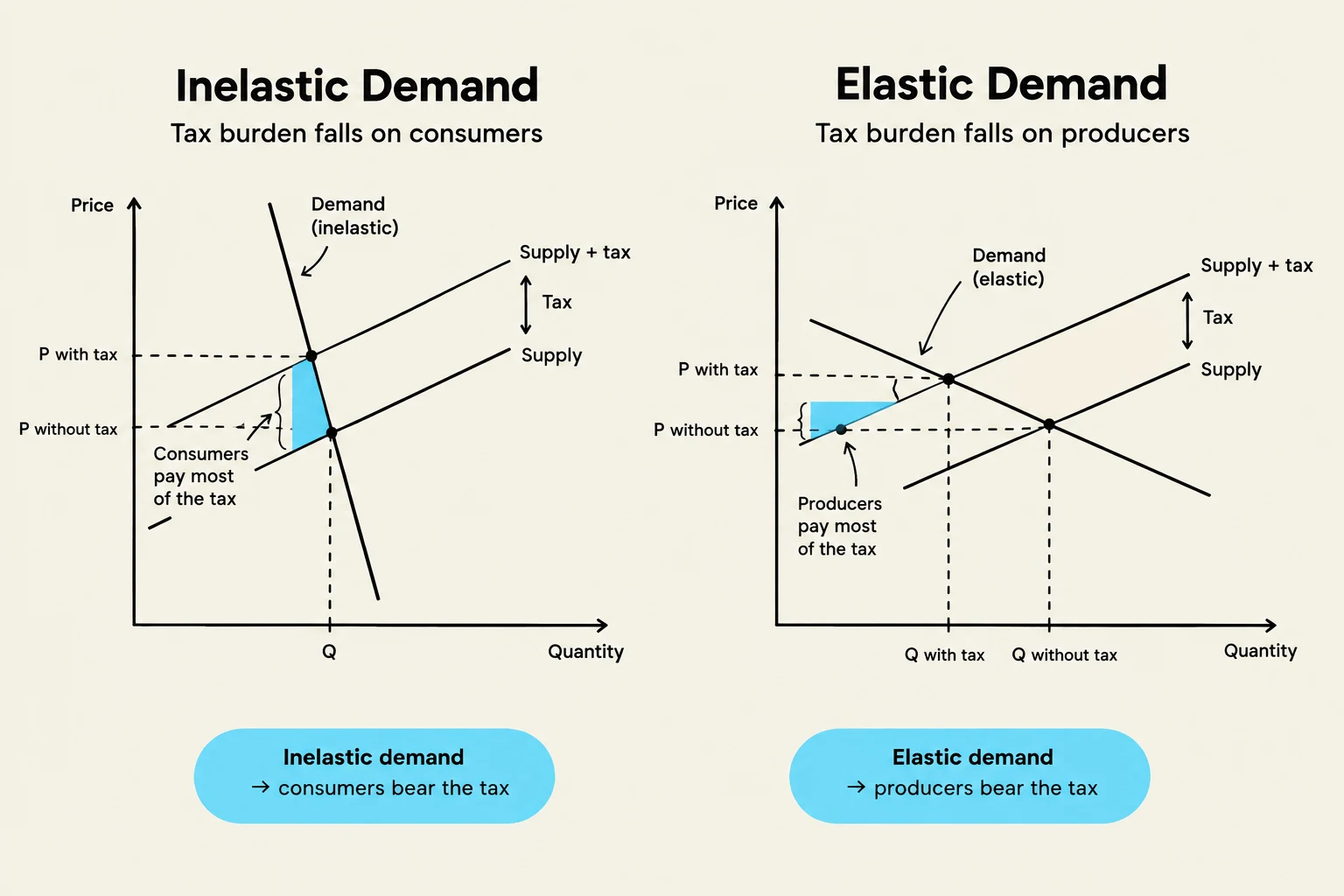
When Consumers Bear the Burden: If demand is inelastic (consumers are not very sensitive to price changes, such as with gasoline) and supply is elastic, the tax burden falls mainly on consumers.
When Producers Bear the Burden: If demand is elastic (consumers will quickly stop buying if the price rises, such as with luxury boats) and supply is inelastic, the tax burden falls mainly on producers.
Exam Tip: To remember tax incidence, think of a "long-distance relationship." The partner who is less "committed" (more elastic/flexible) can walk away more easily. Therefore, the partner who is more "committed" (inelastic) ends up bearing more of the burden.
This image illustrates the concept of tax burden distribution in economics, comparing inelastic demand (where consumers bear most of the tax) with elastic demand (where producers bear most of the tax) using supply and demand graphs.
Welfare Effects: Surplus and Deadweight Loss
Taxes create winners and losers in the economy. To understand these effects, we look at three key components:
Consumer Surplus: The benefit consumers receive when they can purchase a good for less than the maximum price they were willing to pay.
Producer Surplus: The benefit producers receive when they sell a good for more than the minimum price they were willing to accept.
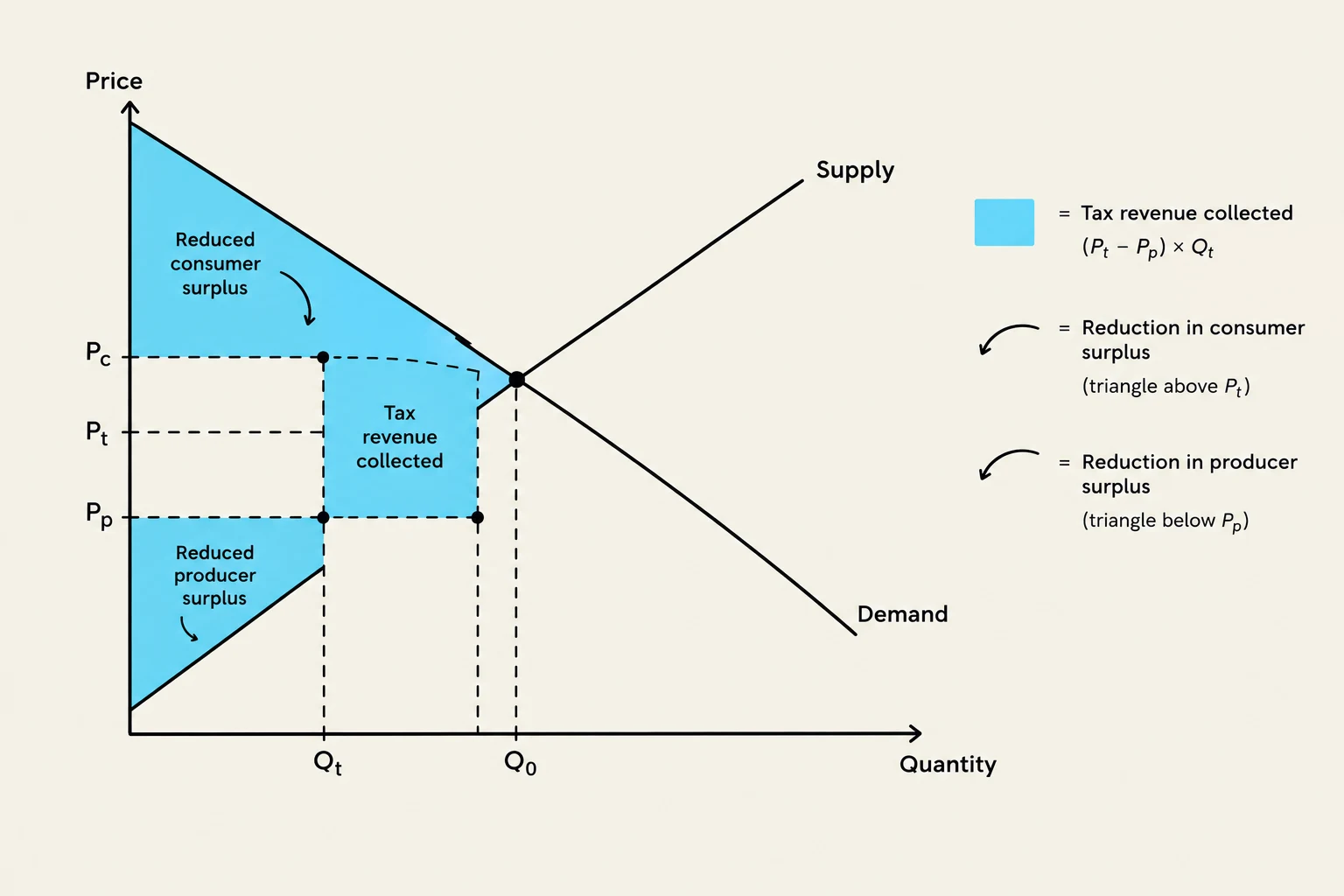
Tax Revenue: The total amount of money collected by the government, calculated as:
Tax Revenue=Tax per unit⋅Quantity sold after tax
However, taxes also create a cost to society known as deadweight loss (DWL). Deadweight loss represents the loss in total surplus (consumer + producer) that is not captured by anyone—not even the government. It occurs because the tax discourages mutually beneficial trades that would have happened in a free market.
The size of the deadweight loss is highly dependent on elasticity. If demand or supply is very elastic, the quantity traded drops significantly, leading to a larger deadweight loss. Conversely, if demand or supply is inelastic, the quantity traded changes very little, resulting in a smaller deadweight loss.
This graph illustrates the economic impact of a tax on a market, showing the reduction in consumer and producer surplus, and the tax revenue collected.
Equity vs. Efficiency in Tax Policy
When governments design tax systems, they often face a trade-off between tax equity (fairness) and tax efficiency (minimizing deadweight loss).
Principles of Fairness
There are two primary ways to view tax fairness:
The Benefits Principle: Suggests that those who benefit from public spending should bear the burden of the taxes that pay for it.
The Ability-to-Pay Principle: Suggests that those with greater financial resources should pay more in taxes.
This leads to different types of tax structures. A progressive tax takes a larger percentage of income from high-income earners, while a regressive tax takes a larger percentage from low-income earners.
The Efficiency Trade-off
If a policymaker's goal is purely efficiency—minimizing deadweight loss—they should tax goods with the lowest price elasticities. For example, taxing a life-saving medicine like insulin would cause very little deadweight loss because demand is inelastic. However, while such a tax is efficient, it may be considered highly unfair under the ability-to-pay principle.
International Trade: Tariffs and Imports
Taxation principles also apply to international trade through tariffs, which are taxes on imported goods.
In a global market, if the world price of a good is lower than what domestic producers can charge, the country will import the difference between domestic demand and domestic supply. When a tariff is imposed, it artificially raises the domestic price. This has three primary effects:
Increased Domestic Production: Higher prices encourage domestic companies to produce more.
Reduced Imports: Because the price is higher, consumers buy less of the imported good.
Higher Consumer Prices: Domestic consumers must pay more for the product.
While tariffs generate government revenue and support local producers, they do so at the expense of domestic consumers.
Keep reading for free.
Create an account to finish this reading and make it part of your study routine.