The Economic Role of Contract Law in Facilitating Exchange
This reading explains how contract law functions as a crucial mechanism in market economies by reducing transaction costs, managing risk, and maintaining incentives for parties to fulfill their obligations. It details concepts like transaction costs, risk allocation, opportunistic behavior, and the economic rationale b
In a perfect world, every individual would trade with every other individual based on mutual trust and immediate fulfillment of promises. However, the real world is characterized by uncertainty, information asymmetry, and the constant risk of opportunism. Without a structured way to enforce promises, the "friction" of doing business would become so high that many beneficial trades would never occur.
Contract law serves as the lubricant in the machinery of the market. Rather than merely being a set of rules for punishment, it functions as a framework that reduces transaction costs and ensures that parties remain incentivized to fulfill their obligations. By providing a predictable environment, contract law allows economic actors to plan for the future, allocate risks, and maximize social welfare.
The Problem of Transaction Costs
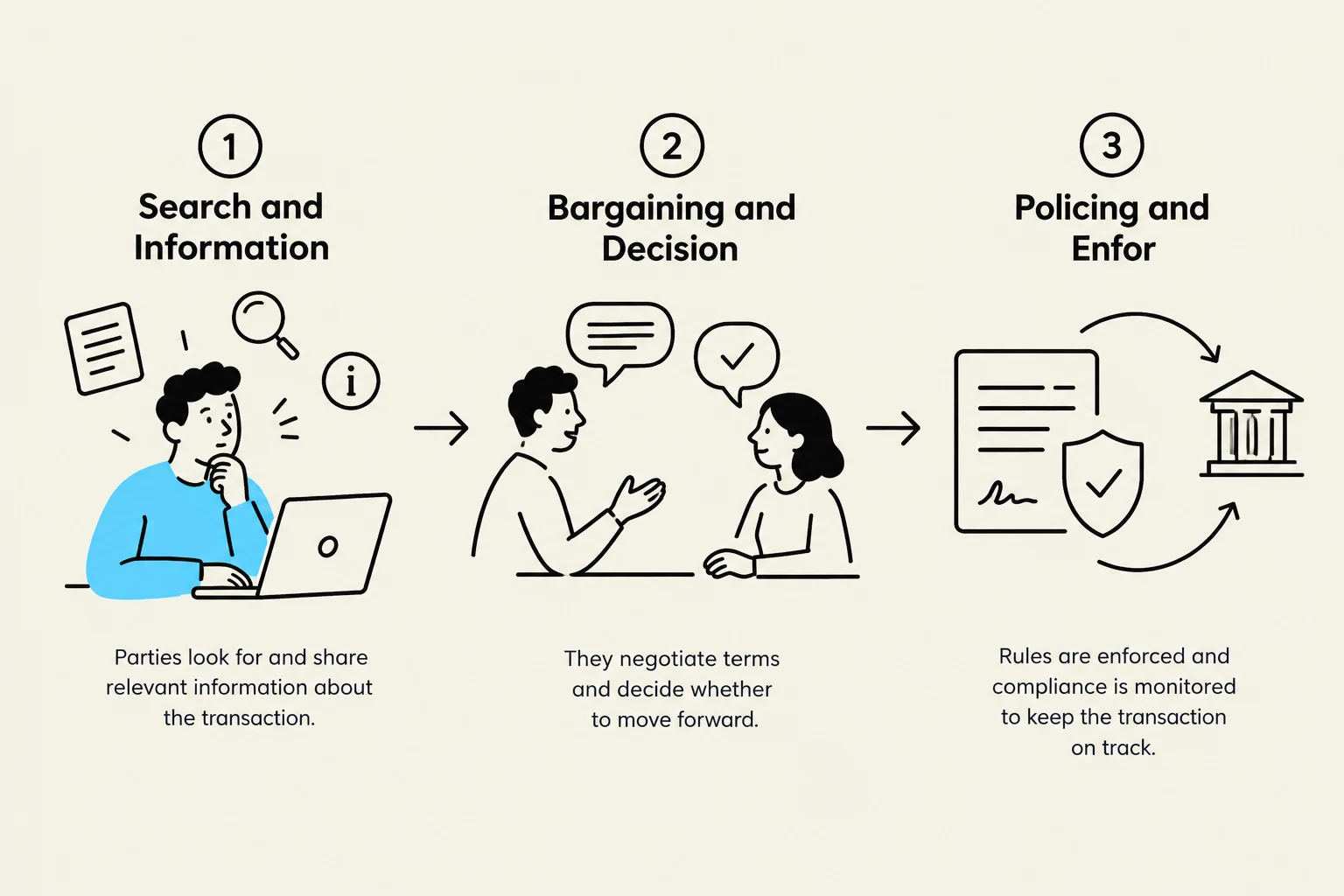
To understand why contract law is necessary, we must first understand the concept of transaction costs. In economics, transaction costs are the expenses incurred during the process of making an exchange. These are not the prices of the goods themselves, but rather the costs of finding a partner, negotiating terms, monitoring performance, and—crucially—enforcing the agreement if one party fails to deliver.
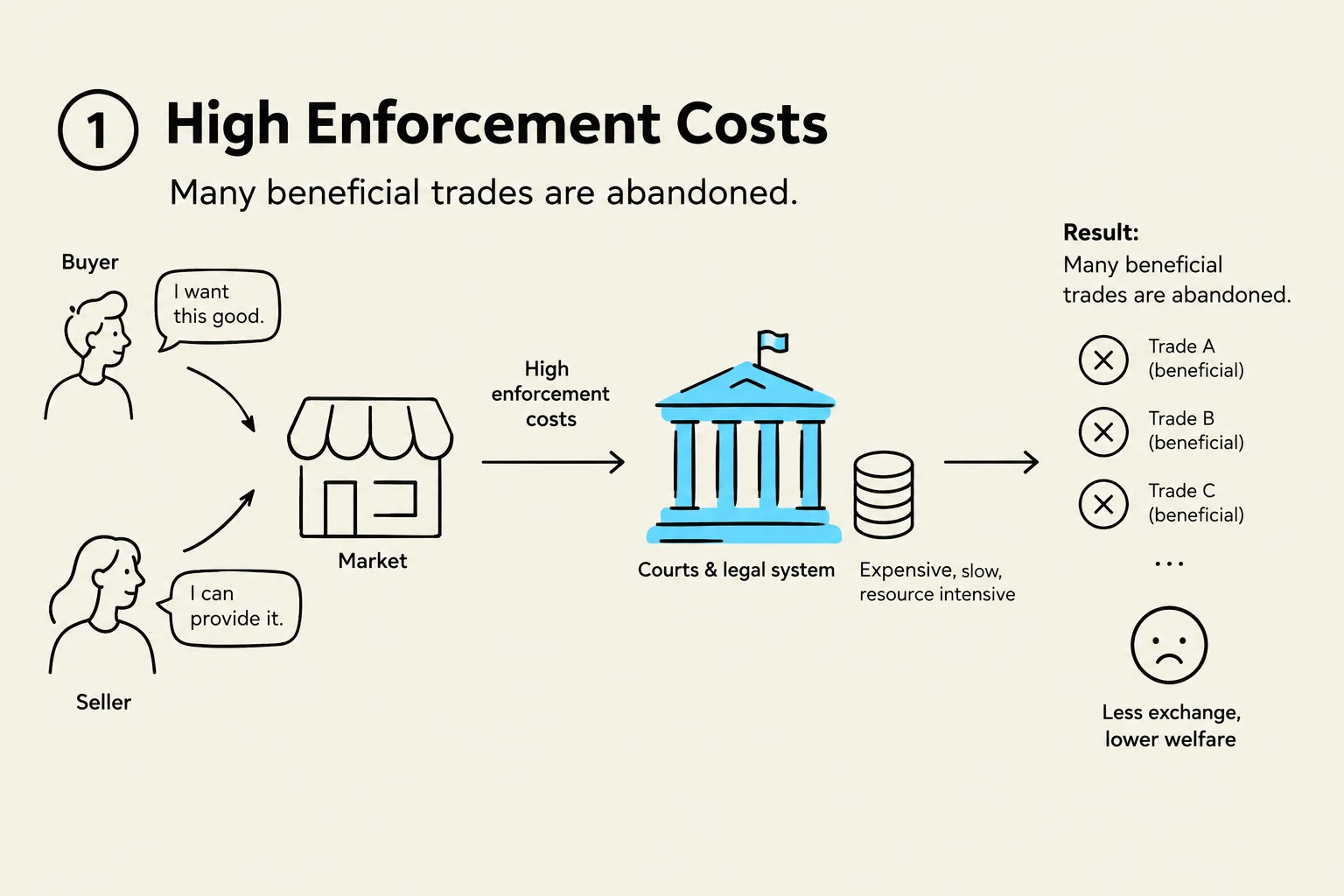
If the cost of ensuring a contract is honored exceeds the potential profit from the trade, the trade will not happen. This is an inefficient outcome because, in a vacuum, the trade would have increased the total wealth of the parties involved. Contract law seeks to minimize these costs by providing standardized rules and predictable remedies.
Exam Tip: When discussing efficiency, remember that a trade is "efficient" if it moves resources from a lower-valued user to a higher-valued user. Contract law facilitates this by lowering the barriers (costs) to making that move.
This diagram illustrates the three key stages of a transaction: Search and Information, Bargaining and Decision, and Policing and Enforcement.
Reducing Uncertainty and Risk Allocation
One of the primary functions of contract law is the management of risk. Every contract involves variables that are outside the control of the parties, such as market fluctuations, natural disasters, or third-party interference.
Contract law provides a "default" set of rules that dictate what happens when things go wrong. For example, if a seller cannot deliver goods due to an unforeseen event, the law provides principles like force majeure or "impossibility" to determine who bears the loss. This predictability allows parties to calculate their expected utility more accurately.
When parties know how a court will interpret an ambiguous clause or how damages will be calculated, they can engage in more complex and large-scale exchanges. They can effectively "price" the risk into the contract. If a party knows they will be liable for a specific amount of damages in the event of a breach, they can purchase insurance or set a higher contract price to offset that risk.
Incentives and the Prevention of Opportunism
Without the threat of legal recourse, parties might be tempted to engage in "opportunistic behavior." This occurs when one party takes advantage of the other after the initial agreement has been made, often because the other party has already invested significant resources into the deal.
Consider a scenario where a construction company buys specialized steel for a specific project. Once the steel is delivered, the buyer might try to renegotiate the price, knowing the seller is now stuck with a niche product that is hard to resell. Contract law prevents this by enforcing the original terms, thereby maintaining the incentive for parties to enter into agreements in the first place.
The economic goal is to ensure that the "incentive compatibility constraint" is met: the cost of breaking a contract (legal damages + reputational loss) must be greater than the gain from breaking it.
This diagram illustrates how high enforcement costs in legal systems can lead to the abandonment of beneficial trades, resulting in less exchange and lower welfare.
Efficiency in Remedies: Expectation Damages
How a court compensates a party for a breach is not just a matter of fairness; it is a matter of economic efficiency. The most common remedy in contract law is "expectation damages." The goal of this remedy is to put the non-breaching party in the position they would have occupied had the contract been fully performed.
Mathematically, if a buyer agrees to purchase an item for price P, and the market price at the time of breach is M, the expectation damages D are typically calculated as:
D=M−P
By awarding these damages, the law ensures that the non-breaching party is made whole, which preserves the incentive to enter into future contracts.
Furthermore, the availability of expectation damages allows for "efficient breach." If a party realizes they can fulfill a contract by paying damages to the other party and still come out ahead, the law allows this. For example, if a supplier can make more profit by breaking a contract with Party A to sell to Party B at a much higher price, the supplier can break the contract, pay Party A their expectation damages, and the total surplus in the economy increases.
This graph illustrates the concept of efficient breach in economics, showing that sometimes breaking a contract can lead to higher profits than fulfilling it.
Summary of Economic Functions
In conclusion, contract law is an essential pillar of a functioning market economy. It facilitates efficient exchange through three main mechanisms:
Lowering Transaction Costs: By providing standardized rules and predictable enforcement, it reduces the cost of negotiating and policing agreements.
Risk Management: It provides a framework for allocating unforeseen risks, allowing parties to price uncertainty into their deals.
Maintaining Incentives: It discourages opportunistic behavior and allows for efficient breaches, ensuring that resources flow to their highest-valued uses.
By transforming "promises" into "enforceable obligations," contract law creates the stability necessary for modern commerce to thrive.
Keep reading for free.
Create an account to finish this reading and make it part of your study routine.