The Economic Effects of Price Floors: Understanding the Minimum Wage
This reading explains the economic concept of a price floor, using the minimum wage as a primary example. It details how a binding price floor above equilibrium can lead to unemployment by creating a surplus of labor. The text also discusses unintended consequences such as capital investment and automation, and measure
In a free market, prices for goods and services are typically determined by the natural interaction of supply and demand. However, governments sometimes intervene to set specific price limits. While these interventions are often intended to protect consumers or workers, they can create significant shifts in market behavior. One of the most common and debated forms of intervention is the price floor.
What is a Price Floor?
A price floor is a legally imposed minimum price that must be paid for a good or service. For a price floor to be "effective" or binding, it must be set above the natural market equilibrium price. If the floor is set below the equilibrium, the market will naturally settle at the higher equilibrium price, making the law irrelevant in practice.
A primary real-world example of a price floor is the minimum wage. The minimum wage represents the lowest hourly rate that firms are legally allowed to pay their employees. While the federal minimum wage in the United States has remained at $7.25 per hour since 2009, many states and large employers like Amazon, Walmart, and Costco pay significantly higher wages to attract and retain talent.
Exam Tip: To determine if a price control is binding, compare it to the equilibrium. A price ceiling (a maximum price) must be below equilibrium to be binding, whereas a price floor (a minimum price) must be above equilibrium to be binding.
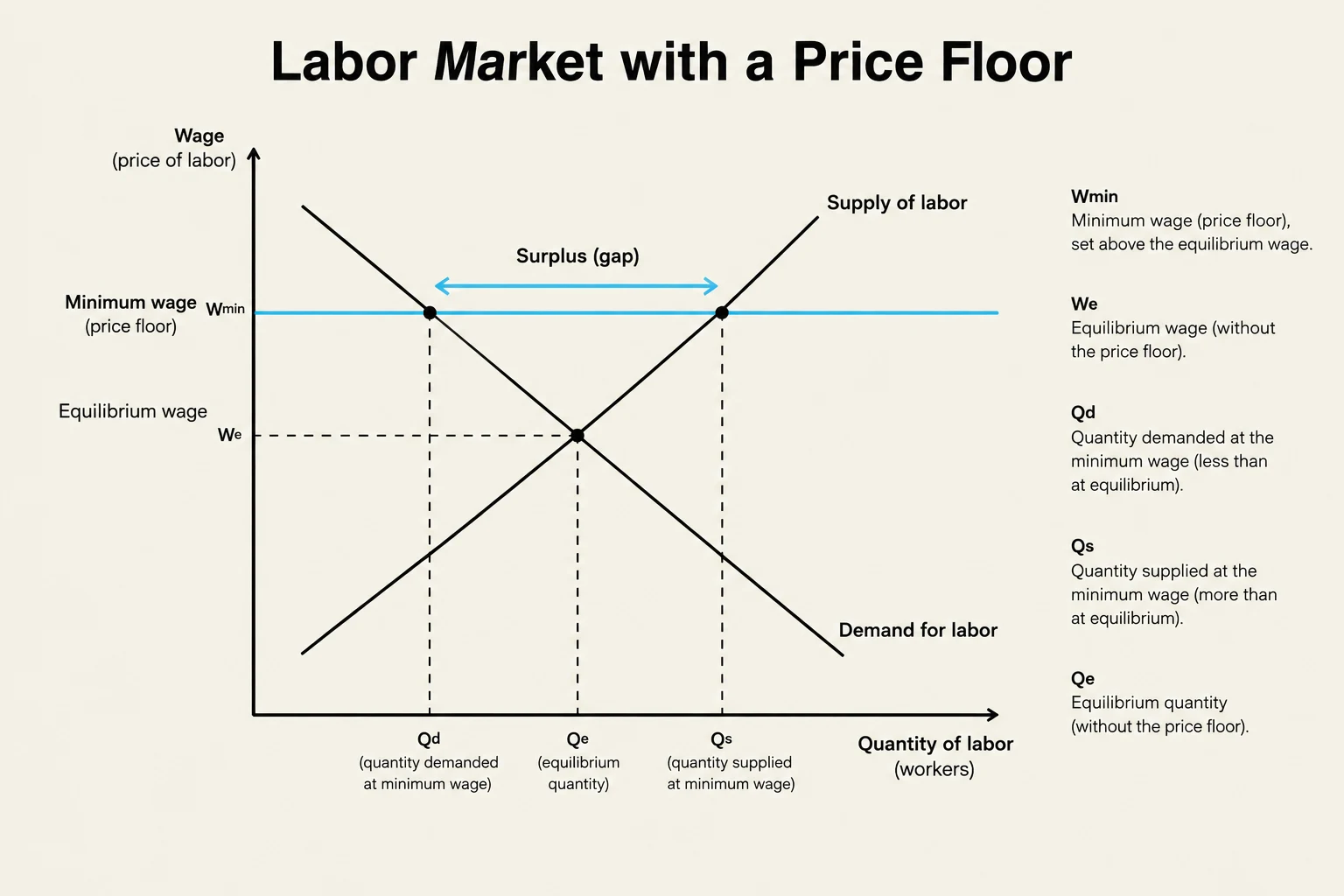
This graph illustrates the labor market with a price floor, showing the effects of a minimum wage on the quantity of labor demanded and supplied, and the resulting surplus.
The Mechanics of Unemployment
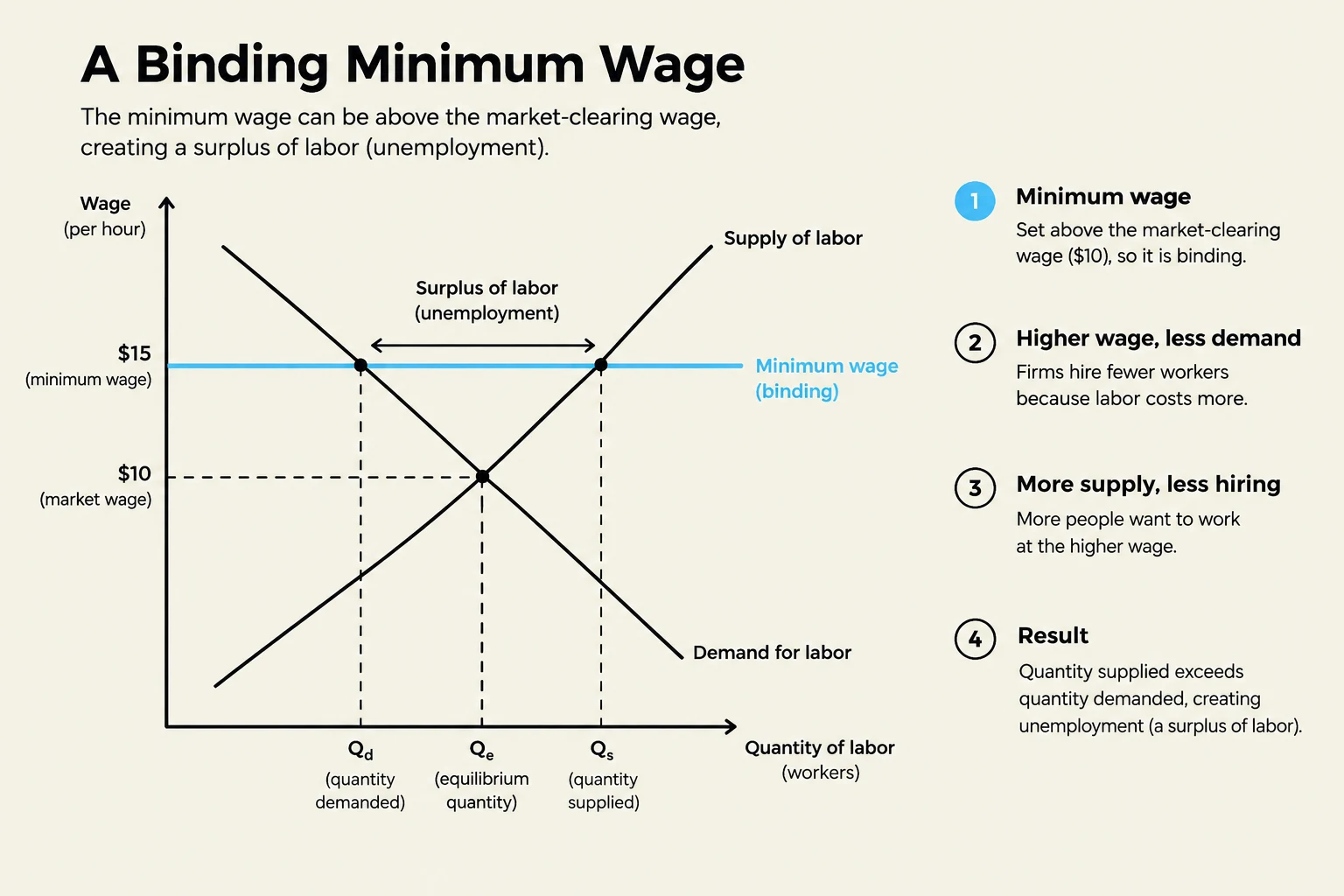
When a minimum wage is set above the equilibrium wage, it becomes a binding minimum wage. This creates a market imbalance because the higher wage changes the behavior of both employers and workers simultaneously.
This imbalance results in unemployment, which in the context of the labor market is a surplus of labor. This surplus is driven by two specific shifts:
Decrease in the quantity demanded for labor: As the cost of hiring workers increases, firms find it more expensive to maintain their current staff. Consequently, they may reduce the number of people they hire.
Increase in the quantity supplied of labor: Higher wages act as an incentive. More individuals are encouraged to enter the workforce or work more hours because the potential earnings are more attractive.
When the quantity of people looking for work (supply) exceeds the number of jobs available (demand) at that high wage, the result is a surplus of workers—commonly known as unemployment.
This graph illustrates the economic concept of a binding minimum wage, showing how setting a wage floor above the market equilibrium can lead to a surplus of labor, also known as unemployment.
Unintended Consequences and Capital Investment
Beyond simple unemployment, binding minimum wages can trigger other structural changes in the economy. Firms often seek ways to mitigate the increased cost of labor through several strategies:
Capital Investment (Automation): Instead of hiring more expensive human workers, firms may invest in capital—such as kiosks, robots, or software—to perform tasks previously done by low-skilled employees.
Relocation: Companies may move their operations to different states or even different countries where the legal minimum wage is lower.
Reduced Hours: Rather than laying off staff entirely, employers might reduce the total number of hours each employee is permitted to work.
Measuring the Impact: Elasticity and Projections
Economists use the concept of elasticity to measure how sensitive the quantity of labor is to changes in the wage rate. A common finding in economic research is a median elasticity of 0.13.
To understand this, consider the following relationship:
Change in Employment=Elasticity⋅Change in Wage
If the elasticity is 0.1, a $10%$ increase in the minimum wage would lead to a $1%$ decrease in employment (for example, among teenagers).
The CBO Projections
The Congressional Budget Office (CBO) has provided specific projections regarding the potential implementation of a $15 federal minimum wage. Their analysis highlights the complex trade-offs involved in such a policy:
Impact Category
CBO Projection Details
Negative Impacts
An estimated $0.8%$ of U.S. jobs (approx. 1.3 million) could be lost.
Positive Impacts
Approximately 17 million workers would receive a pay raise, potentially lifting 1.3 million people out of poverty.
Ultimately, the economic debate surrounding price floors like the minimum wage is not just about whether they cause unemployment, but about weighing the scale of potential job losses against the benefits of increased earnings and greater consumer spending power.
Keep reading for free.
Create an account to finish this reading and make it part of your study routine.