


When we think of law, we often think of justice, morality, or precedent. However, there is another lens through which we can view the legal system: the lens of economics. The economic approach to law does not necessarily seek to replace legal principles with market logic, but rather to apply economic tools—such as incentives, costs, and efficiency—to understand how legal rules function in society.
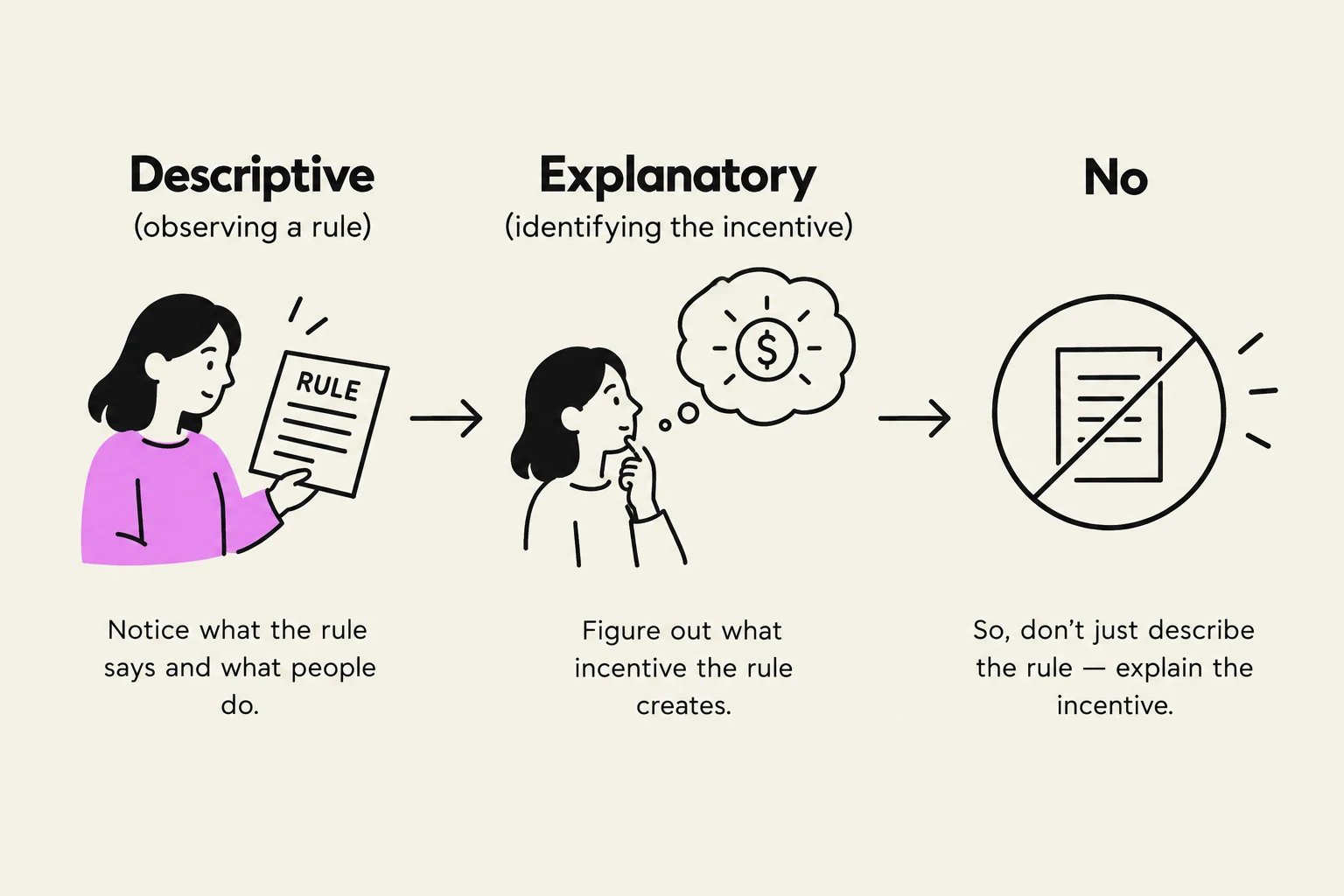
To master this subject, one must distinguish between three distinct ways the economic approach interacts with the law: describing what is happening, explaining why it is happening, and prescribing what should happen.
The Three Pillars: Descriptive, Explanatory, and Normative
The economic approach is not a monolithic way of thinking; it is a multi-faceted methodology. Depending on the goal of the researcher, the economist may be acting as an observer, a detective, or a policymaker.
1. The Descriptive Claim
A descriptive claim seeks to observe and document the current state of the legal system. It asks: "What are the current rules, and how are they being applied?" In this mode, economics is used to map out the landscape of legal reality without necessarily judging it. For example, an economist might describe the frequency of certain types of contract disputes in a specific industry.
2. The Explanatory Claim
The explanatory claim moves a step further by asking "Why?" It uses economic theory to provide a reason for why certain legal rules exist or why people behave the way they do under specific legal regimes.
If we observe that people are driving more cautiously in areas with high fines, an explanatory claim would suggest that the legal rule (the fine) acts as a price on risky behavior, influencing the decision-making process of the driver.
Keep reading for free.
Create an account to finish this reading and make it part of your study routine.
Continue reading freeAlready have an account? Log in
Updated