The Dynamics of Transformational Leadership: Motivation and Work Design
Explores how transformational leadership fluctuates based on leader energy and work design. It examines the roles of motivating work characteristics, leader vigor, and prosocial motivation in driving impactful leadership behaviors.
Leadership is often viewed as a static personality trait—something a person either "has" or "does not have." However, recent research suggests that leadership is actually a dynamic process that fluctuates like the tides. A leader might be an inspiring visionary one week and a passive observer the next, depending on their energy levels and the nature of their work.
This article explores the "ups and downs" of transformational leadership, examining how the design of a leader's job can trigger energy, and how a leader's internal drive to help others determines whether that energy actually translates into impactful leadership.
Understanding Transformational Leadership
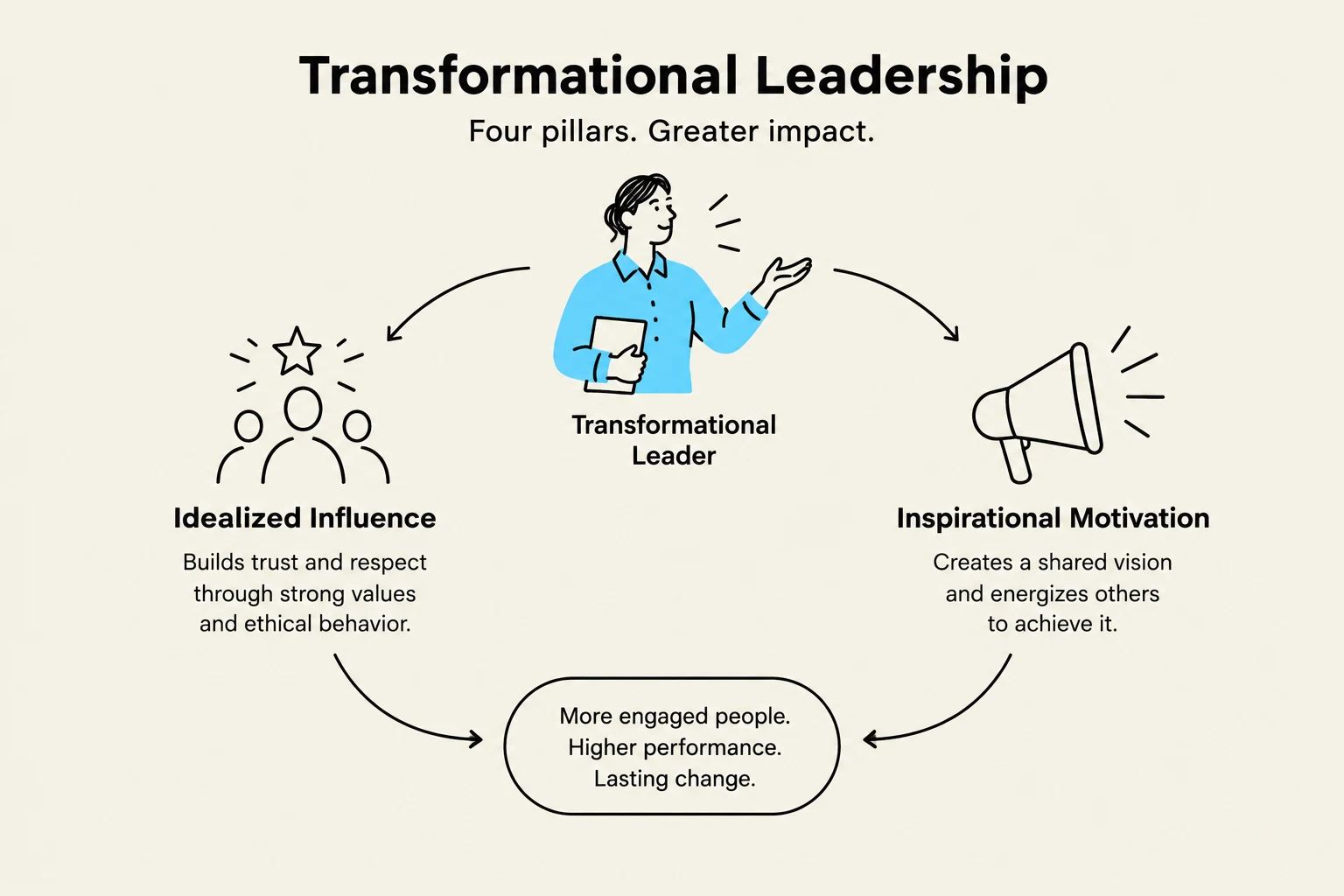
Transformational leadership is a style focused on emotional, inspirational, and symbolic influence. Rather than simply managing tasks, transformational leaders aim to change the very fabric of their followers' engagement and growth. This leadership style is composed of four distinct pillars:
Inspirational Motivation: Communicating an appealing vision based on shared values and ideals.
Idealized Influence: Acting as a consistent role model that followers want to emulate.
Individual Consideration: Recognizing the unique needs and abilities of each follower and acting as a coach.
Intellectual Stimulation: Challenging followers to think creatively and adopt new perspectives.
Because these behaviors are inherently "energy-intensive," they require a significant investment of mental and emotional resources.
This diagram illustrates the four pillars of transformational leadership: Idealized Influence, Inspirational Motivation, Intellectual Stimulation, and Individualized Consideration, leading to more engaged people, higher performance, and lasting change.
The Engine of Leadership: Weekly Vigor and Work Design
If transformational leadership is the "output," then weekly leader vigor is the "fuel". Vigor is a positive, situational work experience characterized by high energy levels, mental resilience, and a willingness to persist through effort.
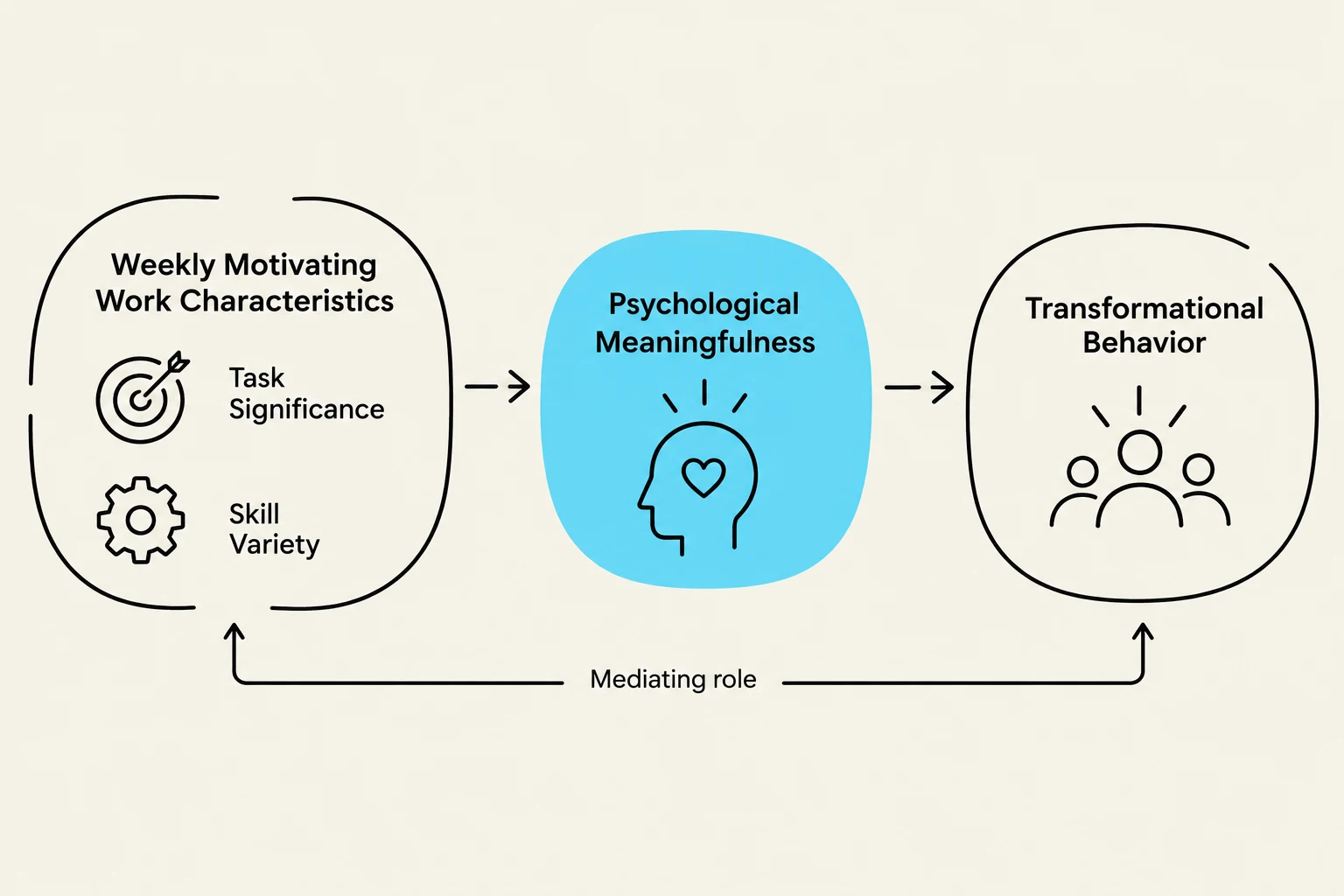
But where does this vigor come from? Research suggests that the way a leader's job is designed plays a crucial role. Specifically, certain motivating work characteristics can trigger a psychological process that releases positive energy.
Key Motivating Work Characteristics
To understand how a leader's week might feel, we look at three specific dimensions:
Task Significance: The degree to which the leader feels their work has a large, positive impact on other people.
Skill Variety: The opportunity to use a diverse range of talents and skills, making the work feel stimulating rather than monotonous.
Cooperation: The level of effective, supportive collaboration the leader experiences with other teams, departments, or management.
When these three elements are present, leaders experience higher levels of vigor. This creates a chain reaction: Motivating Work → Increased Vigor → Increased Transformational Leadership.
Study Tip: In research terms, this is called a mediation model. Vigor acts as the "middle man" (mediator) that carries the effect of good job design over to the actual leadership behavior.
This diagram illustrates the relationship between weekly motivating work characteristics, psychological meaningfulness, and transformational behavior, with a mediating role shown.
The Amplifier: Prosocial Motivation
Even if a leader has high energy (vigor), they might not always use it to be transformational. This is where prosocial motivation—a person's intrinsic desire to benefit others—comes into play.
Prosocial motivation acts as a moderator. A moderator doesn't cause the behavior itself, but it changes the strength of the relationship between two other things. In this case, it determines how effectively vigor is converted into transformational leadership.
The Interaction Effect
The relationship can be understood through two different types of leaders:
High Prosocial Motivation: These leaders are driven by a desire to help. When they feel vigorous, they "channel" that energy directly into behaviors like coaching (individual consideration) or inspiring others (inspirational motivation) because those actions align with their core values.
Low Prosocial Motivation: These leaders may feel energetic, but they lack the intrinsic "prosocial fire" to use that energy for the benefit of others. Consequently, their vigor does not translate into transformational leadership as effectively as it does for their prosocial counterparts.
Mathematically, we can think of the relationship as:
Transformational Leadership≈Vigor⋅Prosocial Motivation
This means that as Prosocial Motivation increases, the "slope" or impact of Vigor on Leadership becomes steeper.
Practical Implications for Organizations
For organizations, this research provides a roadmap for developing better leaders. It is not enough to simply hire "charismatic" people; you must also design their roles and cultivate their values.
Optimize Job Design: Ensure leaders see the task significance of their work. Connect them with the people they are helping so they can see the real-world impact of their decisions.
Encourage Skill Variety and Cooperation: Avoid "red tape" that restricts a leader's ability to use their talents, and foster a culture of cooperation rather than competition.
Cultivate Prosocial Values: During recruitment, look for individuals with a proven track record of helping others. For existing leaders, use storytelling to highlight the social impact of their roles.
Support Energy Management: Since transformational leadership is energy-intensive, organizations should provide tools for "vigor maintenance," such as flexible work arrangements or stress management training.
Summary for Students: Remember the hierarchy of this model. Work Characteristics are the input, Vigor is the mediator (the energy state), Prosocial Motivation is the moderator (the amplifier), and Transformational Leadership is the output.
Keep reading for free.
Create an account to finish this reading and make it part of your study routine.