An overview of the systematic stages involved in bringing a new medicine from initial scientific observation to market approval, including target identification, lead optimization, preclinical and clinical trials, and manufacturing.
Bringing a new medicine to patients is one of the most complex, expensive, and high-stakes endeavors in modern science. The path from a basic scientific observation to a pharmacy shelf is long and fraught with difficulty; the probability of a single research project successfully reaching market approval is less than 1%, often requiring investments exceeding €2 billion. This article explores the systematic stages of the drug discovery and development process, from identifying a biological target to large-scale manufacturing.
1. Target Identification and Validation
The process begins with understanding a disease at the molecular level. Scientists use advanced technologies such as genomics, proteomics, and metabolomics to map out the biological pathways involved in a condition.
Once a pathway is understood, the next step is pharmaceutical target validation. A "target" is a specific biological molecule (usually a protein, receptor, or enzyme) that plays a key role in a disease. Validation involves proving that interacting with this target will actually produce the desired therapeutic effect. For example, in antibiotic development, a target might be a specific enzyme required for bacterial cell wall synthesis.
Exam Tip: Remember that "Target Validation" is not just finding a protein; it is proving that modulating that protein will treat the disease without causing unacceptable side effects.
This diagram illustrates the drug discovery process, starting with disease understanding through genomics and proteomics, followed by target selection, hit identification, lead optimization, and validation.
2. Lead Identification and Optimization
Once a target is validated, researchers must find a "lead molecule"—a compound that shows a promising biological effect against that target.
Lead Identification
Leads can be found through several methods:
High-throughput screening: Testing thousands of compounds against a single target.
Natural products: Exploiting observations from plants or microorganisms.
Rational design: Using computer-aided design and structure-based approaches to build a molecule that fits the target like a key in a lock.
Lead Optimization
A lead molecule is rarely perfect. It often needs to be chemically modified to improve its potency and safety. This stage involves establishing Structure-Activity Relationships (SAR)—studying how changing the chemical structure of the molecule affects its biological activity. Researchers aim to identify the pharmacophore, which is the essential part of the molecule responsible for its biological effect, and then optimize the rest of the structure to improve how the drug moves through the body.
3. Preclinical Testing: ADME and Toxicity
Before a drug can be tested in humans, it must undergo rigorous preclinical testing. This stage focuses on two critical areas: Pharmacodynamics (what the drug does to the body) and Pharmacokinetics (what the body does to the drug).
A key component of pharmacokinetics is ADME prediction:
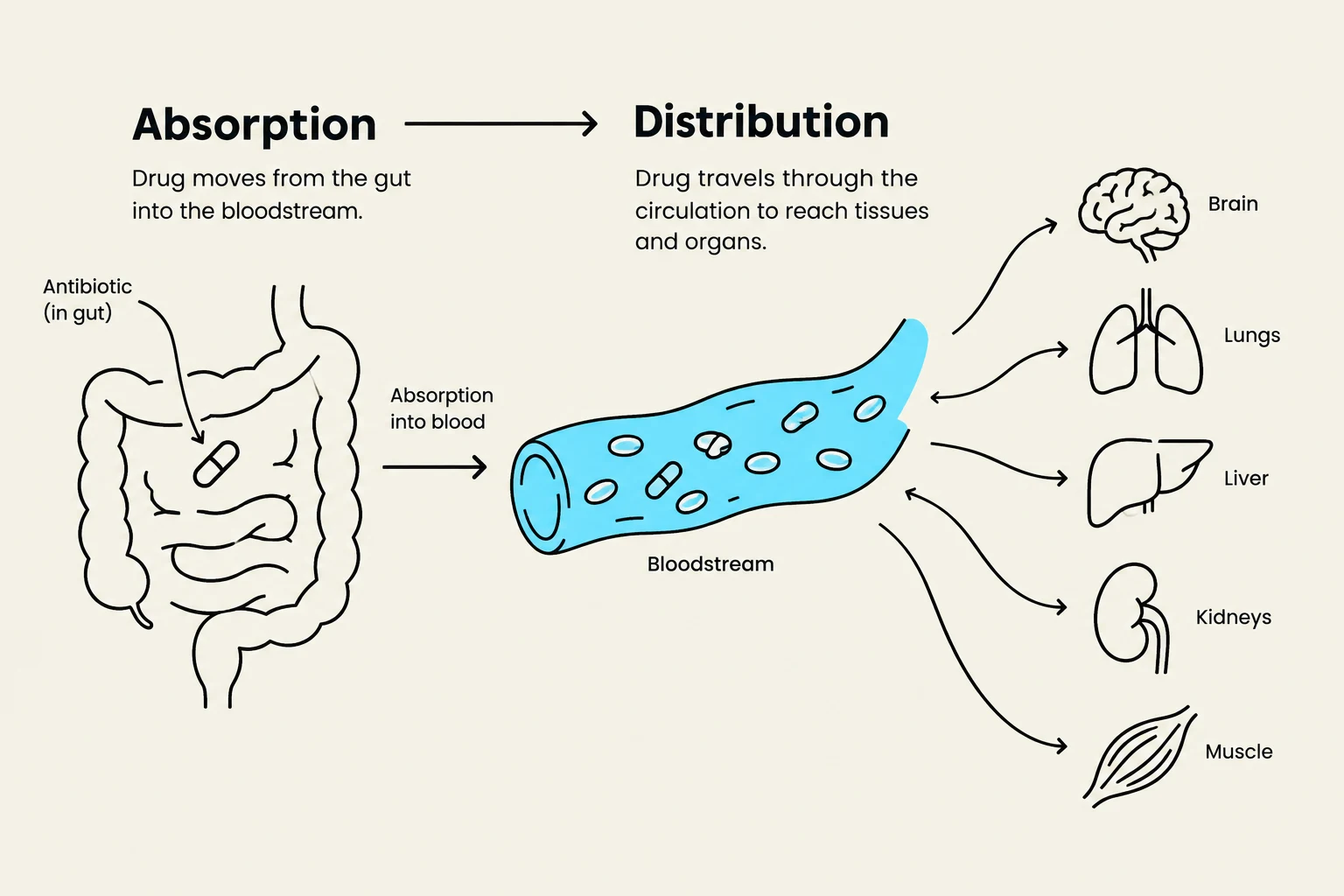
Absorption: How the drug enters the bloodstream.
Distribution: Where the drug goes in the body.
Metabolism: How the body chemically breaks down the drug. A major site for this is the liver, specifically via the Cytochrome P450 enzyme family.
Excretion: How the drug is removed from the body, typically through the kidneys or liver.
Furthermore, researchers must conduct in vivo metabolism and toxicity studies to ensure the drug does not cause harmful effects in living organisms. A vital metric here is the Therapeutic Index, which compares the dose that causes a toxic effect to the dose that produces a therapeutic effect. A high therapeutic index indicates a large safety margin.
This diagram illustrates the absorption and distribution of a drug within the human body. Initially, an antibiotic is absorbed from the gut into the bloodstream. From the bloodstream, the drug is distributed to various organs and tissues, including the brain, lungs, liver, kidneys, and muscles.
4. Clinical Trials
If preclinical results are successful, the drug enters the clinical trial phase. This is where the drug is tested in humans to ensure safety and efficacy. Clinical trials are divided into four distinct phases:
Phase
Population
Primary Goal
Phase I
Small group of healthy volunteers
Safety and dosage
Phase II
Small group of patients
Efficacy and side effects
Phase III
Large group of patients
Confirmation of efficacy and monitoring of adverse reactions
Phase IV
General population (post-market)
Long-term safety and real-world effectiveness
5. Manufacturing, Patents, and Market Access
The final hurdles involve legal protection and industrial production.
Patent Protection
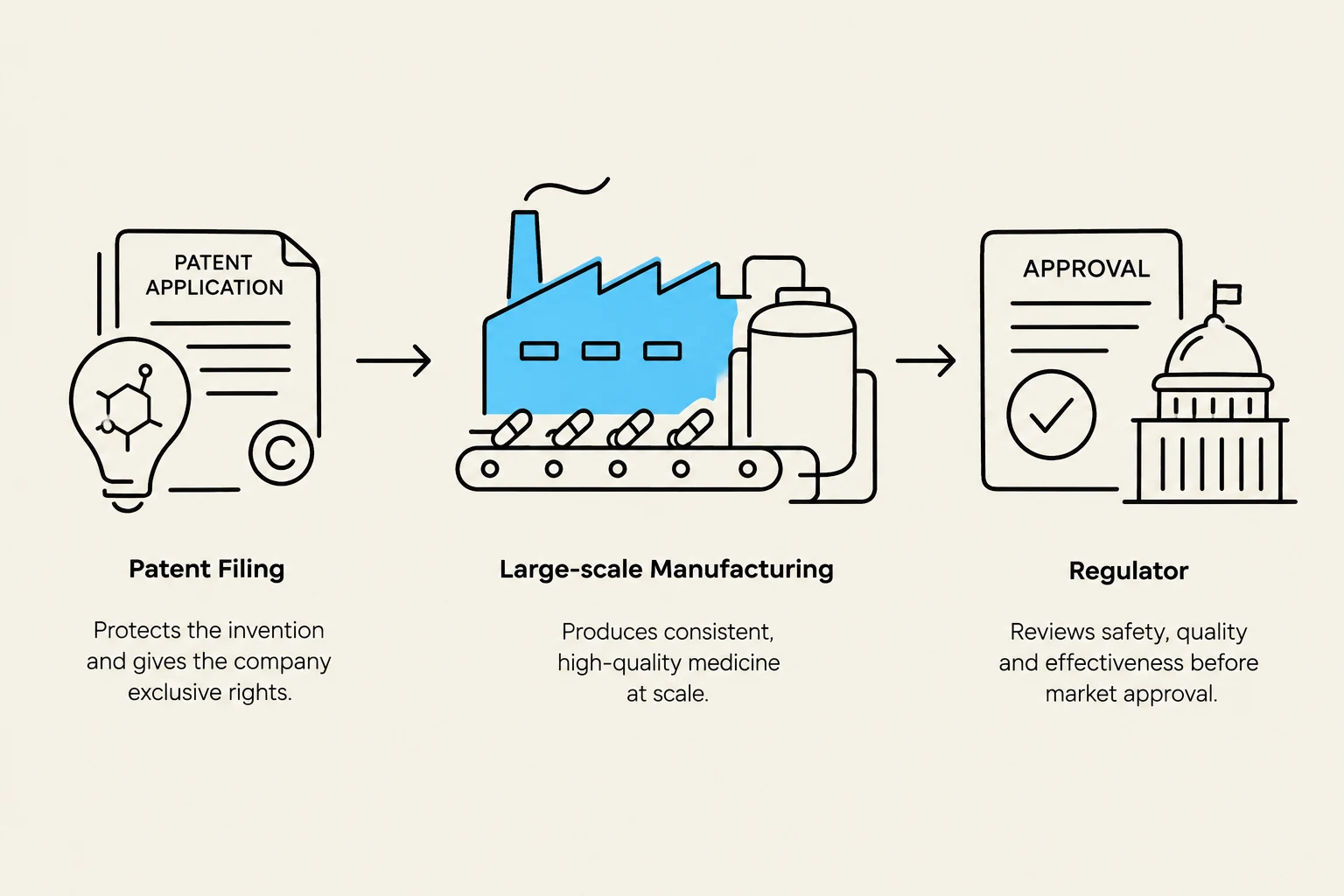
To recoup the massive costs of development, companies file for patents relatively early in the discovery process. A patent provides exclusive rights to use and prepare the drug, generally lasting for 20 years from the date of filing.
Large-Scale Production and GMP
Transitioning from a laboratory setting to mass production is a massive engineering challenge. Companies must consider the cost of raw materials, environmental impact, and the complexity of chemical steps. To ensure every pill or injection is identical and safe, production must follow Good Manufacturing Practice (GMP), a strict regulatory standard for quality control.
This diagram illustrates the process of bringing a new medicine to market, from patent filing and large-scale manufacturing to regulatory approval.
Summary Note: The entire process is a balance of science, safety, and economics. While the goal is to treat disease, the reality of drug development is driven by the need to manage conflicting issues, such as the high cost of research versus the need to treat widespread or "welfare" diseases.
Keep reading for free.
Create an account to finish this reading and make it part of your study routine.